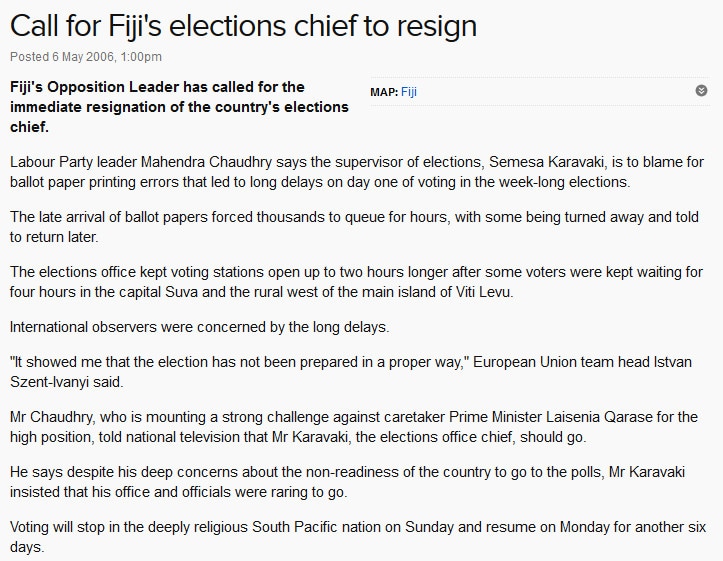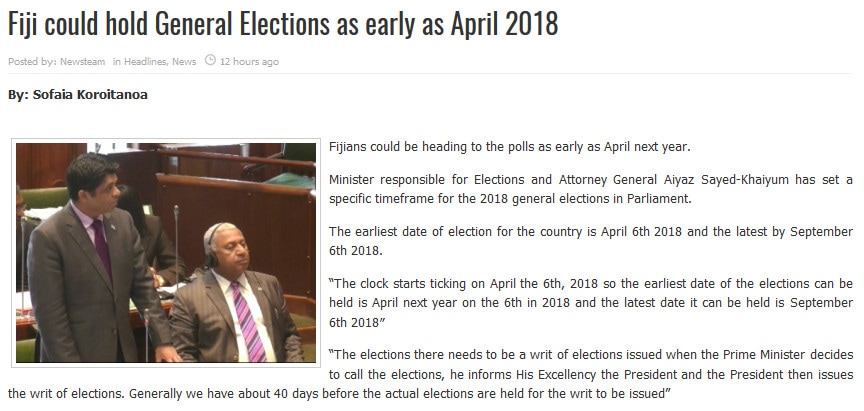
LAND ROBBER: Fijileaks will expose SODELPA MP of chiefly rank who cheated one of his subjects and violated the Electoral Decree in 2014
USPGATE: "With all due respect to the VCP, even though he considers himself an IT expert, he should be listening to people who know what they are talking about instead of imposing his will...VCP unilaterally declaring that USP will no longer support Print mode. No discussions were held, no consequences determined, and no strategies developed. How are staff and students, especially students in the region, supposed to adjust to this overnight? And, then within six months the direction was changed again." - Dr Grewal
"By the way, the FNU MBA program is also AMBA accredited. The USP Administration got very upset at the remarks of the Minister of Education on the MBA program at USP. Logically thinking, the Honorable Minister does have a very strong point – the MBA program is essentially a retail shop where people are temporarily hired to teach classes. It does not have an established infrastructure of full-time permanent professors who not only provide their expertise in the classroom, but also help students develop professionally by mentoring them and bring research into the program to build pathways for the future of the program."
ICT infrastructure
The IT infrastructure is a critical component of course delivery and administrative functionality at USP. The uniqueness of USP, its success regionally, and its mandate and commitment to serve the region is inherently and intrinsically linked to its ICT infrastructure. Most of this infrastructure, especially the satellite systems, have components that are decades old with no plan or money to replace them. Any IT audit at USP will show you that a failure of a couple of components can bring the entire system down in a heartbeat, thus bringing USPs functionality regionally to a screeching halt.
With all due respect to the VCP, even though he considers himself an IT expert, he should be listening to people who know what they are talking about instead of imposing his will. It is an absolute failure of USP management to not have sequentially replaced the IT infrastructure every year so that USP could have avoided the predicament it finds itself in currently. Generous donors established USPNET backbone decades ago, yet USP management did not find it an absolute necessity to put money aside each year to replace this system. It will take at least $10-15M FJD to replace the absolutely critical components of USPNET that are already way past their expected lifespan.
Does the VCP not think that the potential of failure of the twenty year old satellite delivery dishes that can bring the entire USPNET to a grinding halt is something he should have been keeping money aside for each year he has been the VCP? Even experts from JICA have established that these dishes can fail anytime and that there are no spare parts available for them since they are of such old technology and vintage.
The fiber based capacity of USP at Suva is exceeding capacity currently and cannot be increased without extraordinary measures. Yet the VCP keeps on insisting on more online access. He does not miss a chance to show his displeasure with ITS regarding bandwidth complaints, even though ITS cannot expand the bandwidth to meet the ever expanding needs of USP staff and students under given current constraints. Instead of relying on his own expertise, he should listen to and rely upon the advice of experts as to what are the real problems and bottlenecks and what can and cannot be done. This is a critical area that requires intervention and cannot wait two more years for a different approach. There should be a direct correlation between bandwidth availability, affordability and the decision to expand online material content, functionality and accessibility.
The number of students has been steadily growing. The number of sites is growing. The number of courses and other activities being offered over USPNET has been steadily growing. Yet, both the number of ITS positions and ITS budget have been decreasing in both real numbers and real money value. USP management needs to take a reality check in this area. With all due respect to the VCP and the Director of ITS, they have regional knowledge and contacts with ICT people in the Pacific, but neither one of them has the complex technical expertise or the experience that could get them hired as a Chief Information Officer (CIO) or the Chief Technology Officer (CTO) of a multinational organization. Both lack real technical nuts and bolts knowledge and expertise. Given that the VCP has positioned himself as the ultimate knowledge authority on ICT matters at USP and even regionally, there is no one who dares take stock and relay the real state of IT affairs and plan to address the same at USP. If there is a singular point of failure that can impact all of USP and its very existence, it is ICT/ITS.
ICT Infrastructure Recommendations:
Allow technical staff to make relevant decisions. Have the VCP focus on his legacy in ITS regionally, but leave the ITS operations to someone who understands the nuts and bolts of IT and has the required technical knowledge and expertise to create plans for USP ITS for the future.
Hire CTO/CIO with relevant experience. The Director of ITS has great people management skills and is excellent at keeping ITS staff together. However, his limited technical knowledge of modern systems greatly curtails his effectiveness. This is further hampered by his desire to appease the VCP at all costs and not standing up for right technical decisions. Leave people management to him but also hire a CIO or CTO with the relevant experience and technical expertise. Give the CIO/CTO enough power, responsibility and accountability to run ITS as a backbone of a modern multinational organization.
Find Funding to Replace USPNET infrastructure. Beg, borrow or transfer monies to start addressing the very real and very critical need of replacing the dying core USPNET infrastructure. This is a risk USP cannot afford to take or play around with. This was broached with the NZ government for support.
Plan for the future. Stop the management’s blame games and deal with ITS capabilities, capacity and planning in a systematic and realistic way. ICT in the Pacific is a challenge because of cost and availability constraints, including expertise. USP should acknowledge the limitations and management should take into consideration when planning for expansion of online services, including academic offerings, and not blame ITS after the fact for accessibility constraints.
Research and Teaching
USP has gone through a number of workload and reward models, formally and informally, in the last three-four years. These models change arbitrarily at the whims of certain people without robust discussions or feedback from staff concerned. Following are some examples of actual decisions made recently that show weakness of leadership:
VCP unilaterally declaring that USP will no longer support Print mode. No discussions were held, no consequences determined, and no strategies developed. How are staff and students, especially students in the region, supposed to adjust to this overnight? And, then within six months the direction was changed again.
Paying people to publish papers. A lot of money has been given away to staff to publish papers as a mark of research excellence and output. Even a cursory research on the topic will show that it has been established the world over that paying staff to publish papers does not build a research infrastructure at a university and definitely does not help the students.
Absurd and/or non-existent criteria for performance evaluation. Forcing all academic staff to be evaluated on teaching, research and administration is useless. People should be evaluated on functions assigned to them. Rather than refining the system for staff review, it has been changed multiple times, leading to confusion amongst staff. Suddenly everything current is dropped and the criteria changed.
Promotion of staff. Have someone external look at the recent staff promotions, especially to full and Associate Professor levels, and see if it makes any sense. Staff evaluation criteria are changed to favor some people in getting promotions and rewards, and then the criteria are changed again.
Excellence. This is a word that has no real meaning at USP and is used to push agendas. There is no university in the world that is excellent at every topic. Instead of showing leadership in determining two or three areas of excellence where money and focus can be put to make USP world renowned, false claims of expertise and recognition are made, money spent without any plans and no infrastructure created that generates and perpetuates excellence in specific topics. If the amount of money and effort that is being spent on PTAFE, which by the way will not make USP world renowned, were to be spent on Climate Change studies or Economics or Marine Sciences, USP would be known the world over for excellence in that area. USP is an anchor university in the Pacific, yet it is not even known in the world for Pacific Studies.
Administration will tout getting accreditation in certain areas as a mark of excellence – Wrong! Accreditation means you meet the bare minimum standards of quality acceptable to the professional community. Accreditation does not mean you have established your mark in the world in that area of academics. The most touted program at USP, the MBA program, has AMBA accreditation, which means the credentials given out by the program are accepted by professional bodies. Would you say that for all other factors being equal, given the choice between Harvard Business School and USP MBA program a student would choose USP over Harvard because the USP MBA is considered “excellent”?
By the way, the FNU MBA program is also AMBA accredited. The USP Administration got very upset at the remarks of the Minister of Education on the MBA program at USP. Logically thinking, the Honorable Minister does have a very strong point – the MBA program is essentially a retail shop where people are temporarily hired to teach classes. It does not have an established infrastructure of full-time permanent professors who not only provide their expertise in the classroom, but also help students develop professionally by mentoring them and bring research into the program to build pathways for the future of the program. It would be one thing to have a program with established professors running it and distinguished guests brought in to lecture students (e.g. a Nobel laureate) occasionally, but running it almost entirely through ad-hoc temporary appointments is not how an excellent program such as one at an Ivy League school would be run. The MBA program is also used to reward certain people by offering them teaching assignments for extra money.
Online technologies and pedagogies. Credit should be given to USP for quite effectively using Moodle in course content delivery. However, claiming USP is world renowned or a world leader in Moodle or even online pedagogies would be disingenuous to say the least. Proof is in that despite spending lots of money in these areas, universities of the world are not requesting any technologies developed by USP for their use. Self-aggrandizing claims don’t change the world reality. The money being spent on CFL and through FSTE on text messaging being promoted as m-learning has produced no tangible results affecting student outcomes or recognition of USP in the world in the area of online pedagogies.
USP and its students would be much better served in actually letting faculties decide and develop pedagogies effective in their disciplines. These technologies should be driven by the needs of teaching and research in specific areas, and persistent development, rather than arbitrary allocation of monies to favorite departments. CFL should be building what faculties need, not telling them what to use.
Classroom technologies are archaic. Without putting money aside every year to update the classrooms, any claims USP administration makes in terms of being world class in classroom technologies or pedagogies are very suspect. USP students are aiming to be competitive in the world markets. They should be given tools and resources to at least be competitive in the technology based world. Computer labs that have computers that don’t work half the time, classrooms with a projector as the embodiment of classroom technologies, and connectivity limited to being on campus is hardly the mark of a world leading or excellent University technologies.
Research and Teaching Recommendations:
Create a relevant committee of stakeholders with decision making authority. Have a standing committee comprising of staff from each faculty, regional campus representation, IT representation (including CIO/CTO), DVC LTSS, and at least two external experts to guide USP in developing a consistent approach to pedagogical development, including deciding on a strategy for the next couple of years on online content and delivery. Let the faculty decide what pedagogical tools need to be developed or supported. Let faculty and campus representatives decide what is most useful, effective and in demand as far as the delivery modes are concerned. This should be based on analytics and not dictums. CFL should be a support body offering regular trainings and assistance with content. Let faculty experiment with whatever they want to instead of two people getting the resources and travel.
Identify 3-4 areas of excellence to invest in. Instead of paying people to publish, the University should have a strategic initiative of developing maximum 3-4 areas as areas of Prioritize investment in research and teaching excellence and the money should be spent in hiring top notch professors, building infrastructure to support research and linking research to industry and undergraduate and graduate studies. Instead of giving monetary rewards, give internal pilot grants for getting external grants to support research. Number of publications is not a good measure of excellence for research – external research grant funding is a better measure of how your capabilities, capacities and reputation is acknowledged the world over. Trying to be all things to all people, currently defined as excellence, leads to expertise in none. It should be the DVC RII’s responsibility to develop and implement a long term success strategy in research, not the VCP’s. Changing strategy every two years is recipe for failure, not success.
Use clear assessment criteria established and communicated well in advance. Ask just about anybody at USP what they think of iPerform, the Performance assessment system, and they will give you an earful. Performance management is all about managing expectations and achieving institutional and personal goals. It definitely is not about changing measurement criteria every six months and rewarding favorites. iPerform should be scrapped. Staff should be given clear criteria on which they will be evaluated at least one year in advance, if not same for every year, and it should not be so formulated that it has no bearing on the actual job requirements of individuals. There is nothing wrong with evaluating administrators, teachers and researchers differently so long as the criteria are clearly established, communicated and applied consistently.
The VCP should have the least amount of say in who is promoted in staff. Heads of School, Deans, and perhaps inter-faculty representatives are best positioned to know who deserves to be promoted, both from a strategic and a practical stand point. Currently every staff promotion, for all practical purposes, is controlled by one person and one person alone.
Empower stakeholders in the staff promotion process. The VCP should have the least amount of say in who is promoted in staff. Heads of School, Deans, and perhaps inter-faculty representatives are best positioned to know who deserves to be promoted, both from a strategic and a practical stand point. Currently every staff promotion, for all practical purposes, is controlled by one person and one person alone. This essentially removes all confidence, power and stability from the faculties, especially HoSs and Deans. The VCP should have an overt, open transparent veto power, but not behind the scenes maneuvering power as to who is going up and who is going out. Empower the HoSs.
Empower stakeholders to implement USP’s strategic plan. Strategically the VCP, in consultation with faculty, should declare 3-4, or less, areas of excellence for the entire university. After this, he should empower the HoSs of those areas to plan and realize how they will achieve excellence in those areas. VCP’s job is to provide HoSs with resources, including money, canvass in international forums in support of their efforts, and leave them alone to do their job. It should be the HoSs responsibility to structure for excellence, to choose and entice the right candidates for Professorships and build systemic stability in their programs. The VCP can have veto power and executive privilege over matters, but that is a far cry from interfering even at the TA level. Empowering the HoSs and faculty is the only way to build excellence at any university. If the HoS chooses for a staff to teach only one course and instead write grant proposals, then so be it. It should not be hampered by the VCP, the staff review criteria or some formula based workload model. HoSs can be held responsible, that is what KPIs are for, but they have to have power and flexibility.
Incorporate Transparency. Most importantly build transparency in systems, whether it is rewards, performance management, or promotion. Reduce interference and empower HoSs. How can replacing HoSs frequently be good for developing a stable, progressive academic environment? Empower Heads of Schools
Invest in classroom infrastructure. Since classroom technologies and research infrastructure are the backbone of a good teaching and research university, mandatorily reserve monies in each budget for bolstering the research infrastructure, such as labs and instrumentation, and for improving classroom technology infrastructure every year.
Implement an internal grant program. Instead of paying faculties to publish, which has very limited value in developing research programs, perhaps the administration can looking at an internal grants program. Researchers at any level, regardless of rank, could write competitive internal proposals for funding of research pilots. If funded, the desired outcome would be to bring the research to a level that could attract significant external grants. It would develop a grant proposal writing culture, engage students, self –analyze USP capabilities and build an infrastructure progressively for the future. Much more value going forward then paying people to publish. Again, though leadership for something of this sort should be provided by the DVC RII and the staff in faculties, rather than be VCP’s responsibility.
Asus Computers
For many years it has been proclaimed by Procurement, EDF and the VCP that the reason why everybody at the University is required to buy ASUS, and only ASUS computers is because USP has a dealership contract with ASUS and thus makes significant amounts of money. Staff have complained and complained about the quality of the ASUS computers, they have pointed out how other technically comparable computers are cheaper, and regional campuses have gone months without computers because of the turnaround time on ASUS warranty work. FIC has been shown numbers on how the University Computer Shop is making money by selling ASUS computers, hence, the University Procurement exercises a no-tender/tender waiver policy when it comes to buying computers. Following is the reality around ASUS computers:
Procurement has not been able to show or produce any documentation that shows the University is an ASUS dealership. In fact, for the past many years USP has been buying ASUS computers from a reseller in Australia, not from the ASUS factory in Malaysia or elsewhere
Procurement has admitted that there has been no procedure to even compare the bulk purchase pricing the University has been paying on-demand to this reseller in Australia with other bulk pricing offers or even retail pricing in Suva
Procurement has admitted that there have not been any official negotiations followed in the past to determine the bulk purchase of computers from this reseller
Procurement has admitted that it has not followed any process to compare the price of technically similar computers from ASUS, DELL and HP
Finance claims the University makes money off of repairs of ASUS, yet tens of thousands of dollars are written off by the computer shop. Reason provided: they used new computers for parts to repair under-warranty old computers
Finance claims it makes money off the ASUS computers. However, even a cursory glance at the accounts will show some creative accounting. The University loses money because the computers being bought are actually more expensive than retail computers from local vendors, and the profit shown is from the higher cost of selling to internal departments. So, the university is claiming to make money by forcing its own departments to buy these computers at higher prices from its own computer shop, instead of buying cheaper and better computers from the open market. Are there any real benefits to USP buying exclusively ASUS?
Why is it then the University insists on choosing to buy lower quality computers (ask ITS or any staff about the quality) in bulk at a price possibly higher than retail, with tender waivers when the conditions for a tender waiver are not met in this case? The VCP, EDF, Procurement Manager, the Computer Shop manager, and the computer shop Accountant/Finance Officer were all made aware of this and asked for price comparisons and reasons USP insists on buying these computers without competitive bidding. No information or answers were provided by them. The VPA put a halt to this practice till some answers were provided. He was reprimanded for delaying the purchase of these computers and the overriding authority to go ahead with the purchase was exercised directly by the VCP. USP has recently bought a container full of ASUS computers without going through a tender process.
ASUS Computers Recommendations
Audit the last 5 years. This matter should be audited for at least the last five years by external auditors.
Investigate write offs. The auditors should also look into why the Computer shop is being allowed by Finance to write off tens of thousands of dollars each year. The role of the Computer Shop Manager, the Accountant and the Procurement Manager in Finance should be carefully scrutinized.
Follow computer life cycle. The auditors should also look into where the old computers go and what process is being followed there. Where is the accountability?
Transparent tender process. The University very well knows how many computers it needs to purchase for all the campuses each year. These purchases should be made through a transparent tendering process only.
Buy local. Further, it may be prudent and profitable to buy computers from local dealers at USP regional campus locations. Currently computers are bought at and delivered to Suva, and then reshipped to regional campuses, thus adding considerable cost. Similarly, computers are shipped off island from regional campuses for repairs and then have to be shipped back, adding to cost and time. Local retailers could compete quite well under the circumstances. More importantly, it would cut the time people are without computers awaiting repairs.
Support member countries’ economies. Buying computers at competitive prices locally in member countries would also contribute to local economies, provide jobs and project USP as a responsible citizen organization contributing to the sustainability and resilience efforts for local markets. Paying a reseller in Australia and shipping companies achieves none of this and takes money and business away from the island nations.
Procurement contracts
The University obviously has policies and limits around purchasing authorities and requirements
To be continued
The IT infrastructure is a critical component of course delivery and administrative functionality at USP. The uniqueness of USP, its success regionally, and its mandate and commitment to serve the region is inherently and intrinsically linked to its ICT infrastructure. Most of this infrastructure, especially the satellite systems, have components that are decades old with no plan or money to replace them. Any IT audit at USP will show you that a failure of a couple of components can bring the entire system down in a heartbeat, thus bringing USPs functionality regionally to a screeching halt.
With all due respect to the VCP, even though he considers himself an IT expert, he should be listening to people who know what they are talking about instead of imposing his will. It is an absolute failure of USP management to not have sequentially replaced the IT infrastructure every year so that USP could have avoided the predicament it finds itself in currently. Generous donors established USPNET backbone decades ago, yet USP management did not find it an absolute necessity to put money aside each year to replace this system. It will take at least $10-15M FJD to replace the absolutely critical components of USPNET that are already way past their expected lifespan.
Does the VCP not think that the potential of failure of the twenty year old satellite delivery dishes that can bring the entire USPNET to a grinding halt is something he should have been keeping money aside for each year he has been the VCP? Even experts from JICA have established that these dishes can fail anytime and that there are no spare parts available for them since they are of such old technology and vintage.
The fiber based capacity of USP at Suva is exceeding capacity currently and cannot be increased without extraordinary measures. Yet the VCP keeps on insisting on more online access. He does not miss a chance to show his displeasure with ITS regarding bandwidth complaints, even though ITS cannot expand the bandwidth to meet the ever expanding needs of USP staff and students under given current constraints. Instead of relying on his own expertise, he should listen to and rely upon the advice of experts as to what are the real problems and bottlenecks and what can and cannot be done. This is a critical area that requires intervention and cannot wait two more years for a different approach. There should be a direct correlation between bandwidth availability, affordability and the decision to expand online material content, functionality and accessibility.
The number of students has been steadily growing. The number of sites is growing. The number of courses and other activities being offered over USPNET has been steadily growing. Yet, both the number of ITS positions and ITS budget have been decreasing in both real numbers and real money value. USP management needs to take a reality check in this area. With all due respect to the VCP and the Director of ITS, they have regional knowledge and contacts with ICT people in the Pacific, but neither one of them has the complex technical expertise or the experience that could get them hired as a Chief Information Officer (CIO) or the Chief Technology Officer (CTO) of a multinational organization. Both lack real technical nuts and bolts knowledge and expertise. Given that the VCP has positioned himself as the ultimate knowledge authority on ICT matters at USP and even regionally, there is no one who dares take stock and relay the real state of IT affairs and plan to address the same at USP. If there is a singular point of failure that can impact all of USP and its very existence, it is ICT/ITS.
ICT Infrastructure Recommendations:
Allow technical staff to make relevant decisions. Have the VCP focus on his legacy in ITS regionally, but leave the ITS operations to someone who understands the nuts and bolts of IT and has the required technical knowledge and expertise to create plans for USP ITS for the future.
Hire CTO/CIO with relevant experience. The Director of ITS has great people management skills and is excellent at keeping ITS staff together. However, his limited technical knowledge of modern systems greatly curtails his effectiveness. This is further hampered by his desire to appease the VCP at all costs and not standing up for right technical decisions. Leave people management to him but also hire a CIO or CTO with the relevant experience and technical expertise. Give the CIO/CTO enough power, responsibility and accountability to run ITS as a backbone of a modern multinational organization.
Find Funding to Replace USPNET infrastructure. Beg, borrow or transfer monies to start addressing the very real and very critical need of replacing the dying core USPNET infrastructure. This is a risk USP cannot afford to take or play around with. This was broached with the NZ government for support.
Plan for the future. Stop the management’s blame games and deal with ITS capabilities, capacity and planning in a systematic and realistic way. ICT in the Pacific is a challenge because of cost and availability constraints, including expertise. USP should acknowledge the limitations and management should take into consideration when planning for expansion of online services, including academic offerings, and not blame ITS after the fact for accessibility constraints.
Research and Teaching
USP has gone through a number of workload and reward models, formally and informally, in the last three-four years. These models change arbitrarily at the whims of certain people without robust discussions or feedback from staff concerned. Following are some examples of actual decisions made recently that show weakness of leadership:
VCP unilaterally declaring that USP will no longer support Print mode. No discussions were held, no consequences determined, and no strategies developed. How are staff and students, especially students in the region, supposed to adjust to this overnight? And, then within six months the direction was changed again.
Paying people to publish papers. A lot of money has been given away to staff to publish papers as a mark of research excellence and output. Even a cursory research on the topic will show that it has been established the world over that paying staff to publish papers does not build a research infrastructure at a university and definitely does not help the students.
Absurd and/or non-existent criteria for performance evaluation. Forcing all academic staff to be evaluated on teaching, research and administration is useless. People should be evaluated on functions assigned to them. Rather than refining the system for staff review, it has been changed multiple times, leading to confusion amongst staff. Suddenly everything current is dropped and the criteria changed.
Promotion of staff. Have someone external look at the recent staff promotions, especially to full and Associate Professor levels, and see if it makes any sense. Staff evaluation criteria are changed to favor some people in getting promotions and rewards, and then the criteria are changed again.
Excellence. This is a word that has no real meaning at USP and is used to push agendas. There is no university in the world that is excellent at every topic. Instead of showing leadership in determining two or three areas of excellence where money and focus can be put to make USP world renowned, false claims of expertise and recognition are made, money spent without any plans and no infrastructure created that generates and perpetuates excellence in specific topics. If the amount of money and effort that is being spent on PTAFE, which by the way will not make USP world renowned, were to be spent on Climate Change studies or Economics or Marine Sciences, USP would be known the world over for excellence in that area. USP is an anchor university in the Pacific, yet it is not even known in the world for Pacific Studies.
Administration will tout getting accreditation in certain areas as a mark of excellence – Wrong! Accreditation means you meet the bare minimum standards of quality acceptable to the professional community. Accreditation does not mean you have established your mark in the world in that area of academics. The most touted program at USP, the MBA program, has AMBA accreditation, which means the credentials given out by the program are accepted by professional bodies. Would you say that for all other factors being equal, given the choice between Harvard Business School and USP MBA program a student would choose USP over Harvard because the USP MBA is considered “excellent”?
By the way, the FNU MBA program is also AMBA accredited. The USP Administration got very upset at the remarks of the Minister of Education on the MBA program at USP. Logically thinking, the Honorable Minister does have a very strong point – the MBA program is essentially a retail shop where people are temporarily hired to teach classes. It does not have an established infrastructure of full-time permanent professors who not only provide their expertise in the classroom, but also help students develop professionally by mentoring them and bring research into the program to build pathways for the future of the program. It would be one thing to have a program with established professors running it and distinguished guests brought in to lecture students (e.g. a Nobel laureate) occasionally, but running it almost entirely through ad-hoc temporary appointments is not how an excellent program such as one at an Ivy League school would be run. The MBA program is also used to reward certain people by offering them teaching assignments for extra money.
Online technologies and pedagogies. Credit should be given to USP for quite effectively using Moodle in course content delivery. However, claiming USP is world renowned or a world leader in Moodle or even online pedagogies would be disingenuous to say the least. Proof is in that despite spending lots of money in these areas, universities of the world are not requesting any technologies developed by USP for their use. Self-aggrandizing claims don’t change the world reality. The money being spent on CFL and through FSTE on text messaging being promoted as m-learning has produced no tangible results affecting student outcomes or recognition of USP in the world in the area of online pedagogies.
USP and its students would be much better served in actually letting faculties decide and develop pedagogies effective in their disciplines. These technologies should be driven by the needs of teaching and research in specific areas, and persistent development, rather than arbitrary allocation of monies to favorite departments. CFL should be building what faculties need, not telling them what to use.
Classroom technologies are archaic. Without putting money aside every year to update the classrooms, any claims USP administration makes in terms of being world class in classroom technologies or pedagogies are very suspect. USP students are aiming to be competitive in the world markets. They should be given tools and resources to at least be competitive in the technology based world. Computer labs that have computers that don’t work half the time, classrooms with a projector as the embodiment of classroom technologies, and connectivity limited to being on campus is hardly the mark of a world leading or excellent University technologies.
Research and Teaching Recommendations:
Create a relevant committee of stakeholders with decision making authority. Have a standing committee comprising of staff from each faculty, regional campus representation, IT representation (including CIO/CTO), DVC LTSS, and at least two external experts to guide USP in developing a consistent approach to pedagogical development, including deciding on a strategy for the next couple of years on online content and delivery. Let the faculty decide what pedagogical tools need to be developed or supported. Let faculty and campus representatives decide what is most useful, effective and in demand as far as the delivery modes are concerned. This should be based on analytics and not dictums. CFL should be a support body offering regular trainings and assistance with content. Let faculty experiment with whatever they want to instead of two people getting the resources and travel.
Identify 3-4 areas of excellence to invest in. Instead of paying people to publish, the University should have a strategic initiative of developing maximum 3-4 areas as areas of Prioritize investment in research and teaching excellence and the money should be spent in hiring top notch professors, building infrastructure to support research and linking research to industry and undergraduate and graduate studies. Instead of giving monetary rewards, give internal pilot grants for getting external grants to support research. Number of publications is not a good measure of excellence for research – external research grant funding is a better measure of how your capabilities, capacities and reputation is acknowledged the world over. Trying to be all things to all people, currently defined as excellence, leads to expertise in none. It should be the DVC RII’s responsibility to develop and implement a long term success strategy in research, not the VCP’s. Changing strategy every two years is recipe for failure, not success.
Use clear assessment criteria established and communicated well in advance. Ask just about anybody at USP what they think of iPerform, the Performance assessment system, and they will give you an earful. Performance management is all about managing expectations and achieving institutional and personal goals. It definitely is not about changing measurement criteria every six months and rewarding favorites. iPerform should be scrapped. Staff should be given clear criteria on which they will be evaluated at least one year in advance, if not same for every year, and it should not be so formulated that it has no bearing on the actual job requirements of individuals. There is nothing wrong with evaluating administrators, teachers and researchers differently so long as the criteria are clearly established, communicated and applied consistently.
The VCP should have the least amount of say in who is promoted in staff. Heads of School, Deans, and perhaps inter-faculty representatives are best positioned to know who deserves to be promoted, both from a strategic and a practical stand point. Currently every staff promotion, for all practical purposes, is controlled by one person and one person alone.
Empower stakeholders in the staff promotion process. The VCP should have the least amount of say in who is promoted in staff. Heads of School, Deans, and perhaps inter-faculty representatives are best positioned to know who deserves to be promoted, both from a strategic and a practical stand point. Currently every staff promotion, for all practical purposes, is controlled by one person and one person alone. This essentially removes all confidence, power and stability from the faculties, especially HoSs and Deans. The VCP should have an overt, open transparent veto power, but not behind the scenes maneuvering power as to who is going up and who is going out. Empower the HoSs.
Empower stakeholders to implement USP’s strategic plan. Strategically the VCP, in consultation with faculty, should declare 3-4, or less, areas of excellence for the entire university. After this, he should empower the HoSs of those areas to plan and realize how they will achieve excellence in those areas. VCP’s job is to provide HoSs with resources, including money, canvass in international forums in support of their efforts, and leave them alone to do their job. It should be the HoSs responsibility to structure for excellence, to choose and entice the right candidates for Professorships and build systemic stability in their programs. The VCP can have veto power and executive privilege over matters, but that is a far cry from interfering even at the TA level. Empowering the HoSs and faculty is the only way to build excellence at any university. If the HoS chooses for a staff to teach only one course and instead write grant proposals, then so be it. It should not be hampered by the VCP, the staff review criteria or some formula based workload model. HoSs can be held responsible, that is what KPIs are for, but they have to have power and flexibility.
Incorporate Transparency. Most importantly build transparency in systems, whether it is rewards, performance management, or promotion. Reduce interference and empower HoSs. How can replacing HoSs frequently be good for developing a stable, progressive academic environment? Empower Heads of Schools
Invest in classroom infrastructure. Since classroom technologies and research infrastructure are the backbone of a good teaching and research university, mandatorily reserve monies in each budget for bolstering the research infrastructure, such as labs and instrumentation, and for improving classroom technology infrastructure every year.
Implement an internal grant program. Instead of paying faculties to publish, which has very limited value in developing research programs, perhaps the administration can looking at an internal grants program. Researchers at any level, regardless of rank, could write competitive internal proposals for funding of research pilots. If funded, the desired outcome would be to bring the research to a level that could attract significant external grants. It would develop a grant proposal writing culture, engage students, self –analyze USP capabilities and build an infrastructure progressively for the future. Much more value going forward then paying people to publish. Again, though leadership for something of this sort should be provided by the DVC RII and the staff in faculties, rather than be VCP’s responsibility.
Asus Computers
For many years it has been proclaimed by Procurement, EDF and the VCP that the reason why everybody at the University is required to buy ASUS, and only ASUS computers is because USP has a dealership contract with ASUS and thus makes significant amounts of money. Staff have complained and complained about the quality of the ASUS computers, they have pointed out how other technically comparable computers are cheaper, and regional campuses have gone months without computers because of the turnaround time on ASUS warranty work. FIC has been shown numbers on how the University Computer Shop is making money by selling ASUS computers, hence, the University Procurement exercises a no-tender/tender waiver policy when it comes to buying computers. Following is the reality around ASUS computers:
Procurement has not been able to show or produce any documentation that shows the University is an ASUS dealership. In fact, for the past many years USP has been buying ASUS computers from a reseller in Australia, not from the ASUS factory in Malaysia or elsewhere
Procurement has admitted that there has been no procedure to even compare the bulk purchase pricing the University has been paying on-demand to this reseller in Australia with other bulk pricing offers or even retail pricing in Suva
Procurement has admitted that there have not been any official negotiations followed in the past to determine the bulk purchase of computers from this reseller
Procurement has admitted that it has not followed any process to compare the price of technically similar computers from ASUS, DELL and HP
Finance claims the University makes money off of repairs of ASUS, yet tens of thousands of dollars are written off by the computer shop. Reason provided: they used new computers for parts to repair under-warranty old computers
Finance claims it makes money off the ASUS computers. However, even a cursory glance at the accounts will show some creative accounting. The University loses money because the computers being bought are actually more expensive than retail computers from local vendors, and the profit shown is from the higher cost of selling to internal departments. So, the university is claiming to make money by forcing its own departments to buy these computers at higher prices from its own computer shop, instead of buying cheaper and better computers from the open market. Are there any real benefits to USP buying exclusively ASUS?
Why is it then the University insists on choosing to buy lower quality computers (ask ITS or any staff about the quality) in bulk at a price possibly higher than retail, with tender waivers when the conditions for a tender waiver are not met in this case? The VCP, EDF, Procurement Manager, the Computer Shop manager, and the computer shop Accountant/Finance Officer were all made aware of this and asked for price comparisons and reasons USP insists on buying these computers without competitive bidding. No information or answers were provided by them. The VPA put a halt to this practice till some answers were provided. He was reprimanded for delaying the purchase of these computers and the overriding authority to go ahead with the purchase was exercised directly by the VCP. USP has recently bought a container full of ASUS computers without going through a tender process.
ASUS Computers Recommendations
Audit the last 5 years. This matter should be audited for at least the last five years by external auditors.
Investigate write offs. The auditors should also look into why the Computer shop is being allowed by Finance to write off tens of thousands of dollars each year. The role of the Computer Shop Manager, the Accountant and the Procurement Manager in Finance should be carefully scrutinized.
Follow computer life cycle. The auditors should also look into where the old computers go and what process is being followed there. Where is the accountability?
Transparent tender process. The University very well knows how many computers it needs to purchase for all the campuses each year. These purchases should be made through a transparent tendering process only.
Buy local. Further, it may be prudent and profitable to buy computers from local dealers at USP regional campus locations. Currently computers are bought at and delivered to Suva, and then reshipped to regional campuses, thus adding considerable cost. Similarly, computers are shipped off island from regional campuses for repairs and then have to be shipped back, adding to cost and time. Local retailers could compete quite well under the circumstances. More importantly, it would cut the time people are without computers awaiting repairs.
Support member countries’ economies. Buying computers at competitive prices locally in member countries would also contribute to local economies, provide jobs and project USP as a responsible citizen organization contributing to the sustainability and resilience efforts for local markets. Paying a reseller in Australia and shipping companies achieves none of this and takes money and business away from the island nations.
Procurement contracts
The University obviously has policies and limits around purchasing authorities and requirements
To be continued