EVIL NAZIS: | On 1 October 1946 Goering was sentenced to be hanged; on the eve of his execution, 14 October, he bit on a phial cyanide. |
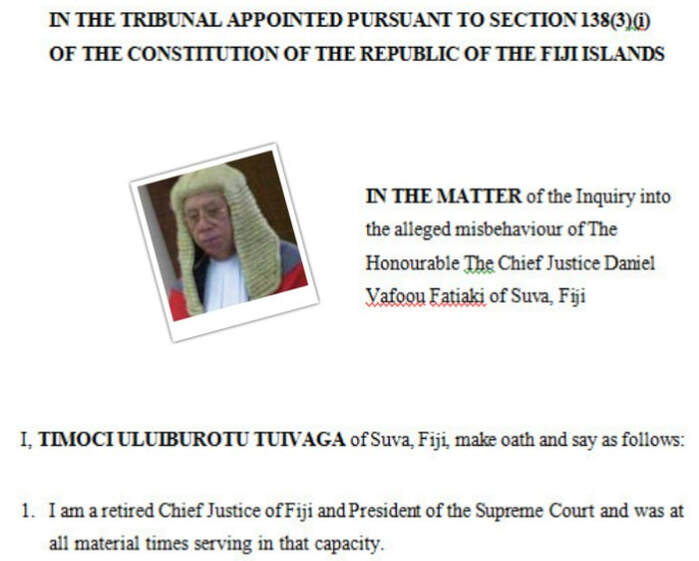
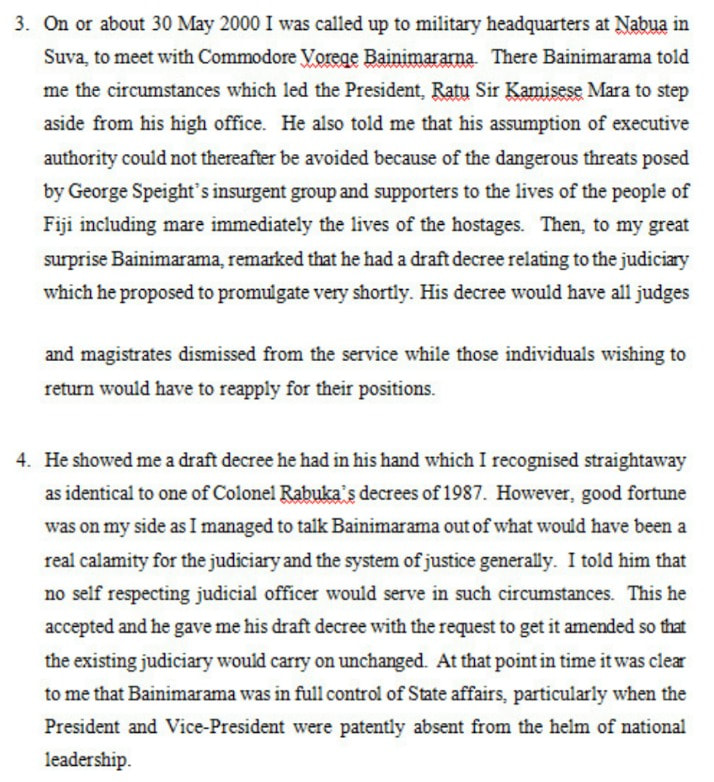
COMING SOON, Ari Taniguchi v Biman Prasad (Judicial Reivew): As the case against NFP leader, Rabuka's Deputy Prime Minister, and Finance Minister takes a murky legal turn behind the scenes, we shine spotlight on the current DDP Pryde through the Affidavit of the then suspended Chief Justice DANIEL FATIAKI, filed by Munro Leys Lawyers in 2007From Fijileaks Archive, 25 September 2021
MUSIC TO THE EARS: Are the march organizers telling us that the RFMF is in agreement with the marchers, for it agrees that Fiji was held down by the Bainimarama-Khaiyum DICTATORSHIP for 16 years? |
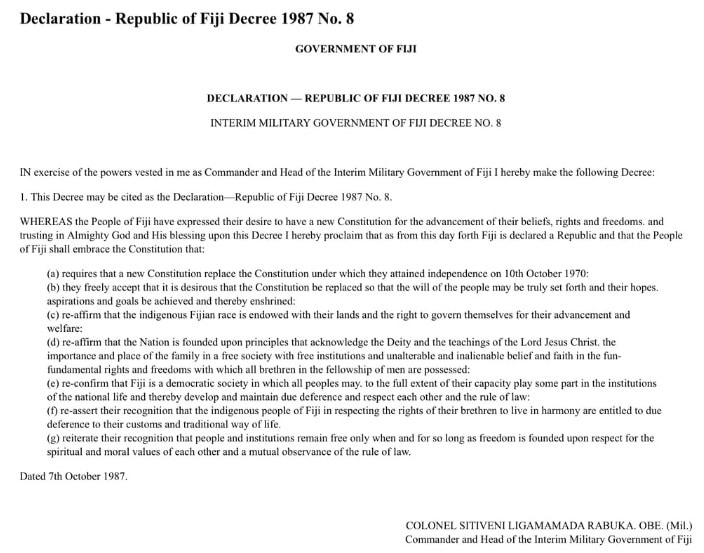
Meanwhile, another COUPIST RABUKA, left it to his attack hounds to sort Bainimarama's punishment while he projected himself as a man who couldn't cast a stone at a fellow solider, for the GCC had forgiven him (Rabuka) and had granted him IMMUNITY for the racist 1987 COUPS. Later, the late NFP leader Jai Ram Reddy, agreed to insert the IMMUNITY clause in the 1997 Constitution of Fiji. Now, also, in the 2013 Constitution of Fiji |
There were 27 ayes, 24 nos and 4 did not vote.
This is after the Leader of the Government in Parliament, Lynda Tabuya withdrew the earlier amendment motion and moved the original motion again that Bainimarama be suspended from parliament for 3 years effective immediately, to be served until February till 17th February 2026, that Bainimarama to issue a written apology to the President within 14 days from today February 17th 2023, that Bainimarama issues an apology to the public within 48 hours, that during the period of suspension Bainimarama is not allowed to enter the parliamentary precincts and that if Bainimarama fails to comply, necessary enforcement measures must be imposed to ensure compliance.
Tabuya had moved an amendment motion earlier for Bainimarama to be suspended for 18 months from parliament after breaching parliamentary privilege following a request by the Prime Minister and the Opposition MPs.
In the earlier amendment motion, Tabuya moved that Bainimarama issue a written apology to the President within 14 days from today February 17th 2023, that Bainimarama issues an apology to the public within 48 hours, that during the period of suspension Bainimarama is not allowed to enter the parliamentary precincts and that if Bainimarama fails to issue an apology as outlined, the penalties be served consecutively for a total of 3 years.
This followed the debate on the motion where the Parliamentary Privileges Committee recommended that Bainimarama be suspended for 3 years from parliament after breaching parliamentary privilege. The Opposition had requested for a 10 minute break to discuss the amendment motion and return to parliament.
Bainimarama was not present in parliament.
When the Opposition returned, they made it clear that Bainimarama will not apologise as he had done nothing wrong and they felt that the amendment motion would have been an apology and no suspension.
Parliamentary Privileges Committee Chair, Lenora Qereqeretabua had earlier tabled the committee report with recommendations.
Home Affairs Minister, Pio Tikoduadua had earlier said Bainimarama uttered words that are denigrating and humiliating to the Head of State and also as Commander-in-Chief when appealing to the rank and file of the RFMF which in view of Tikoduadua are highly seditious and disrespectful while dishonoring the dignity and bringing parliament into disrepute which contravene the parliamentary standing orders.
Speaker of Parliament, Ratu Naiqama Lalabalavu said the words used by Bainimarama are matters which are out of order in parliament and constitute a prima facie breach of privilege.
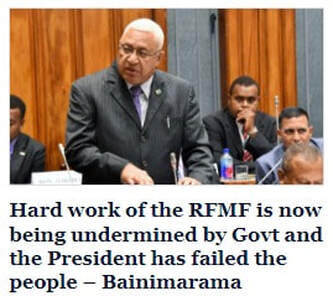
Bainimarama had said President, Ratu Wiliame Katonivere has failed the Fijian people and he will go down in history as the person who aided and abetted the most incompetent and divisive government.
He also said unfortunately, he has to inform the rank and file of the RFMF that all the philosophical commitment and years of hard work of the RFMF is now being undermined and disregarded by this Government.
Bainimarama said the President who we looked up to because we believed that he genuinely believed in the values and principles of Constitution has done an about turn.
The Opposition Leader said Fijians, in particular the weak and vulnerable, those who want actual and practical implementation of the rule of law, those who want the practical implementation of the Constitution and those Fijians who want socio-economic stability, all look up to the RFMF to guarantee these if and when it is under threat.
He appealed to the rank and file of the RFMF to preserve their manna, to maintain their credibility and their calling and not forsake their constitutional role.
Bainimarama said he wishes to inform the RFMF that its gift and legacy, the Fijian Constitution, is being ignored and bashed on a daily basis and the current Prime Minister wants, what the RFMF worked so hard for, removed.
Section 62 of the parliamentary standing orders says when speaking a member must not impute improper motives to any other member.
It says the President’s name may not be introduced to influence Parliament or any committee, the conduct of members, the President, the Chief Justice (performing the functions of the office of President under section 88 of the Constitution), members of the judiciary, or other persons acting in a judicial capacity must not be raised, except on a motion with notice introduced with the Speaker’s permission.
In any other situation, reference to the conduct of any of these individuals is out of order.
The standing orders also says it is out of order for a member, when speaking, to use offensive words against Parliament or another member; treasonable words; seditious words; or words that are likely to promote or provoke feelings of ill-will or hostility between communities or ethnic groups within Fiji. Source: Fijivillage News
Fijileaks: The FFP president RATU WILIAME KATONIVERE should have been DISMISSED as PRESIDENT of Fiji, and charged for aiding and abetting the FijiFirst Party government's 16 years of dictatorship. After all, before Bainimarama's political chiefly lackey became FFP nominated President of Fiji, he was the party President. He was promised the Presidency, and he replaced FFP's Jioji Konrote at the Government House. Understandably, Bainimarama's outburst in Parliament against Katonivere, leading to possible three year suspension, is the outburst of a jilted 'political husband' against the head of his political household, the Tui Macuata Ratu Williame Katonivere. Katonivere must be held responsbile for his party stealing the name FijiFirst, and the 16 years of FFP Bainimarama-Khaiyum dictatorship
POLITICS IN FIJI IS ONE LONG STAB IN THE BACK:
Liu Muri or Aaage Picche
*That provision in the 2013 Constitution under which Bainimarama is to be suspended from Parliament for three years for his ATTACK on his former political lackey was designed by Aiyaz Khaiyum to prevent any such scurrilous attacks on the Presidents appointed by the FFP.
*Now, the very provision has come to BITE Bainimarama because his former FFP president has liu muried his political hooligans.
If FFP had won the election, the same Katonivere would have cheerfully continued to promote and protect his beloved FFP government.
He had even donated to the party's coffers to fight the elections.
The FLP leader Mahendra Chaudhry had correctly pointed out why Katonivere should never have been appointed president but in a typical Chaudhry fashion, he went quite because it didn't suit his political agenda during the recent election.
From Fijileaks Archive, 22 October 2021
*The NFP should have raised objections to Rt Naiqama Lalabalavu being appointed SPEAKER. But no, the party that has never been in power for the last 60 years, has hung its political underwear firmly on Rabuka's PAP mast, with Lenora Qereqeretabua now DEPUTY to Naiqama.
ONLY IN FIJI: We were shocked when the failed PAP candidate Ratu Naiqama Lalabalavu, the Tui Cakau, was appointed SPEAKER to sit in the same chair that was once occupied by the late Speaker Jiko Luveni. Lalabalavu was suspended from Parliament after he was found guilty by the FFP dominated Privileges Committee for calling Luveni, 'Vutusona'. *Now, the deranged are cheering and baying for Bainimarama to be expelled or suspended from Parliament by the Coalition dominated Privileges Committee. A tit-for-tat response.
*The NFP, at least, should have raised objections to Naiqama being appointed SPEAKER. But no, a party that has never been in power for the last 60 years, has hung its political underwear firmly on Rabuka's PAP mast, with Lenora Qereqeretabua now DEPUTY to Naiqama.
*Qereqeretabua is also chairing the Parliamentary Privileges Committee that is hearing the case against Coupist Bainimarama. The other members include Lynda Tabua, Ratu Rakuita Vakalalabure, Esrom Immanuel, Faiyaz Koya and Jone Usamate.
*Bainimarama was summoned to appear before the committee after the Speaker of Parliament, Ratu Naiqama Lalabalavu referred him to the committee.
*ONLY IN FIJI, where a paramount chief calls a woman - the SPEAKER of Parliament - 'Vutusona', is suspended for two years, returns to parliament as a SODELPA MP, defects to Rabuka's PAP at the last minute, fails to be elected to Parliament, and is now SPEAKER of Parliament.
Naiqama was suspended from Parliament after Fijivillage had made available their audio recording to their then puppet master Aiyaz Khaiyum in 2015
From Fijileaks Archives, 21 May 2015
All the rapes, beatings, torture, detentions were corroborated by Amnesty International, the British High Commission in Fiji and other highly reliable sources, despite the absence of Instagram, where Lynda Tabuya was seen CHEWING Fiji Airways to make her point
RAPES, TORTURE, BEATINGS AND DETENTION OF POLITICAL OPPONENTS WAS TAKING PLACE BECAUSE THE COUPIST RACIST THUG HAD OBTAINED DUBIOUS AMNESTY FROM HIS PARAMOUNT CHIEF, THE LATE RATU SIR PENAIA GANILAU
TREACHERY TO GIRMITIYAS:
Girmit Day will be celebrated on Monday 15th May, 2023.
Just look how NFP leader BIMAN PRASAD agrees with PAAPIs to celebrate Girmit Day on 15 May, and NOT on 14 May 2023. REASON: It was on 14 May 1987 that Rabuka consigned Indo-Fijians into the dust-bin
What the COUPIST Sitiveni Rabuka started in 1987 is nearing completion in 2023. Fiji is being 'Fijianized' or iTaukeinized at breathtaking speed, assisted by the NFP leader BIMAN PRASAD, whose party had sold Indo-Fijian rights at the London Constitutional Conference in 1970. Since the i-Taukei are a majority, it is the minorities in Fiji who need protection under international law from the rampaging i-Taukei MOB |
NO LAUGHING MATTER, PRESIDENT KATONIVERE.
When will Fiji see an Indo-Fijian or the so-called Other as PRESIDENT of Fiji?
We have had Chiefs and a Rotuman holding the Presidency
PRESIDENT KATONIVERE mixes Chieftainship with High Office. He should have kept Ratu Epenisa Cakobau OUT of the Government House. The Non i-Taukei Fijians, except those exploiting indigenous and chiefly rights for political gain, should be really worried about the return of the GCC under the Rabuka Coalition government. This body, operating like a state within a state, has brought Fiji to where we are today as a divided nation. They should be running their villages, NOT sitting at Government House, and in the Speaker's Chair. Tradition is a Guide, Not a Jailor
The President says the people of Macuata and the Kubuna Confederacy has always shared a close bond and their visit is a testament to the longstanding traditional ties that they both share. Ratu Wiliame says as they embark on a new journey, they will face many challenges, however, support and respect are needed to establish their ties traditionally.
Source: FBC News, 11 February 2023
In his response to President Ratu Wiliame Katonivere’s opening speech in Parliament, the Minister for Rural and Martime Development and Disaster Sakiasi Ditoka says he celebrates the decision to restore the GCC, traditionally the apex of the vanua.
He says the recent “veisiko” or visitation to the President by the Vanua of Bau and viral picture of Turaga i Taukei Bolatagane and the Turaga Taukei Mataiwelagi expressing themselves in joyful greeting is a beautiful reminder of the good times we have ahead of us.
A SNIPPET OF HISTORY. In 1858, the Wesleyan missionary Reverend Thomas Williams, published his classic 'Fiji and the Fijians - The Islands and their Inhabitants'. It is regarded by historians as the best single insight into Fijian (i-Taukei) life. Here is one fascinating event that reveals how i-Taukeis (including Ditoka) continue to perpetuate myths, ignoring the 'invention of tradition'. The Rev Williams on 'King of Fiji':
'Before the death of the King Tanoa, the whites residing in Fiji wrote to General Miller, H. B. M. Consul-General at the Sandwich Islands, complaining of their ill-treatment by Thakombau, the young Chief of Mbau and heir of Tanoa, but already exercising virtually the kingly power. General Miller sent a letter about the matter to the Chief, addressing it, "To the King of Fiji". When this letter arrived, a Tongan Chief, who had visited Sydney and could read English, was staying with Thakombau, to whom he interpreted the Consul's dispatch, translating the address, "Tui Viti." This title, till then unknown, thus became fixed and proved of great use to the young Chief during his regency, though a cause of bitter jealousy to other Chiefs, some of whom I heard comforting themselves by saying, 'It is without authority: foreigners gave it to him.'. Later, the appellation became the hereditary title Vunivalu and Tui Viti.
Coups, counter coups and ‘Bau Constitution’ - The Cakobau Government
By VICTOR LAL
According to the records of the colonial government’s archivist, A.I. Diamond, the advent of Europeans resulted in a marked increase in the extent and ferocity of native warfare. Towards 1850, power and influence in the Fiji were beginning to centre on the chiefdoms of Bau, Rewa, Somosomo, Verata, Naitasiri, Macuata, Bua and Lakeba. Of these Bau was undoubtedly the most powerful, her chiefs having extended their influence by means of warfare, intrigue, and judicious alliances over nearly one-third of Fiji. By 1850, Cakobau had achieved a position so near to paramountcy that foreigners had begun to address him as Tui Viti (King of Fiji). Cakobau’s claim to the title was not generally recognised by Fijians outside his own dominions, and it would scarcely merit mention here were it not for the fact that it brought him later into conflict with the United States government. In 1855, the latter had brought indemnity claims against him for damage and loss of property said to have been sustained by Americans at the hands of the Fijians.
Although Cakobau himself was not personally responsible with the incidents on which the claims were based, the US government insisted that as King of Fiji, he was responsible for the actions of his subjects. The claims amounted in the end to over $45,000 (dollars), a sum which Cakobau could not hope to raise by himself, and as they were pressed with the threat of warlike reprisals the Vunivalu found himself in circumstances which could lead to his downfall.To add to his difficulties, Cakobau began to find his supremacy threatened after 1855 by the rise to power of Ma’afu. The latter, a Tongan war chief, had come to Fiji with his retainers in 1848, thirty-one years before the introduction of Indian indentured labourers to Fiji. After aiding Cakobau in a campaign against the chiefs of Rewa and their allies, Ma’afu had established himself in Lau. From there he began to extend his influence into other parts of the Group until by 1865 he controlled Beqa and large parts of the western coasts of Viti Levu and Vanua Levu. Cakobau watched his rival’s activities with increasing alarm, seeing in them preparations for his own eventual subversion and overthrow. Harassed by these difficulties, Cakobau turned for advice to the British Consul, William Thomas Pritchard, who responded by urging him to offer Fiji to Great Britain. Though Cakobau had no authority to make such an offer, he in his extremity, agreed and a formal Deed of Cession was drawn up on 12 October 1858, offering Fiji to the British government on certain conditions, including the payment of the American claims in return for a conveyance of 200,000 acres of land to the British crown.
The offer was subsequently acknowledged, ratified and renewed by the Fijian chiefs on 14 December 1859. The Deed of Cession was taken to England for presentation by Pritchard himself who made vigorous efforts on arrival to ensure that the offer was favourably received. After some delay, the British government despatched a Colonel W.G. Smythe to Fiji to investigate and report on the expediency of annexation. Smythe’s report, however, was unfavourable, and in 1862 the Government of New South Wales in Australia was instructed by the British authorities to inform Cakobau and his supporters that the offer of cessionhad been declined. Shortly after this refusal Cakobau repeated the offer to the United States government. The latter, however, being engaged at the time in Civil War, sent no reply.Between 1865 and 1871 several attempts were made to introduce a measure of political stability into Fiji by means of Confederations, but for various reasons, more especially the inexperience and mutual suspicion and hostility of the leading chiefs, none of the Confederacies succeeded. In 1865 Cakobau and Ma’afu were persuaded to co-operate in the establishment of a Confederacy of the six most powerful native dominions in Fiji; these being Bau, Rewa, Lakeba, Bua, Cakaudrove, and Macuata.
The chieftains of the six, claiming to speak for the whole of Fiji, constituted themselves a General Assembly with power to legislate for a code of laws which was to be effective throughout Fiji. The members states were to retain their sovereignty, but each agreed to observe the common code of laws and to unite for the preservation of peace and order. The Confederation was inaugurated on 8 May 1865 under the Presidency of Cakobau. Much hope was entertained for the success of the venture and for the first two years it functioned well enough. But in 1867, when Ma’afu began to canvas support for himself as President of the Assembly, Cakobau and several of the leading Fijian chiefs withdrew and the Confederacy collapsed. Upon the failure of the 1865 Confederation, Ma’afu and Cakobau immediately set up institutions for the control of their own spheres of influence. Ma’afu, with the help of his European secretary, R. S. Swanston, induced the chiefs of Lau, Cakaudrove and Bua to combine under his leadership in a Confederation (the Tovata i Viti or Tovata i Lau), similar in character to the Confederation of1865. At the same time, Cakobau, urged on by the European settlers at Levuka, adopted for his own dominion the form of a European monarchy modelled on the Hawaiian Constitution.
The latter is of particular interest as it afterwards formed the basis of theso-called Cakobau Government of 1871. The Lau Confederation, under Ma’afu’s direction was moderately successful and held together until 1871. Ma’afu later assuming the title of Tui Lau. The Bau monarchy, however, collapsed within a year mainly as a result of internal dissension and lack of revenues. In 1869, an attempt was made to re-instate it under a revised constitution but it failed almost immediately and for the same reasons as its predecessor.The huge influx of White settlers during the cotton boomof the 1860s brought with it a corresponding increase in the need for stable and unified government. Hitherto the British, American and German consuls, supported by occasional visits from warships, had managed fairly effectively to protect and regulate the affairs of the European population and to mediate between their own nationals and the Fijians.
The competency of the Consuls, however, was limited and by 1870 it was clear that if the lives and property of the settlers and the interests of the natives themselves were to be secured a local government would have to be established with legislative authority over the whole of Fiji and coercive power sufficient to keep the peace and enforce the law.Fiji’s first coup Although most of the settlers were agreed in principle on the need for such a government, constant dispute between the various sections of the European population made concerted action difficult. In the end, the ‘national’ government was established by means of a coup. In the early months of 1871,a group of Levuka businessmen formed a conspiracy and approached Cakobau in secret with a proposal that he place himself at the head of a Government claiming sovereignty over the whole of Fiji. The attempt could easily have ended, like others before it, in a fiasco. This one, however, came as a complete surprise and was, moreover, well-timed. Cakobau was occupied in the successful conclusion of a campaign against the Lovoni people on the island of Ovalau. Thus not only was his prestige enhanced but that victory was turned to account by the penalty meted out to the Lovoni people.
The latter were expropriated and sold into servitude to white planters at the rate of £3 a head and a yearly hire of the same amount. The revenue from the 'hire’ of Lovoni labour was considerable and as it was placed at the disposal of the new Government the latter began, unlike its predecessors, with at least one assured source of annual income.The proclamation of the ‘Cakobau Government’, as it has come to be known, at first raised a storm of protest among the Europeans in Levuka. But opposition was greatly reduced by the publication of a ‘Gazette’ containing among other things, an undertaking by the Executive to delay the initiation of all matters other than those of urgent public necessity until a House of Representatives had been assembled. With this assurance, the majority of the settlers were content for the time being to accept the new Government as a ‘fait accompli’ and many even lent their active support to it.It was obvious to most, however, that the future of the Government depended heavily upon the reaction of Ma’afu. Ma’afu was not only the leader of a powerful alliance of chiefs, but could easily, if he chose, set himself up as the champion of the dissident elements among the Europeans.
But surprisingly enough Ma’afu offered no resistance to the coup and even agreed to co-operate with the new Government. On 22 July he visited Levuka and, in the course of discussions with Cakobau lasting two days, acknowledged him as TuiViti, took the oath of allegiance and abandoned all territorial claims outside Lau, the seat of his power. In return he was made Viceroy of Lau with salary of £800 and was given a clear title to the islands of Moala, Matuku and Totoya. The acquiescence ofMa’afu effectively disposed of the threat of serious resistance from the native Fijians and by the end of the year all the ruling chiefs had tendered their allegiance to Cakobau.The ‘Bau Constitution’The first Gazette, issued by the new Government on 5 June 1871, gave notice that Cakobau, Tui Viti, had been pleased under the Bau Constitution to appoint an Executive (mostly Europeans) consisting of the following: Sydney Charles Burt, George Austin Woods, John Temple Sagar, James Cobham Smith, Gustavas Hennings, and Ratu Savenaca and Ratu Timoci. Government Gazette No.2, published on 10 June 1871, contained explanations of the main causes which had led to the appointment of the Executive.
These were three: (a) the largely increasing European population, (b)the growing want of confidence in commercial matters, and (c) the hesitation of merchants and financial interests in the colonies to deal with investments in Fiji until a form of government should be adopted. The Gazette also gave notice that delegates from all the districts in Fiji had been summoned to meet at Levuka on 1 August to discuss and amend the Constitution of 1867. The House of Delegates met under the chairmanship of J.S. Butters, the former mayor of Melbourne and Speaker of the Legislative Assembly of Victoria, and after two weeks deliberation, passed the Constitution Act of Fiji, 1871. This Act was signed by Cakobau on 18 August and came into force on the 1 October. The first Parliament of the Cakobau Government was opened by Cakobau on 3 November 1871. It sat until the 17 December, having passed about 20 ‘Bills’.
The Second Coup Attempt
By March 1872 there was evidence of growing distrust of, and lack of confidence in, the Government. Much jealousy was displayed over ministerial and public service appointments, and there was widespread complaint at what was described as ‘the absurd attitudes and arrogant bearing’ adopted by certain Ministers towards the public. The task of the Cakobau Government was further hampered by the effects of an economic recession resulting from the collapse of the market for ‘sea-island’ cotton. Many of the white settlers suddenly found themselves in acute financial distress and resistance to taxation increased. Revolutionary movements became active and on one occasionan armed insurrection inspired by an organisation calling itself the ‘Ku-Klux-Klan’ very nearly succeeded in overthrowing the Government. The fact that the Government survived this threat largely as a result of assistance offered by a British man-of-war did little to enhance its stature in the eyes of the public. Resistance to the Government at length resolved itself into a demand for the dissolution of the Assembly, the holding of a new election, and the dismissal of the Premier, S.C. Burt. On 18 March the Cakobau government yielded and Burt resigned. Cakobau invited J.B.Thurston, a white Tavenui planter and one of the members of the Legislative Assembly for Tavenui district, to join the Government and the latter, upon accepting the invitation, acted as Premier in the absence of G.A. Woods, who was originally chosen for the post but who was away in Australia at the time.
The third and last session of the Legislative Assembly sat between 31 May and 12 June 1873. The principal business set down was the amendment of the Constitution Act of 1871, the operation of which had been found too expensive and cumbersome. Of the 28 members of the Assembly, only 14 attended, and of these only 5 were minority, the Government were defeated and the Cabinet accordingly resigned. Cakobau, however, declined to accept, and instead issued a Proclamation dissolving the Assembly. The Assembly never sat again and thereafter administration continued under Ministerial direction until the establishment of an Interim Government on 23 March 1874.
A general election was due to be held in 1873; but at a meeting of the King-in-Council held on 29 July 1873, at Nasova, Levuka, it was resolved that the arrangements for the election should be abolished. On 11 July 1873 Cakobau appointed a RoyalCommission to revise, consolidate and amend the laws. The Commission drew up the so-called ‘National Constitution and Fundamental Laws of the Kingdom of Fiji, 1873’, and though it received the assent of Cakobau it was never adopted, owing largely to the opposition of Commodore Goodenough and the British Consul, E.L. Layard. Throughout 1872 and 1873 resistance to the Cakobau Government, particularly on the part of the Europeans, increased. In Ba, the settlers staged a revolt and again the Government found itself obliged to accept the intervention of a British warship. By the middle of 1873 the administration was facing bankruptcy and it was clear even to its supporters that the regime could not last. Responsible elements among the European community began topress for cession of Fiji to Great Britain or the United States.
The Cession of Fiji to Great Britain
On 17 March 1874, the British Consul gave warning in a public notice that the Cakobau Government was bankrupt and cautioned all British subjects againstallowing the Government further credit. The notice further declared that British subjects accepting or retaining official posts in the Armed Constabulary were liable to prosecution under the UK Foreign Enlistment Act. The Consul’s action practically put an end to the attempt at self-government, and the newly formed Ministry strongly advised Cakobau to reconsider the question of annexation by Great Britain. A meeting of the leading Fijian chiefs was held in March, and the 21stof that month a formal offer of cession was made to the Commissioners who communicated it to the Imperial government in London.
At the meeting, held at Levuka on 23 March 1874, attended by the Commissioners, Cakobau and other high chiefs, the foreign Consuls, the Chief Secretary Thurston and the Chief Justice (St Julian), it was resolved that an Interim Government should be established to carry on the administration of Fiji pending a decision by the Imperial government on the subject of annexation.The offer of cession made on 21 March,contained terms which proved unacceptable to the British government and as a result, Sir Hercules Robinson, then Governor of New South Wales, was despatched to Fiji in September 1874, to negotiate. On 30 September Robinson telegraphed Lord Carnarvon in London: ‘The King (Thakombau) has this day signed an unconditional cession of the country. I am leaving today on a tour to obtain the signature of Ma’afu and other ruling Chiefs’. His mission was successful and on 10 October Cakobau, Ma’afu and other principal chiefs ceded the sovereignty of Fiji to Great Britain. Upon the conclusion of the Deed of Cession, Sir Hercules Robinson established a Provisional Government to carry on administration until the arrival of the Governor and the Proclamation of the Colony.
The administration of the Provisional Government terminated on the 1 September 1875, with the proclamation of the Royal Charter erecting Fiji into a separate Colony and with the assumption of office of the first resident Governor, Sir Arthur Hamilton Gordon, the man responsible for introducing Indian indentured labourers into Fiji in 1879. Gordon was safeguarding the Fijian population as they were still struggling to fight off an epidemic of measles in 1875 which had killed about 40,000 of the estimated population of 150,000 Fijians. The epidemic occurred after Cakobau and his two sons, who had contracted mild cases of measles during their return voyage from a visit to Sydney, were allowed to land in Fiji before they had completely recovered. Responsibility for the disaster rested with the captain and medical officer of H.M.S Dido. They failed to impress upon E.L. Layard, the British consul for Fiji and Tonga, the serious consequences that might result from failure to place the patients in quarantine.
The Deed of Cession
King Cakobau had sent Queen Victoria a basket of earth to symbolise the handing over of the land of Fiji and his oldest and favourite war club. This latter item was later returned to Fiji by King George V where, topped with a silver crown and a dove of peace, it became the mace of the Legislative Council and subsequent Parliaments of Fiji. The Deed of Cession has been regarded as the charter of Fijians indigenous rights. It has been appropriated by Fijians of different political persuasions for different purposes. It is worth remembering that it was mostly the eastern chiefs who had made an unconditional cession of their islands to Great Britain. As Governor Sir Ronald Garvey noted in his Cession Day’s speech in 1957, ‘to read into the Deed more than that, to suggest, for instance, that the rights and interests of the Fijians should predominate over everything else, does not service either to the Fijian people or to their country’.
The adoption of that view, Sir Ronald continued, ‘would mean complete protection and no-self-respecting individual race wants that because, ultimately, it means that those subject to it will end up as museum pieces’. The late Ratu William Toganivalu, a high chief and Cabinet Minister in the Alliance Government, had argued in the House of Representatives in June 1970: ‘There was nothing in the Deed of Cession to say that when England was to hand over Fiji that it was to hand it over holus-bolus to the Fijian people and to the Fijian people alone. There was nothing whatsoever written in it and as the Fijian chiefs gave Fiji unreservedly to Great Britain, my interpretation is that if Great Britain wants to give it back she gives it back in the condition which she finds it. It does not necessarily mean that she should give it back to the Fijian people.'
The late Ratu Sir George Cakobau, on the other hand, had demanded: ‘I have nothing against independence. Let it come. But when it comes, I should like this recorded in this House-Let the British government return Fiji to Fijians in the state and same spirit with which Fijians gave Fiji to Great Britain.’
Ratu Sir George Cakobau
As the great-grandson of Ratu Seru Cakobau, the late Ratu George Cakobau was paramount chief of Fiji and the first Fijian to hold the post of Governor-General in post-independent Fiji. On 18 September 1959 he was formally invested as Vunivalu and Tui Kaba in front of more than 3000 people at Bau. The dignity and restrained emotion of the occasion emphasised its historic significance. Not for 106 years had the impressive ceremony been performed. The ceremony thus became linked with 26 July 1853, when Ratu Cakobau, later Tui Viti -Ratu George’s great grandfather-was installed. The keynote of the ceremony was set when Ratu Edward Tugi Tuivanuavou Cakobau, Ratu George’s first cousin, presented him with a tabua, pledging the Bau people’s loyalty and the loyalty of all those associated with Bau.
When the coups of 1987 made world headlines, Ratu George had been retired three years from the gubernatorial role. Efforts by followers of Dr Timoci Bavadra’s government, which had been overthrown by Sitiveni Rabuka, to solicit Ratu George’s aid in the complicated events, which split the two major races and divided families and tribes, proved unsuccessful. He however denounced Rabuka’s threats to remove his successor Ratu Sir Penaia Ganilau as governor-general and impose a republic. Earlier, however, he had received Bavadra and his ministerial colleagues at the chiefly island of Bau. He indicated his support for the new inter-racial government and for the western Fijians or Melanesian Fiji and distanced himself from their traditional rivals in the Polynesian east.
This was, as Kenneth Bain wrote on Ratu Cakobau’s death, ‘the classic Fijian dynastic divide’. As Vunivalu of Fiji, Ratu George’s supremacy had never been dangerously challenged and his ancestry gave him a prime say in Fijian affairs. During the disturbances of 1959 in Suva, he warned the rioting and looting crowd who had assembled for a public meeting at Albert Park in Suva: ‘I do not want to stop your meeting. I want to speak of the damage you have done. You are not young and you know right from wrong. But whatever you do, remember the name of Fiji. The reputation of the Fijians is up to you. That is all.’
On Fiji’s independence in 1970 Ratu George was Minister for Fijian Affairs. In 1977 his statesmanship saved the political career of the first Prime Minister Ratu Sir Kamisese Mara on the defeat of his predominantly Alliance Party at the hands of the National Federation Party. He asked Ratu Mara to re-form a government which was to last until the latter’s second and serious defeat in 1987, prompting military intervention in Fiji’s politics. He was deeply saddened to see the severance of the links with the British Crown which he had so cherished because his great-grandfather was the architect of the cession. In March 1988, however, when Ratu Mara, without apparently consulting Cakobau beforehand, set off for London and Buckingham Palace, he was outraged. The purpose of Ratu Mara’s visit was to try to persuade the Queen to retain the title of Tui Viti - Queen of Fiji- which was passed to Queen Victoria by Ratu Seru Cakobau at cession in 1874.‘The title came back to me’, Ratu George said in Bau, ‘when Fiji became independent in 1970. I have no plans to abdicate. The title is not Ratu Mara’s to give away’.
The implications for an already fragmented and divided Fijian society was far-reaching, as played out during the recent the hostage crisis.
The Mara/Cakobau Dynasty
In recent years there has been a public split between the Mara/Cakobau political and traditional dynasty. The victory of the Fiji Labour Party, the inclusion of Ratu Mara’s daughter as a Minister in Chaudhry’s government, and Ratu Mara’s elevation as President of Fiji, drove a further wedge between the Mara-Cakobau clan in Fijian politics. It was not surprising, therefore, that Speight and others hailing from the Cakobau side of the traditional clan had been baying for Mara’s political blood shortly after seizing power. Unlike the Mara family, the Cakobau family had been badly defeated at the polls. As the Daily Post pointed out on 19 May 1999, a year to the day Speight and his hoodlums seized the Chaudhry government, the Cakobau family name was not enough to muster the support of Tailevu voters as brother, sister, and cousin lost their respective seats. Members of this chiefly Bau and Tailevu family, regarded highly throughout the country, could not hold on to their voting leads, and lost out after preferences were distributed. Ratu Epenisa Cakobau, Adi Litia Cakobau’s brother, lost the Tailevu South Lomaiviti open seat to political enthusiast and Fiji Labour Party candidate Isireli Vuivau. Ratu Epenisa was among those who had formed the Fijian Association Party. However, he withdrew his support from the party after his elder sister Adi Samanunu contested the 1994 elections for the SVT. ‘Family unity is very important to me’, he had said then.
The first to concede defeat was Adi Litia Cakobau, the daughter of the late Vunivalu. She had contested the Tailevu North/Ovalau open seat, a seat which my late father, as President of the Tailevu North Alliance District Council, had actively campaigned and helped Ratu George Cakobau to win in the 1970s. Adi Litia and Ratu Epenisa had contested the elections under the SVT electoral tickets.
An emotional Adi Litia attributed their loss to what she described as the other Fijian parties determination to eliminate the SVT. ‘It is really sad that the other parties had preached that we had sold out the interest of Fijians. People, the Fijians, need to understand their Constitution. The rights of the indigenous is well protected. The question they should ask is what will happen now-will they be able to get extra or special protection as given to them by the SVT.’
She noted that her loss was as a result of ‘a divided Fijian front’. Adi Litia said that the ‘vanua no longer could dictate the people’s political preference but that is democracy’. ‘The people have chosen their representatives and that is what counts’, Adi Litia said. She had also moved Sitiveni Rabuka’s name for chairman of the Great Council of Chiefs, while Ratu Tevita Vakalalabure of Cakaudrove moved her name for vice chairman.
This clearly showed that the provinces of Tailevu and Cakaudrove wanted to control the Council, especially after the SVT lost power in the general elections to the People's Coalition of Labour, Fijian Association and PANU.
Fijileaks: Unlike previous overthrow of democratically elected governments by Rabuka and Bainimarama, this time around, the overthrow of the Coalition government will be constitutional - for the RFMF is legally mandated to carry it out in the 2013 Constitution of Fiji. That is if it is executed by the Commander Ro Jone Kalouniwai, and not by some rogue elements in the military. We are also tired of being reminded that the 2013 Constitution is ILLEGAL. If the detractors want to talk about illegality, we need to accept that the only constitution that was legal was the 1970 Constitution that Rabuka tore apart and had replaced it with a racially discriminatory and autocratic 1990 Constitution of Fiji. It was under this Constitution that he ruled Fiji until he lost the 1999 election.
*Fijileaks to Tikoduadua: COUPIST Bainimarama, your former PAYMASTER, like Rabuka before him, is once again appealing to the raw instincts of the RFMF foot soldiers who are protectors of the nation under Section 131 of the Constitution of Fiji, under which you are serving in Rabuka's Coalition government.
*It is time you called for the stripping of IMMUNITY that was inscribed into the 1990, 1997 and 2013 Constitutions, and let the Fiji High Court rule on its validity.
*It is shocking that the late NFP leader JAI RAM REDDY, arguably one of the best legal minds, had agreed to the IMMUNITY provision in the 1997 Constitution but then both Reddy and Rabuka were only interested in POLITICS and not whether the Immunity Clause was legal or illegal.
*In 2004, our Founding Editor-in-Chief had argued that the Immunity granted to Rabuka was illegal (see below). This was upheld by a group of human rights lawyers in London in 1999 when there were plans to arrest Rabuka based on the Chilean dictator General Pincohet precedent. And, only last year, another set of lawyers came to the same conclusion when we had planned to arrest the suspended Police Commissioner Sitiveni Qiliho for beating and torturing the late Brij Lal, and other opponents of the Bainimarama regime. Tikoduadua, you should never have agreed to become PS to Bainimarama, and later a FFP government minister.
TREASON IS TREASON, whether by Bainimarama or Rabuka
Our Founding Editor-in- Chief's Opinion in the Fiji Sun of 2004 on Rabuka's dubious Immunity:
"The Queen’s representative, Ratu Sir Penaia Ganilau, pardoned Rabuka before he declared Fiji a Republic but it was unconstitutional act
Her Majesty was saddened the coup-colonel severed 113-year old chiefly link with British Brown"
"As Professor Yash Ghai and Jill Cottrell (in a chapter to a book Sovereigns and Surrogates-Constitutional Heads of State in the Commonwealth, 1991) have pointed out, it seems that the G-G confused two powers: that to grant a pardon, and that to grant immunity from prosecution, the second of which he did not possess. The 1970 Fiji Constitution contemplated only the former, furthermore, even that power which the G-G possessed under the Constitution, was to be exercised only on the advice of the committee established for the purpose. In other words, Rabuka’s pardon, or immunity was, and still is, questionable in the eyes of the law. Moreover, the Queen had never consented to the pardoning. She had simply ceased to be the Head of State when Ratu Penaia resigned on 15 October, and Fiji’s membership of the Commonwealth had lapsed. On 14 May 1987, Rabuka therefore committed treason against Queen Elizabeth 11 of England and Fiji but escaped the death penalty."
2004: Victor Lal The Fiji Sun, 2004
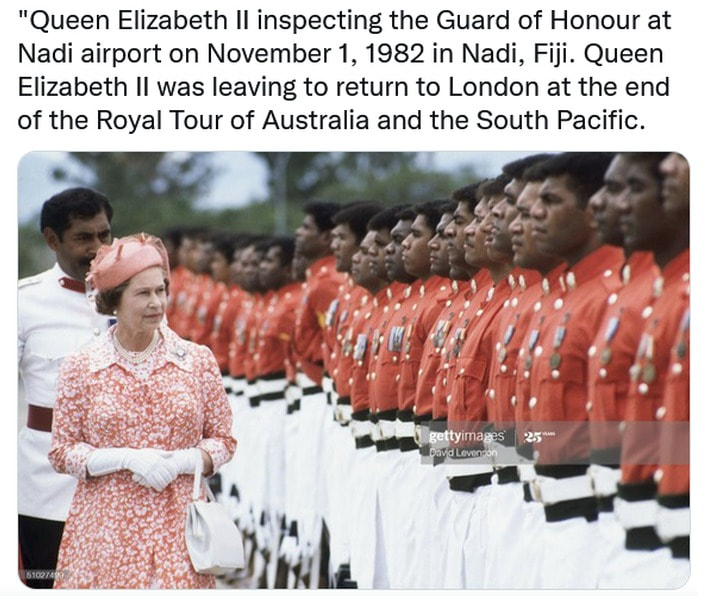
In a robust defence of his treasonable coups of 1987, Sitiveni Rabuka now claims that he did not have to ask for a pardon because he had already ousted Her Majesty, Queen Elizabeth 11, and made Fiji a republic after the coups.
He was responding to questions raised by government senator, Reverend Tomasi Kanailagi, in the Senate on why the people who staged the coup in 2000 have not been pardoned, although the 1987 coup leader was allowed to walk free.
Responding, Rabuka said: ‘Kanailagi has no in-depth knowledge on what he is talking about because I didn't have to be pardoned by anyone ... the only one who could have pardoned me was the Queen, whom I ousted in that coup. I had effectively removed her.
Was Rabuka pardoned?
In order to answer the question we need to examine the events between 19 May 1987 when Rabuka and others were granted prerogative of mercy; 5 October 1987, when he declared Fiji a republic, and 15 October when Ratu Sir Penaia Ganilau resigned as Governor-General. Rabuka had never ousted the Queen; she had ceased to be the head of state on 15 October. Moreover, throughout the 2000 Speight crisis, Rabuka had claimed that he could not be prosecuted because he had obtained immunity from prosecution for his 1987 actions. If that is so, then he was either ‘pardoned’ or granted ‘immunity’.
On 19 May 1987, the Governor-General (G-G), Ratu Penaia, who was also the tribal head of Rabuka’s Cakaudrove province, pardoned Rabuka for his exemplary behaviour after overthrowing the Bavadra government and on the pretext of helping to restore democracy. The G-G went even further, and on the 29 May, promoted Rabuka to full colonel and commander of the military, effective from the date of the coup, 14 May. Ratu Penaia also promoted other officers who had taken part in the coup as well. From the perspective of Fijian provincial and tribal politics, the effect was to strengthen the position of officers from Cakaudrove at the expense of those from Lau and Tailevu.
The Great Republican Debate
On 20 July the Great Council of Chiefs (GCC) met in Suva for a three-day meeting to discuss various alternatives to solve the deepening constitutional, economic, and racial crisis. It was widely anticipated that the extremist Taukei Movement had planned to ask Ratu Penaia to step down and then have the GCC declare Fiji a republic, with an exclusive Fijian government. The Taukei Movement spokesman, speaking at the first day of the meeting, urged the chiefs to revoke the 1874 Deed of Cession and declare Fiji a republic. He was not alone in promoting such a course. Nine of the 14 provinces had passed resolutions calling for an immediate declaration of Fiji as a republic, while the other five had agreed to support a republic only if the G-G’s initiative to bring about a political compromise failed.
The next day the meeting heard Rabuka calling for the formation of a ‘Christian democratic state’ and retention of ties with the Queen, rather than a republic. The GCC, on Wednesday, much to the surprise of many, rejected, for the time being, the idea of declaring a republic, but reserved the right to do so in the future. Rabuka called the decision ‘a consensus between the objectives of the Taukei Movement, the aim of my coup, and the wishes of the Great Council of Chiefs’.
On Friday 31 July, Rabuka was officially installed as commander of the army, ironically, at the Queen Elizabeth Barracks, where he told the 1,500 invited guests: ‘I am really here today as the representative of the great chiefs and the people of Fiji. I am doing this for you.’ More importantly, he was still serving under the Queen’s representative, the G-G, who was also the Commander-in-Chief of the Royal Fiji Military Forces.
Meanwhile, Ratu Mara, Ratu Penaia and Bavadra tried to reach a compromise deal for interim power-sharing in the so-called ‘Deuba Accord’. Rabuka’s response was lukewarm but the Taukei Movement was violently opposed to it. It described the proposed power-sharing as ‘degrading and a sell-out’. Sakiasi Butadroka, the leader of the Fijian Nationalist Party, called for an immediate declaration of a republic. But Rabuka, with the help of the Taukei extremists, struck once again, on Friday 22 September, carrying out a second coup. He announced over Radio Fiji that he had assumed executive authority over the G-G. He detained Bavadra, who was heading west, and also placed the G-G under armed guard at Government House.
However, Ratu Penaia maintained he was still the legal authority and refused to endorse the second coup. He also refused to co-operate when Rabuka and a group of his military officers offered him the tabua (whale’s tooth) for ‘slighting’ their chief. One of Her Majesty’s English magistrates, John Small, was detained and also assaulted. Despite the bullying tactics, the Chief Justice Sir Timoci Tuivaqa and the judges of the Supreme Court refused to recognize Rabuka’s authority. Sir Timoci and the other judges still saw Ratu Penaia as Queen’s representative and repository of authority in Fiji. Rabuka even threatened to dismiss the G-G if it was necessary for ‘legitimising my assumption of executive authority’. Rabuka also disclosed that the ‘Governor-General did not accept’ his offer to become President. ‘It will take lions to move me out of here’, Ratu Penaia said later.
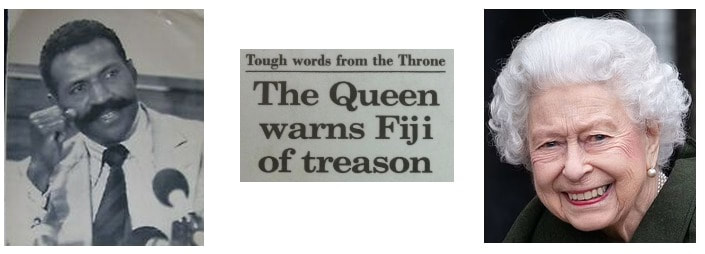
A frustrated Rabuka, therefore, announced that he had assumed full authority, and also indicated that he would declare a republic shortly and offer the presidency to Ratu Mara, which angered the great Lauan chief. The Chief Justice continued to be a thorn in Rabuka’s side. He stated that Rabuka’s proclamation had no legal standing until the G-G was physically removed from office. The worst was to follow. The Queen personally sent a message accusing Rabuka of disloyalty which was broadcast once over the radio in the Fijian language before being suppressed by the military:
She told the nation: ‘For her part Her Majesty continues to regard the Governor-General as her presentative and the sole authority in Fiji. Anyone who seeks to remove the Governor-General from office would in effect be repudiating his allegiance and loyalty to the Queen. Her Majesty hopes that even now the process of restoring Fiji to constitutional normality might be resumed Many Fijians hold firm their allegiance to the Crown and to the Governor-General as the Queen’s personal representative. The Queen would be deeply saddened if these bonds of mutual loyalty and affection which have long so held the Fijian people and the British monarchy together were to be restored.’
Even Siddiq Koya, now a spent political force, and who in 1970 had called for a republic with a Fijian head of state, tried to dissuade Rabuka from declaring a republic.
Briefly, after a long protracted struggle, Rabuka and Ratu Penaia came to a compromise allowing the G-G to act ‘in his own deliberate judgement’. Ratu Penaia had two options: he could resign and clear the way or he could ask the Queen to accept the changes to the constitution approved by him. That night, the G-G contacted the Queen and asked her to consider a constitution with sweeping changes that entrenched native Fijian paramountcy at the expense of the Indo-Fijian population. She refused.
On 9 October, Ratu Mara flew to London to have an audience with the Queen but she politely declined to see him. Instead, she flew to Vancouver to attend the Commonwealth Heads of Government meeting. However, on 15 October, Ratu Penaia suddenly resigned. He wrote to her: ‘My endeavours to preserve constitutional government in Fiji have proved in vain, and I can see no alternative way forward.’ The Queen, in regretfully accepting the resignation, expressed her gratitude for his loyal services and admiration for his courageous efforts to prevent Fiji from becoming a republic, and added that she was sad ‘to think that the ending of Fijian allegiance to the Crown should have been brought about without the people of Fiji being given an opportunity to express their opinion on the proposal.’ On 5 December Ratu Penaia became the new President of Fiji. Rabuka was promoted Brigadier of the Royal Fiji Military Forces.
Pardon and Prerogative of Mercy
It is quite clear from the sequence of events that at no time had Rabuka ousted the Queen, nor had the Governor-General, until 15 October, ceased to be her constitutional representative in Fiji. Rabuka was however pardoned on 19 May 1987, when Ratu Penaia purported to grant immunity to Rabuka in respect of his treasonable actions in overthrowing the lawfully constituted government, by virtue of the prerogative of mercy. The prerogative of mercy is a special power vested in the Head of State, which enables him or her to pardon or reduce the sentence of a convicted person.
Historically, this power has been exercised only in the most exceptional circumstances, such as where a miscarriage of justice has resulted in the conviction of a person who is innocent, or where a prisoner becomes terminally ill, so that it would be overly harsh to require him to serve out his sentence.
But as Professor Yash Ghai and Jill Cottrell (in a chapter to a book Sovereigns and Surrogates-Constitutional Heads of State in the Commonwealth, 1991) have pointed out, it seems that the G-G confused two powers: that to grant a pardon, and that to grant immunity from prosecution, the second of which he did not possess. The 1970 Fiji Constitution contemplated only the former, furthermore, even that power which the G-G possessed under the Constitution, was to be exercised only on the advice of the committee established for the purpose.
In other words, Rabuka’s pardon, or immunity was, and still is, questionable in the eyes of the law.
Moreover, the Queen had never consented to the pardoning.
She had simply ceased to be the Head of State when Ratu Penaia resigned on 15 October, and Fiji’s membership of the Commonwealth had lapsed.
On 14 May 1987, Rabuka therefore committed treason against Queen Elizabeth 11 of England and Fiji but escaped the death penalty.
On 19 May he was resigned to face the gallows, as he boasted: ‘The penalty for treason in all Commonwealth countries is death, and if this is to be my destiny I will accept it.’
But on the same day he managed to extract a questionable pardon, or immunity, from Ratu Penaia who, on 23 May, confirmed that he had granted Rabuka an amnesty.
It therefore follows that Reverend Kanailagi is correct in his assertion in the Senate.
But the pardon was, and remains, illegal because the Queen was still head of state until 15 October 1987, and the G-G had not followed the right procedure as required of him under the Constitution.
She had never authorized Ratu Penaia to perform the unconstitutional act of pardon.
Ratu Penaia himself had refused to accept the illegal takeover at the time of the pardoning
.
He was still, legally, ‘The Queen’s Man’ on the ground in Fiji. And the Queen, the Head of State.
In June 1987 we were even celebrating Her Majesty’s birthday, while Fiji was burning with racial and political strife.
In passing, amnesty was further entrenched in the 1990 racist Constitution and again in the 1997 Constitution, and impunity was not restricted to Rabuka and his close accomplices like Senator Apisai Tora, who played a major role in the destabilization of the Bavadra government.
Even that amnesty and impunity is now in doubt.
For Tora has tabled a motion in the Senate to establish a Commission of Inquiry into the validity of the Constitution.
Is Tora, inadvertently, also prizing open the legal net to bring Rabuka, and many others sitting in the Senate with Tora from the 1987 coups and its aftermath, to justice for treason?
In the old days, there were the hanging, drawing and quartering (including disembowelment while the offender was still alive) of men convicted of high treason in England.
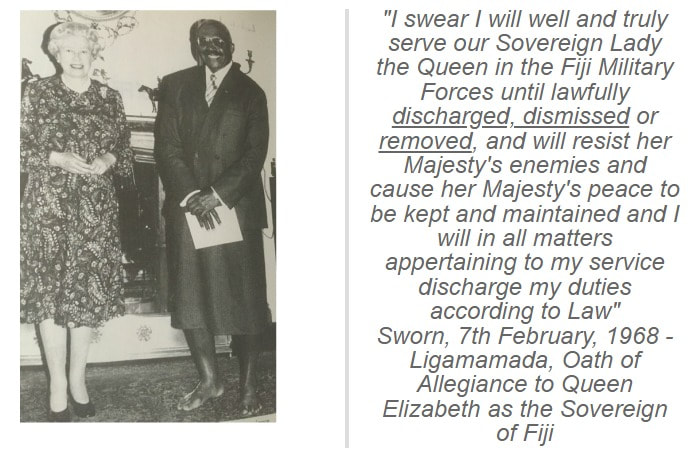
On 7 February 1968, Rabuka had taken an oath of allegiance to loyally serve Her Majesty when he joined the 'Royal Fiji Military Forces' "No, there was no discussion in Parliament on whether Fiji should become a REPUBLIC, but the legal advisors at the time
said, “The only way to go now is to go all the way to being a Republic,
because you have sacked Her Majesty the Queen. If she comes back, then you are all liable for treason against Her Majesty. So, the only way to put an end to that is to just say, “This is no longer Her Majesty’s Government. It’s no longer Her Majesty’s territory of Fiji. It is now a republic.”
Fijileaks: It is bloody time PAP MPs and Rabuka, with the tacit silent support of NFP leader Biman Prasad, STOP invoking the former late JAI RAM REDDY's comments on the role of the Great Council of Chiefs and the elevation of indigenous rights for a peaceful Fiji. Reddy had NO MANDATE to prostrate before the CHIEFS and sell out Indo-Fijian RIGHTS. How many generations does it require for one to become NATIVE? Which descendants, that of Ma'afu or Lutunasobasoba, are real NATIVES? How can Rotumans born in Rotuma be NATIVES on the Fiji mainland, and Indo-Fijians and Other non-iTaukei born on Fiji mainland can't be natives? As we argued in 2000, Rotumans are NOT indigenous to Fiji (if we argue that Indo-Fijians and Other non-iTaukei are not indigenous), so cut the crap out that i-Taukei and Rotumans are indigenous to Fiji, and must be accorded First Nation status
In a sign of a less than diligent commitment to the work ethic, the Speaker adjourns the session for "morning tea" less than 45 minutes after it began and before the Opposition leader, Frank Bainimarama, gets to his feet. O vinaka. Enjoy the purini.
And then after the break, the Pot gets up to call the Kettle black. Bainimarama accuses the Coalition of engendering a climate of fear, to the biggest kaila in parliamentary history.
And incredibly, the Opposition Leader accuses the Head of State of failing in his duty to the Constitution and failing in his role as RFMF Commander in Chief - confirming a monumental falling out between Bainimarama and Khaiyum and Ratu Wiliame Katonivere.
It is an attack on the Head of State unprecedented in Fijian political history. And Bainimarama compounds the seriousness of his breach of parliamentary etiquette to make none-too-subtle references to the rank and file of the RFMF having been betrayed by the new government.
Is it incitement for yet another armed intervention in Fiji?
It sure sounds like it. Shameless. Grubsheet
Fijileaks: The Coalition government is treading on political egg-shell and today's outrageous flouting of the secular provision in the 2013 Constitution by the failed PAP candidate Naiqama (652votes) will be one of many reasons if the RFMF is called upon by the already aggrieved and frightened non-iTaukei population for protection from this new government under Section 131 of the Constitution of Fiji.
*During the election campaign, we had branded NFP leader BIMAN PRASAD, Rabuka's Jinnah who, in his greed for power, will sell the non-iTaukei population to PAP and SODELPA.
For the first time in NFP's history, the party is actually part of a government, hence Prasad, instead of flexing his political muscle to tame PAP-SODELPA excesses, will remain SILENT AS A LAMB.
But his silence will take the Coalition to the RFMF 'Slaughter House' under Section 131 (2) of the 2013 Constitution of Fiji.
As for Naiqama, we are not surprised. He was jailed for seizing the military barracks at Labasa during the 2000 Speight failed coup, and was trounced at the 2022 general election but Rabuka brought him as SPEAKER precisely to promote and push the 1987 i-Taukei agenda
DESPITE being PAP candidate, Rabuka's paramount chief, and the Tui Cakau, Naiqama only managed to obtain 652 votes. His own Northern division traditional subjects gave him only 317 votes. He has NO MANDATE to recite the parliamentary prayer, 'In Jesus Name'.
[email protected]
Archives
November 2026
October 2026
September 2026
August 2026
July 2026
June 2026
May 2026
April 2026
March 2026
February 2026
January 2026
December 2025
November 2025
October 2025
September 2025
August 2025
July 2025
June 2025
May 2025
April 2025
March 2025
February 2025
January 2025
December 2024
November 2024
October 2024
September 2024
August 2024
July 2024
June 2024
May 2024
April 2024
March 2024
February 2024
January 2024
December 2023
November 2023
October 2023
September 2023
August 2023
July 2023
June 2023
May 2023
April 2023
March 2023
February 2023
January 2023
December 2022
November 2022
October 2022
September 2022
August 2022
July 2022
June 2022
May 2022
April 2022
March 2022
February 2022
January 2022
December 2021
November 2021
October 2021
September 2021
August 2021
July 2021
June 2021
May 2021
April 2021
March 2021
February 2021
January 2021
December 2020
November 2020
October 2020
September 2020
August 2020
July 2020
June 2020
December 2018
November 2018
October 2018
January 2018
December 2017
November 2017
October 2017
September 2017
August 2017
July 2017
June 2017
May 2017
April 2017
March 2017
February 2017
January 2017
December 2016
November 2016
October 2016
September 2016
August 2016
July 2016
June 2016
May 2016
April 2016
March 2016
February 2016
January 2016
December 2015
November 2015
October 2015
September 2015
August 2015
July 2015
June 2015
May 2015
April 2015
March 2015
February 2015
January 2015
December 2014
November 2014
October 2014
September 2014
August 2014
July 2014
June 2014
May 2014
April 2014
March 2014
February 2014
January 2014
December 2013
November 2013
October 2013
September 2013
August 2013
July 2013
June 2013
May 2013
April 2013
March 2013
February 2013
January 2013
December 2012
October 2012
September 2012