Fijileaks
  • Home
  • Archive Home
  • In-depth Analysis
    • BOI Report into George Speight and others beatings
  • Documents
  • Opinion
  • CRC Submissions
  • Features
  • Archive

CRYING OVER SPILLED MILK: Seventh Day Adventist pastors complain to Fijileaks, say Fiji First stole their 'wheet bix-milk" idea; SDA schools provide breakfast to students in rural areas - Wheet Bix their company!  

25/3/2015

7 Comments


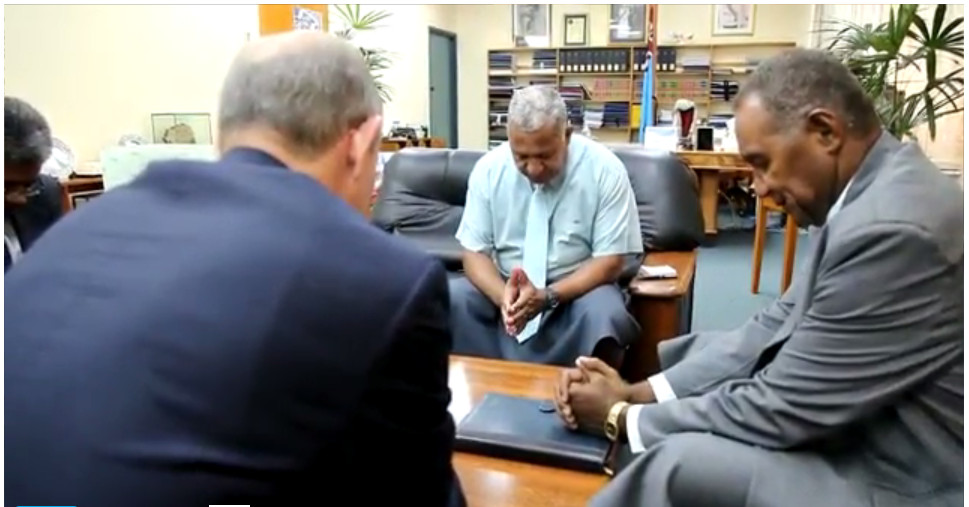
2011: Leader of the world-wide Seventh Day Adventist Church Dr Ted Wilson praying with Frank Bainimarama in PM's Office in Suva:
'You must walk humbly with God'
Picture
The leader of the world wide Seventh-Day Adventist church called on Bainimarama in February 2011, urging him to rule justly. Dr Ted Wilson visited Bainimarama at his offices in Suva. Bainimarama was pleased to have the scriptures read and explained to him. Pastor Wilson recommended the counsel found in Micah 6:8 and urged him to rule justly, love mercy, and to walk humbly with his God. "The primary concern of government is to serve and look after the people," Bainimarama said. "The counsel from God's Bible is wise and I have listened to it." And both leaders prayed together. The world president also thanked Bainimarama for providing religious liberty throughout Fiji. "It is a basic human right to allow all people the freedom to worship ," Pastor Wilson said. He gave Bainimarama a personalised copy of the book "The Desire of Ages" by Ellen White. "Please do not put this book on a shelf somewhere," he asked. "Please add it to your personal library." Bainimarama encouraged Seventh-day Adventists to continue their educational and spiritual work with the people of Fiji. Pastor Wilson was accompanied by Pastor Waisea Vuniwa, the president of the Trans Pacific Union Mission and David Gibbons, Communication Director for the South Pacific Division

The God Dividend: The Sanitarium Health & Wellbeing Company is the trading name of two sister food companies (Australian Health and Nutrition Association Ltd and New Zealand Health Association Ltd). Both are wholly owned by the Seventh-Day Adventist Church. The two Sanitarium companies don't pay company tax on their profits, due to their ownership by a religious organisation. Sanitarium have defended their tax exemption, stating they operate exclusively for charitable purposes, and that income tax exemptions are available to all companies and individuals who limit themselves to charitable purposes. However the exemption has been criticised and is considered unfair by their competitors. Its flagship product is Weet-Bix, now given by Bainimarama's government to all Year 1 students in Fiji, while other students have to just look on in envy and anger - 'Milk and Wheet Bix Apartheid'

“I’m especially delighted to announce that as well as a free glass of milk a day, each Class One child will also be given a serve of Weetbix a day, thanks to the CJ Patel Group and Fiji Dairy Limited.” - Bainimarama; CJ Patel is the agent for Sanitarium foods. PMeghji lost the distributorship due to their liquor business some years ago. Weetbix is promotional stuff thrown in by CJ and Sanitarium Foods. Did CJ pay zero in tax and duty?
One promotional Weetbix in a plastic packet for each 20,000 students daily in Fiji. Any tax concession and duty on milk?
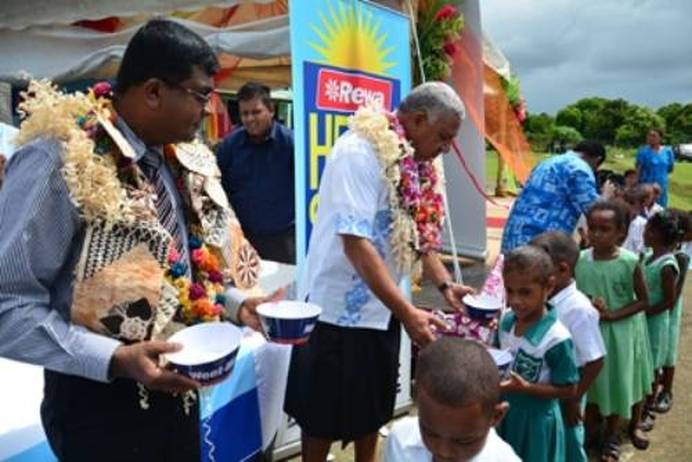
Picture
The Fijian Government today announced that all Year 1 students in the country will get 1 serving of weet-bix with 250ml of milk on every school day.

Prime Minister Voreqe Bainimarama made the announcement while launching the Free Milk Initiative at Nakelo District School in Tailevu this morning.


“I’m especially delighted to announce that as well as a free glass of milk a day, each Class One child will also be given a serve of Weetbix a day, thanks to the CJ Patel Group and Fiji Dairy Limited.”

“They are also very generously providing you with your very own bowl and spoon. I wish to thank the CJ Patel Group of Companies and Fiji Dairy Limited who have partnered with my Government for all the hard work it has put in to deliver this massive logistic undertaking and have gone the extra mile to ensure that all class one students receive a healthy meal every morning.”

Speaking to the students of the Nakelo District School, Visama Sanatan, Nuku District School, Ratu Veikoso Primary School, Kaba District School, Nasemila Primary School and Daku Primary School, Bainimarama said more than 20,000 children will benefit from the Free Milk Program across Fiji.

“We are building healthy bodies in this first year of your school lives to help build healthy minds. To enable you to benefit fully from the education revolution, we are pursuing to make you smarter and turn Fiji into a clever country.”

“My Government promised through the FijiFirst manifesto that we would provide this milk from the start of the school year. It has taken a bit longer than we thought but we have been determined to get the program exactly right for the sake of every year one child – no matter where they live - and here it is.”

“Not every Fijian child is privileged at home to enjoy the benefit of a glass of milk a day. But for our Year One students, those days are over. In this critical first year of school, we are giving them a nutritional boost to strengthen their bodies and it doesn’t matter who they are or where they come from. Every YearOne student benefits.”

“As with our free education program for all students in primary and secondary schools, no longer is a child’s family circumstances the determining factor in whether he or she receives adequate nutrition in the first year of primary school or gets the best possible start in life.”

“Whether your parents are well off or struggling, you are all getting the best possible chance to have both a healthy life and a good education,” said the Prime Minister.

 “And from where I stand as Prime Minister, nothing that my Government has ever done is more noble because by building healthy bodies and healthy minds, we are building a healthier and smarter nation for the benefit of every Fijian now and in the years to come.” Source: Fijilive, 23 March 2015
Picture
7 Comments

We "CAN" see the wood from the trees: Fiji and China signing MOU for Forest Co-operation might signal the struggling local forestry sector investors death-knell?; just look at the fate of other MOUs' with CHINA!

25/3/2015

2 Comments

 
PictureLURKING IN THE BUSHES: Are local forestors doomed?
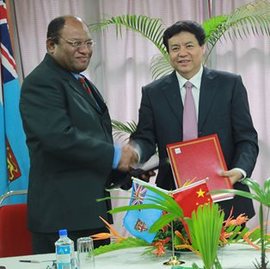
FIJI AND CHINA SIGN MOU ON FORESTRY COOPERATION 3/23/2015

The Fijian government today signed a Memorandum of Understanding (MoU) with the government of the People’s Republic of China on forestry cooperation.

The MOU will enable both countries to share experiences on forestry developments, training, research, climate change and the exportation of forest products to China.

Fiji’s Minister for Fisheries and Forests Hon. Osea Naiqamu said the MoU will help them work towards improving their resource base and building a more resilient forest sector.

“We see this MOU as a means for building closer ties and more collaboration and we are confident that it will open new doors and create new opportunities within the forest sector of the two countries,” Hon Naiqamu said.

“It is also our hope that this MoU will add more value to our current collaboration and will pave the way forward for a much stronger economic cooperation and capacity building,” he said.

Chinese Minister of State Forestry Administration Zhao Shucong in signing the MoU said this was a starting point for both countries to be able to improve their resources and to share their experiences of the Fiji forestry developments.

Mr Zhao said the MoU will also strengthen and promote forestry cooperation to a higher level and build up more cooperation between the two countries.

He has also invited the Minister for Forests to visit China in order to be able to share more experiences and knowledge.
Source: Fiji Ministry of Information

Picture
Picture
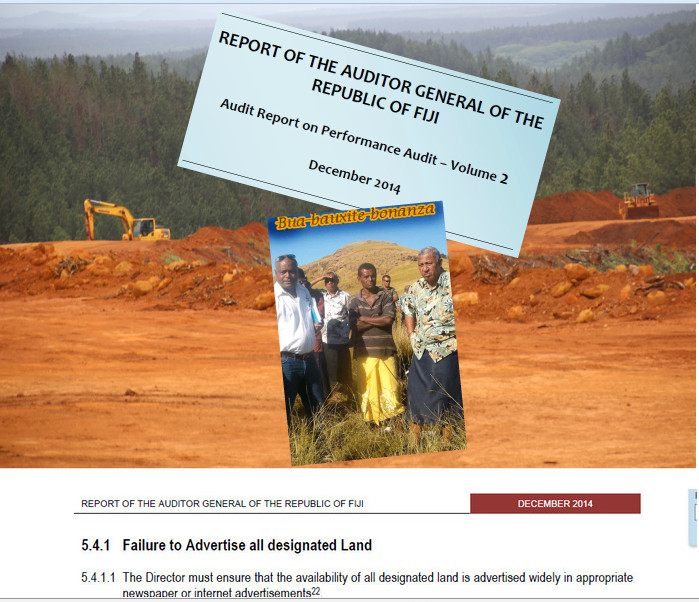
http://www.fijileaks.com/home/digging-beneath-the-surface-audit-report-found-aurum-bauxite-mining-didnt-give-fair-share-of-payment-to-landowners-over-extracted-bauxite-in-breach-of-lease-bainimarama-had-gifted-lease-to-aurum
2 Comments

FREE MILK IS HEALTH RISK WITH TEMPERATURE CHANGE - REWA life milk doesn't have the six month shelf life; not all schools have coolers!

24/3/2015

13 Comments

 
PictureBainimarama and Mahendra Reddy distribute free milk and Weetbix at Nakelo District School in Tailevu
Concerns are still being raised regarding the free milk program that was launched by government earlier this week.

Speaking to FBC News, Fiji Teachers Union General Secretary Agni Deo Singh says they’re still concerned with the distribution and storage of milk in schools.

“The rural and maritime schools where there might not be facilities for storage in terms of temperatures it requires to be kept at, our country is a very warm country. We’ll have to be careful about preserving it.”

Fijian Teachers Association President Gauna Halofaki says their main concern is the preservation of milk and its supply to schools in outer districts.

“It’s a geographical set up of Fiji we have so many rural schools and Fiji is scattered so much it’s the sending of the milk and the preservation and those are the things we need to think of.”

Fiji Muslim League President Hafizud Dean Khan says they have not received any response yet from their primary schools in regard to storing their milk supply.

In a statement, a faith- based organization, the Arya Pratinidhi Sabha of Fiji, says the program is a first in Fiji’s post independence history.

Sabha President Kamlesh Arya said they are conscious that many primary schools, have attached kindergartens where younger students need similar attention.

The initiative, laudable as it is, is somewhat discriminatory in a sense the youngest stand by watching and waiting but are not included in the program.

Meanwhile, the Education Ministry’s Director for Primary Education Kolinio Takali says they have visited all education districts last month to brief them on how to store and document the milk supply.

“In some schools in some areas where truck or carriers cannot reach the school we have drop off points then they’re grouped in clusters, then one is tasked to arrange for transport from the drop off points off that cluster to each schools.”

Prime Minister Voreqe Bainimarama had said the 250 ml packets have a shelf life of six months.

Free milk for the youngsters will benefit the growth and nutrition of students. Source: FBC News


13 Comments

John Samy to Bainimarama: GCC changes could have been handled in ways more consultative and inclusive; the deportation of newspaper publishers raise questions on the rule of law and legal courts in Fiji!

24/3/2015

9 Comments


Fijileaks to Readers: We will respond soon to MIDA HOUND DOG who expects Fijileaks to become another pro-regime rag sheet:

Picture
Picture
Picture
Picture

"I walked away from ANU for all sorts of reasons: personal...Also, the intellectual trajectory of my work has shifted dramatically. I don't think that my then supervisor Prof. Brij Lal was best suited and theoretically trained to supervise. Incidentally, ANU is very anti theory and I was trained in the US by Gayatri Spivak the leading philosopher in Marxism, deconstruction and post-colonialism. I think Brij's work is mired in romanticism.' Ashwin Raj, 27 March 2014, responding to comments from Fijileaks readers who wanted to know why he did not complete his PhD at Australian National University; Fijileaks gave him the right of reply before approving any of the comments. He cheerfully responded, saying Brij Lal was the 'wrong academic supervisor  for his thesis"

Picture

John Samy to Bainimarama: The Letter outlining contentious issues!

Picture
Picture

"In regard to the current Minister for Finance (Mahendra Chaudhry) following the disclosures about his private financial arrangements. Subsequent to this, you indicated that you asked the Minister concerned to refrain from making any public statements on issues not directly related to his portfolio. Your directive has clearly been disregarded. Recently, the fact that the Minister spoke on Peoples Charter and referendum, etc while visiting India has not helped. It gave further fodder to the ethno-nationalists in Fiji who are vigorously opposed to the Peoples Charter." John Samy


Picture
Dear Prime Minister,

I feel compelled to write to you, to inform you that in view of a number of recent developments,  I feel greatly compromised in continuing to serve as Head of TASS. Several key, senior members of my TASS team feel likewise.


Please recall our discussions of March, 2007 when I first met you. Among the range of issues  that we had then discussed, including in the meeting that you had kindly arranged for me with the Military Council, please recall that I had raised the issue of leadership. In particular, I had put to you, and also the Military Council, what legacy you all wished to leave behind you as leaders: is it one of a repressive regime that trampled upon the basic human rights of the people or is it to regain and redeem the image and reputation of both the RFMF and also Fiji. We had discussed the great importance of all this in order for Fiji to regain its rightful place, in and to re-integrate into, the international family of nations.

From those discussions in March 07, and since then, as I have got to know you more personally, I have been convinced about your personal motivations, ie that you truly and sincerely seek to rebuild Fiji towards the soundly governed and prospering democracy that it should always have been. I also had believed that the Interim Government, under your leadership, was completely committed to those same objectives and have expected it to demonstrate this, consistently, through its actions. Now, in the light of a number of recent experiences, it has become extremely difficult for me to remain so convinced of the Interim Government’s intentions, particularly in regard to the way forward.

As you know, on the Peoples Charter, despite the enormous pressures, the distractions and the efforts to derail it, we have been making good progress. This is because in both NCBBF and TASS, we have people who are highly dedicated, hardworking and patriotic. Moreover, the ordinary people of Fiji look up to the Peoples Charter with hope, at a time when hopelessness, deprivation and hardship is on the rise.

The mainstream media has sided with those who remain steadfast in their opposition to you and the Interim Government. They have been vigorous in their efforts to discredit NCBBF and to derail the Peoples Charter process. As nasty as the vilification of much of the media and the more disgruntled leaders of Fiji’s society has been, it has not dissuaded us in any way from our conviction to move ahead with the crucial work on the Peoples Charter. Nothing about the pressures and the opposition that we have faced, including the vilifications that I have personally endured, have in any way influenced what I now say to you in this letter.

In Fiji today, the opponents of progress in this society are those who fear the loss of power, privilege and opportunities for corruption. It is apparent that they would stop at nothing to undermine the Interim Government and the work on the People’s Charter. It is sad that they seem better organized and more effective than the government. Moreover, the Interim Government does not help its own cause when it acts in ways that tantamount to shooting its own feet.

The vision of a better Fiji through the Peoples Charter is, among other things, about good political governance, ie adhering to the highest standards of accountability, transparency and the rule of law. However, when it comes to promoting good governance we are very much dependent on the Interim Government to lead by example, to demonstrate consistently, through its actions, that change is not only intended through the Peoples Charter at a later date, but that it is being made now. Unfortunately, the Interim Government has tended to fail on this vital test. Some IG decisions do not appear to be or have not been in accord with basic principles of good governance. Coordination within the IG is weak and often leaves the government under-prepared. Too much of the way the Government goes about its work shows little anticipation of the possible opposition or consequences that lie ahead. There is little sense of building coalitions for support or of networking in any effective way. Despite the many good actions that the Government tries to take, it seems unable to communicate effectively about its intentions. The overall public relations track record of the IG is dismal.  

What has been of real and growing concern, in recent months, is that some of the more high profile activities of the Interim Government have been conducted in such a recklessly indifferent way as to undermine effective governance. These have seriously impacted on our work on the Peoples Charter, constraining our ability to make a credible case to the people of Fiji as to the urgent need to instill good governance across all institutions in Fiji, public and private.

There have been a number of incidents which have enabled the Interim Government’s many detractors to portray it as the very antithesis of good governance. I would like to recall a few, as examples.

Please recall my submissions to you in regard to the current Minister for Finance (Mahendra Chaudhry) following the disclosures about his private financial arrangements. Subsequent to this, you indicated that you asked  the Minister concerned to refrain from making any public statements on issues not directly related to his portfolio. Your directive has clearly been disregarded. Recently, the fact that the Minister spoke on Peoples Charter and referendum, etc while visiting India has not helped. It gave further fodder to the ethno-nationalists in Fiji who are vigorously opposed to the Peoples Charter.

A further example is the decisions taken by the Interim Government in regard to the Great Council of Chiefs. The case for change, as I know through you, are well based but this could have been handled in ways that were more inclusive and consultative.

PictureHannah (top) and Hunter (below)
A third example is the Interim Government’s peremptory decision to deport Mr. Russell Hunter. The manner in which the deportation action was handled, supposedly on “national security” grounds, dramatically worsened the relationship between the media and the government. It also  scuttled opportunities that the NCBBF was at that particular time pursuing to build engagement with the Australian Government, especially as a delegation led by Co-Chair Mataca was in Canberra just days after Mr.Hunter was deported.

The decision late last week to deport Mr. Evan Hannah, again supposedly on “national security” grounds, has brought to a head my concerns about what is the real attitude of the Interim Government to good governance. There appear to be very few people in Fiji who see this as other than a vindictive act aimed at muzzling the media. To follow that up by the government making a statement to the public a day later, and that too on World Media Freedom Day, that it promotes a free media and free speech was both puzzling and did not help enhance the credibility of the Interim Government. In addition, and probably even more seriously, Mr Hannah’s deportation now appears to have also called into question the attitude of the Interim Government to the rule of law and to the legal courts of Fiji. 

In summary, the perception of the Interim Government that is emerging is that it is not caring, that it is high-handed and reckless, and that it is unable to get things ( that  matter ) done. The Fiji Civil Service of which you are the head, is currently neither “civil” nor is it service –oriented, especially as it is evident that a large part of the Public Service is not aligned to the goals and direction of the Interim Government. In fact there is reason to believe that it is working against the interests of the IG. In addition, the use of strong arm tactics, such as in the deportations of Hunter and Hannah,  has profoundly negative consequences and raise fears that the Military may be seeking to entrench itself in the political governance of Fiji.

Moreover, such actions appear to be being taken in total disregard to their many obvious consequences and without consideration of whether there were other, better options.  For example, if the motivation behind the recent deportations is to convince the media to behave more responsibly, then I am afraid that precisely the opposite would in fact be achieved. It has also undercut the ability of the NCBBF to respond to one of its terms of reference, by coming up with acceptable ways to improve the working relationship between the media and the government in the interests of promoting good governance

The Hannah deportation incidence has dramatically sabotaged the environment that we are working on. It now can be expected to have a whole range of consequences, such as an even more rabid opposition to the People’s Charter; the probable refusal of political parties to engage in the forum on electoral reform; an inability to progress the much-needed efforts on political dialogue; and a likely failure to find ways that enable international development partners to engage with Fiji in the foreseeable future. This is regrettable as on all of these fronts, I believe the NCBBF was making good progress.

These opportunities have probably now been seriously impaired if not lost. Unless the Interim Government is able to quickly access new sources of political advice that convincingly help it to practice good governance, while steering a more measured and sure footed course towards an election, the prospects for the NCBBF’s work on the Peoples Charter being successfully brought to a conclusion are now extremely bleak.

It is for these reasons, with the bulk of my concerns being on issues of principle related to good governance, that I have felt I should communicate in this candid way to you. I suggest that we meet to discuss all this, and in particular, where do you wish to go from here and on whether there remains a role for me and my senior colleagues in TASS, in going forward.

Yours sincerely

John Samy
4 May 200
8

9 Comments

Proposed Political Party Leaders Meeting was 'Face-Saving Exercise"; Fijileaks reveal more behind the scenes machinations between John Samy, Frank Bainimarama and Aiyaz Khaiyum in 2008 on Fiji's road map!

23/3/2015

12 Comments

 
Picture

"I have to-date believed and worked on the understanding and premise that you (and indeed also the RFMF) are genuinely committed to Option One (to exercise visionary, unifying but strong, decisive and statesmanlike leadership) as the path to follow to achieve the change agenda in the draft Peoples Charter. However, my deep sense of dismay and disquiet stemmed from the fact that after listening to the discussions in the meeting last Tuesday, I had the distinct impression that, individually and collectively, you all seemed to be tending towards Option Two above (your leadership adopts the modality of “my way forward is the only way”; and that in the face of continued resistance, you (and the IG and RFMF) resort to strong arm tactics and an increasingly dictatorial approach to governance.) If my reading of what transpired in the Tuesday meeting is correct, then for me, that is unacceptable; and for that reason, I cannot and will not continue to serve now as Head, TASS. I should leave at the end of my current term which comes to an end next Friday...Before I conclude this note, let me please briefly touch on the forthcoming meeting of Political Party leaders...It is important that Monday’s Meeting is conducted in a positive atmosphere and directed at some preliminary but solid outcomes which would give oxygen to the dialogue process." - John Samy, 2008

Picture
Prime Minister,

1. I thank you for the opportunity for us to meet yesterday so that I could discuss with you my concerns about the developments following the phone call that you made to me around lunch-time last Monday. The subject matter of that phone call was the proposed meeting of Political Party leaders, that you had earlier agreed to convene on Monday, 27 October, 08. Over the phone, you reminded me that you had been averse to the idea of such a meeting to be held at this time; that after I had convinced you to convene it, you did not have the opportunity to brief the Military Council ( MC ) on it, and that the latter was strongly opposed to it; that you felt being rushed by me into agreeing to this;  and that you had decided to cancel the proposed meeting. I urged you to reconsider the decision to cancel; I pointed out to you the damage that any such action would do to your credibility; and I requested that we meet later, the same day, upon your return from the West. Within the hour of that phone conversation, I sent you a short email, and then, late Monday, as I did not hear from you, I sent you a more detailed note. In both these communications (copies attached), I urged you not to cancel the proposed meeting of Political Party leaders.

2. On Tuesday, at short notice just before noon, I was asked to go to your office to brief the Military Council on this matter. This meeting was attended by you, the Attorney General (AG ) and the MC members. In this meeting, you reiterated your displeasure at being rushed into convening a meeting that you did not feel this was the right time to convene. You were enjoined on this view by the MC as well as the AG who indicated that the whole initiative was ill conceived, ill-advised and not timely. The consensus among you all seemed that if there was a way or reason to cancel the meeting, then you should but it was agreed, with much reluctance, to go ahead only as a face-saving exercise. The meeting then went on to discuss, with the recent High Court ruling that the Interim Government is legal as a backdrop, a number of related issues : on democracy and the need for elections; the need for political parties; on whether Fiji now needs international community support . The point was repeatedly stressed that the IG is now in a very strong position; and that in going forward ( “Taking Fiji Forward” ) it should be “ more independent” and stick to the vision (of the Peoples Charter ) .

3. I left that meeting feeling that I had lost your trust and confidence but more importantly, with a deep sense of dismay and disquiet. In our meeting yesterday, for which opportunity I am thankful, I tried to explain to you my concerns; and we agreed that I should, in reflecting further upon the various issues, to put all this to you in writing. I submit this to you in strict confidence, and request that you likewise share this with the members of the MC and the AG, before you respond to me.

4. First and foremost, please allow me to outline, in summary and albeit rather briefly, the objective basis of my coming forward to work with and to support you in the wake of 5 December, 06. In the reasons that you gave for removing the Qarase Government, and the “clean-up campaign” that you said you were resolved to effect, the following were some of the key elements of your change agenda :

·        Sustainable democratic governance including transparent, accountable and just governance,

·        Removing racism including race-based policies, structures, and institutions, and

·        Achieving national unity.

5. While I personally do not support the military overthrow of elected governments, and had so indicated to you the very first time that we met in March 07, I fully supported the change agenda that you outlined. It  was for this reason that I was prepared, of my own free will, to put my personal reputation on the line, to come and work with you and to actively support you, to help achieve such a progressive and unifying vision for Fiji and its people. I believe that so far, I have served with selfless dedication, with much personal sacrifice, and despite the persecution and vicious assaults on my character and motivation.

6. The Fiji that you inherited, as Interim PM, was on a precipitous path of decline. As a nation the country was deeply fractured and divided. Trust among its communities and confidence was at an all time low. The draft Peoples Charter has further developed and articulated your change agenda and vision for Fiji. This provides the more comprehensive framework for taking Fiji forward. Your resolve, to remain focused and committed, to taking Fiji forward through the Peoples Charter, is very clear and without doubt. The most critical question now is HOW ??

7. On this question of how, I submit to you that you, as PM and also head of RFMF, have essentially two options :
·        One, to exercise visionary, unifying but strong, decisive and statesmanlike leadership. You must lead the way in bringing the communities together, in building trust and in restoring confidence and hope, for a better future. The changes that you seek are not “quick-fixes” and they cannot be rail-roaded if they are to be durable and effective. Under this option, you do things within the law and constitutionally, through dialogue and by building a broad-based consensus for and ownership of the change agenda. OR

·        Two, your leadership adopts the modality of “my way forward is the only way”; and that in the face of continued resistance, you ( and the IG and RFMF ) resort to strong arm tactics and an increasingly dictatorial approach to governance. Under this scenario, the restoration of parliamentary, democratic governance gets shifted to a unspecified date into the future ie that elections are convened but only after the Peoples Charter is implemented.

8. I have to-date believed and worked on the understanding and premise that you (and indeed also the RFMF ) are genuinely committed to Option One as the path to follow to achieve the change agenda in the draft Peoples Charter.

However, my deep sense of dismay and disquiet stemmed from the fact that after listening to the discussions in the meeting last Tuesday, I had the distinct impression that, individually and collectively, you all seemed to be tending towards Option Two above. If my reading of what transpired in the Tuesday meeting is correct, then for me , that is unacceptable; and for that reason, I cannot and will not continue to serve now as Head, TASS. I should leave at the end of my current term which comes to an end next Friday.

9. I need to know of your position on the above, and indeed that of the IG and the RFMF in regard to the above.

10. I do not wish to repeatedly go over my very strong conviction on the indispensable role of a genuine political dialogue process to achieve your vision for a better Fiji in a sustainable democracy.  I have always spoken of the advantages of carrying the people along with you on your solutions rather than imposing your solutions on them.  In talking about the people of Fiji, you have already been reaching out to the grass roots people in an unprecedented way but you also need to work with the existing political institutions in Fiji, just as you have to work with other stakeholders and within the law.  After the High Court decision, it is even more important for you to reach out early, and remain consistent, not only as a visionary and statesmanlike but also strong and decisive leader.

11. Before I conclude this note, let me please briefly touch on the forthcoming meeting of Political Party leaders.

12. It is important that Monday’s Meeting is conducted in a positive atmosphere and directed at some preliminary but solid outcomes which would give oxygen to the dialogue process.  You should be aware that the outcomes from this meeting would be analyzed and scrutinized very carefully by the media, the international community, the business community and stakeholders. In this respect, it is important for you to agree on some core principles.  It is suggested that these include:

Ø A strong commitment on the part of all to genuine dialogue and consultation,

Ø Commitment to electoral reform and restoring parliamentary democracy,

Ø Inclusiveness,

Ø Respect for differences,

Ø Open-mindedness,

Ø Looking for the positives rather than negatives in the participants,

Ø Using persuasion rather than dictatorial edicts,

Ø Humility rather than arrogance,

Ø Resolve to remain steadfast on the legal and constitutional path.

13. This forthcoming Monday meeting is yet another opportunity for you to show leadership that is visionary, outreaching and of statesman’s proportions. You will need consistency of message and language. You will need to be strong but this strength can only be derived from the people and not only through military strength.

 14. I would think that you would feel greatly heartened by the euphoria created over the past few days by your announcement to call the all parties’ dialogue and without pre-conditions.  I gather people across the country are  talking about the dialogue with much hope and joy. It appears that the whole of Fiji is with you as you start the process, sharing their goodwill and giving their blessing and best wishes.

15. You would have also noted the positive statements from the Pacific Islands Forum and Australia. They have welcomed the process and even offered assistance. You would have noted that Australia, for the first time, did not mention March 2009 but changed their language to an “early elections”.

16. In conclusion, and in regard to the issue of whether or not I continue in my current role, I greatly appreciate that in our meeting yesterday, you were re-assuring, especially that you would like me to see the draft  Peoples Charter work finalized, that it gets submitted to the NCBBF and then to the President by mid-December 08. I am prepared to continue and do this, plus more as you may need me to, if I can have your firm assurance that the path for moving Fiji forward would steadfastly follow Option One rather than Option Two, as outlined in para 7  above.

17. I am greatly appreciative and thankful that you have always afforded me the opportunity to be forthright in the way in which I engage and serve you.  It is within this spirit that I submit this to you.

(John Samy)
23 October, 08


Picture
12 Comments

BAINIMARAMA'S WILLING BRIGADE POST 2006 COUP: Interim Finance Minister Chaudhry talked John Samy into formulating Peoples Charter

22/3/2015

17 Comments


"At 5 pm that same day, I met PM Bainimarama ( I/PM ) in his Office; with MPC [Mahendra Pal Chaudhry] being the only other person in attendance. This meeting lasted over 3 hours." - John Samy

Picture
The Fiji Peoples Charter Initiatives

Some Personal Notes

John Samy

  • In early February, [200]7, Francis [Narayan] and I went to Fiji on a private, personal visit. We spent some time in the West before going to Suva.
  • While in Suva, following an early morning jog at Suva Point, I decided to drop by (at about 7am ) to see Mahendra P. Chaudhry ( MPC ), then Minister of Finance in the Interim Govt. ( and who was deposed as Prime Minister by the Speight coup in 2000). I had not seen or talked to MPC for about 12 years. MPC  was out in the yard in his garden, cleaning up. We agreed to meet the next morning.
  • The next morning, over breakfast at his residence, MPC and I had a discussion over almost three hours. This was a very frank and wide-ranging discussion; and during this, MPC requested me to extend my stay in Fiji to help the IG formulate its Road Map for the Return to Parliamentary Democracy. I said I could not stay on in Fiji but promised to send in my comments/suggestions/inputs for the IG’s Road Map;
  • Upon return to Auckland, I worked overnight to put on paper my thoughts/suggestions;. and, on the next day, sent this via email to MPC. These were titled : “ Way Forward Road Map”, WFRM.
  • When the IG announced its “ Road Map”on 20 February, 2007, there was nothing in there that I could recognize relative to my WFRM submission.
  • I then re-sent my WFRM  notes by email to Minister Chaudhry, indicating to him that perhaps he had not received those the first time. A week later, MPC called and over the telephone, shared with me PM Bainimarama’s response to my suggestions/ recommendations in regard to the way forward.
  • When Chaudhry called me, he said PM Bainimarama wanted to move forward on the new “ Road Map” proposal I had put up ( Note : at this point, there was no reference to a Peoples Charter initiative ). Moreover, Chaudhry said PM Bainimarama wanted to engage me and pay me for my services; to take this whole thing forward.( see copy of communication with MPC and Bainimarama’s letter, attached ).
  • I told Chaudhry that I needed to meet PM Bainimarama first; and that for that purpose, I would pay my own way to Suva; that the issue of hiring and paying me was premature.
  • I went to Fiji, at my expense, for a period of 8 days in early March, 07. On arrival in Suva, the first person I met was Ratu Joni Madraiwiwi ( who was Vice President of Fiji and who was removed in the wake of the December, 06 coup). I gave him a copy of the WFRM, and mentioned to him the possibility of the IG moving forward on this. I requested him to consider the possibility of serving as Co-Chair of a National Council should one be constituted. 
  • At 5 pm that same day, I met PM Bainimarama ( I/PM) in his Office; with MPC being the only other person in attendance. This meeting lasted over 3 hours. After the introductory courtesies, I started by indicating to the I/PM that I did not support the military overthrow of elected governments; that I fully backed the stance taken by me ( ie the NZ ) Government; that in the wake of successive coups since May, 1987, Fiji had been on a path of precipitous decline and stagnation; that the reforms ( ie the “Clean-up Campaign”) that Bainimarama advocated was much needed but that he had no mandate; that he had to and must go to the people of Fiji, and that this be done through an inclusive, consultative and participatory process, ie one that was not fettered with or manipulated by the Military and the IG, to enable the people to become better aware of the overall situation of Fiji, and for them to chart the way forward to resolve Fiji’s deep- rooted problems.

    I put to him the idea of Ratu Joni Madraiwiwi serving as Co-Chair should the I/PM decide to go forward with the basic ideas and proposals contained in the WFRM; and I also impressed on him that if he were to set up a National Council, then it would need to be inclusive and broadly representative and include all of his major opponents.
  • During that week in March, besides talking to Ratu Joni M. I also coordinated closely with a number of people outside of the Government. They included Profs. Rajesh Chandra and Vijay Naidu, Akuila Yabaki, Radike Qereqeretabua, Suli Siwatibau, Jone Dakuvula. I tried to outreach Wadan Narsey but he inflicted abuse and walked away ! In between all these meetings, which included several more one-on-one sessions with the I/PM, I did further work on the WFRM and developed that into a fuller draft proposal, titled : “ Developing A Better Fiji For All …Through ….  A Peoples Charter for Change and Progress”.
  • When this draft Proposal was ready, the  I/PM asked me to appear before the full the Cabinet, and, upon my suggestion, he agreed that I should also meet with the full Military Council. Both these meetings were held on the same day, at short notice. Also, before departing Suva to return to Auckland, upon my request and after getting the I/PM’s clearance to do so, I met with the NZ High Commissioner ( Michael Green); and gave him a full briefing on what I had been doing in Suva that week. I gave him an advance copy of the Draft Proposal to forward to the authorities in Wellington. Soon after I arrived back in Auckland, received communication from Ratu Joni Madraiwiwi declining any role or involvement on this Peoples Charter initiative.
  • I continued to do further work on the draft PC proposal, and went back to Fiji in April, 07 ( with me paying for my expenses). This draft Proposal was then circulated widely, in mid-April 07,  to leaders of various national organizations ( a total exceeding 150 ); and also to Heads of Governments (including Aus and NZ ) and International Organizations ( World Bank, ADB, UN, COMSEC,EU ).The I/PM personally signed each of these letters which invited recipients to provide comments and inputs to finalise the Proposal and also to get involved, support and contribute in formulating a Peoples Charter.
  • During the balance of 2007, I was in and out of Fiji numerous times, specifically for the purpose of providing assistance to move this initiative forward. For the year ( 2007) as a whole, I did just over ten months of work at no cost to the IG. I met my own expenses ( with supporting in-kind contributions from some friends and well-wishers from Auckland and in Fiji). I politely refused Bainimarama’s offer of remuneration
  • In September, 07 ( ie before the formal launching of the PC initiative scheduled for 10 October,07) I formally wrote to the I/PM, seeking his assurances on certain critical preconditions and key principles (see letter of 28 Sep07).
  • The above is an annotated outline of how the PCCPP process got underway; and the basis on which I was prepared to put my reputation on the line and to get fully and deeply involved.
  • The 45 –Member National Council for Building a Better Fiji ( NCBBF) was appointed by the President of Fiji in late 2007. The leaders of all major political parties and leaders of other representative national level organizations, including the deposed Prime Minister Laisenia Qarase, were invited to become members of the NCBBF. Archbishop Petero Mataca, the head of the Catholic Church and the I/PM were appointed by the President to serve as the two Co-Chairs; and in early January, 2008, I was appointed as Head of the Technical Secretariat of the NCBBF. The first meeting of the NCBBF was held in mid-January, 2008.
A core group of those opposed to Bainimarama and the IG, including Qarase, the Methodist Church leadership and several political parties refused to participate in the NCBBF and in the work on the Peoples Charter. In fact, they mounted a vigorous campaign, supported by the mainstream media, to undermine and discredit the whole process.

  • By mid-December, 08, the NCBBF concluded its work and submitted its Report to the President of Fiji, together with the Peoples Charter for Change, Peace and Progress ( PCCPP). Following extensive, nation-wide consultations and outreach, the NCBBF reported to the President that 64% of the adult population of Fiji had embraced and supported the PCCPP.
John Samy
Auckland


“In a recent lunch meeting, the architect of the Peoples, Charter, John Samy, told the Ambassador that that he undertook the process thinking it would be helpful to Fiji.  As political events have unfolded since the Charter’s launch in August, Samy has lost enthusiasm for the direction of the IG.  He expressed disappointment about the intimidation used to get people to endorse the Charter. Samy understands now that the aspirational goals of the Charter) some of which are necessary to take Fiji away from race-based politics) will not be met without returning to the 1997 Constitution and Parliament.  Ultimately, it might require a deal among all the parties and it is too soon to tell whether the PPDF can achieve this.  Samy said he was looking forward to his return to New Zealand...
“Some of Samy’s frustration at the direction the IG has taken undoubtedly stems from encounters with attorney general Aiyaz Sayed-Khaiyum, who remains close to Bainimarama and is strongly opposed to holding elections in the near term.  Fiji’s highest ranking civil servant, Parmesh Chand,  reached out to the Ambassador to express concern, both his own and on behalf of others within the IG seeking elections in 2009, about the AG’s influence with Bainimarama.  Chand’s view, that the AG has captured the ear of Bainimarama in a negative way, is widely held in Fiji.”  US Ambassador Steven McGaan to Washington, Wikileaks, 2008

Picture
Picture
SMILING coupists - at the launching of the Peoples Charter for Change in Fiji
Picture
From the Archives
August 2008, Fiji Sun
The Draft Peoples Charter: $2.4million document for dustbin


By VICTOR LAL


A member of the National Council for Building a Better Fiji had whetted my anticipation to Himalayan heights, making me stay up late into the English night, for he had sent me an advance copy of the draft People’s Charter for Change, Peace and Progress shortly before its official release to the much maligned media, and indirectly, to the Fiji Islanders.

The NCBBF member had, however, attached a grumbling note to the draft copy: “Sorry, this is all they could come up with, despite a budget of $2.4million.” Curiously, he neither defended nor apologised for his own involvement in the preparation of the 38-page post-coup document, which is most likely to end up in the dustbin of history, or as I have recommended, it be placed in a $2.4million “coup museum”.

Now, after a sombre reflection, the NCBBF member says that he is actually shameful of the document and its contents but is too scared to register any dissension. He claims that he had been taken for a ride – in fact, Fiji has been taken for a ride. But let us hope, and without God’s intervention, that the draft charter’s journey will be cut short, and for a variety of compelling reasons.

It is instructive to recall that a member of the NCBBF, Father David Arms, the principle architect of the recommendation for electoral reform, had urged the NCBBF members to take advantage of the military coup, and by extension the absence of parliamentary democracy, and accept his recommendation for the introduction of proportional voting system. Fathers Arms said there was a need to abolish the communal seats as it “is complicated, leads to unfair results and divides the people ethnically”.

He said, “As the military regime was more or less acting outside the Constitution, the NCBBF should take the opportunity to push through the electoral reforms and amend the Constitution, by taking advantage of the military authority and ignoring the legal constitutional requirements for making such changes”. His prayers have been heeded, for the draft charter wants changes to the electoral system.

The charter maintains that the electoral system is one of the ways to ensure sustainable democracy and good and just governance in Fiji. It wants to abolish the communal representation system provided for under the 1997 Constitution and the Electoral Act 1998, and replace this with the use of a common roll system for all future elections.

The NCBBF wants to establish, as it claims, a fair system of voting so that all the interests and wishes of the people of Fiji can be represented in the Parliament as expressed through free, fair and honest elections and for this, we should adopt an Open List Proportional Representation (PR) Electoral and Voting System.

The draft charter proposed to incorporate specific anti-discrimination measures into Fiji’s electoral laws, to ensure no person is discriminated against, by political parties on the grounds of race, religion, gender or circumstance.

It also wants to from remove the multi-party government clause, the mandatory power sharing arrangement as provided for under the Constitution. As well, it proposes lowering the voting age from 21 to 18 years of age, and wants to maintain compulsory registration but calls for the abolition compulsory voting.

The draft charter wants the electoral system removed from the Constitution and enacted as law so that it may be amended and reformed from time to time according to the will of the people. However, it suggests that the fundamental recommendations of non-ethnic voting, equal franchise and Proportional Representation be enshrined in the Constitution. It says Fiji’s electoral system is racially discriminatory and undemocratic.

It adds that the United Nations Convention on Discrimination and the Right to Universal and Equal Suffrage requires each individual vote to be equal in value. The current communal system of representation entrenches inequalities, by not providing one value for one vote, has contributed to the “coup culture”, and the consequent ethnic-based politics that has impeded our national development. The draft charter says it commits the country to a free and fair electoral process, that promotes one people, one nation and one identity.

There is nothing fundamentally wrong with the electoral system, except, maybe, the concept of mandatory power sharing in the Constitution. It is perverse to recommend changes to the electoral system on the basis that the 2006 general election was rigged, or because the party favoured by the military, the Fiji Labour Party, had not won the last general elections.

Yes, the above arguments are not in the draft charter, but one assumes that these arguments featured into the formulation of the final recommendations, based on the post-coup “official investigations” and FLP statements and pronouncements. What went really wrong, leading to the coup, was that the multi-party cabinet was not given time to work out some of the major differences between the different parties, and once the coup took place, the FLP did not stand up to defend human rights, the rule of law, and democracy. Instead, its leader took up a Cabinet position, and only recently claimed that the coup was necessary to “save the economy”.

Meanwhile, as I have consistently critiqued, most of the arguments in the draft charter do not hold up to scrutiny. I will be commenting upon various aspects of the charter later on, but suffice to plead with the nation, we should not be disheartened by the draft charter, for history is on our side, provided the Constitution, as the charter maintains, remains the supreme law of the land. After every coup in Fiji, men and women of good and bad intentions have come out to “Move Fiji Forward”, and the present lot in the NCBBF are no exception. In drafting the Peoples Charter, however, they had the mighty power of the guns behind them, and a cool $2.4millions of the taxpayers’ money.

We must, to use the Churchillian phrase, “Never Surrender” to those who had no mandate from the people to draft the charter. As I have consistently maintained, the military and its shadowy coup backers, had not gone to the people for permission to execute the coup, so they have no right to come to the people for the endorsement of the draft charter. This lot should stand for election and subject their charter to a national referendum.

And, the NCBBF must not, even feebly, dare to invoke the President’s name, to claim legitimacy. Digressing, it is time President Ratu Josefa Iloilo made a weekly appearance on the presidential lawn to address the nation or publicly endorse all future laws and decrees, which the interim regime claims he has endorsed at Government House. He is the people’s President and he must be seen and heard by the people! 

The NCBBF’s proposed draft charter is a re-incarnation of the late Professor Asesela Ravuvu’s Constitutional Review Commission, albeit for different reasons, and it should be meted out the same fate, but without the support of the FLP, which was in the forefront of driving a death knell to it. We may recall that Professor Ravuvu was the architect of the racist 1990 Constitution after the 1987 coups. In 1988, he and I had bitterly clashed across the table at the British Foreign and Commonwealth Office seminar on post-coup Fiji in London. Among the participants was Ratu Epeli Nailatikau, who had been deposed as army commander by Sitiveni Rabuka’s coup but had later accepted to go up to London as Fiji’s post-coup high commissioner.

Many of Professor Ravuvu’s views which he was trying to formulate at the London conference later found their way into his 1991 book, Fiji: The Façade of Democracy, and in 2000, he re-surfaced to chair the CRC after the Speight coup. A similar pattern is discernable in the deliberations and papers of the NCBBF members, who want to do “A Ravuvu” after the 2006 coup – to shove their vision of Fiji through the draft Peoples Charter.

In September 2000, the FLP had denounced the composition of the Ravuvu commission charged with “reviewing” the 1997 Constitution. But the judiciary, in the person of Justice Anthony Gates, put a stop to its forward march and imposition on the nation. He later delivered another judgment, which should be a salutary warning to the drafters and backers of the Peoples Charter.  

In Jokapeci Koroi & Ors v Commissioner of Inland Revenue & the Attorney-General, Lautoka High Court, Civil Action No 0179/2001L, Justice Gates declared: “Unruly persons are unlikely to seek validation for their usurpations from judges. Nor should the courts give their sanction when application is eventually made under the doctrine of effectiveness, for there is no such force behind it. In this regard, I respectfully differ from [Hans] Kelsen. Judges should expect and anticipate that the usurpers will see them removed. So be it. Judges do not represent the law. The doctrine of effectiveness has no moral underpinning, and judges do no honourable business therefore in according lawfulness to de facto administrations.”  

And as I have written elsewhere, the present rulers of Fiji and their shameless apologists are nothing but mere “tenants” of Fiji’s future; they have no right to use and abuse their powers in the name of the people. In the path of the usurpers stands the 1997 Constitution and the Judiciary, and I have no doubt that the judges will choose the Constitution and not the Peoples Charter.

In case, the “People” of Fiji have let down their guard, another New Zealander has appeared on the scene, chosen to take the draft charter to the people. His name is Pat Craddock. The NCBBF chief John Samy, who came down from New Zealand to head the NCBBF, claims that Mr Craddock is the perfect choice as he has previous experience in Fiji. Can Mr Samy tell us how much are the taxpayers paying this man, a former senior audio producer with the USP and later journalism lecturer?

 Interestingly, in 2000 Mr Craddock had taken a swipe at Professor Ravuvu’s appointment to head the CRC, pointing out the late professor’s views in the book The Façade of Democracy. He went on to note in the Pacific Media Watch (20 June 2000): “When and if the former Prime Minister (Mahendra Chaudhry) and the other 30 hostages emerge pale-faced but safe from the cells of Parliament, it will only be a short time before they talk loud and often to a waiting world media. I am not sure that guns and threats can silence these and other voices. It looks like being a long, dark and also a noisy night for Fiji.”

Well, when Mr Craddock and his team take the draft Peoples Charter to the people, they should not hesitate to shout back at them, and through them, to the interim regime: “We have had enough of repression and suppression. Tell the regime to take the charter and go to hell. We need election, democracy, rule of law, human right, and bread and butter for our families. And want to see a detailed breakdown of how our $2.4million was spent on preparing this charter.”

The draft Peoples Charter for Change, Peace and Progress belongs to the dustbin of history; for it is a regressive document, prepared by a team of individuals (locals and foreigners) who had no mandate from the People of Fiji. It is time for the Fiji Islanders to really make noises, and their noises must be heard around the world.

If not, Fiji will continue to be plunged into further darkness, by forces who seem to believe that might is right. And that the taxpayers’ money is there for their taking!


Picture
Picture
THEN MY DICTATOR FRIENDS CAME FOR ME! Akuila Yabaki : ANOTHER one from the Peoples Charter shown the door and dragged to court
17 Comments

BETRAYED AND BANISHED: Megalomaniac Aiyaz Khaiyum behind most betrayals and banishment of Indo-Fijians so he can hog centre-stage and hold Bainimarama by the 'balls' - just look at the treatment of John Samy

22/3/2015

9 Comments


The arsonist had every right, so he thought, to torch his former academic supervisor Professor Yash Ghai's Draft Constitution for Fiji and impose his own 2013 Constitution of Fiji, and yet Professor Brij Lal, according to the Rottweiler and his puppy Timoci Natuva, should not have, as one of the architects of the 1997 Constitution of Fiji, defended his 'Constitution' from the 2006 coup treasonists including Aiyaz Khaiyum; oddly, Khaiyum had no misgiving using Brij Lal and other critics of the 2006's research materials for his Masters Thesis at the University of Hong Kong:

Picture

"Khaiyum abuses his illegal AG office by warding off foreclosure and selling his properties in exchange for IG favors; the bank unwilling to foreclose for (the entirely reasonable) fear that its expatriate managers would be DEPORTED should they do so" -
US Ambassador Steven McGaan to Washington

PictureJOHN SAMY: Another Victim; US ambassador McGaan
Peoples Charter architect John Samy told US Ambassador McGann Frank Bainimarama must return to 1997 Constitution (co-authored by Professor Brij Lal) and Parliament if Charter goals are to be achieved in post-coup Fiji

BY VICTOR LAL 

In late December 2008 John Samy, credited as the architect of the Peoples Charter, had a lunch meeting with United States Ambassador Steven McGaan in Suva. The then dictator Frank Bainimarama had earlier asked McGann’s predecessor Larry Dinger in November 2007 if the United States government could provide him US$2.6million to help fund the Peoples Charter exercise, led by Samy.

It has emerged that during that lunch meeting with McGaan in 2008, Samy had expressed his grave reservations on the Charter, as McGann reported to Washington in a leaked Wikileaks cable dated 22 December 2008 under the heading John Samy and the NCBBF Process. First, McGaan explained the background to the Charter: “The National Council for Building a Better Fiji (NCBBF) completed nation-wide &consultations8 on the draft Peoples, Charter this month and presented their report to the president on December 15.  The NCBBF claimed to have consulted approximately 425,000 people, with more than 370,000 completing response forms, 92 percent of which reportedly fully endorsed the Charter.  As reported reftels B and C, the consultation process involved a wide range of coercion and is perceived as having very little legitimacy. Opponents continue to question why, if the public truly supports the Charter, the IG remains unwilling to hold a public referendum on the document as originally promised. Meanwhile, the role the Peoples, Charter will play in Fiji,s future and how its aspirational goals will become political realities remains a mystery.”

Intimidation used to get people to endorse Peoples Charter: Samy

McGaan then turned to the contents of the meeting, informing Washington: “In a recent lunch meeting, the architect of the Peoples, Charter, John Samy, told the Ambassador that that he undertook the process thinking it would be helpful to Fiji.  As political events have unfolded since the Charter’s launch in August, Samy has lost enthusiasm for the direction of the IG.  He expressed disappointment about the intimidation used to get people to endorse the Charter. Samy understands now that the aspirational goals of the Charter) some of which are necessary to take Fiji away from race-based politics) will not be met without returning to the 1997 Constitution and Parliament.  Ultimately, it might require a deal among all the parties and it is too soon to tell whether the PPDF can achieve this.  Samy said he was looking forward to his return to New Zealand.”


Khaiyum obstacle to holding election – Samy and Parmesh Chand

In the same cable, McGann, under the heading “Aiyaz Sayed-Khaiyum and the Politics of Delay” noted Samy’s disenchantment with the Peoples Charter: “Some of Samy’s frustration at the direction the IG has taken undoubtedly stems from encounters with attorney general Aiyaz Sayed-Khaiyum, who remains close to Bainimarama and is strongly opposed to holding elections in the near term.  Fiji’s highest ranking civil servant, Parmesh Chand,  reached out to the Ambassador to express concern, both his own and on behalf of others within the IG seeking elections in 2009, about the AG’s influence with Bainimarama.  Chand’s view, that the AG has captured the ear of Bainimarama in a negative way, is widely held in Fiji.”

Khaiyum defaulter on several property loans, says US Ambassador McGaan


Khaiyum abuses his illegal AG office by warding off foreclosure and selling his properties in exchange for IG favors
; 
the bank unwilling to foreclose for (the entirely reasonable) fear that its expatriate managers would be deported should they do so

McGaan also explained why Khaiyum was holding Fiji back from going to the polls: “While ideology undoubtedly plays a role, Sayed-Khaiyum’s personal ambition and political isolation likely fuel his opposition to near-term elections. The AG is not affiliated with any major political party, has limited contacts outside the IG, and would face an uncertain future should he lose his position.  He was in default on several property loans to one of Fiji’s largest banks for much of the past two years; the bank unwilling to foreclose for (the entirely reasonable) fear that its expatriate managers would be deported should they do so.  He recently resolved the delinquencies by selling the properties to law firms he dishes out IG work to, for prices well above fair market value. For the time being, Sayed-Khaiyum seems firmly ensconced, having time and again proven himself as Bainimarma’s go-to guy, resolving a number of political and economic problems created by other IG ministers.”


John Samy’s candid acknowledgement to US Ambassador Steve McGaan in 2008 flies flat in the face of lying deputy secretary of the Strategic Framework for Change in Fiji, Edward Tuindau in 2011. His speech to the Melanesian despots in Nadi on 5 September 2011, Tuindau told the gathering: “The Peoples Charter process was a nation-wide inclusive and participatory process. It represents Fiji’s own way of addressing its deep-rooted, complex and fundamental problems. The NCBBF had received very strong broad-based support from the people of Fiji for the draft Peoples Charter with an acceptance rate of 64%.
It is on the basis of such a feedback from the people of Fiji that the NCBBF finalised the draft document and submitted this – The Peoples Charter for Change Peace and Progress to His Excellency the late President of Fiji in December 2008 for endorsement”

The Peoples Charter architect John Samy told US ambassador Steve McGaan that INTIMIDATION was used to get the people of Fiji to endorse the Charter.

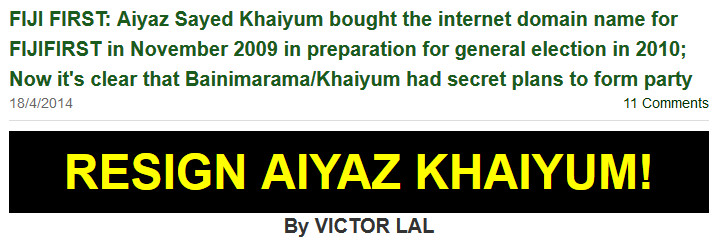
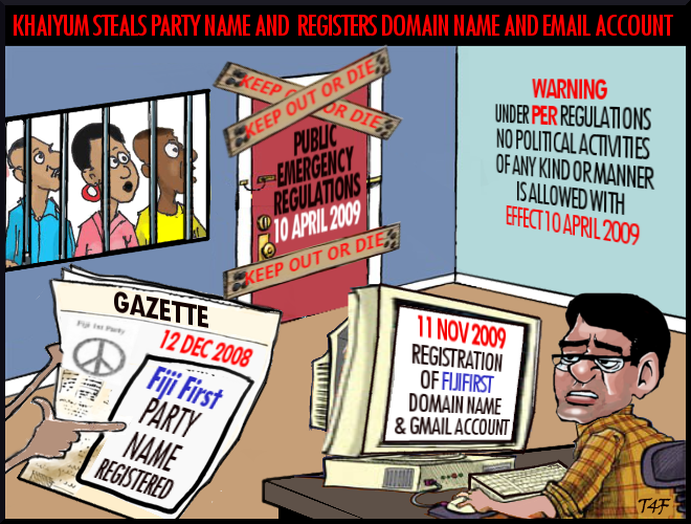
Fijileaks: And Fiji was being held to ransom by a megalomaniac and near bankrupt illegal Attorney-General Khaiyum,  Bainimarama’s go-to guy thug. Khaiyum had also secretly registered the FijiFirst Party in 2009

Picture
Picture
Picture
9 Comments

TYRANNICAL SILENCE: Narsey says 'Animal Farm' continues in the banning of Professor Brij Lal and wife; worst, Indo-Fijians in positions of power and influence palpably silent on the couple's banning from Fiji

21/3/2015

15 Comments

 
Picture
Fiji’s Animal Farm Continues
Letter to the Editor
20 March 2015
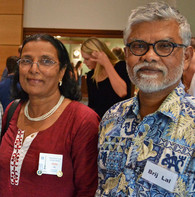
Dear Sir,


The Minister for Immigration and Defense (Colonel Timoci Natuva) has “explained” the Fiji Government’s ban of Professor Brij Lal and Dr Padma Lal on the grounds that Brij Lal “has been very vocal and opposed the move towards democracy after the events of 2006” and that “his actions were viewed by the Government of the day as prejudicial to the peace, defence, public safety, public order, security of the Government of Fiji.” (Fiji Times, 19 March 2015).

Minister Natuva’s response suggests that not only does he not have to worry about over-taxing his brain cells, but that Fiji’s Animal Farm is alive and well under the elected government of Bainimarama and Khaiyum.

(a) Given that Brij Lal opposed the illegal removal of a lawful democratically elected government of Qarase, only in Animal Farm can Minister Natuva claim this was “opposing the move towards democracy”.

(b) Only in Animal Farm can Minister Natuva “forget” that his “Government of the Day” was the illegal treasonous government of Voreqe Bainimarama who had to write into the 2013 Constitution, complete immunity for unspecified actions for himself and his collaborators, between 2000 and September 2014?

(c) only in Animal Farm can a peaceful law-abiding pen-wielding Australian academic, a former Fiji citizen and recipient of Fiji’s highest Honors, be considered by Minister Natuva (on the orders of Bainimarama and Khaiyum) to be “prejudicial to the peace defence, public safety, public order, security of the Government of Fiji”, which is backed by the might of only 3000 fierce Fijian soldiers and 3000 policemen.  Heaven forbid, is brave soldier Natuva admitting that “one pen is mightier than the sword”?

(d) Only in Animal Farm, can Minister Natuva give no justification whatsoever (and not be asked by the media either) for banning Dr Padma Lal, an environmental economist and an expert on the sugar industry who has not been politically vocal at all, whose only “crime” is that she is married to Brij Lal, and perhaps the double misfortune of being my sister.

(e) Only in Animal Farm will great “women’s champions” like Madam Nazhat Shameem and Minister Rosy Akbar remain conveniently silent about the denial of the basic human rights of Dr Padma Lal to enter Fiji, because of her “crime” of being the wife of Dr Brij Lal.

(f)  Only in Animal Farm will Indo-Fijian civil society organizations (the Arya Samaj, the Sanatan Dharam, the Sangam, the Gujarat Society) and the great girmitiya descendants and supporters of the Bainimarama Government (like Satendra Nandan, Subramani,  Rajesh Chandra, Ganesh Chand, Mahendra Reddy, Vijay Naidu, Rajendra Prasad, Thakur Ranjit Singh,etc.) keep totally quiet about the banning of one of the most peaceful and valued girmitiya “sons of Fiji” who has contributed his entire academic life to the written history of the Indo-Fijians (Dr Brij Lal) and the banning of their former USP academic colleague, luminary and Gold Medalist, Dr Padma Lal.

(g) Only in Animal Farm can an “elected government” ban decent law-abiding people like Brij and Padma Lal, while welcoming and rewarding foreigners who came to support the violent 2006 treason and the illegal Bainimarama Government, like John Samy, Shaista Shameem, John Prasad, Francis Narayan, Robin Nair, Peter Thompson, Sharon Smith-Johns, Graham Davis, etc.

Given Minister Natuva’s statement, a few members of the Fiji public might lose some sleep trying to identify  which animals in George Orwell’s Animal Farm might accurately represent Natuva, Bainimarama and Khaiyum.

But the majority of Fiji citizens can always help themselves go to sleep by counting their own numbers (no prizes for guessing which animals they represent in Animal Farm).

Professor Wadan Narsey


Picture
Picture
Picture
Picture
Picture
Picture
Picture
Picture
Picture
Picture
Picture
Picture
15 Comments

FREEBIES DELAYED: As Education Minister Reddy fails to deliver the promised textbooks, students in Indian state of Bihar CHEAT in Exams!

21/3/2015

5 Comments

 
FREE TEXT BOOKS DELAYED: All books covered under the Free Text Book scheme will be distributed by the end of next month as schools are yet to receive the full set of books required. This is exactly a month’s delay from an earlier deadline of March 31st and it’s now almost nine weeks into the first school term. Education Minister Dr Mahendra Reddy has told Parliament yesterday 87 text books are needed for Years 1 to 13. So far, they have produced 49 text books – of which there are 199, 632 copies. The rest should be in the schools by the end of the first school term. “The remaining 38 text books, we have outsourced the printing to two other printers. So, a total of three printers are operating at the moment – the government one – Education Resource Centre, and two other private printers are there. By the end of next month, we will finish distribution of text books throughout Fiji.” MP Ratu Kiniviliame Kiliraki and Opposition Leader Ro Teimumu Kepa demanded explanations as to how students will cope if no text books are provided.The Minister says the delay in the distribution should not in any way affected studies. - Source, FBC News

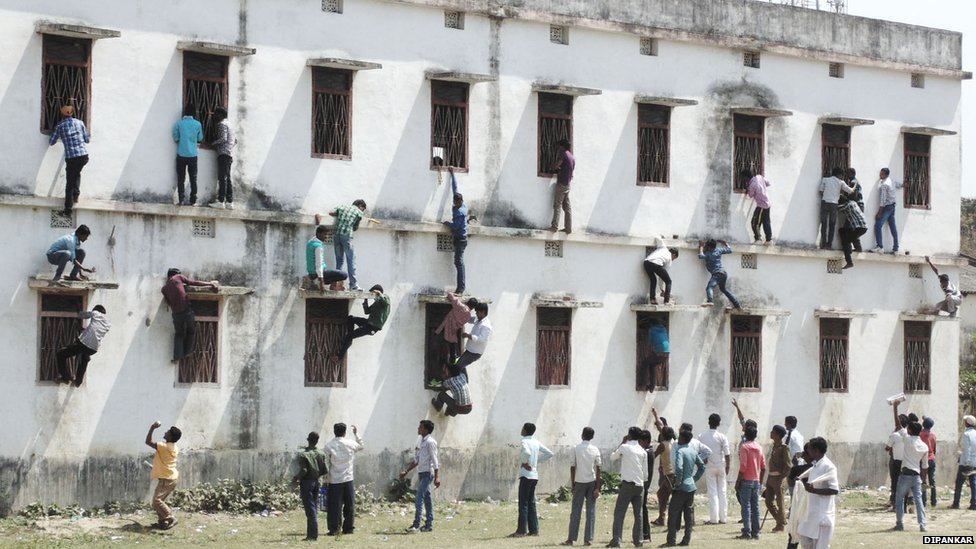
MONKEY EXAMS: Indian families and friends help Bihari students CHEAT
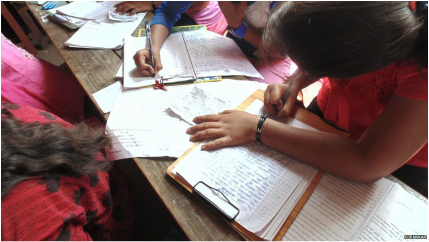
Many students smuggled in textbooks and notes into the examination centres despite tight security - and parents and friends were photographed scaling the walls of test centres to pass on answers to students during the current secondary school examinations

Picture
Cheating in exams is fairly common in the Indian state of Bihar, but new images have emerged which show just how large-scale and blatant the practice is. Source: BBC News
Picture
The examinations, held by the Bihar School Examination Board (BSEB), began on Tuesday and are scheduled to go on until 24 March. Officials say more than 1.4 million students are taking the tests. Most of the incidents of cheating this year have been reported from Saharsa, Chhapra, Vaishali and Hajipur districts. Local newspapers have been full of photos of parents and relatives trying to help their children cheat even at considerable risk to their own lives, BBC Hindi's Manish Saandilya reports from the state capital, Patna.
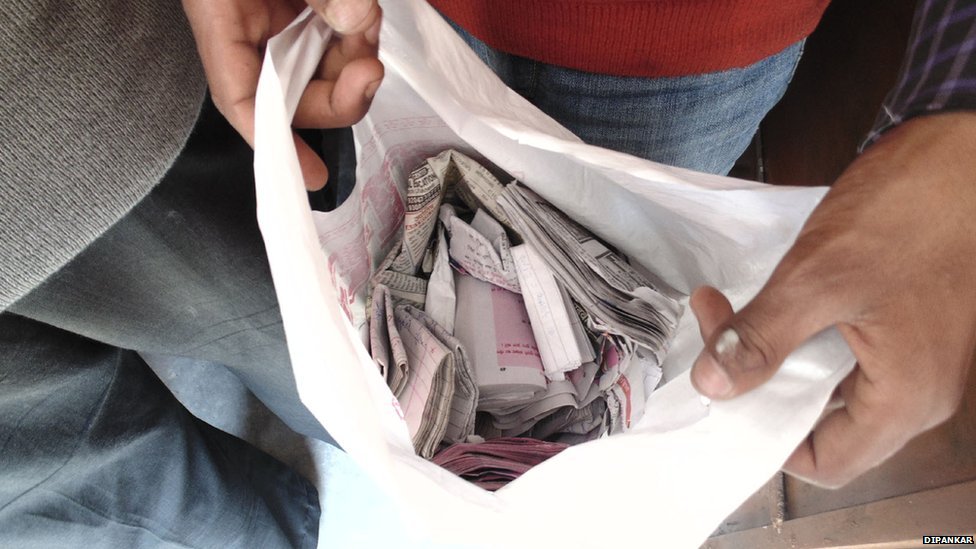
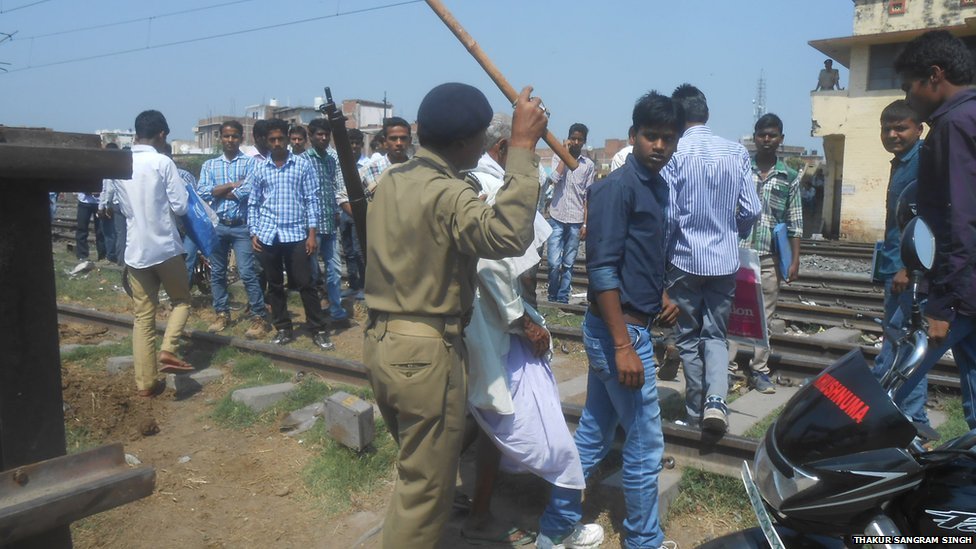
Some photos even show policemen posted outside the centres accepting bribes to look the other way, our correspondent adds. Photojournalist Dipankar, who took the photos in Saharsa district, says when he went into the examination hall and began taking pictures, the students did not seem worried at all. Despite the many reports that have appeared in the local newspapers, the authorities seem uninterested in taking any action against the students, he says. Dipankar says during a raid at just one school on Wednesday, the authorities seized sheets containing answers which filled up nine sacks. Nearly 20 parents were detained briefly for trying to help their children cheat, but they were let go after a warning, he adds.
Those caught cheating can be barred from taking an examination for up to three years, they can also be jailed or ordered to pay a fine, but punishment in such cases has rarely been reported in Bihar. Education officials say they are committed to holding free, fair and peaceful examinations, and that examination centres are being filmed and special "flying squads" of officials are making surprise visits to the centres. They say at least 400 students who have been caught cheating have been expelled. But they say the government alone cannot stop cheating without help from students and parents. "What can the government do to stop cheating if parents and relatives are not ready to cooperate? Should the government give orders to shoot them?" the Times of India quoted Bihar Education Minister PK Shahi as saying. Source: BBC News

Picture
The Indian authorities seized sheets containing answers which filled up nine sacks.
Picture
At some schools, like this one in Saran in Chhapra district, parents also clashed with the police.
Picture
Picture
http://www.fijileaks.com/home/thank-you-vinaka-and-dhanyavaad-yes-dr-mahendra-reddy-at-least-as-education-minister-you-could-have-acknowledged-the-sourcesideas-in-your-speech-to-fnu-lautoka-campus
Picture
5 Comments

MEDIA FREEDOM YES, NOT HATE SPEECHES, Khaiyum tells UN Human Rights Council; wants DEVELOPMENT Model of Journalism; we say, NO, Fiji needs INVESTIGATIVE Model of Journalism,to expose lies, corruption

21/3/2015

10 Comments


Khaiyum told UNHRC that the media "played a pivotal and negative role" in Fiji's "historical past of racism, and religious prejudice" which cannot be allowed to happen again. To this end, he says government is working with the media through the Media Industry Development Authority (MIDA), "to encourage the media to work towards a development model of media freedom - one in which the media plays an important part in building a just and equal society."; We challenge Khaiyum's lies, for until he brought in draconian media decree [to ensure Fiji First party election win], the press was in the forefront of challenging racism and religious prejudice without fear or favour; in fact one his Interim Ministers (Finance) Mahendra Chaudhry had exploited the scourge of RACISM to become millionaire overnight, hiding $2million in secret Australian bank account - and when Victor Lal, through the Fiji Sun, exposed it - what did Khaiyum and Bainimarama do - they defended Chaudhry and deported the paper's publisher Russell Hunter out of Fiji; another Minister (Inoke Kubuabola) has built his political career on RACISM; We also say that we cannot rely on the present Fiji Sun to lead the way in Investigative Journalism, for they have tied themselves to the sulu and dhoti of Khaiyum and Bainimarama's government; in fact, they have SMOTHERED the Role of Investigative Journalism in Fiji! We will never encourage anyway (whistle-blowers) to go to Fiji Sun, for they will give you a cup of tea, keep you engaged in conversation, while one of them will phone the military to take you up to the camp - remember its a shameless pro-regime propaganda rag sheet since 2008!

Picture
From the Archives:

Chiefs, Church, and Coup Culture
The “Tagi ni Taukei” mantra the root of all evil in Fiji

By VICTOR LAL

Fiji Sun, 13 May 2007


“Sit down everybody, sit down. This is a takeover. We apologise for any inconvenience caused. You are requested to stay cool, stay down, sit down and listen to what we are going to tell you. Please stay calm, ladies and gentlemen,” announced a man cowardly hiding behind a mask. Another man who was sitting down quietly in the public gallery soon joined the masked man: “Mr Prime Minister, please lead your team down and remain calm. Mr Prime Minister, Sir, will you lead your team down to the right…”


One Captain X, and a 38-year-old Lieutenant-Colonel Sitiveni Rabuka, twenty years ago, at 10am on 14 May 1987, spoke these treasonous words as a “hit squad” of ten soldiers toppled Dr Timoci Bavadra’s NFP/FLP Coalition government in the first military coup in the South Pacific. As the parliamentarians were being detained, one Cabinet minister Dr Tupeni Baba, related to Rabuka, naively but defiantly, shouted, “What kind of a joke is this?” What was being played out in Parliament was no joking game; it was part of a fulfilment of an obnoxious prayer, “The Tagi ni Taukei – Cry of the Taukei”, that had been earlier recited in the home of Methodist Church minister (once the head of the Methodist Dilkusha Indian Circuit), Reverend Tomasi Raikivi, a cousin of Rabuka’s: “Save us, and save our land. You saved the Israelites, when foreigners took their land from them. Dear God, please answer our prayer and do the same for us. Amen”. Although the prayer ended with “Amen”, what should have been intoned was “Amin” – for the plan was to hunt and hound out fellow Indo-Fijians like Idi Amin did in Uganda.

The other so-called “Man of God” beseeching his Heavenly Lord for guidance was Ratu Inoke Kubuabola, a cousin of the late President Ratu Sir Penaia Ganilau. Kubuabola was President of the Fiji Council of Churches and Secretary General of the Bible Society of the South Pacific. It was Kubuabola, who had first termed the extreme Fijian nationalist organization that had sprung up following Dr Bavadra’s election victory as the Taukei Movement, and he was its direct link with Mr Rabuka leading up to the coup.

The two men of the robe were not alone. At the prayer meeting were others, who would later carve out respectable standing and careers from the debris of the 1987 coups: Ratu Finau Mara, the son of the late President Ratu Sir Kamisese Mara; Ratu George Kadavulevu, son of the Paramount Chief of Fiji, the late Ratu George Cakobau; Ratu Keni Viuyasawa, the brother of Brigadier Ratu Epeli Nailatikau; Daniel Veitata, Apisai Tora, the late Jone Veisamasama, Qoriniasi Bale and Filipe Bole. There were other countless and faceless chiefs, thieves, and others who were part of Rabuka’s Operation Kidacala (Surprise) plan to seize power.

Some other bogus nationalist taukeis would later crawl out of the shadows, among them Isikeli Mataitoga, a legal officer under the Director of Public Prosecutions and a Captain in the Territorials. He is today ensconced in the Foreign Ministry, charged with making the world understand another coup – “Frank’s 2006 Coup”. Looking back at the 1987 television tapes from Britain’s Channel Four television, in which he (a spokesman for Rabuka) and I prominently featured during the 1987 coups on the opposite sides of the racial divide, I had asked one forthright question: “How many generation does it take for one to become a native?”

A sixth generation Indo-Fijian on Viti Levu, I had angrily pointed out to the world television viewers in 1987 that most of those running around beating up Indo-Fijians and claiming to be “indigenous” were themselves “bloody foreigners” – from outer islands of Fiji, from Lau and Bau, which are not connected to the mainland, and from Vanua Levu. “These Fijians have been the cause of all our racial and political problems on the mainland which houses the Parliament. Just look at the western division of Viti Levu – a model of peaceful existence to be emulated by the world.” Of course, it was an exaggeration to blame all the so-called “bloody foreigners”, but the backgrounds of most of the key players surely pointed to in that direction, except maybe for the backgrounds of Apisai Tora, Sakiasi Butadroka, and the assistant Roko Tui Naitasiri, Ratu Meli Vesikula. An examination of the key players in the 1987 coups does reveal that the majority had come from Navatu-Natewa in Vanua Levu. Dr Baba later observed: “A lot of them, when we were released, took off their masks and came over and actually shook hands with me. They come from my part of the island.”

“They arrive on the mainland of Viti Levu, and in order to stay put, raise the chant – the Cry of the Fijians”, I told Channel Four and BBC television viewers. Their principal target has always been Indo-Fijians, as expressed by coup executioner Rabuka, I said. Just listen to his racist nonsense about his coup: “It was a matter of cultural survival. Sink or Swim. There was no way we were going to go down. The Indians had become an unbearable presence in Fiji. The Hindus and Muslims are pagans who must be converted to Christianity.” We could say the same about him and other non-Viti Levu born Fijians, I told BBC: “Send these bloody foreigners, including their paramount chiefs, back to their islands and villagers, like the British did in the old colonial days. Rabuka should swim back to his village, Nakobo, or wherever he has come from, in Vanua Levu. He has become an unbearable presence and a disgrace on mainland Viti Levu. But no, we believe that Fiji belongs to all. We should be judged by the content of our character, and not by the colour of our skin.” Race, I argued, was a mere smokescreen for Fijian chiefs, thieves, and other taukei who just want to reach the economic and political mountaintop.

Meanwhile, if the coup was planned in a pastor’s house, it was to be eventually sanctioned in the house of the chiefs – the Great Council of Chiefs - all in the name of “Tagi ni Taukei”. Shockingly, the prominent chiefs had other racial agendas, including Ratu Mara and Ratu Penaia. Instead of criminalizing the coup, they constitutionalized post-coup racism in the new 1990 Constitution that was now being drafted to ensure Fijian paramountcy, irrespective of the fact that the coup was introducing a culture of violence and violations, and terror and terrorism. To be sure, their own chiefly, political, and economic survivals, was their primary agenda.

In fact, Mr Rabuka would later argue that Ratu Mara, despite his protestations, had sanctioned Rabuka’s coup. It seems poor Babu Singh, an Indo-Fijian and life-long personal bodyguard to Ratu Mara, had been more faithful to his oath than his boss to parliamentary democracy, multi-racialism, and the rule of law. In the interim, Fiji would become another country, for the taukei to plunder and prosper from the blood, toil, tears, and taxes of non-taukei, all disguised under the rubric of affirmative action and chiefly rule.

The Tagi ni Taukei slogan again found expression in the 2000 Speight coup, with Ratu Mara, now as President, sacking Mahendra Chaudhry as Prime Minister and appointing a caretaker administration. While describing George Speight and his gang as terrorists, Ratu Mara however noted the concerns of those holding the Chaudhry government hostage, stating “These will be thoroughly examined and solutions considered to further protect and enhance the position of the indigenous Fijian community”. In the late 1960s Ratu Mara notoriously claimed that if the Indo-Fijians ever gained political power in Fiji, then “Suva would burn to the ground, and all the indigenous Fijians would lose would be the Indians’ records of their debts”. He had never envisaged that he might be consumed in those bogus nationalist flames. Forty years later, in 2000, the Fijians did burn down Suva. Ironically, he lost his own presidency, with the looter’s leader George Speight remarking that, “From where I sit he [Ratu Mara] has no legal claim to the title of president”. In the end the great chief was forced to make a humiliating exit to Lau, a broken and bitter man, blaming among others, the coup godfather Sitiveni Rabuka, for being involved in the 2000 coup.

And yet Ratu Mara’s downfall did not discourage another of his clansman Laisenia Qarase to once again take up the “Tagi ni Taukei” slogan, as he told the UN General Assembly in 2000 in his capacity as the military installed Prime Minister: “The crux of our political crisis in Fiji is that indigenous Fijians and Rotuman communities felt threatened by certain policies which non-indigenous leadership of the Peoples Coalition Government had implemented following their decisive victory in our national elections in May 1999. It was this fear and anxiety about their future that led to mass demonstrations and ultimately the coup d’etat on May 19th this year. It manifested itself also in the mass looting of shops, destruction of property, and threats to people and their families, and unfortunately and tragically, the victims were mainly members of our Indian community.” The Rotumans had also joined in the unmusical Tagi ni Taukei hymn.

Even Commodore Bainimarama had been temporarily sucked into the nationalist cause, for he had refused to allow Mr Chaudhry and his Peoples Coalition government back into power after ending the hostage crisis. His court affidavits to the High Court had similar nationalistic tune. He had even signed away Speight’s freedom, subject to conditions, in the Muanikau Accord. The military high command, supported by the chiefs, went on to openly embrace Mr Qarase’s racialist demands for political and economic supremacy for the taukei. His regime, despite his racist rhetoric, became the darling of Australia, New Zealand, the Commonwealth, the United Nations and the United States.

Now, poor Mr Qarase wants to return to Suva from his self-imposed exile in Mavana. He wants to earn a living and be with his family. During the 2000 crisis, he had told the UN and the Commonwealth to stay out of Fiji, for it was an internal matter for the Fijians to sort it out. Mr Qarase must be allowed to return to Suva. But Commodore Bainimarama’s clean up campaign must continue. He should even ask Mr Tevita Fa, the lawyer now representing Mr Qarase, to hand over tape recorded evidence which Mr Fa claimed in April 2002 that he (Mr Fa) had which shows that Mr Qarase and his entire team were involved in the vote buying scheme in the 2001 elections. Mr Fa had made the claims while representing his client Peniasi Kunatuba long before Kunatoba’s trial and conviction over the agriculture scam.

As for Mr Rabuka, the godfather of the coup culture in Fiji, he should be expelled from the Great Council of Chiefs, which had made Mr Rabuka its only life member to honour him for staging his two military coups in 1987. It will be a fitting punishment, although it is twenty years too late. After all, the chiefs are now saying that they do not recognise Commodore Frank Bainimarama’s coup because they do not believe in coups. To recall Mr Rabuka’s own words in his book “No Other Way”: “I respect chiefs. I do not like the composition of the Great Council of Chiefs. There are so many non-Chiefs there who will try to dictate the resolutions of the Great Council of Chiefs. The Chiefs are so humble, their personalities and their character do not make them forceful enough when they discuss matters. They will agree, they will compromise…whereas those who are not Chiefs in there tend to very, very selfish.” Whether Mr Rabuka sees himself as one of those self-seeking commoners is another matter, but he only recently indicated that he was willing to lead any reconstituted Great Council of Chiefs.

A complex set of domestic and foreign variables account for the 1987 and 2000 coups. The most prominent has been the Tagi ni Taukei slogan from the chiefs, the church and a vast majority of native Fijians. Now when they are at the receiving end, the mantra of the day is the rule of law, democracy, human rights, and elections. The way forward, as I proposed previously, is Government of National Unity, made up of those who genuinely have Fiji and not merely taukei Fijians, at heart.

There is also no room for the obnoxious views of Mr Rabuka who told his official biographer in 2000: “My hope is that Indians will migrate. We tighten the controls, then Fiji is no longer attractive to the Indian settler as it has been over the last 120 years.” Reflecting on the 1987 coups he declared: “I have no regrets about the coup. I apologised in the recent (1999) election campaign for the suffering it caused and I am sorry for that, not for the coup. If I was in that situation, I would do it again. It was right. I conducted the coup to seal off the threat of sustained and widespread violence, and to move the country to a form of civilian rule that would be acceptable first to the Fijians. I am at peace with the coup. The history of Fiji would have been tragically different had I not “lanced the boil”.

Let us hope that never again will we hear the Tagi ni Taukei nonsense, that has been the root of all evil and coups in the country, beginning with the 1987 Rabuka coups, which took place on 14 May, 108 years to the day the Indians were introduced as indentured labourers to toil the sugar, copra and tea plantations of Fiji.

Fijileaks Editor:
We will not see the Fiji Sun write a frank, honest and scathing review, like the one above, against the present Government and its policies (which are numerous); No, they will lose their advertising from the regime, will be hauled to the barracks, with Land Force Commander Sitiveni Qiliho spitting in their face and slapping them, like he did to Professor Brij Lal, and Aiyaz Khaiyum will ask his lapdog MIDA chairman to take the writer to court under the MIDA Decree (which should be reviewed now that we have a semblance of democracy, freedom of speech, freedom of expression and human rights)
. Fijileaks will continue to strive to speak out as many of its contributing team had done through the pre-Russell Hunter deportation Fiji Sun in 2008.

Lal and Hunter win Fiji's top journalism award

We are the best: Fiji Sun

9/22/2008
The Fiji Sun was the receiver of the Robert Keith-Reid Award for outstanding journalism


Below is the citation.

“This year’s Robert Keith-Reid Award for Outstanding Journalism is multi-faceted. It goes to two people who are not present tonight, and involves more than one publication.

The main recipients are Russell Hunter, former editor-in-chief and publisher of the Fiji Sun, and Victor Lal, the newspaper’s UK-based investigative reporter.

“To them and the Fiji Sun goes a joint and well-earned accolade. They receive this for reportage on highly controversial taxation, and other matters associated with overseas bank accounts of the former interim finance minister Mahendra Chaudhry.

Mr Hunter’s leadership and support for Mr Lal and the Sun’s editorial team provided the professional context for what is arguably the best example of investigative journalism in the history of the Fiji media.

“Mr Hunter knew that in the current climate he was putting himself at risk. But this did not deter him from pursuing the great cause of the public’s right to know,

“Along with Mr Lal, he acted in the best traditions of crusading journalism. Mr Hunter and his newspaper paid a heavy price when he was virtually abducted from his home at night and summarily deported.

“Victor Lal displayed extraordinary persistence and skill in developing and uncovering the story in a series of articles over several months. His was a fine example of research and analysis based on documentation made available to him by sources who were also prepared to take a risk. The topic was complex requiring meticulous attention to detail in accomplishing and presenting the facts.

“To the Fiji Times and its editor Netani Rika, the judges give a special commendation for first publication of the name of the person at the centre of the controversy. It was not long after that the Fiji Times’ publisher Evan Hannah was also deported.

“The judges wish to acknowledge the work of all journalists who have been threatened or intimidated during a perilous time for the media and yet have continued to stand by the principles of their craft in defending media freedom and the people’s right to be informed.”

Picture
Picture
Picture
Picture
Picture
Picture
FHRC consulted Government on Affirmative Action Report
Friday, August 11, 2006
Fiji Sun
By VICTOR LAL

The consultant who reviewed the Affirmative Action programme for the Fiji Human Rights Commission provided ample opportunity to the Prime Minister's Office to respond to various queries. The consultant's recommendations titled 'Report on Government's Affirmative Programmes 2020 Plan for Indigenous Fijians and Rotumans and the Blueprint - June 2006', which the Commission is yet to officially release, notes that 'the government had decided that rather than the Government submitting comments on the consultant's draft report to the Commission, the Commission should proceed to its publication and public release'.

If it is true, than the Prime Minister is clearly wrong to raise the concern that FHR report on the Blueprint is definitely biased as the Commission consultant did not approach him or his CEO to get the government's side of the story on the setting up of the program. He also expressed concern that the report was only prepared by one consultant who never spoke to anyone at the PM's Office.

Mr Qarase said he is now analyzing the report following comments by the Commission that it would take the government to court if it does not make immediate changes to the Affirmative Action Program. According to the report, the Government was provided with a number of opportunities to be heard during the investigation.

It was advised of the intention to investigate and invited to provide information about all affirmative action programmes. In March 2005 the Office of the Prime Minister was advised that a number of government ministries, departments and agencies had not responded to requests for information, and the assistance of that office was sought in obtaining their cooperation - some departments subsequently responded, others did not; That same month the CEO of the Prime Ministers Department, the report claims, advised that at a discussion of departmental Chief Executive Officers on 18th March 2005 it had been agreed that the Prime Minister's Office would reply on behalf of Government through its Chief Executive Officer, though no response was received.

Over two months later, on 23rd May 2005, the CEO of Prime Ministers Office sent a copy of the publication For the Good of All, which had been tabled in Parliament in 2004. Later, on 24 November 2005, the same CEO sent copies of a second report on the implementation of the affirmative action programmes under the Social Justice Act that had been tabled as Parliamentary Paper No 108 of 2005. The CEO also supplied the Commission with a copy of the Preliminary Analysis by the ADB of the 2002/2003 Household Income and Expenditure Surveys (September 2005) together with comments.

Despite these opportunities already given, the Commission claims, it provided the Government with a final opportunity to comment on the investigators report and the draft report was sent to the government with the request that a response be received by 23 March 2006. The government subsequently sought an extension of time, and the date for final response was amended to 1 May 2006.

On 19 May 2006, according to the report, the CEO of the Prime Minister's Department wrote to the Commission to advise that the government had decided that rather than the Government submitting comments on the consultant's draft report to the Commission, the Commission should proceed to its publication and public release.

In 2004 the Commission had instigated an 'own motion' investigation into the Government's affirmative action programmes under the Social Justice Act 2001, aspects of the Blueprint initiated by the Interim Government in July 2000 and adopted and continued by the SDL Coalition Government, and the Social Justice Act itself. When notified of the Commission's intention to undertake the investigation, the SDL Coalition Government had offered its cooperation, says the report.

The Commission's decision to instigate the own motion investigation was triggered by the number of complaints it received from different sources about the Affirmative Action law and policy as well as by the Commission's own concerns about the proposals of two different Governments to enact Social Justice legislation for Fiji.

The investigation examined whether each affirmative action and blueprint programme, the policy, and the law complied with the requirements for affirmative action in Chapter 5 (section 44) of the Constitution. Based on the consultant's research, the report concludes that overall, but with some exceptions, the affirmative action programmes put in place by Government under the Social Justice Act 2001 do not comply with the Constitution.

The Social Justice Act 2001 does not comply with the Constitution. It continues as follows:

Affirmative action programmes based on ethnicity do not comply with the Social Justice provisions (Chapter 5, section 44) of the Constitution.The programme as a whole lacks a proportional balance between any disadvantage intended to be addressed and the measures being taken to alleviate the disadvantage. Minor or even presumed but non-existent disparities between ethnic groups have been used to justify the complete exclusion of groups other than indigenous Fijians and Rotumans from the bulk of the programmes

The programmes fail to make provision for all who are disadvantaged. This is particularly so in relation to women, who are far more disadvantaged than men. Individual programmes are weighed so disproportionately against Indians, women and other disadvantaged groups as to undermine the legality of all the programmes based on ethnicity.

No programme accurately links its goals to the disadvantage borne by the target group that it is intended to overcome.

Few programmes identify any performance indicators and those that do have no historical component. It is therefore not possible to monitor the effectiveness of the programmes without data that identifies trends before and after the programmes were initiated. There is no data that relates to whether alleged disparities between indigenous Fijians and Rotumans and Indians, for example, have reduced in the areas where affirmative action programmes have been introduced.

On the question whether Government has discharged its burden of establishing justification for the programmes, the report says that the Government's principal justification for its affirmative action programmes, that the rural sector is poorer than the urban sector and a majority of indigenous Fijians live in rural areas, is seriously flawed. In fact, the poorest households in rural areas are Indian.

The Government's other main justification (that the average income of indigenous Fijians is below that of Indians and Others and therefore all indigenous Fijians are disadvantaged and entitled to affirmative action) does not meet the legal standards imposed by the Constitution, the Human Rights Commission Act, and international law.

The programmes fail to justify the distinctions based on ethnicity on which most of the programmes are based. The Government has not established that 'the race-based affirmative action programmes meet the legal standards for these particular programmes'. According to the report,

the programmes have not been established in response to a justifiable compelling Government interest;l the programmes are not narrowly tailored to remedy the past discrimination or present disadvantage that they purport to correct;

the programmes are not narrowly tailored to exclude from the indigenous Fijian group preferred, any members who are not, or are no longer disadvantaged, through means testing, or class-based and other appropriate measures;

the programmes are inflexible, without waiver provisions to narrow their scope;

criteria in relation to targets make no reference to those qualified group members in the relevant sector or industry;l there is no evidence that the Government has considered race-neutral alternatives;l although the programmes are temporary, the periodic review mechanisms are inadequate;

there is little or no consideration given to degree and type of burden, including on excluded groups, caused by the programme.The report goes on to ask whether affirmative action law and programmes are lawful, and answers in the following:

Since the Affirmative Action programmes do not fulfil the requirements of the Social Justice Chapter in the Constitution, they are not protected by the exemption in section 44 (4). Accordingly, to the extent that certain disadvantaged groups are excluded from the Affirmative Action programmes, they are being unfairly discriminated against in contravention of their rights contained in section 38 (2) of the Constitution.l Since the Affirmative Action programmes do not fulfil the requirements of section 21 of the Human Rights Commission Act, they amount to unfair discrimination in breach of section 17 of the Act.

Since the Affirmative Action Programmes do not fulfil the 'special measures' requirements contained in international human rights instruments such as the Convention on the Elimination of All Forms of Racial Discrimination (CERD), they amount to a contravention of the rights contained in section 38 (2) of the Constitution.

Since the Affirmative Action programmes are based on the Social Justice Act 2001, and the Social Justice Act itself breaches Chapter 5 of the Constitution, the programmes cannot be justified on grounds that they comply with the Act.It concludes by noting that the 50/50 by 2020 Development Plan, the Blueprint and the Social Justice Act 2001 have the combined effect of imposing large-scale discrimination against the minority ethnic groups, specifically on the disadvantaged categories within these groups, and more generally on other disadvantaged groups who have not been provided with affirmative action programmes to improve their conditions of life.

The affirmative action law, policies and programmes do not comply with the requirements of Chapter 5 of the Constitution.

We say to Fiji First Party MPs and their beneficiaries: We never saw you nor heard you opposing racism, dictatorship or even defending press freedom or freedom of speech - so stop making out you deserve praise from the public and international community

10 Comments
<<Previous
Forward>>
    Contact Email
    ​[email protected]
    Picture
    Picture
    Picture

    Archives

    July 2026
    June 2026
    May 2026
    April 2026
    March 2026
    February 2026
    January 2026
    December 2025
    November 2025
    October 2025
    September 2025
    August 2025
    July 2025
    June 2025
    May 2025
    April 2025
    March 2025
    February 2025
    January 2025
    December 2024
    November 2024
    October 2024
    September 2024
    August 2024
    July 2024
    June 2024
    May 2024
    April 2024
    March 2024
    February 2024
    January 2024
    December 2023
    November 2023
    October 2023
    September 2023
    August 2023
    July 2023
    June 2023
    May 2023
    April 2023
    March 2023
    February 2023
    January 2023
    December 2022
    November 2022
    October 2022
    September 2022
    August 2022
    July 2022
    June 2022
    May 2022
    April 2022
    March 2022
    February 2022
    January 2022
    December 2021
    November 2021
    October 2021
    September 2021
    August 2021
    July 2021
    June 2021
    May 2021
    April 2021
    March 2021
    February 2021
    January 2021
    December 2020
    November 2020
    October 2020
    September 2020
    August 2020
    July 2020
    June 2020
    December 2018
    November 2018
    October 2018
    January 2018
    December 2017
    November 2017
    October 2017
    September 2017
    August 2017
    July 2017
    June 2017
    May 2017
    April 2017
    March 2017
    February 2017
    January 2017
    December 2016
    November 2016
    October 2016
    September 2016
    August 2016
    July 2016
    June 2016
    May 2016
    April 2016
    March 2016
    February 2016
    January 2016
    December 2015
    November 2015
    October 2015
    September 2015
    August 2015
    July 2015
    June 2015
    May 2015
    April 2015
    March 2015
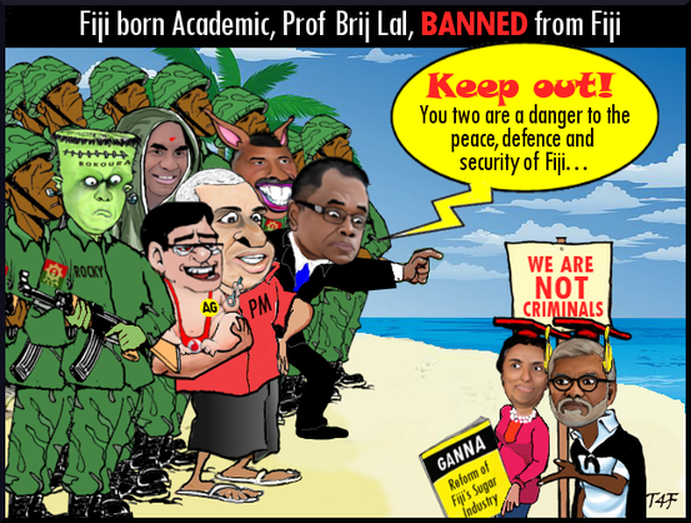
    February 2015
    January 2015
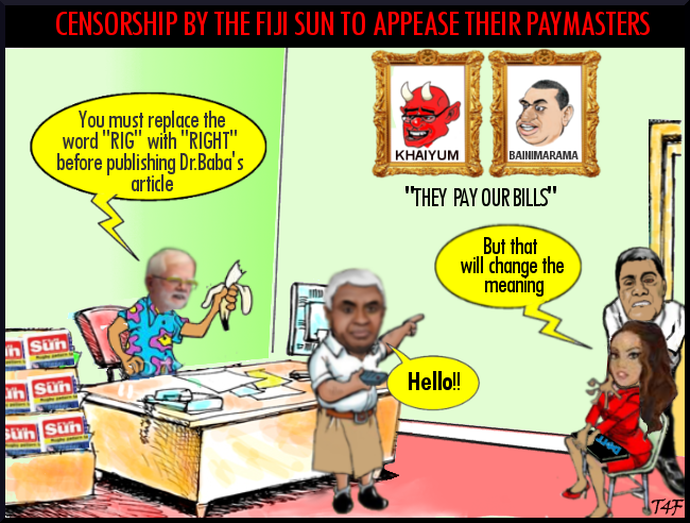
    December 2014
    November 2014
    October 2014
    September 2014
    August 2014
    July 2014
    June 2014
    May 2014
    April 2014
    March 2014
    February 2014
    January 2014
    December 2013
    November 2013
    October 2013
    September 2013
    August 2013
    July 2013
    June 2013
    May 2013
    April 2013
    March 2013
    February 2013
    January 2013
    December 2012
    October 2012
    September 2012