Fijileaks
  • Home
  • Archive Home
  • In-depth Analysis
    • BOI Report into George Speight and others beatings
  • Documents
  • Opinion
  • CRC Submissions
  • Features
  • Archive

Beddoes reports Fiji SUN to MIDA chairman claiming "media breaches"

8/5/2014

3 Comments

 
Picture
May 5 2014
Mr Ashwin Raj
Chairman
Media Industry Development Authority
Suva

Dear Sir
Fiji Sun Breaches


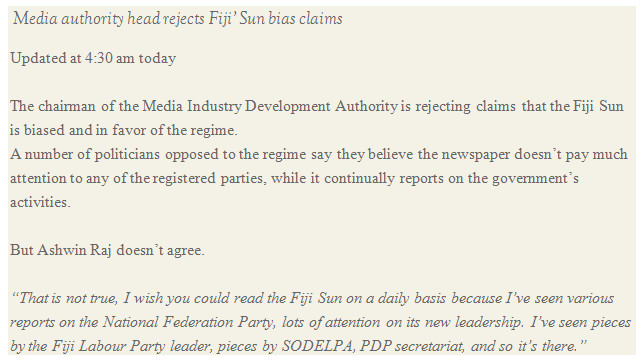
"I write in response to comments attributed to you and reported in the Fiji Sun's April 30th Coconut Wireless column by Ms Jyoti Pratibha and Fiji Today's Open Forum blog. Details of both reports are outlined below for your reference:

  • Fiji Today Report:

Picture
•    Fiji Sun Coconut Wireless Page 4 April 30th

Perrotting the Beddoes Line?


Quote: ‘The anti lot down at Radio New Zealand International didn’t get the answer they sought when they questioned MIDA Chairperson Ashwin Raj about the newspaper [Fiji Sun. RNZI’s seemingly rather inexperienced Alex Perrottet parroted the line of politician from the past Mick Beddoes of Sabeto. This is that the Fiji Sun does not report on the political parties here. Mr Raj told this RNZ fellow: I’ve seen various reports on the NFP, lots of attention on its new leadership. I’ve seen pieces by the Fiji Labour Party Leader, I’ve seen pieces by SODELPA, PDP secretariat, and so it’s there” Mr Raj questioned whether Mr Perrotiet had actually seen the Fiji Sun. unquote. As you will no doubt conclude, the sarcastic and snide references that Miss Pratibha uses to identify me and Mr Alex Perrottet are inconsistent with the provisions of the Media Decree’s Ethics standards, in particular:-

Sec 1: Accuracy, balance and fairness: in particular  (d) ‘Media organizations have a duty to be balanced and fair in their treatment of news and current affairs and their dealings with members of the public’ & (e) Editorial comment in any medium must be clearly identified as such and kept separate from news reports.

And

Sec 21: Impartiality and balance: Media organizations shall endeavor to show fairness at all times, and impartiality and balance in any item or programme, series of items or programmes or in broadly related articles or programmes over a reasonable period of time when presenting news which deals with political matters, current affairs and controversial questions.

While Miss Pratibha may well have thought she was being smart with her sarcastic remarks about me, in truth she only served to expose her immaturity and basic lack of etiquette as well as her well known bias in favour of the regime. Her reporting style that is often based on generalizations and exaggerations. I have no problem being labelled a ‘politician from the past’ because it is from my past experiences that I have learnt to always speak to the facts and not be persuaded to make generalized statements bearing no relevance to the truth. Only experience can teach you that and Miss Pratibha has little, as yet. I have seen the same articles and news items you refer to and which are produced regularly by Ms Pratibha, Mr Maika Bolatiki and others and their employer the Fiji Sun. From my own observations they have been in continuous breach of the Media Industry Decree.  The entire political reporting is a study in a lack of balance.  Your organization has failed to take any appropriate action, despite the fact that these occur on a daily basis. You also said you had not yet received a complaint to be able to act on these breaches.

In February 2014 I lodged my first complaint with MIDA [Matai Akauola] regarding comments published by the Fiji Sun that quoted supporting comments for Bainimarama’s election bid from the outgoing Indonesian Ambassador. The Indonesian Embassy issued a statement denying their Ambassador made the remarks that the Fiji Sun article attributed to him.  This suggested that Maika Bolatiki and the Fiji Sun made up the story in clear breach of the Media Industry Decree. However, as of today, I am not aware of any action undertaken against the Fiji Sun and its Political Editor. The Fiji Sun has not corrected its article. Last week, I sent my 2nd complaint to MIDA [Matai Akauola] this time about the Fiji Sun and its breaches of the Political Parties Decree and the Media Industry Decree for holding out Fiji First as a political party before it is registered. Today I submit my 3rd complaint to MIDA.  This time it relates to your statement that there is no bias in terms of the Fiji Sun’s promotion of the Bainimarama regime and proposed party as claimed by political parties.

MEDIA SURVEY


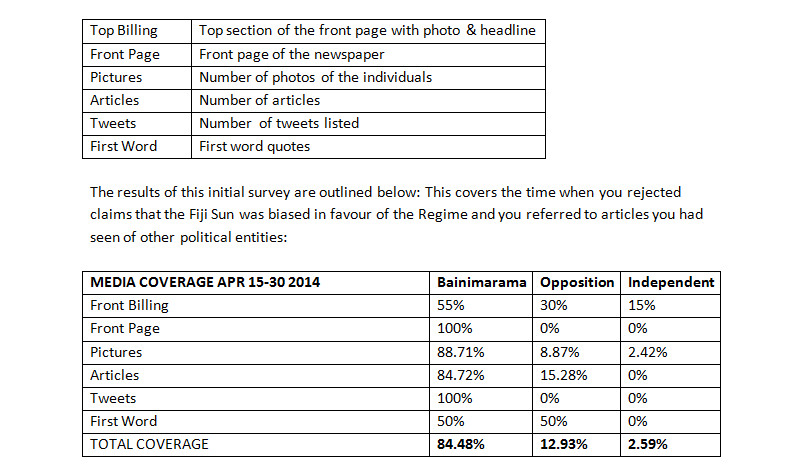
I am currently assessing the various political articles and reports of the news media in Fiji and will release the findings in due course.  However, given that the Fiji Sun continues to breach the decrees unabated I have decided to use a small sampling of the assessment so far to make my point in response to your statement. A partial result of my findings covers 12 days of publication between 15th to 30th April 2014. I have used the following basic headings against which I score the reporting patterns: The Opposition includes SODELPA; FLP; NFP; PDP.
Picture
A variance of 10% to 20% between the Bainimarama Group and the Opposition groups can be defended to a point.  However I am not so sure that an 84% vs 13% variance as demonstrated by the short survey can be defended.  This is when our media is supposedly free and independent and, according to you, the Fiji Sun has balanced political coverage

The other results of my short assessment clearly show that Frank Bainimarama and the regime had 55% of the Top Billing, 100% of the Front Pages, 89% of the Pictures, 85% of the articles.

I am not sure how one can say the extent of the articles of Bainimarama and the Regime as published by the Fiji Sun is accurate and fair, as required by Sec 1; or that it is impartial and balanced as required by Sec 21, when almost all of the articles featuring Bainimarama and the Regime carry no comment on the opposition view point.

I put it to you that your impression that the Fiji Sun is balanced in its political coverage is based on the fact that until fairly recently, the opposition had been largely absent from all media and therefore the appearance of some articles recently may well seem as though the opposition is getting as much coverage as the regime. This very short analysis says otherwise.

With respect to the Fiji Sun, its reporters Ms Pratibha, Mr Bolatiki and others, their articles and comments I believe are in breach of the following sections:-

i.    Sec 1: Accuracy, balance and fairness: in particular  (d) ‘Media organizations have a duty to be balanced and fair in their treatment of news and current affairs and their dealings with members of the public’ & (e) Editorial comment in any medium must be clearly identified as such and kept separate from news reports.

ii.    Sec 2: Opportunity to reply: Media organizations have an obligation to give a fair opportunity to reply to any individual or organization on which the medium itself comments editorially

Miss Pratibha in particular demonstrates no such fairness or impartiality or balance with her one sided commentary as she makes her support for the Regime plainly obvious and continues to breach Sec 21:-

iii.    Sec 21: Impartially and balance: Media organizations shall endeavor to show fairness at all times, and impartiality and balance in any item or programme, series of items or programmes or in broadly related articles or programmes over a reasonable period of time when presenting news which deals with political matters, current affairs and controversial questions.

In addition, the Fiji Sun and its reporters have been holding out Fiji First to be a political party when it has not yet been registered, again in breach of the political parties’ decree.

I look forward to your urgent attention to all my complaints including this, my 3rd complaint.  An update on the status of your investigations into my 1st & 2nd complaints would also be appreciated.

Finally, in the interests of public information and accountability, I would like to ask you to name your Authority board members.  Also, and again in the interests of accountability in the use of public funds, I would like to ask what you are being paid, what the MIDA employees receive,  and the allowances of your board members.

Yours faithfully

Mick Beddoes
Millis M Beddoes
Complainant


Note: Fijileaks understands MIDA chairman Ashwin Raj is currently in Indonesia.
3 Comments

NO RESIGNATION AS NO CONFLICT OF INTEREST SAYS KHAIYUM! Wrong, deposed Prime Minister Laisenia Qarase did not bring in political party and other objectionable decrees to ensure upper hand in polls!

8/5/2014

9 Comments

 
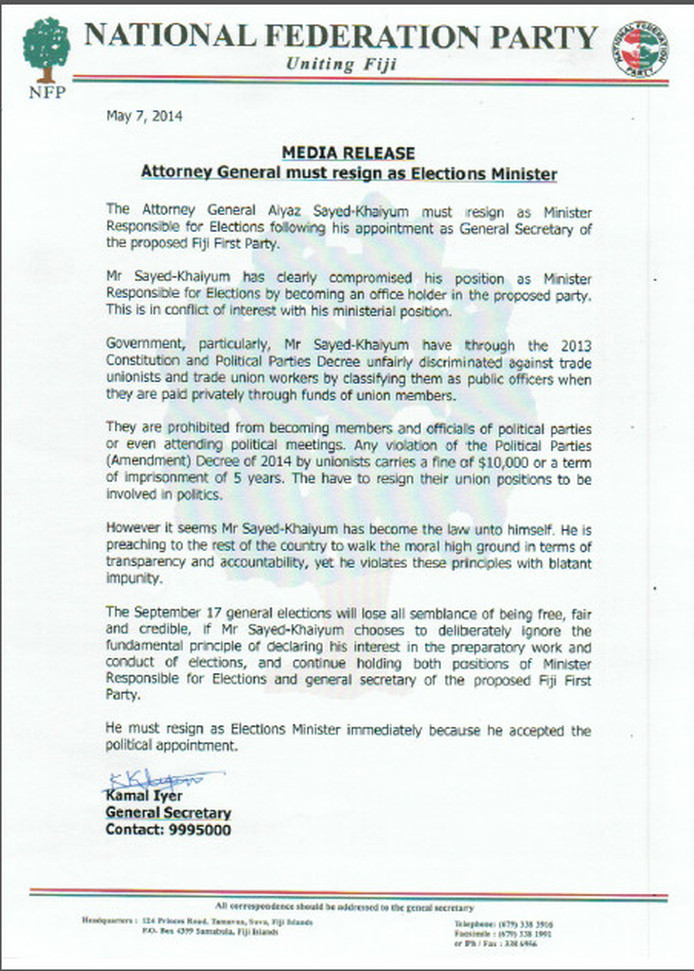
The Attorney General and Minister for Elections, Aiyaz Sayed-Khaiyum said there is no conflict of interest with him holding the Elections Minister's position and the General Secretary's post in the proposed FijiFirst.

The Fiji Labour Party and the National Federation Party have called on Sayed-Khaiyum to resign as the Minister for Elections after taking up the position in the proposed party.

FLP Leader, Mahendra Chaudhry said the FLP will continue to voice its concerns about this.


National Federation Party General Secretary, Kamal Iyer also said Sayed-Khaiyum must resign as Elections Minister immediately because he accepted the political appointment.

However Aiyaz Sayed-Khaiyum said the two parties are not taking a principled position as they did not call for any resignations in the past when Ministers responsible for general elections were holding political party positions.

Sayed-Khaiyum said the FLP and NFP can change their stand from one year to another as seen in this case.

"According to our check of the government gazettes, Sitiveni Rabuka was the Minister responsible for Elections in 1999 while Laisenia Qarase was the Minister responsible for Elections in 2001 and 2006," he said. Source: Fijivillage News.
Picture
Refusing to see blues!
Picture
Picture
9 Comments

BREAKING NEWS: Bijai Prasad steps down as Fiji First Party Vice- President but blasts the Chaudhrys of hypocrisy and double standard; says Chaudhry has been convicted twice but still clinging onto FLP leadership!

8/5/2014

6 Comments


"Without going into too much detail it is ironical and indeed hypocritical that those like Mahendra Chaudry engage in character assassination and refer to criminal records when he himself has been convicted twice - one conviction just a few weeks ago. Indeed we have his son from Australia publishing on social media judgments pertaining to my conviction over 30 years ago when he himself has been recently suspended as a lawyer for professional misconduct." - Bijai Prasad

PictureHONOURABLE EXIT: Bijai Prasad steps down
after Fijileaks disclosure of his past criminal record
The Vice President of the proposed FijiFirst, Bijai Prasad has stepped down from the position.

Prasad who is a former Fiji Labour Party senator confirms that he did not inform the proposed FijiFirst that he was convicted of a crime in the 1980’s and served time in prison. He said since this has now come to light, it is only right that he steps down from the position.

Prasad said proposed FijiFirst leader, Voreqe Bainimarama has insisted on the highest standard of personal conduct and Prasad’s non disclosure has fallen short of those standards. He believes that the proposed FijiFirst is bigger than him and bigger than anyone one else as individuals. 
He said the proposed party is not involved in gutter politics and character assassinations.
Prasad said on the other hand Fiji Labour Leader, Mahendra Chaudhry who has been convicted twice, is now raising issues about Prasad’s conviction when he had no problems in having Prasad as a senior official of FLP since the 1980’s and nominating him as a senator after the last elections.

He also questions Rajendra Chaudhry’s motive who remains suspended from practising law for professional misconduct. Proposed FijiFirst General Secretary, Aiyaz Sayed-Khaiyum said Prasad understands the level of disclosure and the proposed FijiFirst has started a particular level of professionalism. He said it is not a setback but a huge leap forward. Sayed-Khaiyum said the Supervisor of Elections, Mohammed Saneem has been informed about Prasad’s withdrawal. He said they will not replace him as 5 party officials are sufficient under the decree. Prasad confirms that he will be an active member and supporter of the proposed FijiFirst and assist the candidates in their campaigns after the proposed party is registered. Source: Vijay Narayan, Fijivillage News, 8 May 2014

6 Comments

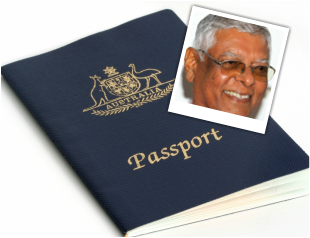
STRIPPED OF CITIZENSHIP: Fiji First Party Vice President and former FLP Senator Bijai Prasad was stripped of Aussie citizenship in 1993 for failing to declare that he had been convicted and jailed for larceny by a civil servant in Fiji in 1983

8/5/2014

4 Comments


She [Prasad's second wife] said that his first wife had visited him every year but that he had told her that the woman was his niece

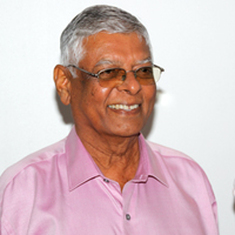
PictureFormer Fiji Labour Party senator Bijai Prasad,
now Fiji First Party Vice President
Bijai Prasad  and Minister Assisting the Minister of Immigration, Local Government and Ethnic Affairs [1993] AATA 209; (1993) 17 AAR 520 (1993) 30 ALD 292 (8 July 1993); Citizenship - [1993] AATA 209; (1993) 17 AAR 520;[1993] AATA 209; (1993) 30 ALD 292

"It is not in dispute that on 21 May 1992 the applicant was convicted in the Magistrates' Court of Victoria of committing a breach of section 50(1) of the Act, namely making a false statement; he was fined $750 and ordered to pay $500 costs. Consequently, the criterion set by paragraph (a) of section 21(1) for the exercise of the respondent's discretion to deprive the applicant of his Australian citizenship is met. "

"In August 1991 the applicant lodged an application for grant of Australian citizenship... On 2 September 1991 the application for citizenship was approved...Four days later the second wife's son called at the Department's office and delivered two letters of complaint written by his mother. She asked what had been done about the information that she had previously given about the applicant. She opposed the granting of citizenship to him on the ground that, once it was granted, his first wife would return to live with him. She stated also that he had "got a police record" having stolen $10,000 from Qantas. She threatened that if she got "no results" she would "get Hinch on to it". In the second letter she asked that matters be speeded up. She said that his first wife had visited him every year but that he had told her that the woman was his niece. She believed that he had plans to divorce herself and bring his first wife to Australia once he had his citizenship. She gave details of a man in Fiji who alleged that the applicant owed him $100,000. She said that she would "leave it till 18/20 Sept. 1991 before I hand it to Hinch". She wrote that she had been trying for one year "to get some results".

"Among the T documents there is a file note dated 23 September 1991 stating that the wife and her son had called in to lodge further documents. One was a letter written by a man in Fiji alleging that the applicant had cheated him of $10,000 and had not divorced his first wife. The second document was a copy of a statement by that person to the Fiji police about the $10,000, together with a copy of an agreement for the purchase of land in respect of which the $10,000 had allegedly been paid. There was also a note signed by a person in Fiji setting out details of the applicant's alleged police record in Fiji. The Department then immediately requested the Australian Embassy in Fiji to verify that information and on 4 October 1991 the Embassy replied that it had received verbal confirmation of it. Early in January 1992 the Department received from the Australian Embassy in Suva a copy of a letter written to it by the Director of the Criminal Investigation Department of the Fiji Police which confirmed that the applicant had been convicted on 20 July 1983 in Fiji of larceny by servant and sentenced to three years' imprisonment. The offence had involved $20,000 which had disappeared from the air terminal deposit safe at Nadi airport where the applicant had been employed. The writer stated that he had personally been in charge of the investigation, that information previously provided to the Embassy that the applicant had no adverse record was incorrect and that his Department was investigating the circumstances surrounding the disappearance of the record. Following the receipt of that information the applicant was charged in the Magistrates' Court in Melbourne with making a false statement contrary to section 50(1)(a) of the Act. He pleaded guilty and, as stated above, was convicted, fined $750 and ordered to pay $500 costs. "

"When cross-examined, he acknowledged that at the time of his application for permanent resident status he had known that persons who were refugees could apply for refugee status and that he had chosen not to take that course but rather to seek permanent residence because he was living in a de facto marital relationship. He gave evidence that he had been a candidate for election to a communal roll seat, representing the Alliance Party, in the 1982 general election in Fiji but had been defeated by the National Federation Party candidate. He said that after the military coup in May 1987 he had been taken in for questioning on three occasions. It had been alleged that he had stopped children from going to school, that he had incited farmers not to cut sugar cane and that he had opposed shops closing on Sunday. He had been detained for periods of between 30 minutes and 4 hours. He said that he had been arrested because of complaints made against him by Indian people who had been opposed to his political views...He gave evidence that at the time of the theft of the money for which he was convicted he had been working for the Nadi Airport Authority after ceasing his employment with Qantas. It is to be noted that in his application for permanent resident status, when required to give details of all employment during the previous ten years, he did not include that employment...Consequently, the criterion set by paragraph (a) of section 21(1) for the exercise of the respondent's discretion to deprive the applicant of his Australian citizenship is met." Read full judgment HERE


4 Comments

Nazhat Shameem appointed Fiji's representative to UN Office in Geneva

8/5/2014

0 Comments

 
Picture
0 Comments

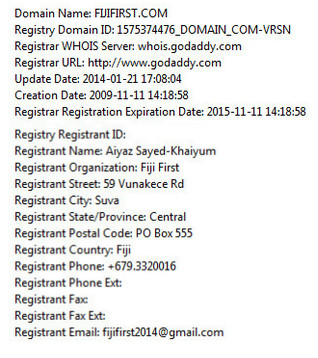
"I WILL NOT RESIGN AS ELECTION MINISTER" - Of course, Khaiyum will not for as far back as 2009 he had bought the domain name Fiji First to help Frank Bainimarama win general election through fair or foul means!

7/5/2014

2 Comments

 
Picture
AIYAZ KHAIYUM - THE CYNICAL MANIPULATOR OF THE 2013 CONSTITUTION OF FIJI:
The 2013 Constitution does not contain any provision that requires ministers to resign should they join a political party. This is only required for public office holders as set out in Section 57 (1) of the 2013 Constitution. Subsection (4) four of the same section points out that ministers are not defined as public office holders which means that the Election Minister Sayed-Khaiyum and Social Welfare and Women Minister Dr Jiko Luveni or any other minister that may be invited to join the proposed FijiFirst party will not need to relinquish their ministerial portfolios to contest the 2014 Election.
2 Comments

Press Freedom Day: Wadan Narsey on the spectacle of self-censorship

7/5/2014

7 Comments

 
Picture
BY PROFESSOR WADAN NARSEY

As part of the World Press Freedom Day celebrations, the USP School of Journalism (headed by Pat Craddock) held a Panel Discussion at USP on Friday 2 May 2014, to discuss the topic “Media Freedom and the Fiji General Election”. This certainly was progress of sorts in Fiji, in the run-up to the elections planned for September.  But who would have thought that the media reports on the panel discussion would themselves illustrate very clearly how self-censorship continues in Fiji, quite contrary to the MIDA Chairman’s guarantee of protection of the media?

Panelists included Ricardo Morris (publisher of the Republika), Seona Smiles (former Fiji Times senior reporter),  Netani Rika (former editor of Fiji Times), Rachna Lal (senior journalist from Fiji Sun), and Ashwin Raj, Chairman of the Media Industry Development Authority (MIDA). The chairperson of the panel was Stanley Simpson, former journalist and a former graduate of the USP Journalism program. Quite interesting for journalists and media outlets was the MIDA Chairman’s declaration that he would protect journalists who remained true to their journalism ethics and reported freely without fear or favor. Mr Ashwin Raj came across as honestly and earnestly attempting to fulfill his duties to the best of his ability,  under the existing media laws. But the self-censored reporting of Fiji’s Press Freedom Day also showed that the media editors simply do not believe the assertion by the Chairman of MIDA that he would protect them if they reported fearlessly and fairly.

Critical views censored

Despite the MIDA Chairman’s statements that he would protect the media, the newspapers and television gave very little coverage to some of the more sensitive and critical views of the panelists.

Neither did they give any coverage to the four critical questions of a professor  (who has written extensively on media censorship in Fiji) who tried to focus the panel on the topic they had been given- the role of the media in the coming elections:

1. Following on from Mr Ashwin Raj’s declaration that media freedom could not be discussed without a thorough understanding of nature of media ownership, the questioner asked the panel how the media owners could allow their journalists to be fearless in their questioning, when the media owners were not dedicated media operators, but had much wider and more important commercial interests which could be hurt badly by discretionary policies of a hostile government.  How indeed could MIDA address the problem of vulnerable media ownership, over which issue it had no legal powers?

2. How could one newspaper report honestly and without fear, when its editor was under a 6 month suspended jail sentence; its owner had been given massive fines over arguably trivial offences; and who remained outside of Fiji while a bench warrant had been issued against him on another minor charge; how could one television station report fearlessly when its license was renewed only a six-monthly basis, clearly intended to be an intimidating measure?

3. How could the voters in the election be educated about the relative merits of competing political parties, when both daily newspapers refused to print most of the critical Letters which subjected the government of the day to greater scrutiny?  Why indeed did MIDA allow this media censorship to continue? Mr Ashwin Raj informed the audience that he had asked the newspaper editors to explain why they published some Letters and not others, but to date, he had received no answer from any of them although several weeks had passed). Ms Rachna Lal (of the Fiji Sun), when pressed, also said that she did not know why some of the Professor’s letters were not printed despite being relevant to the issues considered important in the elections.

4. The professor informed the panel that while acts of censorship (such as being banned as Chief Guest at the 2013 World Press Freedom event at USP, or being “disinvited” as Chief Guest at the 2013 Fiji Food Security Day celebrations) were quite obvious to the public, but how could the MIDA Chairman address the far more subtle forms of censorship, such as being silently excluded from the public policy arena since 2009 by all the media (except The Fiji Times in the last three weeks)? These questions, while extremely pertinent to media freedom and the forthcoming elections, were not reported by the print media, nor even by Fiji TV, even though it had a special Close Up program on the  Panel Discussion. The MIDA Chairman needs to ask himself why the media did not take up his challenge to be courageous in reporting fairly and freely, despite his promised protection.

Stanley Simpson, a less than neutral chair


One member of the audience accused the organizers of the panel discussion of only inviting Bainimarama Government sympathizers to be on the panel. That view was not correct given the quite critical views expressed by panelists  Ricardo Morris, Seona Smiles and Netani Rika, although Ms Rachna Lal expressed her newspaper’s (Fiji Sun’s) broad support for the Bainimarama Government. However, some questions may be leveled at the chairman of the panel, Stanley Simpson and the organizer of the panel discussion, Mr Pat Craddock. Simpson was  not the humble investigative journalist of old, but a new personality arrogantly exuding power, who made no bones about wanting to limit critical questions and comments from the floor.

One senior professor, who was fooled for a moment into thinking that the use of his first name by the Chairman indicated some old friendship, was quickly disabused of that notion when the chair tried to shut him down while he was asking his questions. Simpson made no effort to remind the MIDA Chairman to answer the uncomfortable questions put to him from the floor, although Mr Ashwin Raj, to his credit, insisted on answering them at the end of the discussion. Simpson also arrogantly threatened the audience that he would close down the panel discussion if there continued to be interjections from the floor, as there was from a rather passionate  lady, who objected to the event being dominated by long responses from one panelist, while the audience could not get a word in edge-ways. Stanley Simpson has also become the Interim Secretary of the newly formed Fijian Media Association for journalists, until they elect their new officials.

A cautious Head of Journalism?

A more interesting unasked question was why Mr Pat Craddock did not invite any academics to be on his panel discussion, whether from the School of Journalism itself, or from the small group of other USP academics who have written much about media freedom and censorship. Well known to Mr Craddock would have been a Professor of Economics who has written many criticisms of media censorship in Fiji, censored from the Fiji media,  but available on international outlets such as  Cafe Pacific, run by David Robie and his School of Journalism at Auckland University of Technology http://cafepacific.blogspot.com/2013/05/how-media-ownership-in-fiji-chokes.html

Many articles critical of media censorship have therefore had to be published on my  personal blog https://narseyonfiji.wordpress.com/ and other blogs. Mr Craddock would have bee aware that this Professor was banned last year by the USP management, from being a Chief Guest at the Journalism students’ celebration of World Press Freedom Day.  Did he think that inviting this person to be on the 2014 panel discussion might raise the ire of USP management? Perhaps Craddock was also aware that a previous Head of Journalism (Marc Edge) had fallen foul of the Bainimarama Government, so did he err on the side of caution in not inviting the same critical academic critic to be on the panel?

Whatever the mix of reasons, it leaves Mr Pat Craddock, the new stop-gap Head of Journalism, vulnerable to criticism that he is not averse to practicing self-censorship on Fiji’s Press Freedom Day, just like the media owners and journalists. While the Head of the USP School of Journalism can take some credit for being able to put on a well-publicized and critical panel discussion,  Fiji’s Press Freedom has some way to go before it can be the fearless and fair reporter of elections issues, that the MIDA Chairman (Mr Ashwin Raj) wants it to be
_______________________________________________________________________________________

Don’t Spoil My Beautiful Face: Media, Mayhem and Human Rights in the Pacific

Format: paperback, 362pp, illustrated. Index.
Date: 24 April 2014: ISBN 978-1877-484-25-4
Publisher: Little Island Press
Foreword by Kalafi Moala

“This is an extraordinary ‘secret history’ of a vast region of the world of which David Robie has been a rare expert witness. What makes this epic work so timely is that it allows us to understand the Asia-Pacific at a time of renewed Cold War ambitions and dangers.” – Investigative journalist John Pilger

Professor David Robie, an independent journalist, media campaigner and educator from AUT University’s Pacific Media Centre, distils his lessons from 35 years of working in the Asia-Pacific region. Covering environmental challenges, coups, the nuclear-free and independent Pacific movement and civil rights – as well as many barriers journalists face in the Pacific – his book, Don’t Spoil My Beautiful Face, reveals many of the hidden stories from these island nations.

Review:
http://www.pmc.aut.ac.nz/pacific-media-watch/region-mantra-free-press-and-pacifics-political-spoilers-8571

Sedition, e-libel the new media frontline

'Climate of censorship' chills Pacific media scene

New free press book a must read for 'media spoilers'

New book focusing on 'secret history' of the Pacific [audio]

David Robie's new book should be on shelves of Pacific newsrooms

New book on South Pacific journalism looks at region's history and challenges

David Robie blasts media attackers at book launch [video]

Picture
Picture
Professor David Robie
7 Comments

RESIGN: Fiji Labour Party tells Khaiyum to go after it is revealed he is general secretary of the proposed Fiji First Party led by Bainimarama!

7/5/2014

3 Comments

 
PictureKhaiyum far right, told to resign by Chaudhry
The Fiji Labour Party has called on Minister for Elections, the Attorney General Aiyaz Sayed-Khaiyum to resign after his appointment as the general secretary of the proposed Fiji First party. Labour leader Mahendra Chaudhry said in a statement that Sayed-Khaiyum cannot continue to be the Minister for Elections after his appointment as it is a conflict of interest and abuse of office. “Failure to do so will tantamount to abuse of office. It is also a case of conflict of interest,” says Chaudhry. “FLP also questions the injustice of these public officers being allowed under the regime’s Constitution to contest elections or to hold official positions in political parties while it forbids trade union officials who are not public officials at all, from doing so.” Under Section 57 of the 2013 constitutions subsection 3 (g) the public office means “any office in any federation, congress, council or affiliation of trade unions (whether elected or appointed to that office and including any position or arrangement under which a person receives remuneration, salary, allowances or fees from any federation, congress, council or affiliation of Trade Unions. Section 57(4) states that public office does not include the office of the Prime Minister, the office of a Minister, the office of the Deputy Speaker, the office of the Leader of Opposition or the office held by the Minister by virtue of his or her appointment as a minister. “Such discriminatory treatment is totally abhorrent in any democratic society and I am surprised that the international community continues to support such unjust laws under the regime’s constitution. “Trade union officials are not paid by the public purse nor are they performing any public duty. Why then are they barred from holding official positions in political parties or from contesting elections?” Chaudhry asked. FijiLive understands that trade unionists are classified public office holders by government because they operate through the subs that workers pay them in order to be a member of the union. The AG could not be reached for comments. Source: Fijilive

Chaudhry insists on staying at the helm of Fiji Labour Party as its leader despite conviction

I’m entitled to hold my post in FLP - Chaudhry
Mahendra Chaudhry said he will continue to be the Fiji Labour Party Leader because he is entitled to hold the post. Chaudhry said he is not doing anything wrong under Political Parties Registration Decree.

Under the Political Parties Registration Decree, a person is  disqualified from being an office holder of a political party if that person has, in the five years preceding the date when he or she applies to become an office holder of the political party, has been convicted of an offence and sentenced to imprisonment for a period of not less than 6 months. In Chaudhry’s case, he has been fined 2 million dollars and he only faces the 15 months prison sentence if he does not pay the fine by the 30th of June this year. This means that he can continue to be the FLP Leader as he is not facing a prison sentence at this stage. However Chaudhry cannot contest the September 17th election this year as his conviction remains after he was found guilty of three counts of breach of the Exchange Control Act and sentenced by Justice Paul Madigan. The 2013 constitution clearly states that a person may be a candidate for election to parliament only if the person has not, at any time during the eight years immediately before being nominated, been convicted of any offence under any law for which the maximum penalty is a term of imprisonment of 12 months or more. The same is stated in the Electoral Decree for candidate eligibility. When asked on why he continues to remain the FLP Leader after being convicted and sentenced, Chaudhry said only his members have the right to decide on his future.     
The FLP will have a meeting tomorrow. FLP President, Lavinia Padarath has also revealed that Chaudhry appealed his court conviction last month. Source: Fijivillage News, 7 May 2014

3 Comments

The new Fiji First Vice-President Bijai Prasad-Mahendra Chaudhry spat goes deep and far and involves the Haryana secret millions in Australia!

6/5/2014

0 Comments

 
PictureBijai Prasad (lef) and Suva lawyer Anand Singh with his client convict Mahendra Chaudhry; the FLP leader walks out of court in celebratory mood despite being fined $2million, and now Chaudhry's lawyer, Singh, has confirmed they will appeal against his conviction on exchange control violation charges.


By VICTOR LAL

The newly elected Vice-President of the proposed Fiji First Party Bijai Prasad came to my attention in 2008 when I was searching for the source of convicted FLP leader Mahendra Chaudhry's millions in his secret Sydney bank account.

On 10 February 2008, I wrote to one of FLP lawyers who seemed to have fallen out with Chaudhry: "Is this chap of any interest to us?" And attached the falling news story:

The presence of Fiji Labour Party politicians in the interim Cabinet will result in the demise of the party, outgoing Nadi branch president Bijay Prasad said. Prasad made the comments at his farewell event last night held in the West after holding the position for the past ten years.He said he stepped down from the position for a mistake he made at the party's national council meeting held in Ba where he supported the motion allowing members to join the interim regime.

"We were vigorously campaigning to gain support of our indigenous brothers and sisters," Prasad said. "With the suspension of the GCC (Great Council of Chiefs), reduction of the Ministry of Fijian Affairs to a department of Fijian Affairs, and the overhauling of the NLTB (Native Land Trust Board) with concurrence of our members in the Cabinet, any hope of winning the indigenous support has evaporated in thin air," he said. He added the party's participation in the current regime had widened the racial gap.

"What in fact we are doing is allowing Mr Qarase (Laisenia) or any other leader of the SDL party to win more than 50 seats in the future general election." Prasad said a lot had happened within the party with some decisions made nearly costing the unity and solidarity of the party. "Sometimes, we made a decision then regretted later, like joining the multi-party cabinet without establishing the ground rules, a mistake that could have badly split the party. We were saved by the December 2006 coup," he said.

In response, Chaudhry said the party's involvement in the interim regime was not because it supported nor condoned the coup. He added FLP's involvement with the military regime had been decided at the party's national meeting – to assist in the return of the country to parliamentary democracy.

The FLP lawyer replied as follows: "Be very careful of Bijay Prasad. He loves himself. He fell out with Daaku when Daaku did not assist him with a land sub-division he was doing in Nadi. He is upset too with Junior who collected money from him and did not deliver the goods. He at one time post -coup had moved against Daaku for the above reasons then went back but when Daaku moved against him he is now berating Daaku. We can use him though for what ever reasons. He used to be the anchor man fro [for] Daaku in Nadi."

Now, six years later, in 2014, Chaudhry claims that Prasad was not removed but left the party after he did not get assistance relating to his land deals, an allegation which Prasad denies.

Prasad remained of interest to us, as former Fiji Sun publisher Russell Hunter replied to me on 10 February 2008: "Bijay Prasad could certainly be of interest. He quit the FLP (I think) over it's membership of the IG. He's very vocal against the daaku...I don't know this fellow. But I'm routinely careful with all of them."

The FLP lawyer had claimed that Mahendra Chaudhry had "swindled the [Nadi] branch of $25,000 they had collected in lottery tickets before the 2006 elections", an allegation we had not followed it up with Prasad. Oddly, we had never come around to contacting Prasad for our conduit to him was the FLP lawyer.

Four days later, on 16 February, the same FLP lawyer who was helping us to locate Chaudhry's millions told us that he had asked Prasad to ask questions at the FLP National Council meeting: "Daaku misleads Fiji Parliament ought to be your next article. The ppressure needs to be on. I haven't had feed-back of the National Council meeting but I had asked Bijay Prasad to ask questions. I am hoping the donors from abroad will now disclose what they gave to Daaku and when?"

The FLP lawyer expressed his doubts about the source of the money: "I am sure that the money did not come from Chuatala [Chautala]. The GOI [Government of India] had to use cover to send the money and the [Indo-Fiji] Friendship Society was a cover for it. Besides in the short space of time the Society could not have collected as much in India. I believe the letter [Harbhajan Lal] letter was done post facto to give some evidence to FIRca and nothing else. Bijay Prasad went to the meeting today and said his piece about Daaku resigning. He did it for other reasons. He says none of the FLP delegates have the courage 2 discuss or even refer to the FS [Fiji Sun] article. The delegates will talk when Daaku is not there. So much for courage. But he did say that there is a mood of defeat in the FLP. Daaku looked sombre and withdrawn."

As readers will recall, I had published a series of articles claiming that an Interim Cabinet Minister had evaded taxes but did not name Chaudhry nor disclosed that he was hiding $2million in his Sydney bank accounnt.

On 17 February, the FLP lawyer managed to get Prasad talking: "Well... the story is out. Have feedback of disbelief from people. Now they know its Daaku. M trying to get Bijay to comment on the story. thsi [this] will be from the FLP junta view-point. Lets see how it develops. Good work."

And then the stinger: "After much persuation Bijay Prasad has been on Tv and asked the FLP to clarify if it is a FLP minister that is implicated in the tax evasion row. There was no comment from the President or anybody. Silence...that is part of Daaku strategy. I hope you have follow up articles so the the fire is still burning. Daaku would like the thing to go away of course. Are you and the FS naming him on Tuesday. At least he will tehn [then] have to comment on it."

But who did the secret millions belong to? Again, the FLP lawyer had this to say on 17 February 2008: "I have read your article. I believe that essentially the object was to show Daaku for what he is..Daaku. The second object in my mind is to restore the money to whom it belongs, the ordinary junta of Fj[Fiji] thru the FLP. At the time he was FLP and still is. He collected money as FLP deposed PM. He undertook everywhere to help the community. He also told Firca when it came to avoiding paying tax that he was holding the money on behalf of the community. I believe you should make a strong point that the the funds are and were intended for the community. It ought to be returned to the community with perhaps a trust formed to help the children of farmers or the underpriveleged. This could be a fund for their education or other essential needs. Not for his daughter who is married to a guy earning well over $250k on au scale in Fj. That I believe will be ultimate justice."

I replied as follows: "He was hiding $2,684,130.76 for the last eight years into his private bank account - and was using daaku junior's Sydney address for correspondence....of this $2,084,031.22 came from Haryana - the story on that angle will nail him - re letter and his statement in Parlt etc - the question is where did he get the other $600,099.54 pence from - of course the piece I sent you on the investments, he made $250,000 out of it - but still $350,000 remains unaccounted for - he can argue shout threaten us until the Haryana cows come home but it still remains that he milked them to the last cent and has been enjoying on the loot!!!!! The only fear is what if daaku runs to the High Court after Q's press release and obtains an ex parte injunction from...(comments witheld).

The FLP lawyer's patience was stretching to breaking point, as he enquired on 18 February: "What's the latest? silence from Daaku and Firca is strange and irritating. I wonder what tactics he is employing now? Court tomorow after he is named?" I replied saying immense pressure and threat was now being put on Russell Hunter and our Deep Throats have advised Hunter to go into hiding for a few days as we prepare to drop the bombshell of Chaudhry's secret millions: "Jitoko now says he is not going to comment because he cant comment on private taxpayers - the reason is different - when daaku is reading the letters he wrote, figures etc he knows they are all true - what tactics - they are terrorizing RH: "I've just been advised to be urgently out of town for a few days by a DT. I'm on my way right now."

On 19 February 2008 I informed the FLP lawyer that Chaudhry has denied receciving any money from India, and cited the following article: 'I have nothing to hide' – Chaudhry Wednesday, February 20, 2008: Fiji Labour Party leader and Interim Finance Minister Mahendra Chaudhry reiterated that he has nothing to hide. He was referring to calls by former Labour Party Nadi branch Bijai Prasad for Chaudhry to come clean on the money he collected from Fiji-Indian communities overseas after the 2000 coup. Chaudhry says Prasad should examine his own financial records. "It is amazing after eight years after Mr Prasad being kicked out of the party now raising these stories. If there was any truth I the matter why didn't he raise this in the last eight years? But I'm not bothered the least as I said Mr. Prasad should examine his own record in financial matters," he said.

The FLP lawyer could not believe the lie: "Where did he say thsi?/ Thsi[this] guy is shameless. I think we will have to put the allegations to him. Now that he has responded isn't it possible tp put the whole lot of your allegations to him?" I replied: "Somebody sent it to me - saying it was on fijivillage.com - he must be thick not to realize that his file is out - unless he has gone made [mad], besides being shameless." The FLP lawyer seemed exasperated with those who came out to defend Chaudhry: "The quality of pple who are defending him is amusing like Divend sharma. I am not too impressed with _____ statement in the Sun. Daaku is good in confusing the issues and very shortly he will be attacking _____as a diversion from the central issues. What abt yr NGO story. These will keep the issues focused. Daaku must have a counter-plan and he will activate it shortly..."

On the same day, 19 February, I replied at length: "Yes, I couldnt make out what _____was really trying to get out to the public. I am sure daaku is convinced that F [Frank] will come to his rescue - his file tells a different story - the more i read that letter the more i am convinced that it is a stich up - daaku was taken to task in May- he only gave the letter in late september - again, how could this guy say you are enquiring about the funds and than gives the figures and years it was put into his account - hei - it doesnt take a feverish mind to figure it out - from daaku's bank statements to firca he was acutely aware of the deposits - i will be puncturing his letter - no wonder firca wanted more substantive evidence - when he went for interview he claimed it was held in trust - some smart coolie brother was clever than him and asked him to produce the trust deed - he couldnt - so asked for time and began the delaying tactic until he was able to get hold of this bigger daaku in haryana - it will make daaku look like a fool - and his outright lie to parliament - as i pointed out - the moment the second instalment came - he immediately withdrew $800,00 the next day - we lose the trail of that money - its now where to be seen - it must have gone into investments etc"

By 20th Febraury Fiji was gripped with "Who is the Interim Minister and the FLP lawyer joined the thirsty readers: "My usual news stand did not have the Sun this morning. I was told it sells very fast these days. Has FS recorded an upsurge. That will be good for the paper..."
NOTE: "Daaku" meaning crook in Fiji Hindi was the code name my source inside FIRCA had asked me to use in all our communications regarding Chaudhry's tax records.
TO BE CONTINUED

0 Comments

Jailbird: FijiFirst Party Vice-President Bijai Prasad was jailed for three years in 1983 over $20,000 heist from Air Terminal Services Limited

6/5/2014

4 Comments


Fiji Supreme Court had rejected his appeal against conviction for larceny by a civil servant and three year prison sentence

Picture
PictureBijai Prasad (left) with Bainimarama
handing signatures to Supervisor of Elections;
in 1982 Prasad handled another
parcel landing him in prison
Prasad v Reginam [1984] FJCA 9; [1984] 30 FLR 13 (23 March 1984) [1984] 30 FLR 13

COURT OF APPEAL OF FIJI

Criminal Jurisdiction

BIJAI PRASAD v.REGINAM


[COURT OF APPEAL − Speight, V.P., Mishra, J.A., O'Regan, J.A.]

Date of Hearing: 8 & 9 March, 1984
Delivery of Judgment: 23 March 1984

(Criminal Law − Larceny as a servant − accomplice granted immunity − admissibility of accomplice's evidence − warning as to corroboration).

S. M. Koya for the Appellant
D. Fatiaki for the Respondents


Appeal against conviction by the Supreme Court sitting at Lautoka for Larceny by a servant and sentence of 3 years imprisonment.

On 24 November 1982 a parcel of $20,000 Fiji currency was received by Air Terminal Services Limited Namaka to be placed on an Air New Zealand Flight that evening for Honolulu.

The appellant, a movement controller entered the parcel in the appropriate register and it was placed in the safe. The flight was concelled. Instructions were given to place it on a flight on 27 November 1982. Appellant in the presence then of another colleague opened the safe. The parcel was no longer there.

Police investigations included searching the home of Shiu Narayan a close friend of the appellant, a taxi driver who operated taxis and often picked up fares from the Air Terminal. They found a container with $10,000 in Fiji Currency buried outside Narayan's house. The latter was questioned, earlier denied all knowledge of the alleged theft but latter gave a detailed statement of taking appellant home on 25 idem with a parcel of money. He had kept $10,000 and drove appellant home with the remainder.

Appellant was arrested and charged. Shiu Narayan was granted conditional immunity from prosecution by the Director of Public Prosecutions. He gave evidence for the Crown.

The terms of the immunity from prosecution were:

"The Director of Public Prosecutions is prepared to grant immunity from prosecution to your client, Shiu Narayan, (s/o Ram Charan) of Nawaicoba, Nadi on the following basis: immunity will be given in respect of the larceny offence committed with Vijay Prasad (s/o Ram Padarath), provided Shiu Narayan gives evidence for the Crown in the case against the same Vijay Prasad in accordance with Shiu Narayan's statement to the police. It should be pointed out to Shiu Narayan that this immunity is only given to him to further the interests of justice, and should he differ significantly from his statement to the police he may face charges of perjury or of giving false information to a public servant."

Grounds of appeal included:

1. The learned trial Judge erred in not excluding the evidence of Shiu Narayan altogether. 2. In addition to other warnings admittedly given by the trial Judge, there should have been warning as to the danger of accepting the evidence of a person who because of a grant of immunity was escaping prosecution altogether. 3, 4 and 5 The warning as to the danger of acting on the uncorroborated evidence of an accomplice-
(i) was inadequate;
(ii) the explanation of the nature of corroborative evidence was imprecise and unclear;
(iii) evidence pointed out as being corroboration lacked that capacity.
Ground 1 was supported as "the condition attached to the immunity was manifestly unfair, inherently wrong and dangerous; consequently there was a miscarriage of justice.

It was said that the witness's evidence, because of the conditions attaching to the immunity, had to be in accordance with his statement to the Police without apparent regard to the possibility of untruth in whole or in part; secondly it was given under threat of certain charges should his evidence differ; also there were three statements given to the police.

As to excluding the evidence, the prosecution argued, relying on R V. Sang (1979) A.C. 402 that there was no such discretion. Authorities cited (but later than Sang) may have been inconsistent with Sang; and the Privy Council in McDonald v. The Queen (Privy Council Appeal 52 (1982) did not decide the matter.

In support of the second ground Counsel said the requisite accomplice warning would not be sufficient to avoid inherent danger to the appellant. The court inter alia, said the evidence was admissible.

Grounds 3, 4 and 5.

The Court said that the circumstances pointed out as (sic) corroborative were quite substantial.

The directions as to good character, criticised in ground 6 were adequate in the circumstance.

Held:

Assuming (without deciding) a discretion existed to exclude the evidence of an accomplice who had been given immunity, by applying the test laid down in Ossenton v. Johnston (1942) A.C. 147, it had not been demonstrated that the discretion had been wrongly exercised.

The evidence of the accomplice was admissible. Subject to its being scrutinised in the light of requisite directions prescribed by law, it was capable of being accepted and relied upon by the assessors, if after heeding such directions, they chose to do so.

The direction of the learned trial Judge drew attention to the conditions and terms of the immunity. There was no merit in the submission of a further warning.

Read as a whole the directions were of sufficient clarity to explain the issues including that of corroboration. The word "implicate" which had been criticised, was acceptable to indicate sufficiency of corroborative evidence. It was used by Lord Diplock in D.P.P. v. Kilbourne (1973) 1 All E.R. 440.

Cases Referred to:

R v Kilbourne [1973] 1 All ER 440.
R v Sang [1979] AC 402.
Kuruma v R [1955] AC 197.
R v Pipe (1967) 51 Cr App R 17.
R v Turner (1975) 61 Cr App R 67.
R v McDonald (1983) 77 Cr App R 196.
R v Weightman (1978) 1 NZLR 79.
Ravi Nand v Reg 10 FLR 37.
Gyan Singh v R 9 FLR 105.
Ossenton v Johnston (1942) AC 147.

MISHRA, J. A.:
Judgment of the Court


The appellant was convicted by the Supreme Court Lautoka of larceny by a servant and sentenced to 3 years' imprisonment. He appeals against his conviction and sentence.

On the afternoon of 24th November 1982, a parcel containing $20,000 in Fiji currency was received by Air Terminal Services Limited, Namaka, the appellant's employers, to be placed on Air New Zealand flight leaving the same evening for Honolulu. The appellant, a movement controller, had just reported for duty and was in the process of taking over from another movement controller. He entered the parcel in the register kept for that purpose and the parcel was placed in the office safe. The Air New Zealand flight, however, had been cancelled and they would have to await instructions as to the next flight that would carry the parcel. On 27th November 1982, when such instructions came the accused was again on duty. He opened the safe in the presence of another colleague but the parcel was no longer there. Between the 24th November and 27th November someone had removed it.

During their investigations the police searched the house of one Shiu Narayan, a close friend of the appellant's, who owned several taxis and often picked fares from the Air Terminal. Buried just outside his house they found a container with $10,000 in Fiji currency.

Shiu Narayan, when questioned by the police some time earlier, had denied all knowledge of the alleged theft. He now changed his story and gave a detailed statement admitting that at about midnight on 25th November, 1982, he had picked up the appellant at the air terminal and driven to his own (Shiu Narayan's) house with a parcel of money. He had, at the appellant's request, kept $10,000 and had driven the appellant to his (the appellant's) house with the remainder.

The appellant was arrested and charged.

Shiu Narayan was granted conditional immunity from prosecution by the Director of Public Prosecutions and turned Crown evidence.

The first ground of appeal was that the learned trial Judge erred in not excluding the whole of the evidence of Shiu Narayan.

Shiu Narayan, on his own admission, was a party to the offence with which the appellant was charged and ultimately convicted, but he was neither tried nor charged with any offence. He was given immunity from prosecution, the terms of which appear in a letter from the Director of Public Prosecutions to his solicitors. The relevant parts of the letter are:

"The Director of Public Prosecutions is prepared to grant immunity from prosecution to your client, Shiu Narayan s/o Ram Charan of Nawaicoba, Nadi on the following basis: immunity will be given in respect of the larcency offence committed with Vijay Prasad s/o Ram Padarath, provided Shiu Narayan gives evidence for the Crown in the case against the same Vijay Prasad in accordance with Shiu Narayan's statement to the police. It should be pointed out to Shiu Narayan that this immunity is only given to him to further the interests of justice, and should he differ significantly from his statement to the police he may face charges of perjury or of giving false information to a public servant."

At the point in Crown Counsels opening address to the assessors where mention was first made of Shiu Narayan's evidence, counsel for the defence made objection and submitted that the learned Judge should exclude such evidence on the ground that the accomplice warning "would not be sufficient to avoid the inherent danger to the accused in his evidence". The learned Judge after hearing submissions refused the application. In this Court the appellant formulated the ground of appeal on the footing that the trial Judge erred in not excluding the evidence on the ground that "the condition attached to the immunity was manifestly unfair, inherently wrong and dangerous and that consequently there was a miscarriage of justice". Although the formulation is expressed in terms different from those in which the basic submission to the trial Judge was put, it is clear that the original objection was founded upon the conditions attaching to the immunity and that the complaints were first, that Shiu Narayan's evidence at the trial was required to be in accordance with a statement he had made to the police without any apparent regard to the possibility that such statement might be in whole or in part untruthful and secondly it would be given under the threats of certain charges should his evidence differ significantly from such statement. The matter was compounded by the fact that Shiu Narayan had, at the time the immunity was offered, made three statements to the police.

In this Court, Mr Fatiaki submitted that the trial Judge was invested with no discretion to exclude the evidence. We interpolate that this submission was not offered in the Court below, the matter there being argued and decided on the basis that there was such a discretion.

In support of his submission Mr Fatiaki relied on R. v. Sang 1979 A.C. 402 in which the House of Lords was called upon to make answer to the question, certified by the Court of Appeal as point of law of general importance:

Does a trial Judge have a discretion to refuse to allow evidence - being evidence other than evidence of admission - to be given in any circumstances in which such evidence is relevant and if more than minimal probative value".

The Sang case had to do with the evidence of an alleged agent provocateur but the judgment of the Court of Appeal had reviewed cases dealing not only with such but also those others in which the existence of a wide discretion in a trial Judge to exclude any evidence tendered by the prosecution which had been unfairly obtained, had been acknowledged in obiter dicta by Judges of great name and high authority. And, as Lord Diplock observed, such dicta could be traced "to a common ancestor" in Lord Goddard's statement in Kuruma v. The Queen (1955) A.C. 197, which, after a careful analysis, he held "was never intended to acknowledge the existence of any wider discretion than to exclude (1) admissible evidence which would probably have a prejudicial influence upon the minds of the jury which would be out of proportion to its true evidential value and (2) evidence tantamount to self incriminatory admission, which was obtained from the defendant, after the offence had been committed, by means which would justify a Judge in excluding an actual confession which had the like self incriminating effect".

And after recognising the role of a trial Judge in relation to confessions and evidence obtained from an accused after the Commission of the offence that is tantamount to a confession and his function to impose sanctions for improper conduct on the part of the prosecution in relation thereto, His Lordship said:

" ........ Your Lordships should I think make it clear that the function of the Judge at a criminal trial as respects the admission of evidence is to ensure that the accused has a fair trial according to law. It is no part of a Judge's function to exercise disciplinary powers over the police or prosecution as respects the way in which evidence to be used at the trial is obtained by them."

And I Lord Scarman, in the same case, has this to say:

"The role of the Judge is confined to the forensic process. He controls neither the police nor the prosecuting authority. He neither initiates or stifles a prosecution .............. The Judge's control of the criminal process begins and ends with the trial, though his influence may extend beyond its beginning and conclusion. It follows that the prosecution has rights which the Judge may not override. The right to prosecute and the right to lead admissible evidence in support of the case are not subject to judicial control. Of course, when the prosecutor reaches Court, he becomes subject to the directives as to the control of the trial by the Judge whose duty it is then to see that the accused has a fair trial according to law."
In our view there is considerable force in the submission made by Mr Fatiaki. The right of a Judge to exclude the evidence of an accomplice to whom immunity has been given is not included in any of the exceptions to the general rule enunciated by their Lordships in answer to the certified question. However, we notice that Pipe (1967) 51 Cr. App. R. 17 (in which the whole of the evidence of an accomplice who had been granted immunity was excluded in purported exercise of judicial discretion) and Turnar 61 Cr. App. R. 67 (in which the Court of Appeal proceeds on the basis that such a discretion existed) were not mentioned in Sang.

But we note also from the report of their Lordships of the Judicial Committee of the Privy Council in McDonald v. The Queen 1983 (77) Cr. App. R. 196 one of the grounds of appeal related to the failure of the trial Judge to exclude the evidence of two accomplices who had been granted immunity. It had been conceded by the Crown both in the Court of Appeal of New Zealand and before their Lordships that the trial Judge had a discretion to admit or exclude the evidence. Their Lordships, in the event, found it unnecessary to go into the submission in depth or to dwelling long upon it. These factors and the concession made, may have occasioned oversight of the affinity between the discretion under consideration and the proscriptions which fell from their Lordships in Sang. This apparent recognition, albeit passing, of the existence of such a discretion makes us reluctant to give an imprimatur to Mr Fatiaki's submission. And indeed we do not find it necessary in this case to do so. The observations of their Lordships in Sang, of course, are of high authority and great weight but we note that they are, as Lord Diplock himself allowed, obiter. We find ourselves able to resolve the point by assuming, without deciding, that the discretion existed and by applying the tests laid down in Ossenton v. Johnston (1942) A.C. 147 concluding that it has not been demonstrated to us that the exercise of the discretion was wrong.

It was submitted to the learned Judge that the requisite accomplice warning would not be sufficient to avoid inherent danger to the appellant. We accept that such submission had its genesis in the form of the immunity and the conditions attaching to it and that it was part and parcel of the submission that the witness, to retain the immunity, was under constraint to adhere to his statement whether it be true or false, or in part true or in part false, and that the threat of prosecution for perjury was ever present. But any witness who neglects to tell the truth on oath is in peril of prosecution for perjury if the prescriptions of the statute in that behalf are met. And all the features of the immunity and conditions were as manna sent from heaven for the defence counsel when he set about, as he did, to criticise, to discredit and indeed to ridicule both the evidence itself and the man who gave it. But the evidence was, whatever were its other characteristics, admissible evidence. And subject to its being scrutinised in the light of the requisite directions prescribed by law, it was capable of being accepted and relied upon by the assessors if, after heeding such directions, they chose to do so. If it had been lawfully excluded it would have had resulted, as Judge Buzzard, the trial Judge in Sang observed, in facts which afforded no defence to the charge requiring the Judge to secure the defendant's acquittal before any of the evidence was heard. (See Sang (supra) at page 273A).

In our view, the learned Judge could not properly have dealt with the matter in any other way. Accordingly, we reject the submission.

Ground 2 urges that, in addition to other warnings admittedly given by the learned Judge, the circumstances of the case required an additional warning as to the danger of accepting the evidence of a person who, because of the grant of immunity, was escaping prosecution altogether. In support is cited R. v. Weightman (1978 1 N.Z.L.R. 79). The logic of this ground seems difficult to comprehend. In Weightman the witness was granted unconditional immunity provided he testified at the trial, and could be treated as a person escaping prosecution altogether. Here, the contrary appears to be the case. The main thrust of the appellant's argument under other grounds is that the conditions attached to the immunity would keep the threat of prosecution very much alive inducing the witness to adhere to his statement irrespective of its truthfulness or falsehood. Even so, the learned judge drew the attention of the assessors to Shiu Narayan's escaping prosecution so far in respect of the offence with which the appellant was charged.

He said:

"There may be many reasons (for the grant of immunity), but we are not concerned with them. We are only concerned with considering the fact of immunity knowing that the accused is facing a serious criminal charge, whilst the accomplice will not face any charge; and considering the terms or conditions of the immunity, and how they might bear on the truth or otherwise of the accomplice's testimony."

We do not, therefore, see any merit in the ground.


Grounds 3, 4 and 5 relate to the issue of corroboration. They allege firstly, that the warning as to the danger of acting on uncorroborated evidence of an accomplice was inadequate, secondly, that the explanation of the nature of corroborative evidence was imprecise and unclear and lastly, that the evidence pointed out as capable of being corroborative lacked that capacity.

For the sake of clarity we will deal with the first two allegations together. The learned Judge's directions on these matters were:

"But having said that I have to go into the question of Shiu Narayan's evidence rather more fully. As you have already heard Shiu Narayan's evidence is accomplice evidence. An accomplice is simply someone implicated in the offence, either as a joint offender or a person guilty of some offence connected with the offence charged. To take the case of Shiu Narayan, he was found in possession of part of the money which the Crown says is the subject of this trial. On his own admission he knew it was stolen money when he received it into his possession. He did not immediately report to the police, indeed he has said that he would not have reported to the police, he would not have given the accused's name, if the police had not dug up the money in the garden where he had buried it. On his own admission therefore he is either guilty of being an accessory after the fact of larceny, or of receiving stolen property. So his evidence must be looked at very closely indeed to ensure that it is credible evidence, that it is trustworthy evidence. There is no written law that says that you may not convict on the sole uncorrobated evidence of an accomplice, provided that it is credible evidence and you believe it. It does not necessarily mean that because a man is a thief or has committed an offence, that he is incapable of telling the truth. But there is a rule of practice, which now has the power of a rule of law, a rule that you might agree is based on good sound common sense, that requires that you be warned, and that you should be aware, of the danger of convicting someone solely on the evidence of an accomplice, (even though you may believe that evidence), without there being some independent corroborative evidence in some material particular, and preferably actually implicating the accused.

When I said this warning is based on sound common sense what I meant was this. What you are first and last concerned about is whether what the accomplice is saying is the truth, particularly in implicating the accused person. So you are concerned not only with what is said but why it is said. It is possible that the accomplice has some special reason not to tell the truth, or to falsely implicate the accused, or to ingratiate himself with the police, perhaps to get favourable treatment, by giving testimony that is not the truth? And so you should look at the accomplice's evidence especially carefully to defect flaws in it and you should look for some independent evidence which will corroborate that evidence in some material particular, preferably implicating the accused.

It is not necessary nor is it usually possible to corroborate that evidence in every detail, or to fully implicate the accused by other evidence otherwise of course the evidence of the accomplice would not be unnecessary. What is corroborative evidence? Perhaps I can best explain that by quoting a very eminent Law Lord in an English case who said this:

'There is nothing technical in the idea of corroboration. When in the ordinary affairs of life one is doubtful whether or not to believe a particular statement one naturally looks to see whether it fits in with other statements or circumstances relating to the particular matter. The better it fits in the more one is inclined to believe it. The doubted statement is corroborated to a greater or lesser extent by the other statements or circumstances with which it fits in.' So then once you have considered Shiu Narayan's evidence, and the way he gave his evidence, and responded to cross-examination, and decided whether in itself it is credible evidence, looking at it in the light of all the evidence, including that of the accused and his witnesses, you must see how it fits in with other credible evidence, how it becomes fully or substantially credible in the light of all that other evidence, and look for other credible evidence that makes his implication of the accused credible."
The learned Judge admittedly did not use the traditional formula generally used in directions to assessors on corroboration. It is not suggested that a Judge must. What, however, he has to do is to make it clear to them the nature of corroborative evidence and its need to prove both the commission of the offence and the identity of the offender. Here the evidence of the commission of the offence had come almost entirely from sources other than Shiu Narayan, the appellant himself being the first person to discover the disappearance of the parcel and initiate investigation. There was little in this regard in Shiu Narayan's evidence calling for corroboration. The sole issue at the trial was the identity of the offender.

The learned Judge directed the assessors to decide first if they could treat Shiu Narayan as a credible witness and, even if they believed him, they were to be aware of the danger of convicting the appellant on his evidence alone. He then said:

"And so you should look at the accomplice's evidence especially carefully to detect flaws in it and you should look for some independent evidence which will corroborate that evidence in some material particular, preferably implicating the accused."
Strong objection was taken, justifiably perhaps, to the use of the word 'preferably' which, if left unqualified, might leave the impression that corroborative evidence need not necessarily implicate the accused.

Further directions, however, appear in the summing-up. A few lines earlier the learned Judge had, in a similar context, used the phrase "preferably actually implicating the accused". From that we understand, and think the assessors would have understood, that they were first to see if they could find any evidence implicating the accused directly rather than merely inferentially.

Towards the end of the long passage quoted above from his summing-up occurs:

"You must see how it fits in with other credible evidence, how it becomes fully or substantially credible in the light of all the other evidence, and look for other credible evidence that makes his implication of the accused credible."
Later still, while drawing the attention of the assessors to evidence that could be treated as corroborative he again said:

"Is there any other independent evidence, if believed, which you should look for and which could fit in with Shiu Narayan's evidence, corroborate it, and implicate the accused."
And again:

"Well if you come to the conclusion, after considering all the evidence, that omission by the accused was deliberate with some such intention as I have mentioned then could that not afford corroboration of Shiu Narayan's evidence, directly implicating the accused."
We are satisfied that, taken as a whole, the directions make it clear that the issue before the assessors was whether or not that accused was the thief and that some independent evidence was required to corroborate Shiu Narayan's evidence in that material particular. They also clearly warn the assessors of the danger of convicting without such independent evidence.

The appellant also submits that the use of the word "implicate" fell short of what was required, that some phrase like "perpetrator of the offence" was necessary to indicate active participation. We do not, however, see any ground for possible confusion. The word "implicate" is freely used in D.P.P. v. Kilbourne (1973 1 All E.R. 440) to indicate sufficiency of corroborative evidence. For instance at p.459 occurs:


"But in the context of this case, nothing runs on that, since the evidence of the other boys as to the offences committed against themselves, if corroborative at all, plainly implicated the accused."
If the independent evidence in this case was sufficient to implicate the appellant in the larceny of the parcel it would certainly tend to confirm Shiu Narayan's evidence and would, therefore, be corroborative of it.

The submission, therefore fails.

There is then the submission that the circumstances pointed out by the learned Judge as corroborative were not such. One of the first things the learned judge asked the assessors to decide was whether the money found buried in Shiu Narayan's garden was part of the same money which had been removed from the safe in movement controllers' office at the air terminal. If they had any reasonable doubt on the issue they had to go no further. The assessors, obviously, had no doubt as to the identity of the money the evidence of which had come largely from completely independent witnesses. When dealing with evidence capable of affording corroboration he asked them to consider certain matters not seriously in dispute and others that were. Matters not seriously in dispute were:

(a) that the parcel of the money had been received at the time when the appellant was commencing his shift of duty and he had taken custody of it; (b) that half of this money was found buried in Shiu Narayan's garden at his home. (c) The appellant and Shiu Narayan had been seen together in a car driving from the air terminal towards Nadi just before midnight, the time alleged by Shiu Narayan to have been the time of removal. (d) That night Makitalena Saukuru, also known as Lilly, the only person occupying the office next to the appellant's and whose shift would finish at the same time as that of the appellant at midnight was sent home earlier by the appellant, her superior officer, though this was not an unusual occurrence when there was no aircraft on the ground and, therefore, no work for Lilly to do. (e) The appellant had deliberately omitted to enter this parcel on the handing over sheet for the movement controller who would take over from him.
Significance of this omission was seriously in dispute and had properly been left to the assessors.

These circumstances, depending on the view the assessors took of them, when looked at together, were, in our view, capable of affording corroboration of Shiu Narayan's evidence. The learned Judge, however, mentioned two other matters in this regard which would appear to have little significant as corroborative evidence and add nothing to the weight of the matters so far considered.

These were:

(a) When asked by the police if he could name anyone who might commit such a theft had mentioned one Gulab Singh, a colleague who also worked in that office. He, said the appellant, was supporting a mistress in addition to his own family and was always short of money. Gulab Singh did have a mistress but nothing incriminatory was found against him. (b) Two days later when the appellant, again on duty, learnt that the parcel was being sought for placing on aircraft, he went straight to the safe without checking either with the register or with the handing-over sheet to ascertain which parcel was required. Failure to check does not seem to be a proven fact.

Learned Counsel for the appellant submits that the inclusion of these two matters would vitiate entirely the learned Judge's direction as there is no way of being sure what formed the basis of the assessors' decision. We are unable to accept the submission. The circumstances correctly pointed out to the assessors as corroborative were quite substantial and their value cannot be entirely destroyed by one or two innocuous items of evidence all of which the assessors would have taken into account together.

An appellate court would certainly regard it as a fatal flaw if evidence was erroneously described to the assessors as being corroborative and there was, in fact, no such evidence. Here, however, there were several circumstances which could be properly so described and the inclusion of the two matters referred to above cannot, in our view, be fatal to the conviction.

The submission fails.


Ground 5(A) alleges that the learned Judge's omission to give specific and separate directions on the need for a satisfactory explanation where a witness had made a prior statement contradictory to his testimony was a serious non-direction resulting in miscarriages of justice. When first interviewed by the police Shiu Narayan had denied all knowledge relating to the disappearance of that money and had made no mention of that appellant After the money was found in his garden he made a detailed statement implicating the appellant and describing the part played by himself. There is no suggestion of inconsistency with this last statement. Learned Counsel, however, submits that specific directions were needed concerning the earlier statement containing denial of knowledge of the alleged theft.

Shiu Narayan was not merely a witness who had made an inconsistent prior statement. He was, in addition, a participator in the crime who had turned crown evidence after a grant of conditional immunity. In such a case reasons for a careful scrutiny of evidence are far weightier. Without Shiu Narayan's evidence the prosecution had no case, which made the reliability of his testimony a crucial issue. Nothing loomed larger at the trial than the reason why, having first denied all knowledge of the theft, he was now giving such detailed evidence against the appellant and, in our view, nothing could have gone deeper into the minds of the assessors than his explanation i.e. that once the money was found in his garden he realised that his only salvation lay in telling what he knew. In the long passage quoted above from the learned Judge's summing-up appears:

"On his (Shiu Narayan's) own admission he knew it was stolen money when he received it into his possession. He did not immediately report it to the police, indeed he said that he would not have reported to the police, he would not have given the accused's name, if the police had not dug up the money in the garden where he had buried it .............................. So his evidence must be looked at very closely indeed to ensure that it is credible evidence, that it is trustworthy evidence."
Again, after he had dealt with the question of conditional immunity, the learned judge said:

"As for Shiu Narayan's evidence, you should consider it also as a whole in the light of all the other evidence, see how it fits in with other pieces of evidence how or whether it appears as a credible whole, with all the detail involved, whether he appeared to be holding anything back, the way he gave evidence, and answered questions. You might even consider the admissions made by him in that he knew the money was stolen money, but that he had no intention of taking the matter to the police, or giving the accused's name, or of helping the police, till after the money was found and he then realised that his only hope then was to tell the truth. It was not very commendable that he admitted these damaging facts, but were they the truth? In fact if he had said anything else, would you have believed him?"
We consider this to be a clear statement of the explanation Shiu Narayan gave for changing his stance and the assessors would have had no doubt about their functions as to the acceptability or otherwise of that explanation while considering his evidence.

In Ravi Nand and Another v. Reginam (10 F.L.R. 37 at 45) where a witness, not an accompliance, had made a prior inconsistent statement, this court after citing a passage from Gyan Singh v. R (9 F.L.R. 105), said:

"It is true that the summing up by the learned trial Judge does not contain a detailed direction such as that which was approved by this Court in Gyan Singh v. Reginam. But it is not to be inferred from the passage cited that there is a preliminary issue which must be decided as a preliminary and separate question before proceeding to evaluate the testimony. It is sufficient if due consideration is given to the acceptability of any proffered explanation, and the fact that this has been done may appear inferentially from the summing up or judgment, and does not necessarily call for an express and separate decision of the point."
We do not consider the omission by the learned trial judge in this case to give separate and specific directions in this regard could conceivably have resulted in failure of justice and the ground, therefore, fails.

The additional ground 5(b) relates to onus and standard of proof. We see no merit in it. The learned judge's directions on the issue at the beginning of his summing-up were full and correct. He then drew their attention to it several times again during the summing-up. Counsel for the Crown had referred to the appellant's failure to call Manoa a porter who, according to the appellant, had seen him leave the terminal building. The learned Judge took special care to remind the assessors again towards the end what he had said earlier. He said:

"Remember what I said at the beginning that there is no onus upon the accused to prove his case or anything at all. The accused does not have to give evidence at all, or call any witnesses. He can merely sit back and say "you prove me guilty", and no inference of guilt can be drawn from this refusal to give or call evidence. In certain circumstances it may not be a wise course to take, but nevertheless the accused is entitled to take that course if he chooses to do so, leaving the whole burden of proving him guilty on the prosecution."
Ground 6 alleges that the learned judge's treatment of the appellant's good character in his summing-up was inadequate. In our view, he placed the evidence of appellant's character fully and fairly before the assessors when he said:

"There was a lot more, of course, including the accused's long service with Air Terminal Services and its predecessor Qantas, his family and his children's education, his standing as a candidate at the last general election. An admirable background I'm sure you will agree."
The learned judge had already given detailed directions on Shiu Narayan's position as a witness and there was, in our view, no need to deal with it again by way of comparison.

The submission fails.


As for Ground 7, relating to sentence, no reasons have been put forward by counsel why this court should interfere with the sentence imposed by the learned judge.

In the result the appeal is dismissed both as to conviction and as to sentence.


Appeal dismissed.


PictureBijai Prasad spats with Chaudhry
"I never asked for favours from Chaudhry" - Prasad

The Vice President of the proposed FijiFirst Bijai Prasad has today denied claims that he wanted special favors from Fiji Labour Party leader Mahendra Chaudhry when he was part of the FLP.

This follows Chaudhry’s comments today that Prasad was not removed but left the party after he did not get assistance relating to his land deals. However, Prasad who is a former FLP senator and former Nadi branch President of the FLP, said Chaudhry was planning to replace him in 2007 as Fiji Labour Party’s Nadi branch President.

Prasad said he resigned from the post after exposing a number of things about Chaudhry in the branch meeting in 2007. He remained a member of the FLP. Bijai Prasad said a planned motion in the FLP National Council in 2007 was then moved to get him out of the meeting. On the land deal issue, Prasad stressed that he did not ask for any special privilege from Chaudhry. He said he has nothing to hide and he only needed clarification on why the Lands Department in 2007 was not releasing the 10 leases to him although he had a written undertaking from the Fiji Development Bank that the leasehold market value of $1,000 per lease would be paid after the release of the leases. Prasad said he was asked to leave the FLP because he spoke against Chaudhry and some executives on the manner in which the party was being run. He said he had also criticized other party executives for not having the guts to ask questions in meetings. Prasad said he has done nothing wrong and was not scared of Chaudhry. Source: Fijivillage News, 6 May 2014

4 Comments
<<Previous
Forward>>
    Contact Email
    ​[email protected]
    Picture
    Picture
    Picture

    Archives

    July 2026
    June 2026
    May 2026
    April 2026
    March 2026
    February 2026
    January 2026
    December 2025
    November 2025
    October 2025
    September 2025
    August 2025
    July 2025
    June 2025
    May 2025
    April 2025
    March 2025
    February 2025
    January 2025
    December 2024
    November 2024
    October 2024
    September 2024
    August 2024
    July 2024
    June 2024
    May 2024
    April 2024
    March 2024
    February 2024
    January 2024
    December 2023
    November 2023
    October 2023
    September 2023
    August 2023
    July 2023
    June 2023
    May 2023
    April 2023
    March 2023
    February 2023
    January 2023
    December 2022
    November 2022
    October 2022
    September 2022
    August 2022
    July 2022
    June 2022
    May 2022
    April 2022
    March 2022
    February 2022
    January 2022
    December 2021
    November 2021
    October 2021
    September 2021
    August 2021
    July 2021
    June 2021
    May 2021
    April 2021
    March 2021
    February 2021
    January 2021
    December 2020
    November 2020
    October 2020
    September 2020
    August 2020
    July 2020
    June 2020
    December 2018
    November 2018
    October 2018
    January 2018
    December 2017
    November 2017
    October 2017
    September 2017
    August 2017
    July 2017
    June 2017
    May 2017
    April 2017
    March 2017
    February 2017
    January 2017
    December 2016
    November 2016
    October 2016
    September 2016
    August 2016
    July 2016
    June 2016
    May 2016
    April 2016
    March 2016
    February 2016
    January 2016
    December 2015
    November 2015
    October 2015
    September 2015
    August 2015
    July 2015
    June 2015
    May 2015
    April 2015
    March 2015
    February 2015
    January 2015
    December 2014
    November 2014
    October 2014
    September 2014
    August 2014
    July 2014
    June 2014
    May 2014
    April 2014
    March 2014
    February 2014
    January 2014
    December 2013
    November 2013
    October 2013
    September 2013
    August 2013
    July 2013
    June 2013
    May 2013
    April 2013
    March 2013
    February 2013
    January 2013
    December 2012
    October 2012
    September 2012