Fijileaks
  • Home
  • Archive Home
  • In-depth Analysis
    • BOI Report into George Speight and others beatings
  • Documents
  • Opinion
  • CRC Submissions
  • Features
  • Archive

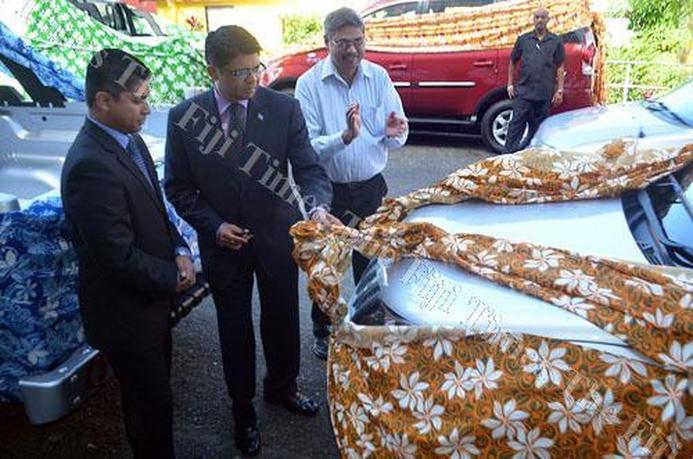
"Appan ke log ko!" - Khaiyum waives duty on 8 Mahindra vehicles worth over half a million dollars 'donated' by India for elections; Khaiyum's chums Tappoos sole distributors of 'Mahindras' and 'Kias' - also spotted doing rounds for Fiji First Party!

23/6/2014

11 Comments


WRAPPED in Secrecy: Did Indian Government 'donate' the eight vehicles or were they bought from Tappoos and shipped to Khaiyum?

Picture
“A diplomatic colleague had dinner with Indian High Commissioner Ajay Singh a few days ago.  Singh, who has made no secret of his support for the interim government's "clean up" effort, described the present Fiji environment as pay-back time...We suggested to Singh at the time of the coup that the Indian Government, the world's biggest democracy, should condemn the RFMF action. Singh argued that many Indo-Fijians were supportive of Bainimarama's efforts.  We suggested that any obvious Indo-Fijian enthusiasm for the RFMF would be playing with fire.  Since then there have been many instances of Indo-Fijians complaining to the RFMF about ethnic-Fijians and of RFMF troops then enforcing street justice with no due process.  To date, nothing has exploded into flame, but there is certainly a danger of "pay back" reversing course with tragic consequences," - US Ambassador Larry Dinger to Washington
Picture
WRAPPED in secrecy: Did Indian Government donate or was it bought off Tappoos and shipped to Khaiyum? Khaiyum, centre, unveils one of eight new Mahindra vehicles while Indian High Commissioner Vinod Kumar, right, applauds as Elections Supervisor Mohammed Saneem looks on at the Elections Office in Suva yesterday.

Picture

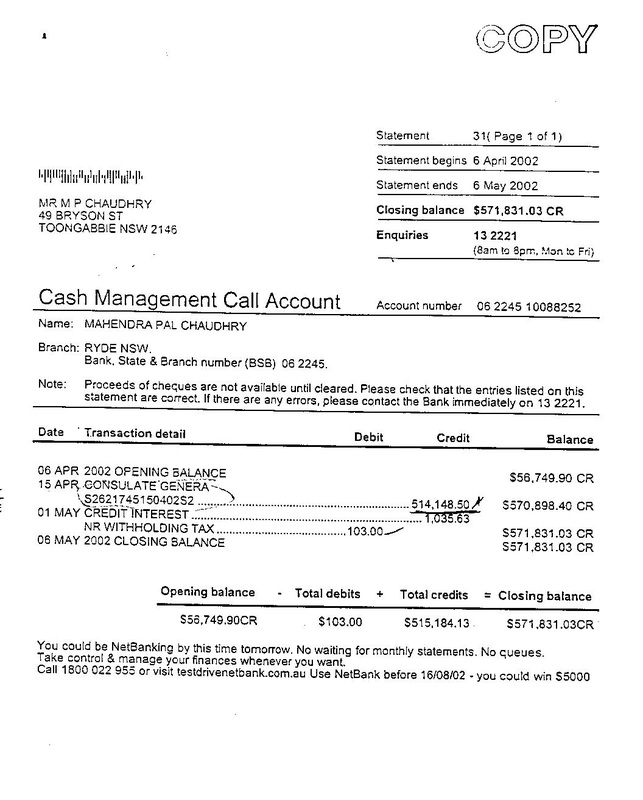
The Indian High Commissions are masters in sending secret funds:
Picture

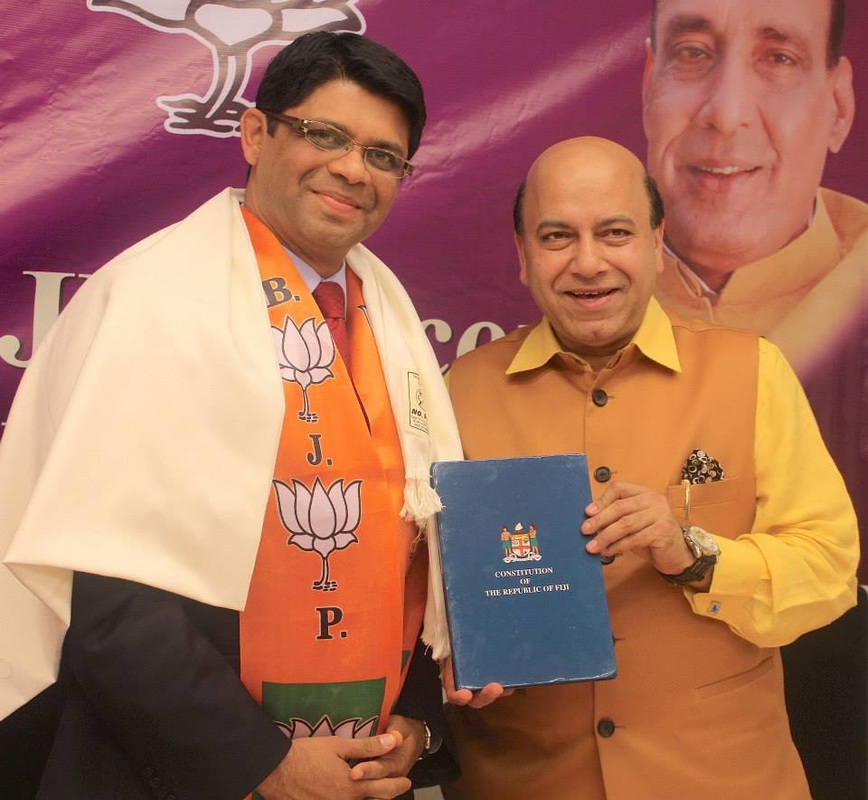
THIS MAN, Vijay Jolly, the convenor, OFBJP (Overseas Friends of BJP), the overseas wing of the present ruling Bhartiya Janta Party, seen below with Mahendra Chaudhry and recently with Khaiyum is the principal suspect linked to Chaudhry's 'Haryana millions'
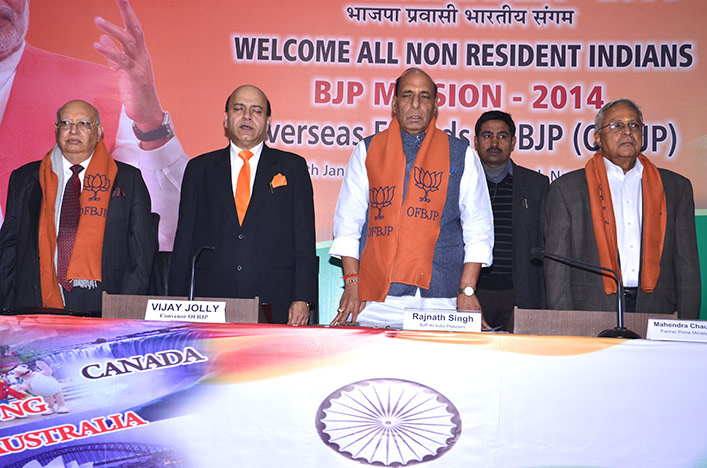
Picture
Picture
Smiling with suspect: Khaiyum is acutely aware that Jolly is implicated in Chaudhry's 'Haryana millions'
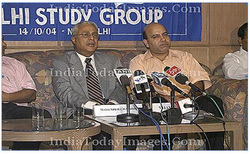
PictureJolly with Chaudhry in New Delhi, 2004
An Extract from 60 page criminal complaint filed with CID and DPP:

Perjury probe request in Mahendra Chaudhry’s affidavit before Justice Daniel Goundar in the Fiji High Court and call for other criminal investigations arising out of Mr Chaudhry’s income tax file


By VICTOR LAL and RUSSELL HUNTER, 4 September 2012


After Justice Goundar’s recent judgment Victor Lal wrote to Mr Jolly (28 August and 1 September respectively) and copied it to other Delhi Study Group office bearers, demanding answers from the Group:

Dear Vijay Jolly

Recently the Fiji Hgh Court gave a judgment in the case of Mahendra Chaudhry and the $2million he had kept in his Australian bank account without informing the Inland Revenue Department here in Fjii

In his ruling, Justice Goundar observed the following:

The applicant (Mahendra Chaudhry) has annexed to his affidavit a reference dated 12 October 2004 from an institution called Delhi Study Group, which gives some insight of the original source of the funds the applicant received. The reference reads:

“This is to confirm that funds were collected in New Delhi and other parts of India, including NRI's (Non-Resident Indians) to assist Hon'ble Mahendra Pal Chaudhry, Former Prime Minister of Fiji in 2000-2002.

The funds were intended to solely assist Hon'ble Chaudhry and his family members to establish residence in another country following the political upheaval in Fiji in May 2000, in which his life and those of his family members were threatened by terrorist elements in Fiji.

Hon Chaudhry is very popular and is held in high regard by the people of India. It was the wish to the people of India to provide Hon'ble Chaudhry financial and physical security at a time when he was bravely defending the democratic and human rights of his people. The funds collect were sent to Hon'ble Chaudhry through assistance provided by the government of India between 2000 and 2002.”

(1)  I would be very grateful if you could kindly let me know when the letter was actually written and who signed the above letter on behalf of DSG?

(2)  I know that Mahend was in New Delhi in October 2004 and was seen at a press conference organized by the Delhi Study Group, and you were also present that day

(3)  When did Mahend ask for the above letter?

(4)  Did he tell the DSG what was the purpose of the letter?

(5)  How was the funds transmitted into his Australian bank account?

(6)  And what amount was put into his bank account in Australia?


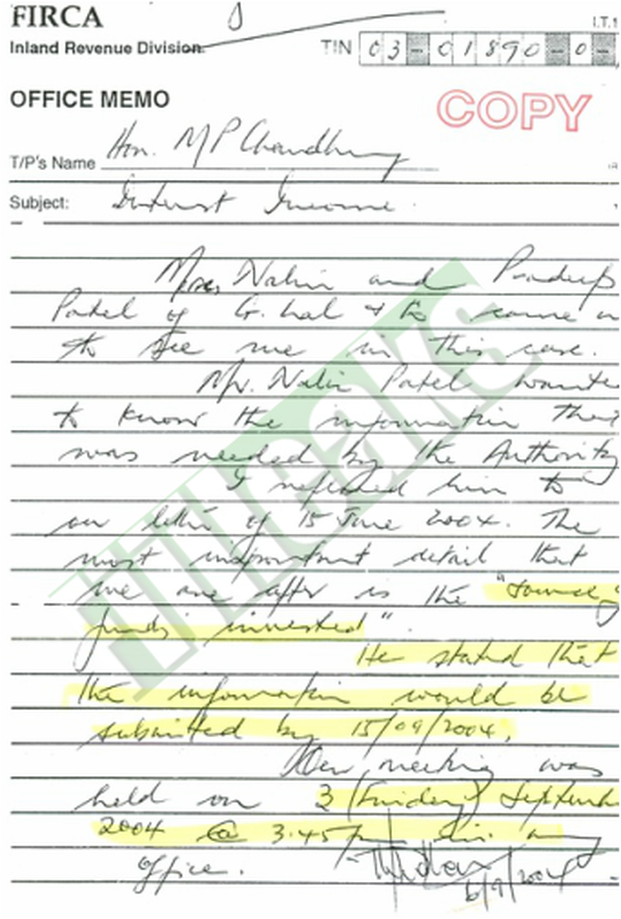
In October 2004 he had provided a very similar letter to Fiji’s tax authorities by someone called Harbhajan Lal from Haryana – see a copy of the letter dated 9 September 2004 (provided by his delegated accountant Nalin Patel)? It’s an English translation from the original which was written in Hindi.

(1)  Do you know who is Harbhajan Lal of Haryana?

(2)  I wonder if DSG and Harbhajan Lal are talking about the same amounts – nearly $2million?

(3)  Was Harbhajan Lal also part of the DSC?

(4)  Was the DSG letter in English or Hindi?


Like the mysterious Harbhajan Lal in 2008, Mr Jolly (nor the other DSG’s office bearers) have replied to Victor Lal; an Indo-Fijian acquaintance of Mr Jolly even called him at his Delhi home on our behalf but we were informed that Mr Jolly is no longer answering his home or mobile phones regarding the Delhi Study Group letter.

Extract:

Three days earlier, on 17 August 2012, Victor Lal had written to Nalin Patel:

Bula Nalin

You may recall I contacted you regarding Mahendra Chaudhry's tax details. You neither acknowledged nor replied to my set of questions that I had sent you in 2008.

To date, I have not been able to locate Harbhajan Lal in Haryana, and now Justice Goundar's judgment quotes a letter from Delhi Study Group, which was never a part of your exchanges, on behalf Mr Chaudhry, with FIRCA in 2004.

I would be very grateful if you could comment on the attachment, especially with the Prime Minister calling upon accountants to take a more active role in the Constitution making in Fiji.

When did you submit that Harbhajan Lal letter dated 9 September 2004 to FIRCA that year?

Did you have a copy of the Delhi Study Group letter dated 12 October 2004 also but chose to submit the Harbhajan Lal one?

Look forward to hearing from you.

Warm regards

Extract:

5: We call upon the Director of Public Prosecutions to ask Mr Chaudhry who transferred the money from India – Delhi Study Group based in New Delhi or Harbahajan Lal in Haryana, India?

6: We request the Director of Public Prosecutions to establish whether Mr Chaudhry and Nalin Patel, in presenting to FIRCA the letter from Harbhjan Lal, whose content was materially false [re his enquiring the details of the funds etc] –Chaudhry (and Nalin Patel) committed a criminal offence under Fiji’s tax laws by offering a false document to FIRCA, namely the Harbhajan Lal letter.

7: We request the Director of Public Prosecutions to investigate the Suva accountancy firm of G. Lal & Co, Mr Chaudhry’s delegated tax agent to deal with FIRCA in 2004, to establish whether it was aware of the inconsistencies in the Harbhajan Lal-Chaudhry correspondence regarding the $2million, and whether the accountancy firm also had in its possession the Delhi Support Group letter dated 12 October 2004.

8: We request the Director of Public Prosecutions to establish whether Mr Chaudhry and Nalin Patel submitted Harbhajan Lal’s letter knowing its content was false in material respects to prevent FIRCA from pursuing the original source of the funds in Mr Chaudhry’s Australian bank account. We call upon the Director of Public Prosecutions to ask Mr Chaudhry which of the two letters – Harbhajan Lal or Delhi Study Group – is the lie – as they both can’t be genuine. Apart from the false accusations against us in his affidavit, the contents of the Harbhajan Lal letter dated 9 September 2004 does not accord with his bank statements from the Commonwealth Bank of Australia which he offered to FIRCA.

In our humble submission we beg the Director of Prosecutions to call upon the Fiji High Court to waiver the statute of limitation for prima facie there is evidence in the “Harbhajan Lal” letter that Mr Chaudhry obtained a favourable decision from FIRCA (an oversight on the part of FIRCA tax officers) through alleged fraud – the contents of the Harbhajan Lal letter does not square with his Australian bank statements.

Moreover, although we do not have a copy of Mr Chaudhry’s affidavit cited by Jutsice Goundar (despite requests for one from the Director of the Public Prosecutions) we call upon the Director of Public Prosecutions to examine the contents of both the Harbhajan Lal and the Delhi Support Group letters.  If there are glaring disparities in the two letters than Mr Chaudhry must be deprived of the statute of limitation for the “fraud”, if any on his part, would be a continuing “fraud” since 2004 when he first offered Harbhajan Lal’s letter and now the Delhi Study Group letter in 2012 to explain away the $2million is his Australian bank account.

Cc:


Justice Anthony Gates, Chief Justice of Fiji

[email protected]

Mr Aiyaz Sayed-Khaiyum, Attorney-General and Minister for Justice

[email protected]

Mr Christopher Pryde, Director of Public Prosecutions

[email protected]

Prime Minister Commodore Voreqe Bainimarama

c/o [email protected]

Mr George Langman, Deputy Commissioner, FICAC

c/o [email protected]

Madam Nazhat Shameem, Consultant, FICAC

c/o [email protected]

Ms Elizabeth Yang, FICAC Prosecutor

[email protected]

http://www.fijileaks.com/home/election-before-justice-chaudhrys-lawyer-anand-singh-wants-fiji-court-of-appeal-to-fast-track-appeal-so-flp-leader-could-fight-election



Picture
ALL THAT SHINES IS NOT THE TRUTH: Another principal suspect iimplicated in Chaudhry's millions. Regime lackey Nalin Patel with Aiyaz Khaiyum. It is obvious why the Director of CID has not acted on Lal and Hunter's criminal complaint filed in September 2012
Picture
11 Comments

'Cry the beloved Country' says Professor Brij Lal as he analyses the crude behaviour and outbursts of Bainimarama, Khaiyum and Tikoitoga!

23/6/2014

1 Comment

 
Picture

"Aiyaz Sayed-Khaiyum characteristically continues to give moronic, self-deluding answers to difficult questions. When asked about the well-publicised videos of police brutality seen across the world, he says: ‘You know, police brutality is not confined to Fiji. I’ve got a report at home about Aboriginal deaths in custody. Does that justify what happened in Fiji? Why compare yourself with the worst of another country?"

And then there is Rear-Admiral Bainimarama. Asked about NFP leader Biman Prasad’s invitation to him for a debate on important social and economic issues facing the nation, he dodges the issue completely and relapses into his old habits. ‘He’s an Indian, without me he wouldn’t even be sticking around.’ And here I was fooled into believing that everyone was a ‘Fijian’ these days.

PictureProfessor Lal
By PROFESSOR BRIJ LAL

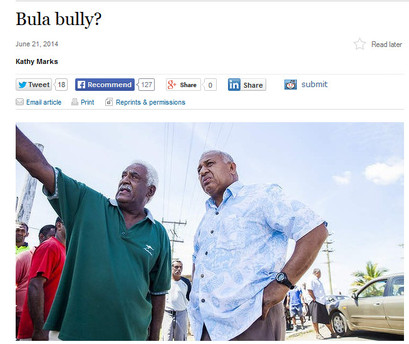
The weekend Fairfax papers in Australia carried a feature article as well as a news report on Fiji, both written by the journalist Kathy Marks. They contain little that is truly surprising, but they make for depressing reading nonetheless.

Aiyaz Sayed-Khaiyum characteristically continues to give moronic, self-deluding answers to difficult questions. When asked about the well-publicised videos of police brutality seen across the world, he says: ‘You know, police brutality is not confined to Fiji. I’ve got a report at home about Aboriginal deaths in custody.’

Does that justify what happened in Fiji? Why compare yourself with the worst of another country? What he forgot to mention is that there was an extensive and independent judicial inquiry into the tragic events here, and the perpetrators were brought to justice. An investigation was promised in Fiji, but no on one knows anything about it. Things were brushed under the carpet as Commodore Bainimarama brazenly promised to ‘stand by my men.’ And those who were convicted of murders and manslaughters soon found their way back into the community through the expedient use of the Compulsory Supervision Order.

It is for good reason that Marks describes Sayed-Khaiyum as ‘ruthless, authoritarian, and vindictive’ who actually runs the country day-to-day while Mr Bainimarama ‘swans around the islands and hobnobs with new allies.’

Brigadier General Mosese Tikiotoga
confirms what everyone in Fiji already knows only too well: that the military has tortured dissidents as the ‘lesser of the two evils,’ the other ‘evil’ being the exercise of freedom of speech, which he sees as threatening and destabilizing. There is no regret, no remorse, because that was the thing to do. And it could happen again. All to preserve the national interest, of course.

Tikoitoga is full of contradictions.  He promises that the military would ‘respect the result of the September elections.’ That’s reassuring. But in the next breath, he says, ‘the army would not tolerate an elected government re-writing the new constitution.’ So: the only result acceptable to the military would be one that elects a Bainimarama government.

What happens if the people, exercising their democratic right, want the constitution amended? Tough luck folks. After all, the 2013 constitution gives the military a guardian role in the protection of the constitution; they are the ultimate arbiters of the national interest, not the peoples elected representatives, not the parliament. There you go. The September elections may turn out to be a cruel hoax after all.

And then there is Rear-Admiral Bainimarama. Asked about NFP leader Biman Prasad’s invitation to him for a debate on important social and economic issues facing the nation, he dodges the issue completely and relapses into his old habits. ‘He’s an Indian, without me he wouldn’t even be sticking around.’ And here I was fooled into believing that everyone was a ‘Fijian’ these days.

More ominously, the Rear-Admiral cloaks himself in the garb of the nation’s saviour, indispensable to its destiny. ‘Fiji can’t afford for me to lose this election because there will be no one to keep the revolution going,’ he tells Kathy Marks. So what happens if the people of Fiji decide otherwise? Maybe a soothsayer could answer that question.

Meanwhile, in a nation gloriously marching ever so purposely towards modernity, where everyone will be equal, where there will be good and accountable government, where there is complete freedom of speech, journalists, academics, lawyers, pro-democracy activists and trade unionists continue to experience ‘official paranoia and wrath’ at hands of a regime ‘intolerant of even the slightest criticism, and unforgiving in pursuit of transgressors,’ writes Marks. Cry, the beloved country.

Brij V. Lal
Canberra


Picture
Professor Brij Lal: "What happens if the people, exercising their democratic right, want the constitution amended? Tough luck folks. After all, the 2013 constitution gives the military a guardian role in the protection of the constitution; they are the ultimate arbiters of the national interest, not the peoples elected representatives, not the parliament. There you go. The September elections may turn out to be a cruel hoax after all. "
Picture
By Kathy Marks
The Sydney Morning Herald
June 21, 2014

Having seized power in a 2006 coup, Fijian hard man Frank Bainimarama now wants to legitimise his rule via a free vote. But will anything really change?

Late afternoon in Lautoka, in Fiji's western sugar-cane belt, and the place is heaving. There must be 2000 noisy, banner-waving people camped out in the city's market square, and every one of them, it seems, wants to grasp the hand of the burly figure just arrived in their midst.

The man moving through the crush of stallholders, taxi drivers, schoolchildren and shoppers is not a rock star, but a military dictator who has ruled this Pacific nation with an iron grip for nearly eight years. For a moment, Rear Admiral (Retired) Josaia Voreqe "Frank" Bainimarama appears overwhelmed. Then he mounts a chair, megaphone in hand, and begins to speak.

On December 5, 2006, Bainimarama, commander of the Republic of Fiji Military Forces, seized power at gunpoint, overthrowing Laisenia Qarase's government and appointing himself "interim" prime minister.

It was Fiji's fourth coup in 19 years - or was it the fifth? Then, in 2009, ditching a promise to hold elections that year, he ripped up the constitution and declared martial law. Already an international pariah, the country was suspended from the Commonwealth and Pacific Islands Forum.

Fast forward to April 2014, and the mercurial leader - having announced that long-suffering Fijians will finally go to the polls on September 17 - is seeking a popular mandate. Last month, he resigned as commander; last week, he unveiled a new political party, Fiji First. Now, swapping his military fatigues for shorts and a floral shirt, he is touring the islands in a restored 1970s Bedford bus, on a mission to enlist the 5000 members required to register his party.

If his reception at Lautoka is anything to go by, the 60-year-old is a shoo-in. Although, by law, he's not yet permitted to campaign - and, as he explains to the crowd, "I don't want the other parties to send my name up to the police station!" (cue roars of laughter) - "that doesn't stop you coming to see me as your prime minister. If you have a problem, you know how to reach me." And he rattles off his mobile number, prompting a frantic scramble for pen and paper.

It's difficult to reconcile this affable showman with a regime accused of trampling human rights and brutalising its citizens. Yet this superficially enchanting country, so welcoming to visitors, is full of perplexing contradictions. And chief among them, perhaps, is Bainimarama's claim that his coup was not a coup, but a revolution, designed to create a more equal society - and a "better" democracy than the one he crushed.

The morning mist is just lifting from the jagged emerald hills flanking Rakiraki, a small town nestling in a far-flung corner of Viti Levu, Fiji's main island. In a shady spot near the bus station, Fiji First volunteers are signing up locals, including Dami Naidu, a sugar-cane farmer, who loiters in the hope of meeting the prime minister. "I just want to tell him he's doing a great job," he confides with a grin, revealing two gold teeth.

Naidu is Indo-Fijian, descended from the labourers shipped over by Britain in the 19th century to toil in the sugar plantations. That ethnic Indians - who these days dominate business and the professions - are Bainimarama's biggest fans might at first seem paradoxical, given that previous coups (in 1987 and 2000) unseated Indian-led governments, and were aimed, ostensibly, at safeguarding the rights of ethnic Fijians. This time, though, an indigenous Fijian government was ousted, and Bainimarama acted in the name of multiracialism, vowing to heal the ethnic rifts that have blighted Fiji since independence in 1970.

What about the way he grabbed power? Naidu shrugs. "He's united the whole country, Indians and Fijians, and he's helping both races, likewise." While earlier coups sparked anti-Indian violence, observes honey farmer Anil Tikaran, since 2006 "there's not that feeling all the time that something bad's going to happen ... We can live virtually without fear."

On Rakiraki's main street, I bump into Bainimarama. "Call me Frank!" he beams, before inviting me to join his battle bus, which - just like Fiji's public buses - is windowless, with vinyl seats and a deep-throated diesel engine. His wife Mary, several friends and a couple of local journalists are already on board, and, as we hit the road, his elder brother, Joe, a taxi driver, leads the way in a Toyota Crown. Like the bus, the taxi is light blue (the party colour, also the national flag's) and flaunts the Fiji First logo (a rip-off of Fiji's coat of arms).

During a two-day blitz of western Viti Levu, following a highway winding past fields of gently waving sugar cane, the dictator is mobbed by well-wishers, many of them ethnic Fijians, or iTaukei. That might seem counter-intuitive, too, because - outraging the indigenous population - he has disbanded the Great Council of Chiefs, a group of revered tribal leaders, and strong-armed the Methodist Church - to which most iTaukei belong - to stay out of politics. (The chiefs, he remarked, "should meet under a mango tree and enjoy home brew".)

Although chiefly hackles still rise at that insult, Bainimarama has redeemed himself, to a degree, by building roads and bringing water and electricity to neglected rural communities. Meanwhile, progressive policies, such as the decriminalisation of homosexuality, have gone down well with urban, educated Fijians. And, as of this year, schooling is free.

In the village of Vatukoula, the prime minister perches on a climbing frame in a children's playground to speak to locals. When Malakai Nanabalarua asks for help with a land issue, he pulls out his phone and calls the ministry in Suva. Nanabalarua is suitably impressed. "That's the kind of leadership we want," he says. A Fijian journalist tells me: "My grandmother has him on speed dial, no kidding. She calls him when the water's out."

In Ba, the birthplace of Mahendra Chaudhry, the Indo-Fijian prime minister held hostage in May 2000 for 56 days by George Speight and renegade soldiers, Shiu Kumar swears that "even if my father is standing for another party, I'll still support Bainimarama". However, another onlooker, Joseph Rogan, gives the first hint that these enthusiastic turn-outs may prove deceptive. Lowering his voice, he says: "Just because we've registered for Fiji First doesn't mean we're choosing. You can register for any party, but come the day no one knows who you vote for."

On the fringes of the crowd, an Assembly of God pastor is seething about the assault on the Council of Chiefs and the once-influential Methodist Church. The two institutions - which Bainimarama regarded as rival power bases - are the "cornerstones of Fijian culture and religion", he declares, and "if you take these away, it's like cutting off both my hands".

Day two in the west, and the prime minister is in buoyant spirits. "We're going to win this election," he tells Good Weekend. "The only question is by how much."

The poll is being spruiked as Fiji's first truly democratic election, since previous voting systems were skewed in favour of indigenous Fijians, who had become outnumbered (but now comprise about 57 per cent of a population of roughly 850,000). Fiji First's principal rival is the Social Democratic Liberal Party, or Sodelpa, founded by Laisenia Qarase, whom Bainimarama installed as prime minister in 2000 after he imposed martial law (in what was effectively a counter-coup) and resolved the hostage crisis.

Qarase won elections in 2001 and 2006, but pursued what many considered an indigenous supremacist agenda, even - to Bainimarama's fury - contemplating pardoning Speight.

Under the new constitution drafted by Bainimarama's regime - the fourth since 1970 - every citizen is a Fijian: a term previously reserved for iTaukei. "We're changing the mindsets of the people, and that's the revolution," he says, bellowing over the roar of the bus's engine.

Why did that require a military takeover, though?

"Unfortunately," he replies, "that's the only way these things can be done in Fiji."

Usually wary of the Australian media, the dictator has his guard down and is happy to chat. "Fiji can't afford for me to lose this election," he warns, "because there'll be no one to keep the revolution going. Sodelpa will come back and we'll have the same old faces and same old racist policies."

There's no risk of Qarase returning, nor Mahendra Chaudhry, still the Labour Party leader. Convicted, respectively, of corruption and fraud, following what each insists was a politically motivated prosecution, both are disqualified from standing. However, Sodelpa's candidates include Sitiveni Rabuka, the charismatic colonel who staged the nation's first coup in May 1987 (and its second four months later).

A rugby-mad former naval officer who rose through the ranks after graduating from Suva's Marist Brothers High School, Bainimarama - who spent 39 years in the military, 15 at the helm - seems genuinely colour-blind. In Nawaicoba, he tells the mainly Indian villagers, gathered in an open-air Hindu temple: "It's very important for me that my Indo-Fijian brothers endorse my party, because it's a multiracial party and I want to take all the races in Fiji forward."

Sylvester Joseph, who is on the bus tour, grew up with "Frankie" in suburban Suva. "He's a great humanitarian," he says. "And he believes in the truth - he was always like that as a young man." He also has a famously short fuse, and, some contend, is still traumatised by a mutiny in November 2000 at Queen Elizabeth Barracks, Fiji's military headquarters, during which he had to flee for his life. At the time of the 2006 coup, he was facing possible charges in relation to five rebel soldiers beaten to death after being captured.

While Bainimarama now craves legitimacy, I sense he may struggle to make the transition to elected politician. Mentioning a rival party leader who has challenged him to a debate, he snaps that "I'm the one that wants democracy here" - adding, in a reference to the 80,000 or so Indo-Fijians who emigrated following earlier coups: "He's an Indian, without me he wouldn't even be sticking around." He also recounts how a European Union commissioner offered him €500 million ($732 million) in aid if he held elections. "I said, 'You think Fiji is like some African country, and every time we have a coup you just give us money?' I nearly hit him over the head with a bottle of Fiji Water."

This evening he's invited to a village meeting in Saunaka, near Nadi, where "most of the big chiefs in the west are going to give me their support". In the event, only two chiefs turn up, but they present him with a tabua, or whale's tooth, and a choir serenades him with mellifluous Methodist hymns. Finally, in one of the more surreal moments of my time in Fiji, dozens of villagers line up to greet him, shuffling towards him on their knees.

Emerging much later, dreamily elated, he sighs: "I could have sat there and drunk kava all night, I was so happy." Then he laughs and declares: "If I was leader of an opposition party, I would give up now."

It's May 2013, and the Coca-Cola games, a schools athletics competition, are under way at Suva's ANZ Stadium. During Fiji TV's live coverage, its sports editor, Satish Narayan, grumbles about the loud music being played during races, and remarks that "CEO Litiana should do something about it". "CEO Litiana" is Litiana Loabuka, eldest daughter of Bainimarama and chief executive of the Fiji Sports Council, which runs the stadium - and Loabuka is livid. An apology, broadcast during a prime-time bulletin, fails to appease her. A month later, reportedly after her father threatens to strip Fiji TV of its licence, Narayan quits.

It's a minor incident, relatively speaking, yet it illustrates the regime's mentality: intolerant of even the slightest criticism, and unforgiving in pursuit of transgressors. Privately owned Fiji TV is a favourite target - the station was forced to fire a respected reporter, Anish Chand, only in May - and so is The Fiji Times newspaper, fined $F300,000 ($175,000) last year for publishing a claim that the country has "no [credible] judiciary". (Fiji's judges were dismissed in 2009 and replaced with pliant appointees, many from Sri Lanka.)

Not only journalists, but lawyers, academics and trade unionists have experienced official paranoia and wrath; so have civil society groups, opposition politicians and pro-democracy activists. A casual remark at a party, followed by a call to his employer, led to a lowly clerk being sacked; businesses can't afford to upset Bainimarama or his attorney-general, Aiyaz Sayed-Khaiyum. An economics professor, Wadan Narsey, says he was forced to resign from the University of the South Pacific after the authorities threatened to withhold funding. "People are terrified of being labelled anti-government," says Ricardo Morris, editor of the independent Repúblika magazine.

Perceived troublemakers are placed under surveillance, serially arrested, harassed by intelligence officers and banned from travelling overseas. Increasingly, the courts are also used to persecute opponents. In 2010, a renowned human-rights lawyer, Imrana Jalal, was charged with licencing infractions at her husband's Suva cafe, of which she was a director. A magistrate who queried the case - normally it would be dealt with by a city council - was fired; it was then, bizarrely, sent up to the High Court, which threw it out, but only after months of worry and legal bills for Jalal. She left Fiji, effectively driven out.

And then there are old-fashioned bully-boy tactics. On Christmas Eve 2006, the head of the Fiji Women's Rights Movement, Virisila Buadromo, was hauled up to Queen Elizabeth Barracks, where she was screamed at, punched, kicked, stamped on and made to lick soldiers' boots. Holding a pistol to her head, two officers told her: "We could kill you right now and put you in an oil drum out on the reef." Since then, countless other regime critics have endured similar treatment - and far worse - in military custody, with several deaths recorded. At the sugar mill in Ba, Felix Anthony, national secretary of the Fiji Trades Union Congress, was beaten up, along with his deputy, by military officers, after being sworn at by a "very agitated" Bainimarama, who threatened to "pour kerosene over us and burn us".

In Aiyaz Sayed-Khaiyum's spacious office overlooking Suva Harbour, I ask him about footage that surfaced last year of police beating and torturing two prisoners. The prime minister's right-hand man - and the author of hundreds of repressive decrees which will remain in force after the election - looks pained. "You know," he observes, "police brutality is not confined to Fiji. I've got a report at home about Aboriginal deaths in custody."

Ruthless, authoritarian, vindictive - these are some of the politer words used about the attorney-general, who performs the day-to-day business of governing while Bainimarama swans around the islands and hobnobs with new allies, including the Chinese. Editors dread a phone call from the Australian-educated Sayed-Khaiyum, who is rarely seen without bodyguards in tow. "One holds his coat, another his bottle of water, another his files," claims one local.

For all their talk of transparency and accountability, he and Bainimarama - who cited rampant corruption as one reason for his coup - refuse to divulge their salaries. It's been years since an auditor-general's report was published, and when I ask Fijians whether the government heeds its own anti-graft message, they guffaw. Rumours of dodgy tenders, foreign bank accounts and luxury properties are just rumours, obviously. And it was, surely, on merit alone that the dictator's daughter got her plum Sports Council job and his brother-in-law was given a ministry to run after being jailed for manslaughter.

The real power in Fiji rests, of course, with the military, now headed by Bainimarama's hand-picked successor, Brigadier-General Mosese Tikoitoga - and the question is: after running the country for nearly eight years, is the military really willing to relinquish control? What if Bainimarama loses the election? What if he concocts an excuse to call in the troops? Will Tikoitoga, who has praised his former boss as "guided by God", oblige?

Reclining in a gold striped armchair in his office at Strategic Headquarters, the urbane new commander tells Good Weekend that although "the prime minister is a very personal friend of mine, and we still enjoy each other's company after a few drinks ... I've made it very clear that the military has to stay out of politics now. We've gone back to barracks to await the election result ... I've also told the chief of police that it's no longer a case of pick up the phone and call the army to set up a roadblock or sort out a crowd." He pauses. "And we will not have another coup, as such - that's quite definite."

That's settled, then - or is it? Rather ominously, Tikoitoga adds that the military "will support an elected government as long as it respects the constitution ... I say that because a lot of the parties are going about saying they're going to change the constitution ... They think they can just come in and throw it away."

Like in any democracy, an elected government will be entitled to rewrite the constitution, and I wonder if he's worried about the provision that grants "absolute and unconditional immunity" to all regime figures in relation to 2006 and everything since.

Ruminating on recent Fijian history, the brigadier-general makes it clear that he believes the military rescued the nation from the brink following Speight's coup, when armed mobs rampaged through Suva, looting and burning, and terrorised Indo-Fijian farmers in rural areas. "We saw a very dark side of Fiji, and we don't want a revisit of that," he says. "That's how ethnic cleansing begins."

The 2006 coup, on the other hand, was "the revolution we had to go through ... to create a Fiji for all Fijians". There's that argument again, yet as Roshika Deo, an independent candidate, points out: "Democracy is not something you force on me at gunpoint, it's got to be made by the people of Fiji." For all the rhetoric, moreover, the military still consists almost exclusively of iTaukei - as does the public service, as does the cabinet. When I relay to Tikoitoga a story about an Indo-Fijian who, on applying to join the army, was asked, "But do you eat beef?" Tikoitoga looks sorrowful, and reveals that he's a vegetarian himself.

According to the opinion polls, Bainimarama enjoys a stratospheric popularity rating of 66 to 83 per cent. While some are sceptical of those figures, there seems little question he will poll strongly in September, particularly with the regime tightly controlling everything from party membership to funding and campaigning - while brazenly flouting its own decrees.

In spite of international input - Australia will co-lead the observer mission - many Fijians doubt the elections will be free and fair, and they accuse Australia and New Zealand of jumping the gun when they lifted travel sanctions against the dictatorship in March. Trade union leader Felix Anthony asks: "How can elections be free and fair when there's no free media, when trade unions are excluded from political life and debate, when [civil society groups] have stiff restrictions on them, when people simply don't feel free to speak out?"

Among indigenous Fijians, claims Laisenia Qarase, "the anger is building up inside and I wouldn't be surprised if there'll be an explosion ... If they manipulate the election, that could be the trigger." Others question whether the election will even take place. "Don't underestimate their capacity for bloody-mindedness," cautions one insider. "The slightest pretext, and they could flick their nose at the international community."

Notwithstanding Tikoitoga's (somewhat ambiguous) reassurances, fears of another coup still loom large. "It's 50-50," predicts Sitiveni Rabuka, who knows a thing or two about coups - and who professes, now, to regret his own hot-headedness. "At the time I felt it was the right thing to do," he explains over a pot of tea on the pool terrace of Suva's Holiday Inn. "But then others tried to follow the same path, and I thought, 'My goodness, what on earth have I started?' That's why I'm standing for election again. People keep blaming me for this coup culture, so I thought I'd better try to correct it."

The instability has played havoc with the economy - more than half of Fijians now live below the poverty line - as well as precipitating another exodus of educated and affluent Indo-Fijians. Rabuka, who made the leap to prime minister in the 1990s, calls this election "a defining moment", while Mahendra Chaudhry warns that "the nation is already on a disaster path, and if these people get in again, it will be completely ruined ... We'll have a dictatorship here in the guise of a democracy." 

Troubled paradise

1987: Colonel Sitiveni Rabuka stages two coups.

May 2000: Fiji's first ethnic Indian prime minister, Mahendra Chaudhry, and cabinet taken hostage by George Speight. Military commander Frank Bainimarama declares martial law, negotiates the hostages' release after 56 days.

December 2006: Bainimarama overthrows Laisenia Qarase's government, establishes a military regime.

April 2009: After Fiji's Court of Appeal rules the coup illegal, Bainimarama abrogates constitution, institutes emergency rule.

March 2014: Bainimarama resigns from military, unveils his new political party, Fiji First.

September 17, 2014: First democratic election for eight years.

Picture
Picture
Fiji military leader admits beatings, torture

By Kathy Marks

As Fiji prepares for its first elections in eight years, the new head of the all-powerful armed forces has admitted that citizens have been beaten and tortured by the military regime, claiming it was necessary to stave off civil disorder.

“I wouldn’t deny that these things happened,” said Brigadier-General Mosese Tikoitoga, hand-picked successor of Frank Bainimarama, who has stepped down from the military to contest the elections. “But a lot of these people were actually trying to instigate violence by creating anti-government movements or militant groups.

“They were talking on the radio and so on … If you let them continue to have a voice, you create a potentially dangerous environment. So it was the lesser of two devils.”

In his first interview with an overseas media organisation since taking over as commander in March, General Tikoitoga also vowed that the military would respect the result of the September 17 election. “We will not have another coup, as such – that’s quite definite,” he said.

However, the army would not tolerate an elected government rewriting the new constitution, he said. The constitution – drafted by the regime of self-appointed Prime Minister Mr Bainimarama, and Fiji’s fourth such document in 34 years – grants immunity from prosecution to everyone involved in the December 2006 coup.

Opinion polls suggest Mr Bainimarama – who has founded his own political party, Fiji First – will win the most seats, although analysts predict he may have to govern in coalition. The dictator enjoys widespread popularity, thanks to a rural development program and the introduction of free education in public schools.

Indo-Fijians – the victims of racially motivated violence following earlier coups – are also keen on Mr Bainimarama, who ousted an indigenous Fijian government in 2006. The prime minister claims that his armed takeover was  a “revolution” aimed at healing Fiji’s long-standing racial divisions, as well as stamping out corruption.

Travelling the islands recently to recruit members for Fiji First, Mr Bainimarama said: “Fiji can’t afford for me to lose this election, because there’ll be no one to keep the revolution going. Sodelpa [the Social Democratic Liberal Party, which he threw out of power] will come back and we’ll have the same old faces and same old racist policies.”

Mr Bainimarama also declared that he “couldn’t give two hoots” whether Australia and New Zealand, which recently lifted travel sanctions against the dictatorship, welcomed Fiji back into the diplomatic fold.

Expelled from the Commonwealth and Pacific Islands Forum, the coup-ridden nation has forged new alliances with China, India and Indonesia and “we’re not going to blow them out now … They’ve been our friends, true friends,” he said:
http://www.smh.com.au/world/fiji-military-leader-admits-beatings-torture-20140620-zsg90.html#ixzz35RxfjxpJ

Picture
1 Comment

Indigenous Pitch: As Vakatora claims to Fijileaks he paid his debt in full before becoming CEO of ATH, his party leader Ro Kepa reminds native Fijian voters of the regime's destruction of all things Fijian since 2006

15/6/2014

8 Comments


"Why is the indigenous community shut out and  discriminated against?  If we fail, the consequences for our small ethnic community cannot be calculated. Keep in mind that there are only some 500,000 indigenous  Fijians on this earth! But we will succeed with the backing of the people, and the support of post-election coalition partners" - Ro Kepa

PictureParty leader Kepa
"Executives, candidates, members and Friends and guests of the Social Democratic Liberal Party, executives, members our candidates.  

This is indeed a momentous day for SODELPA and for Fiji. We gather today to   introduce to you the majority of our candidates to contest the general elections, as we fight to determine the future of Fiji and her people. The delay in announcing others is related to their resignations from the posts they presently hold and their need to fulfill contractual obligations. When the candidates making their debut today have been officially endorsed they will begin to move out to all parts of Fiji carrying our banner reflecting what we believe to be the important messages for all voters.

Although we will not be launching our manifesto until July 7th our Parliamentary candidates understand all too well the task ahead presenting  the framework and thrust of our main policies.
From December 2006, Bainimarama and Khaiyum have been reshaping Fiji in line with their thinking, their laws and their personal interests and aspirations.  Much of what they have done is consistent with the commentary and ideas in an academic thesis on Fijian indigenous culture written by Aiyaz Sayed-Khaiyum.  
I have read some of it and can understand why it has been characterized as a roadmap for the marginalization of Fijians, their chiefs, and their culture.  

The Bainimarama-Khaiyum regime has yet to complete its project for remaking Fiji.  But they are pushing it forward. Witness the way indigenous Fijian students have been grossly disadvantaged in the award of national tertiary education scholarships. Witness, too, the humiliating and unwarranted way certain Fijian public officers who had expressed genuine concerns about this, have been summarily removed from their positions. There was no regard for their legitimate and fundamental rights as citizens. And yet we are constantly being told that everyone is equal in Fiji in their rights and before the law.

Ladies and gentlemen, and fellow SODELPA candidates

It is our task to stop the Khaiyum thesis project as soon as we can and reclaim the country the regime is intent on taking from us.  We see this as a sacred cause; we must defend our way of life, our culture and traditions. MEDA TAQOMAKA NA NODA VAKALIUCA NA KALOU, NA NODA I VAKABULA O JISU KARISITO, NA NODA LOTU, NA NODA QELE, NA NODA VANUA, NA NODA I YAU VAKAMAREQETI. E LEVU VEI IRA SA RA LIU YANI ERA A TAGICA TU NA KENA A MAI TAURI NA NODRA QELE.   SA NODA I TAVI MEDA TAQOMAKA NA VEIKA VAKAITAUKEI WILI KINA NA KENA VAKALESUI MAI NA BOSE LEVU VAKATURAGA.

If we fail, the consequences for our small ethnic community cannot be calculated. Keep in mind that there are only some 500,000 indigenous  Fijians on this earth! But we will succeed with the backing of the people, and the support of post-election coalition partners. And here, let me reassure all communities in Fiji that SODELPA is committed to co-operating with all our citizens to overcome   the consequences of a complex colonial history of ethnic separation.   Just 44 years into independence, we are still constructing this nation; it is a work in progress. We must come together to strengthen social cohesion, to deepen tolerance and respect, and to forge a greater national unity from our diversity. But all this cannot be imposed and it cannot be forced upon us by oppressive and restrictive decrees.

Ladies and gentlemen, and colleagues, We live in an era of global interdependence. Nations and people are connected in new ways and by new technologies. We cannot tell Australia and New Zealand that they are not welcome in the Pacific Islands Forum when they are essential in the lifeblood of our economy. They are our most valuable partners in trade, investment, tourism and development support. We should be doing all we can to build stronger long- lasting and mutually beneficial ties. We need them, other neighbours and allies, and the European Union, in our endeavours to modernize and expand our economy. We need them to help us give our children not just free education, but the best in the quality of education. Similarly we require support from overseas to create quality jobs for thousands of our young people entering the labour market every year.  

The heart of the message we will take to our people is that SODELPA seeks a Fiji revived, a Fiji renewed and radiant; a Fiji of full employment and opportunity where people can lift themselves out of poverty. We seek a nation united and happy in its distinctive diversity, a Fiji that says to the world: We are again a symbol of hope for humankind. We see a free Fiji of equality and just laws, well-governed through the collective authority of a cabinet that is representative of our communities, and answerable to parliament and the people. In our Fiji, the citizenry will possess the constituent power of the state; their voices will be heard.
Together with partners in Cabinet and our respective Members of Parliament, we shall undertake a review of the Constitution.

The starting point is to ask the Supreme Court for an advisory opinion on the status in law of the 1997 Constitution. In this review, there will be full consultations throughout Fiji, so that the outcome is a constitution the people can truly describe as their own. That is true democracy and the true pathway to returning Fiji to the rule of law. A SODELPA government and cabinet will be based on collective consensus and mutual respect in the time-honoured way of the best of our Fijian traditions. There will be no place at all for dictatorial national decision-making dominated by two men. On the crucial issue of a lasting solution to agricultural leases under ALTA, SODELPA will consult closely with its Cabinet partners and with the Opposition in Parliament. There must be a just and fair solution both to the landowners and the tenants.

The SODELPA manifesto has numerous policies for repairing the damage of dictatorial rule and proposals for rebuilding Fiji now, and for our children and generations to follow. All will be revealed at the manifesto launch on July 7th. But I can tell you that our priorities include helping those who are reaping the bitter harvest of poverty and unemployment. Never have so many people been poor; never have so many been without jobs and incomes. Never has there been a greater need to enact measures to put food on the table and provide work for those in need. SODELPA is up for the challenge.  If the people give us the votes we require to form government we will begin 100 days of emergency action to get the country back on course and to bring initial relief to ease the burdens of the masses.

We are committed to bringing relief also to those whose lives are disrupted regularly by power and water cuts and who are denied other basic services that are their right.  Rectifying these problems will take time, but you can be assured, we will be engaged on finding solutions from day one. We will invest in the ailing, deteriorating health system that tests the patience of the pubic every day and that cannot properly meet their medical and clinical needs. There is more, much more. What I have just mentioned are the pressing concerns that require urgent attention. We cannot produce miracles; but we can promise that in government we will bring a high level of commitment and energy to restoring Fiji.

I also assure the nation that we will offer a style of leadership and a moral and ethical code that is very different from the authoritarianism, the vindictiveness, the bungling and the secrecy of the regime. We will be open, fair, consultative, compassionate and just.That is the difference we stand for. Consider just some of the things we have experienced and witnessed at the hands of the Bainimarama-Khaiyum leadership. They took aim at the Great Council of Chiefs, which opposed their military coup and declined to support their nomination for a vice president. The GCC therefore became an obstacle to their project and ambitions.  The chiefs were insulted and treated with contempt.  The GCC was dismantled and banned.

SODELPA will reinstate the GCC and let the chiefs and people determine its future in the light of history, experience, identity and tradition. There lies the difference between SODELPA and the regime. They robbed all of us of our liberties and freedoms and denied us certain legal rights. We are still subject to oppressive decrees . Where the genuine rule of law prevails, laws are enacted for the general good.  In a dictatorial regime laws are often decreed in order to protect the few and to target particular sections of society, including trade unions, the media, and opponents.  

Today I bring to the attention of the nation a question which says much about the regime. I declare now that as one of our first acts in Government, oppressive and restrictive decrees and policies of spite and vindictiveness will be cast out. They do not belong in the Fiji of our future. So tell the people that we are different and they can trust us to bring lasting and fair changes. A SODELPA Government will return all authority for dealing with indigenous Fijian land issues to the native Lands Trust Board and abolish the Land Use Decree. The Decree gives dictatorial authority to the prime minister. The landowners have no right to challenge his decisions in court if they feel those decisions  are not  in the best interests of their mataqali.  On the other hand , owners of freehold have access to the courts to protect their interests.

Why is the indigenous community shut out and  discriminated against?  

We will review the policy on landowner consultations.  If, after wide discussions with them it becomes clear they are not happy about the fairness of the current policy of obtaining the consent of only 60 percent of the landowners for a dealing on indigenous Fijian land, we will change that policy. The security and needs of the landowners must always be the paramount consideration.

And we will also review the current policy on poundage deductions on lease rent incomes.
We shall reduce the deduction by requiring Government to pay for the surveys and demarcation of land made available by the owners for leasing and for the general economic benefit of the nation. We will continue what Prime Minister Qarase’s government started with indigenous landowners at Nadi airport. This is to pay to the original landowners the rent that is being paid for their land which was acquired, but is no longer used for a public purpose.

Here again, you can see the difference between SODELPA and the current Bainimarama and Khaiyum regime.
The regime withheld the Auditor General’s reports, thus denying the people the right of full disclosure of government finances, especially before an election.  Bainimarama-Khaiyum will soon have spent nearly $15 billion of our money, without properly accounting publicly for a single dollar of it.

The latest vote-buying strategy is the promotion of their housing grant subsidy offered to individuals or couples buying or building new homes if their combined income is not more than  $50,000 a year. It cannot be coincidence that this is being pushed only three months before the elections. The 2007 national population census showed that the majority of the Fijians now reside in urban and peri-urban areas. It also showed that the biggest urban-based family units in terms of numbers per family are Fijians.

I wonder how many of these Fijian families will benefit from this housing assistance scheme? Are we going to see the same unjust outcome as the national scholarship scheme? We will publicise all the Auditor General’s reports and operate an accountable and open government.  And we will table in Parliament for all to see full details of the distribution of the benefits of this government’s policies in education, housing and various welfare support assistance schemes.That is the difference we in SODELPA and our partners in Cabinet  will represent.
The regime uses fear as a tool of control.  Bainimarama-Khaiyum have stayed silent on the fear question.  The reason is clear: fear serves their purpose, their desire to dominate and command.

SODELPA intends to rid Fiji of the fear they have created and which prevails in the country today. That is the difference we and our partners in Cabinet will bring. Voreqe Bainimarama has refused to renounce violence. It is an article of faith for SODELPA that solutions to a nation’s challenges cannot be reached through violent acts and illegality.  We believe in the peaceful, democratic power of the people and the application of the law.

Note well the difference.

Bainimarama-Khaiyum got several thousand pensioners in their sights and, in collaboration with the FNPF, unjustly slashed their contractual payments and then refused them the right of legal redress. They went after a group of former members of parliament and enacted a decree to stop their pensions.  I declare my interest.  I was one of the victims.  There is a suspicion they acted in this way as a warning to us to behave ourselves. When they decided to resume payments they left amounts still owing.

I declare today that SODELPA will never, ever target and penalise pensioners.  We will treat them with respect. We are sympathetic to restoring pensions that were cut or alternatively providing some form of compensation.  Again, I declare my interest and will act accordingly at the right time. The voters can see the difference between us on pensioners’ rights.  Just recently we heard through the media about Tamanirarama Jone, a student who lost his scholarship because he exercised his right to be associated with a political cause. It appeared to be an act of intimidation; the message to other young scholarship holders was clear. This mean action by the regime’s scholarship board left that boy and his single mother, Sereima Kidia, in distress. For 19 days they were twisting in the wind. An anguished Sereima pleaded publicly for her son to be forgiven.  I wondered then what our country was coming to when a mother had to seek forgiveness for her son when he had done nothing wrong.  Finally someone, somewhere relented, and Tamanirarama was told his scholarship would be reinstated. The explanation for what had happened was not persuasive or clear. This episode is still  surrounded by confusion.  The truth is elusive.

SODELPA says Sereima and Tamanirarama are owed a full apology by the scholarship committee and from the regime. That is what a SODELPA Government would have done. That is the difference we offer. When you are in the wrong, apologise. In any case, we would never have attached a political restriction as a condition for the grant of a publicly funded scholarship.  The right to free speech, free association and free assembly is a fundamental human right. I could go on at greater length highlighting the points of difference separating SODELPA from the Bainimarama-Khaiyum government. But let me offer just one more example. We are all familiar with the complete mess the regime has made of introducing its unpopular e-ticketing scheme for bus fares. Confusion still reigns. What has probably not been noticed is a detail buried in a statement last year from the Fiji Bus Operators Association.  

They disclosed that passengers failing to obtain and retain a ticket can be fined $500 and sent to prison for up to five months! Think about that for a moment. An absent-minded Bubu, or a housewife loaded down with shopping, might easily lose a ticket. Under this law they could end up in prison! Where else in the world would this happen?  This is not the Fiji we know.  It is not the Fiji we want. It  is  the Fiji of  Khaiyum’s law. SODELPA is with the Bubus and the housewives. We will scrap this extreme legislation.

That, once more, is the difference.
Ladies and gentlemen, I return now to the agenda of the day - the announcement of election candidates. We had over 100 applicants; they were interviewed over a period of several weeks by a selection committee. The committee worked on a points system linked to criteria designed to assist the party in its decisions. Hard choices had to be made because of the overall high quality of the contenders. The result is a representative group with the qualities, the skills and the experience required for forming a stable and effective government and strong cabinet.  Importantly, eight have served in parliament previously. They will give the newcomers the benefit of their knowledge of parliamentary procedures.

The candidates come from many parts of Fiji and will campaign in designated areas so we can retain the concept of  “local” members, which is a cornerstone of representative democracy.
I am very proud of the calibre of our line-up. The people of Fiji can feel confident they are worthy representatives to look after their interests in parliament.

And now candidates will be called to step forward.

Today they receive their commissions and call to service from SODELPA. It is a summons to national duty.
They march under the SODELPA banner. But their mission is to serve all the people, all communities, and all sections of our society, wherever they live. For all those who applied and could not be accommodated, I say thank you for your assurances of continuing support. We shall explore other ways through which we can enlist your help in the service of our nation.

Thank you for listening. God Bless you all.
On to victory!


The Khaiyum Thesis on how to destroy Fijian culture
8 Comments

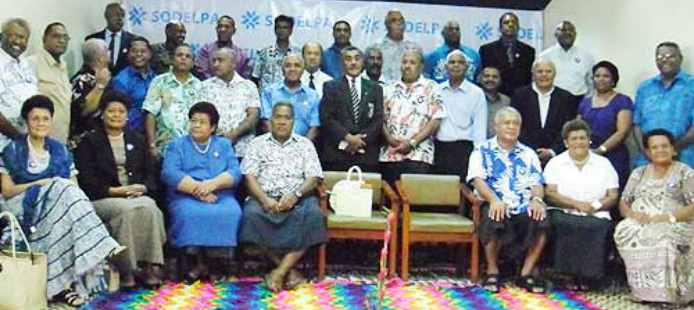
TEAM SODELPA: Party unveils over 40 candidates for September poll; PDP defector Nirmal Singh and NFB debtor Vakatora chasing for votes!

14/6/2014

8 Comments

 
Picture
FIJI's Social Democratic Liberal Party (SODELPA) has announced 44 of their nominations for candidates to contest the September 17 election under its banner. The nominees were unveiled today in Suva and endorsed by members present. SODELPA nomination for candidates to be submitted to the Fijian Elections Office:
Ro Teimumu Kepa,
Rt Viliame Tagivetaua,
Rt Naiqama Lalabalavu,
Josefa Dulakiverata,
Rt Suliano Matanitobua,
Mikaele Leawere,
Kiniviliame Kiliraki,
Luke Ratuvuki,
Nanise Nagusuca,
Rt Viliame Niumataiwalu,
Anare Jale,
Anare Vadei,
Rt Sela Nanovo,
Rt Isoa Tikoca,
Viliame Gavoka,
Sitiveni Loco,
Niko Nawaikula,
Jeremaia Namuaira,
Rt Osea Bolawaqatabu,

Simione Drole,
Iosefo Nainima,
Rt Jone Kubuabola,
Dr Tupeni Baba,
Pio Tabaiwalu,
Dr Mere Samisoni,
Losena Salabula,
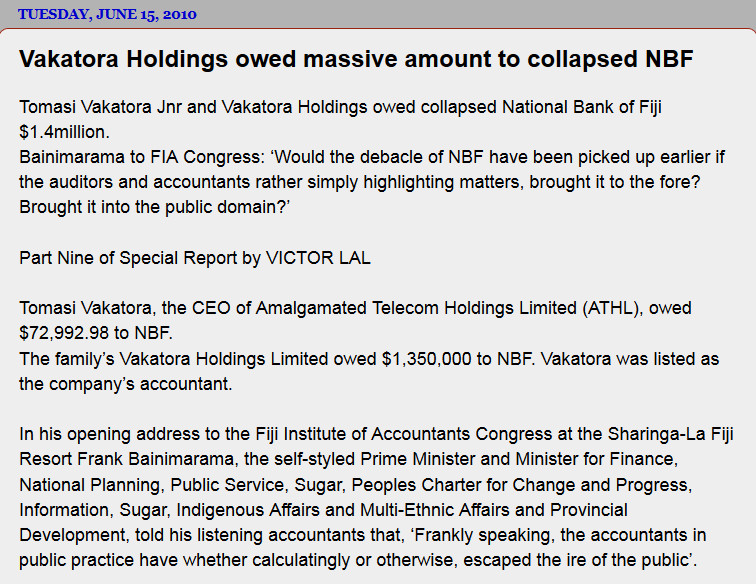
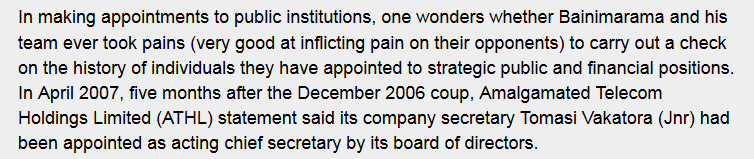
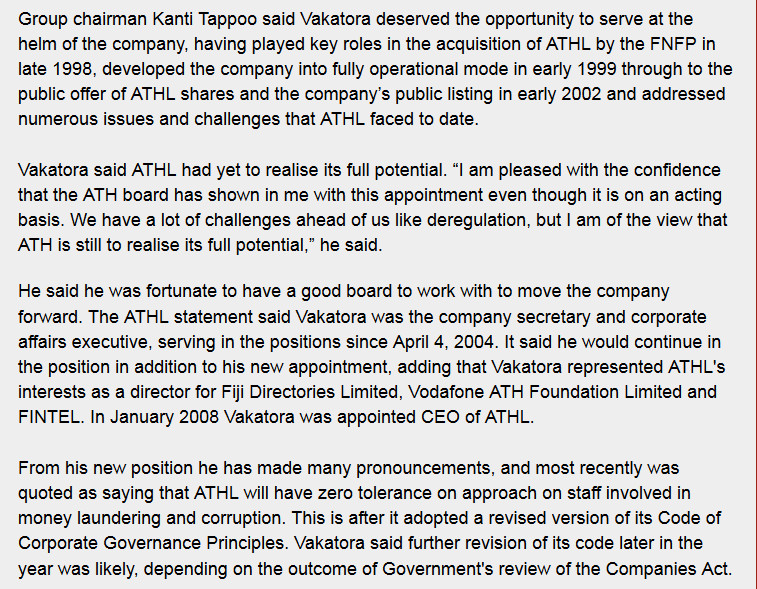
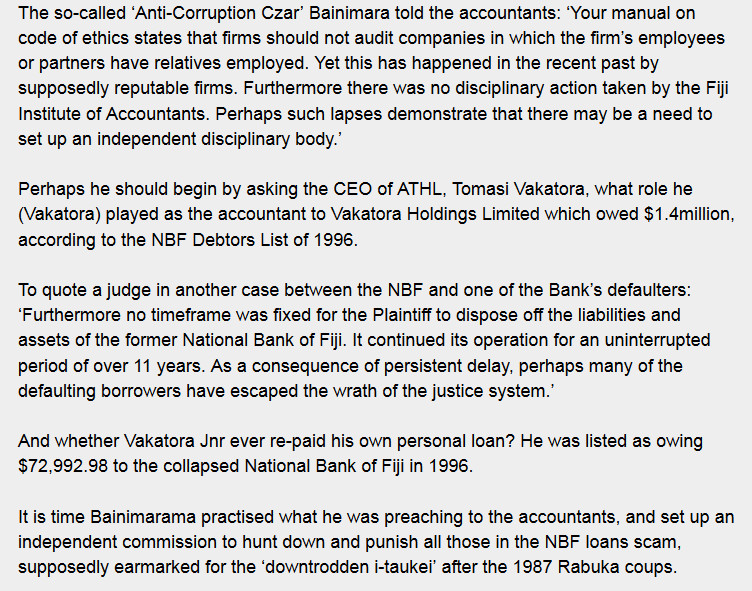
Tomasi Vakatora,
Salote Radrodro,
Penina Ravulo,
Mitieli Bulunauca,
Laisani Qaqanilawa,
Parayame Cakacaka,
Semesa Karavaki,
Samu Saumatua,
Simione Rasova,
Rt Jone Bouwalu,
Marika Lewaqai,
Rt Nemia Vainitoba,
Viliame Satala,
Mick Beddoes,
Abdul Sahim Cavalevu,
Sushil Shudhkar,
Nirmal Singh, and George Shiu Raj.
Six more names will be released later. Source: http://fijilive.com/news/2014/06/sodelpa-unveils-44-nominations-for-election/57969.Fijilive
Picture

The Rabuka Precedent: NBF debtor Vakatora should be stripped of his candidacy, for Rabuka was refused Sodelpa ticket for his 'coup' past: http://www.fijileaks.com/home/sodelpas-vengeful-hounding-of-coupist-sitiveni-rabuka-will-backfire-as-mick-beddoes-waqavonovono-et-al-and-womens-wing-claim-scalp;

http://www.fijileaks.com/home/former-opposition-leader-mick-beddoes-response-to-sitiveni-rabukas-claims-that-his-recent-opinion-piece-was-responsible-for-rabukas-difficulties-with-sodelpa
Picture
Picture
Picture
Picture
Picture
Fijileaks Editor: Tomasi Vakatora Jnr is yet to inform Victor Lal if he cleared his NBF debts.

See Full Report at Coupfourpointfive: http://www.coupfourandahalf.com/2010/06/vakatori-holdings-owed-massive-amount.html
Picture
8 Comments

NBF Debtor Ema Druavesi sings praise of party: "I support FijiFirst Party of Bainimarama"; both Druavesi and Dictator have short memory of what he told voters about the debtors: 'They ripped off their fellow Fijians'!

14/6/2014

4 Comments


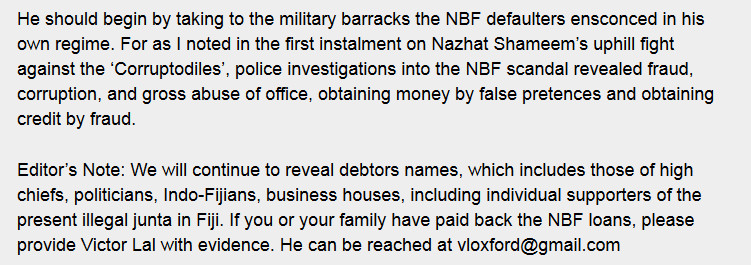
In February 2014, Bainimarama had warned voters against politicians and hangers-on responsible for the infamous National Bank of Fiji (NBF) scandal: “Now, some of those same politicians and hangers-on who were responsible for this scandal – and others who benefited personally – are seeking your vote in the forthcoming general election. They are relying on you having short memories. They are treating you as if you are stupid. I urge you to call their bluff and consign them to the political dustbin of history.  With their noses stuck firmly in the trough, this elite – aided by a grossly irresponsible management and board – raided the National Bank of Fiji for loans that many had no intention of repaying. They ripped off their fellow Fijians...The funds of ordinary Fijians were misappropriated. These elites effectively robbed their own countrymen and women – decent, hardworking ordinary people who had put their trust in the Bank and the Government.”
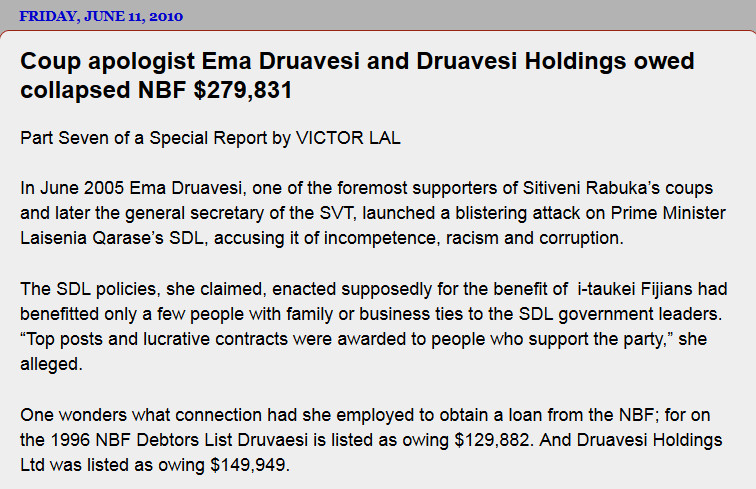
One of the NBF debtors has joined his political bandwagon: The former party secretary of the Soqosoqo ni Vakavulewa ni Taukei (SVT), Ema Druavesi, says she supports Bainimarama/Khaiyum's FjiFirst Party; Fiji's ambassador to Geneva and former High Court judge Nazhat Shameem, who had led an uphill fight as DDP Prosecutor to bring the debtors to justice, found the NBF scandal revealed fraud, corruption, and gross abuse of office, obtaining money by false pretences and obtaining credit by fraud; see Victor Lal: _http://www.coupfourandahalf.com/2010/05/fnpf-saga-and-ghost-of-collapsed.html

Picture
See Full Report at Coupfourpointfive: http://www.coupfourandahalf.com/2010/06/coup-apologist-ema-druavesi-and.html
4 Comments

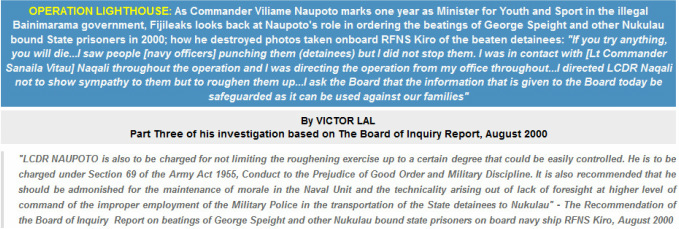
PARTNERS IN CRIME TO POWER SEEKERS: Bainimarama greets fellow fugitive from law Naupoto as he accuses Fiji  Times (NOT FIJI SUN) of bias and FT owner Motibhai of hiding in Australia from justice in Fiji!

13/6/2014

1 Comment

 
Picture
PACK OF LIARS: Bainimarama accuses Fiji Times of lying and yet his own A-G and Minister for Elections Aiyaz Khaiyum lied on his US Visa Form! Watch Shazzer Grubby video.WARNING WARNING WARNING: If you believe in a Free Press do not watch this video. It includes a long rant attacking the Fiji Times for bias and inaccurate reporting. If Bainimarama could prove his claims MIDA would have fined the paper already. . At the launch of the FijiFirst Party Bainimarama showed he has a split personality. There is this fight between the democrat he believes he is and the dictator he really is. Unfortunately for Fiji the Dictator wins this fight.
https://www.facebook.com/photo.php?v=517390361694550
Picture
Picture
Picture
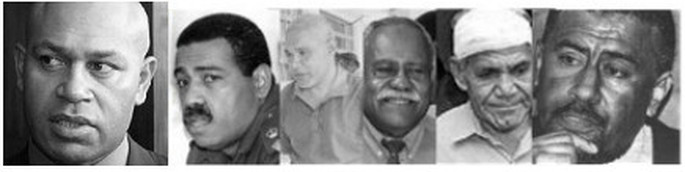
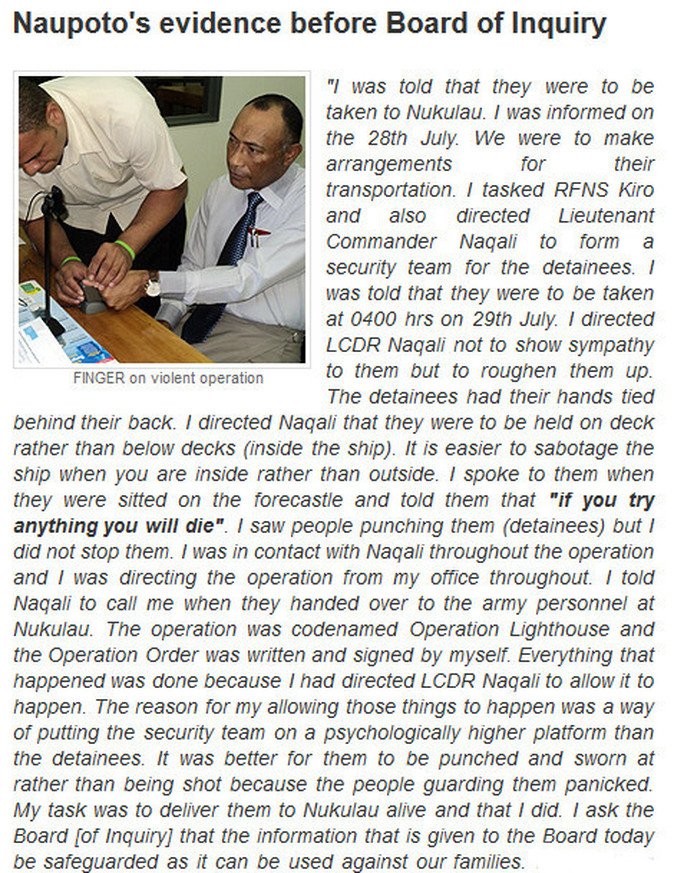
PARTNERS IN CRIME TO POWER SEEKERS: Bainimarama greets fellow FUGITIVE on the run from justice as he accuses Fiji Times owner Mahendra Motibhai of hiding in Australia; below is excerpts from 2013 Fijileaks
Picture
Picture
Picture
Picture
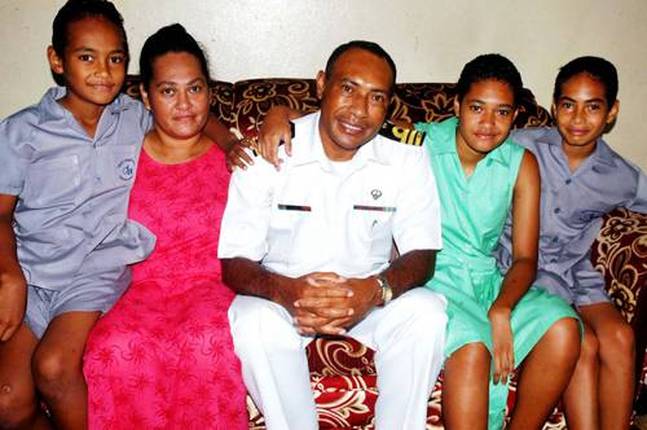
HAPPY FAMILY: Naupoto hides a violent past and still a fugitive from law
1 Comment

Regime Soap Opera never ending: Now, Colonel Kurusiga talks up abuse of audits but silent on military's abuse of funds running into millions!

13/6/2014

0 Comments

 
Picture
FIJI DEMOCRACY NOW Blog:
Abuse of Audits Instead of Abuse of Audits

Deputy Permanent Secretary of the Ministry of iTaukei Affairs, Colonel Apakuki Kurusiga, has admitted that he’s years behind in auditing the books of his ministry. He said when he came to office he found that no financial audits had been carried since 1997. But now, he says, accountants are working on the 2003 financial report. And he says a selection of cases will be referred to the Police for investigation. Corruption in the Ministry of iTaukei Affairs was one of the reasons seizing power nearly 8 years ago, so why have we had to wait until now for an audit and the possibility of charges? And while we’re on the subject, where is the audit of the RFMF and all the unauthorised spending and fraudulent procurement that was notorious before the 2006 coup?: Fiji Sun 11 2014 Accounts – Board: Audit shows Abuse; in 2011 Fijileaks had highlighted:

Picture
Picture
0 Comments

Vodafone CEO Aslam Khan retires: As revealed by Fijileaks, Pradeep Lal to take over at the helm

13/6/2014

3 Comments

 
PictureAslam Khan takes retirement
Vodafone Fiji has announced the retirement of its Managing Director, Aslam Khan from the company at the end of this month.

Khan has been at the helm of Vodafone Fiji as its first and only Managing Director to serve in this position since the inception of the company.

Board Chairman, Ajith Kodagoda said Khan has been a strong, committed and visionary leader of the company.

He said Vodafone is the biggest and most identified brand in the country and an employer of choice for many youngsters because of Khan.

Reflecting back on his 20 years at the company, Khan says it has been an incredible journey and most satisfying career with Vodafone and he has no regrets.

Khan said he has been privileged to lead one of the best and top ranked mobile network brands in the World.

Meanwhile, it has also been confirmed that the current Chief Operating Officer at Vodafone, Pradeep Lal will succeed Khan at the end of his tenure. Lal has been with the company for over 10 years. Source: Fijivillage; Fijileaks story: http://www.fijileaks.com/home/change-of-guard-at-vodaphone-fiji-ltd-ceo-aslam-khan-to-retire-soon-making-way-for-pradeep-lal-chief-operating-and-chief-finance-officer-at-vodafone-take-over-khan-reiterates-vodafone-is-not-spying-on-citizens


3 Comments

GET FIJI PASSPORT IF YOU DONATE TO FIJIFIRST PARTY: UFDF claims regime offering Fijian Passport/VOTE for $750 in USA and Hong Kong!

12/6/2014

1 Comment

 
Picture
The UFDF said today that it has received disturbing but reliable information from multiple sources in the US and from Hong Kong that on offer is a new $US750 donation for Fiji First in exchange for a Fiji passport and qualification to vote in the September elections.
The UFDF said that Frank Bainimarama was campaigning in California accompanied by Mr Winston Thomson and following the campaign meetings a $US550 plate dinner was held and some $US10,000 was raised. And it is during these meetings that the promotion of the $US750 for Fiji Passports is made and an invitation to vote for Fiji First in the September elections. The UFDF said the $US 750 offer for Fiji passports and voting rights this year is on offer in Hong Kong and is likely to be more wide spread then just the US & Hong Kong. The UFDF is calling on the good, honest law abiding citizens who are appalled at the level of manipulation and fraud being undertaken by some in authority and have knowledge or proof to email details and information to: [email protected]. The UFDF says the identity and source of information will remain confidential at all times. The UFDF said today it would be communicating its latest concerns to the Supervisor of Elections and the Electoral Commission not anticipating any serious due diligence or effort to establish the truth, given their past in-actions, but also as a record on file to be used to bring the perpetrators and their supporters to account for their participation in this ongoing fraud against the people of Fiji once democracy is restored. UFDF, June 12, 2014

Picture
Picture
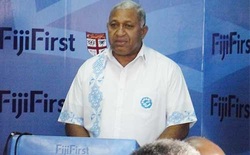
PictureBainimarama at the official launch of FijiFirst Party
Bainimarama takes swipe at his political party opponents: "We champion equality and fairness for all"

Fiji's Prime Minister Voreqe Bainimarama today hit back at the other four political parties as he launched his FijiFirst party in Suva. Addressing supporters who turned up at the party's head office in Toorak today, Bainimarama described the Fiji Labour and National Federation (NFP) parties as not having the courage to speak on sensitive issues. The Peoples Democractic Party (PDP) he says "have compromised their basic principles of fairness because they desperate for votes" and as for SODELPA "we know stands for elitism...who want to go back to the unfair and elite systems which only serve the few."

In contrast he says the FijiFirst champions equality and fairness for all irrespective of their status in society. "Chief or commoner - will get treated fairly and equally," Bainimarama said. "Equality and fairness does not mean that the chiefly status of traditional leaders is stopped or curtailed. In fact it gives it more strength." He further called on Fijians, as the country prepares to go to the polls, to judge for themselves the work his government has done in the last seven years. "Judge for yourself how much life has improved under my government, judge for yourself the true and genuinely inclusive intentions, I have for the betterment of all Fijians," Bainimarama said. "And the work we started seven years ago, must now continue for the sake of all Fijians under the banner of FijiFirst."

"Given our track record of service to all Fijians, imagine what FijiFirst can do as an elected government now that there won't be any restrictions. “This is your chance to play your part and contribute towards the election of our party that will ensure that Fiji is not only a prosperous and modern nation but will also become an admired nation where equality and fairness becomes a corner stone for our great nation. “I want the best for all of you. I want to continue the good work that we have done in education, health, women's rights, water, electricity, better roading, modernising laws pertaining to domestic violence, human trafficking, we have changed the archaic rape laws to give women and children better protection. “

Meanwhile, in the coming days, the party will be looking to register volunteers, supporters and candidates. “Indeed the support is growing. In our text message platform, through which we had called for volunteers and people to join as friends of FijiFirst, within 24 hours, we had over 100 Fijians, young and old, men and women, from all over Fiji texting to become a volunteer and over 300 Fijians texting to become supporters of FijiFirst. “ The party is also in the process of finalising offices in Nasinu, Nausori, Rakiraki, Ba, Lautoka, Nadi Sigatoka, Savusavu and Labasa. Aside from the launch and the opening of their new office, the party today also launched their facebook page and twitter account.

“Our website carries all our information, including our Constitution and our values, and other relevant information. You can also on line contribute towards our manifesto which will be revealed in time to come.” The party has also identified teams to start their various pocket meetings and is also looking at organising rallies in the coming months: http://fijilive.com/news/2014/06/bainimarama-hits-back-launches-fijifirst/57953.Fijilive
Copyright 2014 © Fijilive.com

Picture
1 Comment

DOWN WITH THE DICTATOR: Fijians living in Santa Rosa (USA) protest as Bainimarama wines and dines with an old childhood Fijian friend!

11/6/2014

8 Comments

 
Picture
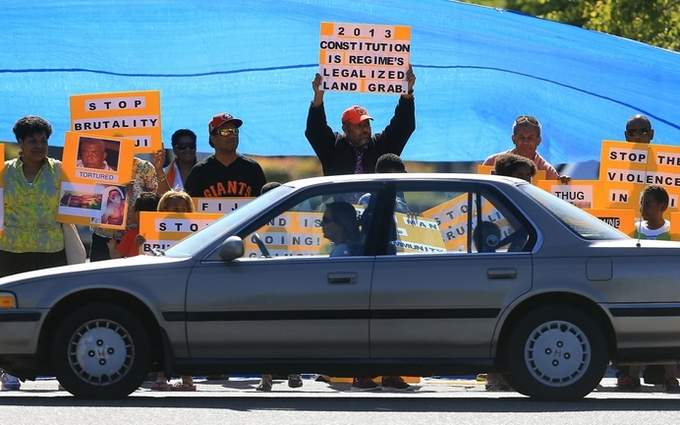
Members of Sonoma County's Fijian community protested the appearance of Bainimarama, on Friday, June 6, 2014, at the Finley Center in Santa Rosa, USA
FROM THE PRESS DEMOCRAT, Santa Rosa:

The prime minister of Fiji attended a private dinner Friday night in Santa Rosa, where he was met by a vocal group of several dozen Fijian protesters, many of whom said they were denied access to the event.

Commodore Josaia Voreqe Bainimarama, also known as Frank Bainimarama, arrived in a motorcade of black vehicles just after 7 p.m. at the Finley Community Center's Person Auditorium.

Bainimarama's car passed about 50 demonstrators who held up signs that said “Free Fiji” and “Stop the Violence in Fiji” as it headed around the back of the auditorium, where he was escorted into the building to speak to a group of about 150 people, organizers said.

“He's here to spend time and visit with the Fiji people in this area,” said Ben Nawagauou of San Rafael, a childhood friend of Bainimarama, who helped organize the event. “Those people (the protesters) don't know what they're talking about. They don't know anything about him.”

Bainimarama seized power in a 2006 coup and in 2009, the country's constitution was abrogated. His actions have drawn the ire of native pro-democracy groups and led to the country's expulsion from the Commonwealth of Nations, an intergovernmental organization of former British colonies and territories.

Fiji is an archipelago of about 330 islands in the central Pacific Ocean. It became independent in 1970 under a parliamentary democracy, but since Bainimarama's coup, the country's fourth since 1987, there has not been a democratically elected government.

Bainimarama announced plans to hold elections in September, but leaders of an American-based pro-democracy movement called the Democracy and Freedom for Fiji Movement, who organized Friday's protest, say they doubt the elections will be held fairly.

“All we want is for him to step aside and allow our country to have free and fair elections,” said Vilisi Nadaku, 49, of Santa Rosa.

Several Fijians said they came expecting to attend the event, which was supposed to include a traditional meal followed by a speech and a question and answer session with Bainimarama, only to learn they would not be allowed inside.

“What are they scared of? The truth,” said Siteri Velia of Santa Rosa, part of a close-knit community of Fijian caregivers in Sonoma County.

“They don't want anybody to ask questions. This is not what Fiji is about,” Velia added.

Several protesters said they could not return to their homeland because they feared reprisal from the Bainimarama government.

Fijians on both sides of the issue said that in a country of less than a million people, many knew each other and the political crisis had pitted families and friends against each other.

“We are all one people, one family,” said Nawagauou. “In the end, that is what's important.”
Picture
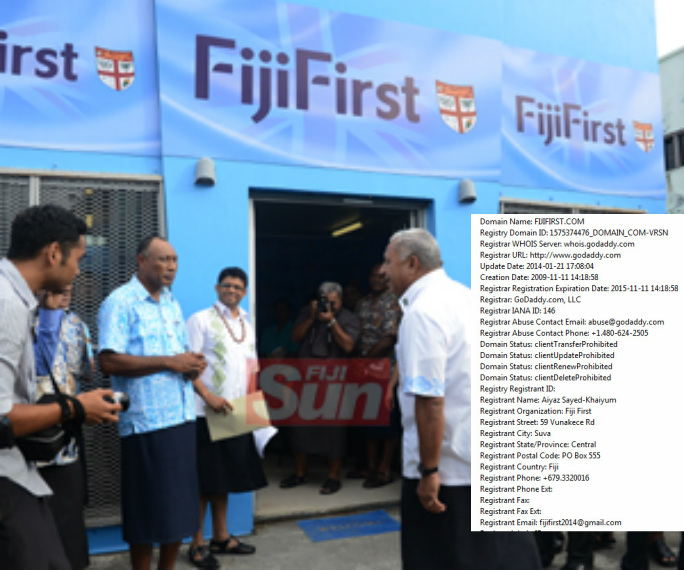
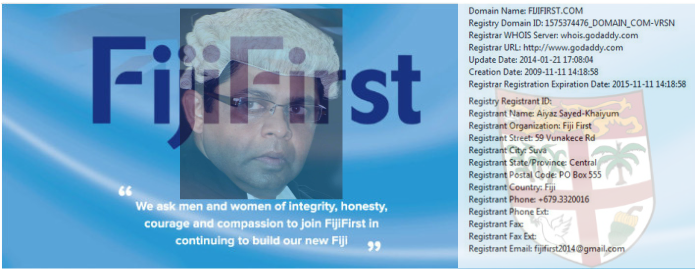
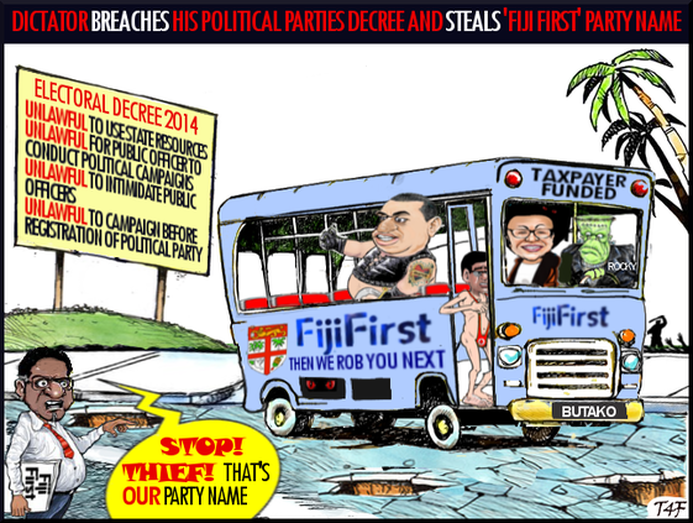
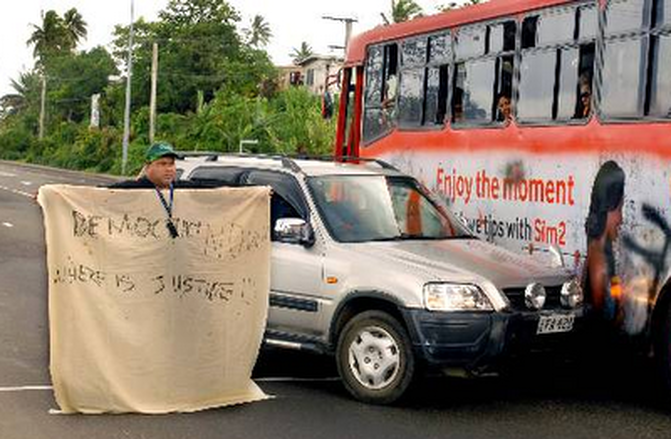
REMEMBER HIM: What occurred on an ordinary Suva afternoon Friday 19th February 2010 is the feat of a Fijian folk legend to be told. It wasn’t performed before live TV or to an assembled media audience. It wasn’t a great rugby sevens winning try nor some valiant deed on a battlefield afar. Vilisi Nadaku from Namara had done it- the stuff of high human moral courage up there with the best. He had boldly approached the military guards strewn at the bottom floor of the Prime Minister’s office building and demanded he deliver a letter to the man himself. The soldiers queried the contents with suspicion but were taken by the man’s quiet but firm insistence on delivering it personally. They escorted Vilisi all the way up to the Prime Minister’s office where the soldier knocked, saluted, entered and delivered the letter. Prior to his short but epic walk throug Suva from the other end of the city, Vilisi had knelt and prayed at Centenary Church for courage and success in his simple delivery mission. It was complete –the rest was up to the Lord. He had fasted with his family and now that the season of lent had begun he will sacrifice his job and his family’s welfare for what he believed in-Democracy. This simple delivery in time will mark the beginning of the restoration of democracy in Fiji post December 2006 coup. According to Radio New Zealand International News of Sun 21st February 2010, a letter calling for elections to be held in Fiji this year has been submitted to the military-led regime in Suva. The petition was from Mr. Nadaku, his wife Ana and their five children, demanding Bainimarama and his Interim government returns Fiji to the polls this year, 2010. Vilisi rose to fame with his lone protest demonstration of the SDL/Interim Regime court ruling in October of 2008. He was charged, convicted and fined an exorbitant amount for breaching the PER decree. Now it has emerged that the crook Khaiyum was himself breaching his own PER when he secretly registered the domain and e-mail account name FijiFIRST, the name of his party now.
8 Comments
<<Previous
Forward>>
    Contact Email
    ​[email protected]
    Picture
    Picture
    Picture

    Archives

    July 2026
    June 2026
    May 2026
    April 2026
    March 2026
    February 2026
    January 2026
    December 2025
    November 2025
    October 2025
    September 2025
    August 2025
    July 2025
    June 2025
    May 2025
    April 2025
    March 2025
    February 2025
    January 2025
    December 2024
    November 2024
    October 2024
    September 2024
    August 2024
    July 2024
    June 2024
    May 2024
    April 2024
    March 2024
    February 2024
    January 2024
    December 2023
    November 2023
    October 2023
    September 2023
    August 2023
    July 2023
    June 2023
    May 2023
    April 2023
    March 2023
    February 2023
    January 2023
    December 2022
    November 2022
    October 2022
    September 2022
    August 2022
    July 2022
    June 2022
    May 2022
    April 2022
    March 2022
    February 2022
    January 2022
    December 2021
    November 2021
    October 2021
    September 2021
    August 2021
    July 2021
    June 2021
    May 2021
    April 2021
    March 2021
    February 2021
    January 2021
    December 2020
    November 2020
    October 2020
    September 2020
    August 2020
    July 2020
    June 2020
    December 2018
    November 2018
    October 2018
    January 2018
    December 2017
    November 2017
    October 2017
    September 2017
    August 2017
    July 2017
    June 2017
    May 2017
    April 2017
    March 2017
    February 2017
    January 2017
    December 2016
    November 2016
    October 2016
    September 2016
    August 2016
    July 2016
    June 2016
    May 2016
    April 2016
    March 2016
    February 2016
    January 2016
    December 2015
    November 2015
    October 2015
    September 2015
    August 2015
    July 2015
    June 2015
    May 2015
    April 2015
    March 2015
    February 2015
    January 2015
    December 2014
    November 2014
    October 2014
    September 2014
    August 2014
    July 2014
    June 2014
    May 2014
    April 2014
    March 2014
    February 2014
    January 2014
    December 2013
    November 2013
    October 2013
    September 2013
    August 2013
    July 2013
    June 2013
    May 2013
    April 2013
    March 2013
    February 2013
    January 2013
    December 2012
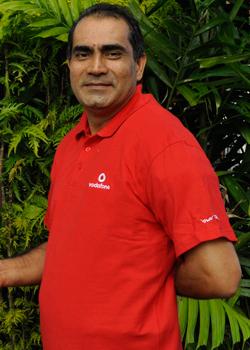
    October 2012
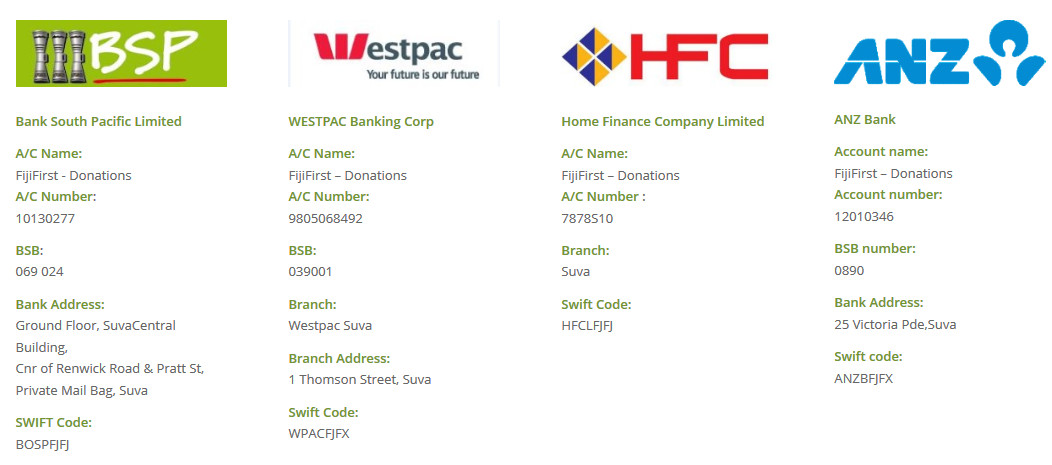
    September 2012