Fijileaks
  • Home
  • Archive Home
  • In-depth Analysis
    • BOI Report into George Speight and others beatings
  • Documents
  • Opinion
  • CRC Submissions
  • Features
  • Archive

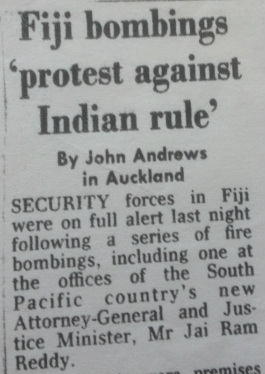
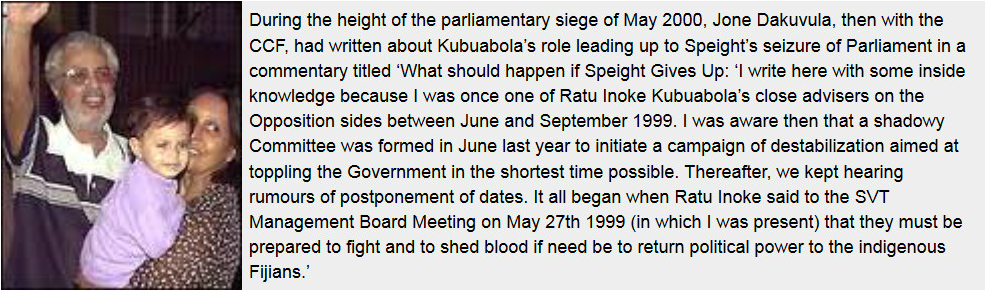
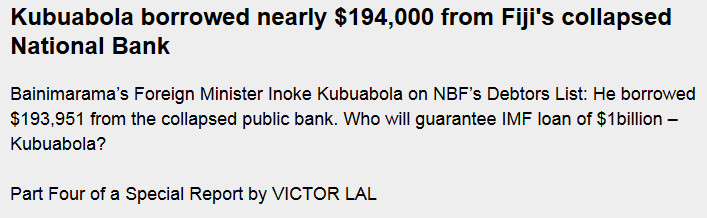
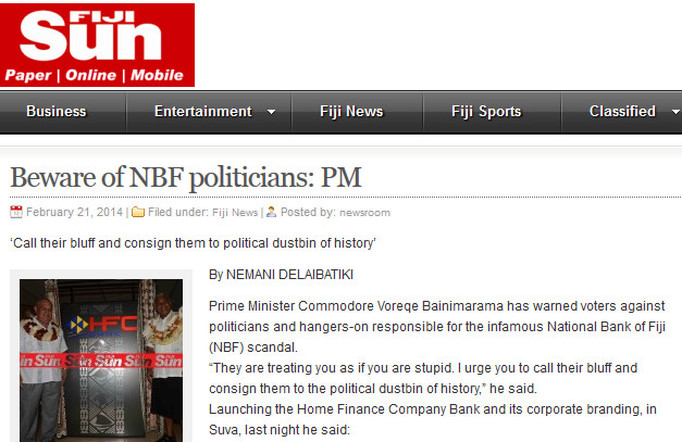
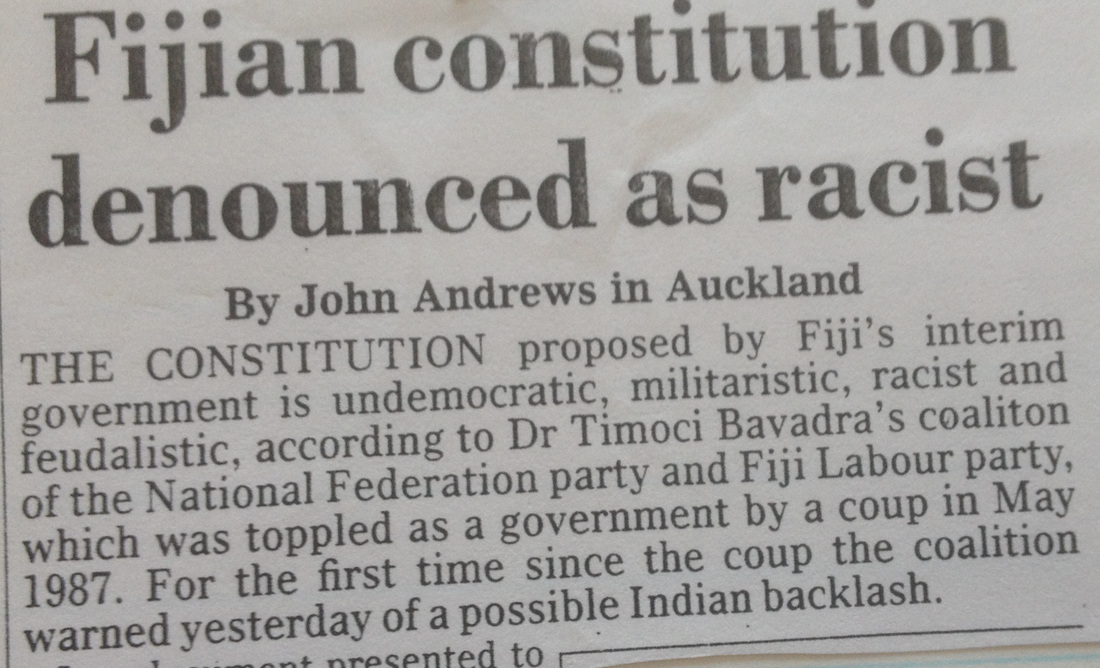
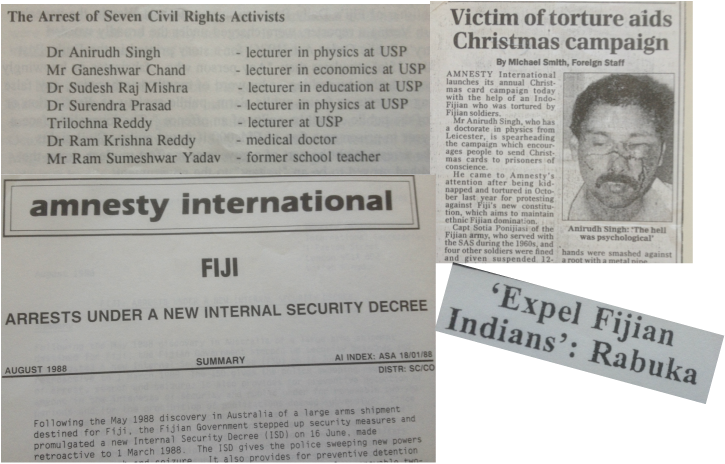
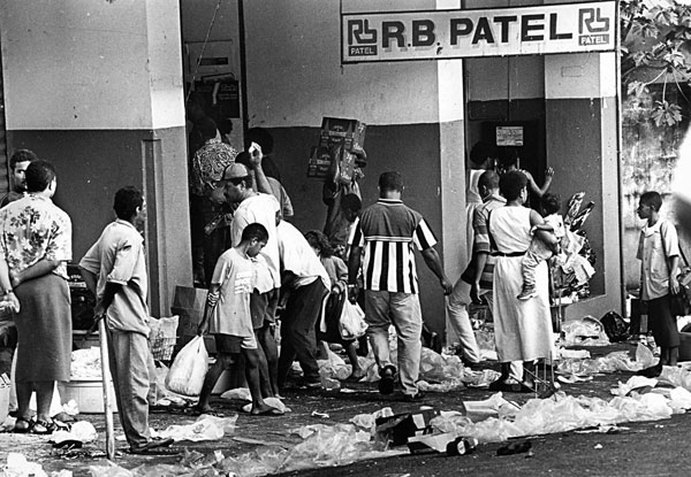
HE IS BACK: The OLD violent racist and nationalist Inoke Kubuabola who drove thousands of Indo-Fijians out of Fiji in 1987 is standing for election under FijiFirst Party banner, led by Bainimarama and Khaiyum!

25/7/2014

6 Comments


'After the coups of 1987 and 2000, there was a mass exodus from Fiji of tens of thousands of our best and brightest people..This exodus was a national tragedy that robbed Fiji of the opportunity to develop itself years ago into the nation that it is only now starting to become – unified, proud, with a keen sense of purpose and punching above its weight in our region and the world.'
Frank Bainimarama to Tilak High School students

Picture
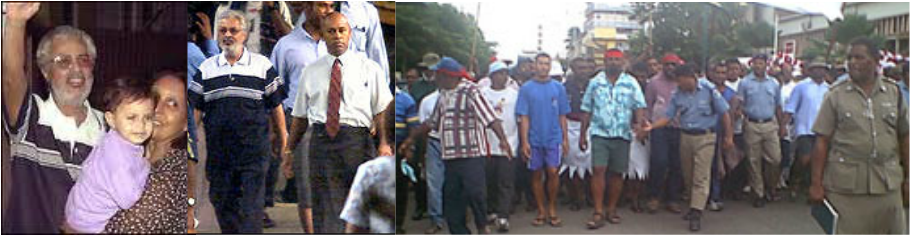
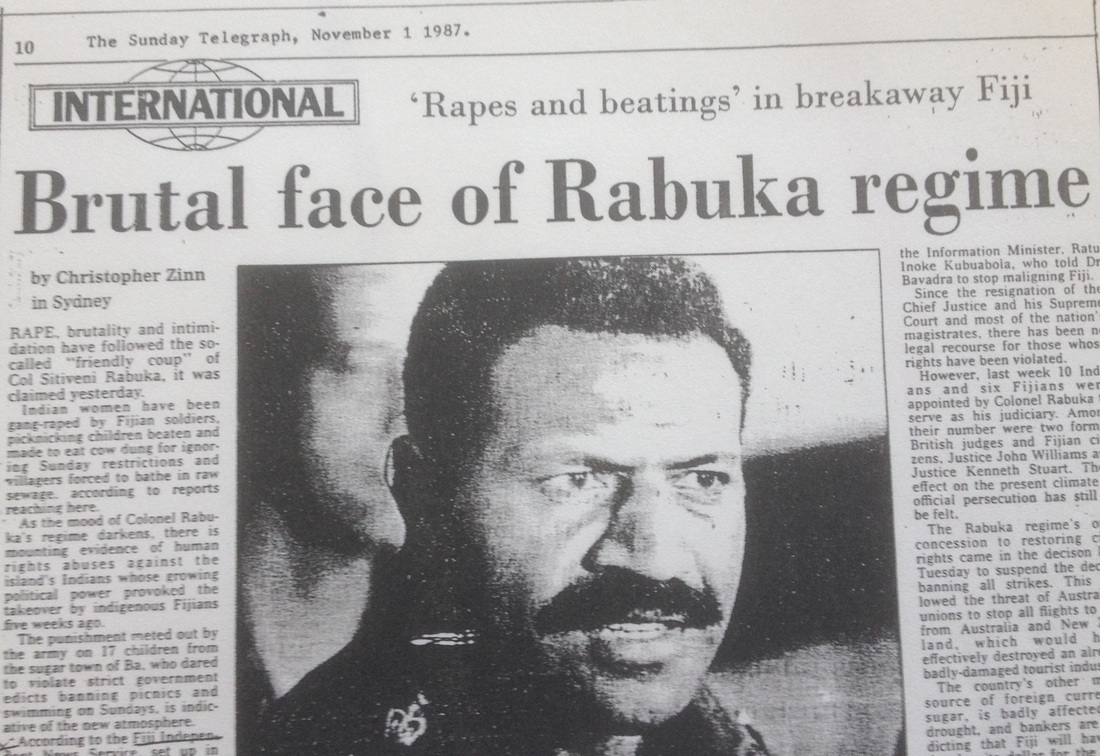
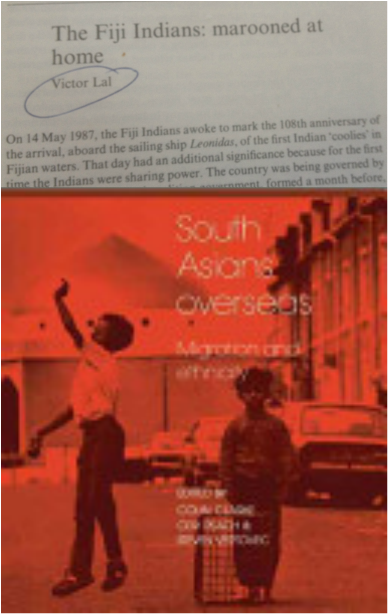
VICTOR LAL, the author of the above book, was among the thousands of Indo-Fijians who was driven out of Fiji after the 1987 coups by the racist and violent actions of Fijifirst party candidate and present Foreign Minister Ratu Inoke Kubuabola; in 2000, as Minister for Information in the short-lived post-Speight coup Qarase-led government, Kubuabola took out a full page advertisement in the Daily Post to condemn Lal for standing up for human rights in Fiji. Ironically, the Bainimarama/Khaiyum regime also declared Lal persona non grata from the country of his birth - FIJI - after he exposed, in 2008, Bainimarama's then Finance Minister Mahendra Chaudhry's secret $2million in Sydney bank account. Bainimarama and Khaiyum had refused to sack Chaudhry from their Cabinet.
24 August 2000: Kubuabola attacks Victor Lal after joining post George Speight coup as Minister for Information in the interim Qarase led government:
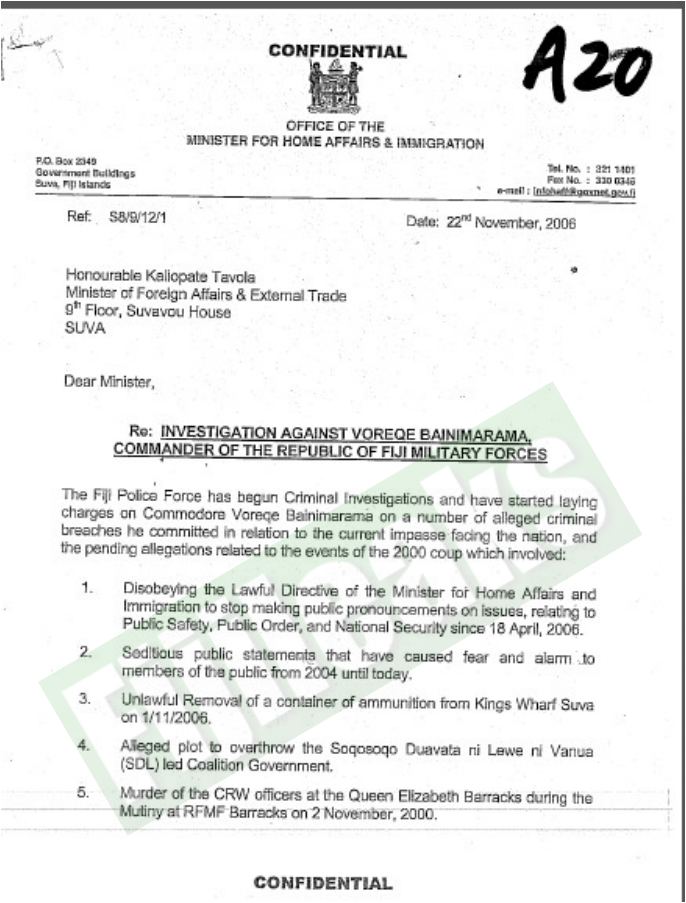
“Victor Lal’s articles [in Fiji's Daily Post] all have a simple, indeed simplistic stance, restore Chaudhry and impose democracy as defined by Lal and his friends. What he is advocating is an Indian supremacist doctrine, a new version of Hitlerian herrenvolk for Fiji. The racism lies in his desires, not those of us Fijians. His obsession to control Fiji, blinds him to his own ambitions.”

Kubuabola was responding to the London based Movement for Democracy in Fiji which had intensified its fight for deposed Chaudhry’s political rights. The then Commodore Frank Bainimarama had claimed in his February 2001 affidavit before the Fiji Court of Appeal that he had abrogated the 1997 Constitution because he was satisfied that people engaged in the events of May 19 [2000 Speight coup] were of the perception that the document had watered down the interests of indigenous Fijians: “Whether or not those perceptions accorded with reality was not my principal consideration. The perceptions were genuinely held by largely unsophisticated Fijians not equipped to adequately comprehend the niceties and technicalities of the Constitution.”
Picture
Picture
Excerpt from Victor Lal: Fiji: Coups in Paradise - Race, Politics and Military Intervention:
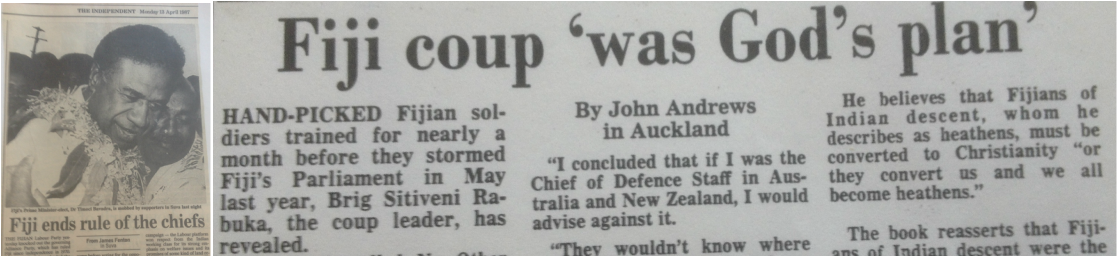
"Ratu Inoke Kubuabola told Islands Business magazine of May 1988 that for more than six hours on April 19 he and Rabuka, later joined by Jone Veisamasama, 'talked about different options'. It was on 19 April that the groundwork for the coup was laid and according to Kubuabola, 11 May was the day his co-conspirators decided to proceed with its execution. He also claims that when it was learnt that Parliament  would not sit on Friday they had agreed to bring forward the coup to Thursday. Another crucial intermediary between the Taukei Movement and the military, the Rev Tomasi Raikivi, provided his house in Suva as a centre for overall planning. Thus it was there that Rabuka met the other conspirators on Easter Monday, nine days after the defeat of the Alliance Party. We will let Rabuka explain the rest, as he did to Eddie Dean and Stan Ritova in his infamous autobiography No Other Way. He went to Rev Raikivi's for, ' … What he understood was an ordinary 'grog' party. It was early evening, and he just walked in, as he normally would, throwing his 'sevusevu' of yagona towards the bowl where the 'grog' was being mixed. 'I saw all these people sitting down, and realised it was some kind of a meeting. Some of the people greeted me, although I could not see everyone clearly because it was fairly dark in the lounge-room. Nobody asked me to leave.' When his eyes adjusted to the darkness, he discovered the gathering was 'quite a formidable group'. He says it included Ratu Finau Mara, Ratu George Kadavulevu, Ratu Inoke Kubuabola, Ratu Keni Viuyasawa, the brother of Brigadier Epeli Nailatikau, Filipe Bole, Ratu Jo Ritova of Labasa, Ratu Jale Ratum, 'Big Dan' Veitata, and the host Raikivi. Another leading light at this meeting was Apisai Tora.''
Picture
The South Asian diaspora came into being with the end of slavery in the British Empire. Huge numbers of labourers were recruited in the Indian sub-continent for indentured labour schemes, notably in Southeast Asia, South and East Africa, Mauritius, Fiji and the Caribbean, and also in French colonies. Later there were waves of 'free' immigration to these and other countries, including, in the last generation, Britain itself and North America. This set of essays by scholars from several different disciplines offers detailed accounts of the experience of the migrant communities, and the editors contribute valuable overviews. South Asians Overseas: Migration and Ethnicity, originally published in 1990, is an indispensable resource for scholars interested in the diaspora, or concerned with problems of migration; re-published by Cambridge University Press in paperback, February 2010
Picture
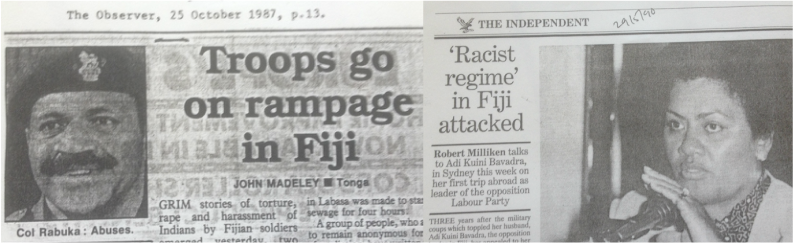
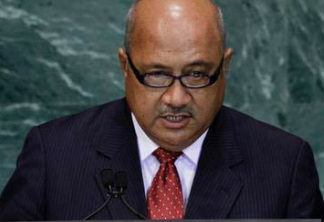
KUBUABOLA: SERIAL COUPSTER, 1987, 2000 and 2006. One of the key violent, nationalistic, opportunistic and racist figure largely responsible for driving thousands of Indo-Fijians out of Fiji after the 1987 Rabuka coup
Picture
Picture
Picture
Picture
6 Comments

SPORTING HERO JUMPS OVER TO FijiFIRST Party: Paralympian Delana to contest election alongside Ministers, Bainimarama, Khaiyum et al

25/7/2014

2 Comments


The other FijiFirst Party candidates are: Nemani Tukubu Bainivalu, Inia Batikota Seruiratu, Dr. Mahendra Reddy, Alexander D. O'Conner, Rosy Sofia Akbar, Joseph Veramo, Teddy F. Fong, Timoci Lesi Natuva, Jone Usamate, Jimilai Wainibalagi, Iliesa Delana, Dr Jiko Fatafehi Luveni, Inoke Kubuabola, Viliame Naupoto, Neil Sharma, Lorna Eden, Osea Naiqamu, Mereseini Vuniwaqa, Alivereti Nabulivou, Aiyaz Sayed-Khaiyum and Frank Bainimarama

Picture
Gold grab: Fiji’s first Olympic Paralympics gold medalist Iliesa Delana to contest for FijiFirst Party
Picture
KHAIYUM BACK ON HIS FEET: Bainimarama releases in drips the first batch of his party candidates for election
2 Comments

THE GREAT LAND DEBATE: Aiyaz Khaiyum corrects Jioji Kotabalavu's assertion that native Fijian land is not safe under the Constitution; Khaiyum says Kotobalavu is peddling untruths like other parties

25/7/2014

7 Comments


"In his politically-motivated analysis written in a pseudo-academic manner, Kotobalavu purports to argue that landowners’ protection under the Constitution is undermined because of the Decree. Even a first year law student would be able to tell that the Constitution is the supreme law of the land and all other laws are subservient to it.
If there is a law that is contrary to the Constitution, then that law would either need to be amended or repealed." - Aiyaz Sayed Khaiyum

PictureKhaiyum sets the land record straight - challenges
Kotobalavu's analysis
By Aiyaz Sayed-Khaiyum
General Secretary
FijiFirst Party


"J[i]oji Kotobalavu (“Kotobalavu”) wants to show that the rights and ownership of iTaukei lands by the customary owners are not safe or protected under our Constitution (see http://www.fijileaks.com/home/fact-and-fiction-about-i-taukei-land-ownership-kotobalavu-responds-to-fiji-suns-simplistic-and-subjective-conclusion-that-native-land-is-safe-under-baikai-constitution-of-2013)

This is farthest from the truth and falls into the same category of misrepresentations and untruths currently being spread by some commentators and politicians to mislead members of the public. Below is a brief analysis of Kotobalavu’s article vis-a-vis the law and facts.

Firstly, Kotobalavu tries to read section 28 of the Constitution in isolation. Section 28, which expressly states that ownership of all iTaukei land shall remain with the customary owners and shall never be permanently alienated, is not the only section that provides constitutional protection to iTaukei landowners.

Kotobalavu fails to take note of section 29(4) of the Constitution which provides that – “Parliament and Cabinet, through legislative and other measures, must ensure that all land leases and land tenancies provide a fair and equitable return to the landowners …”

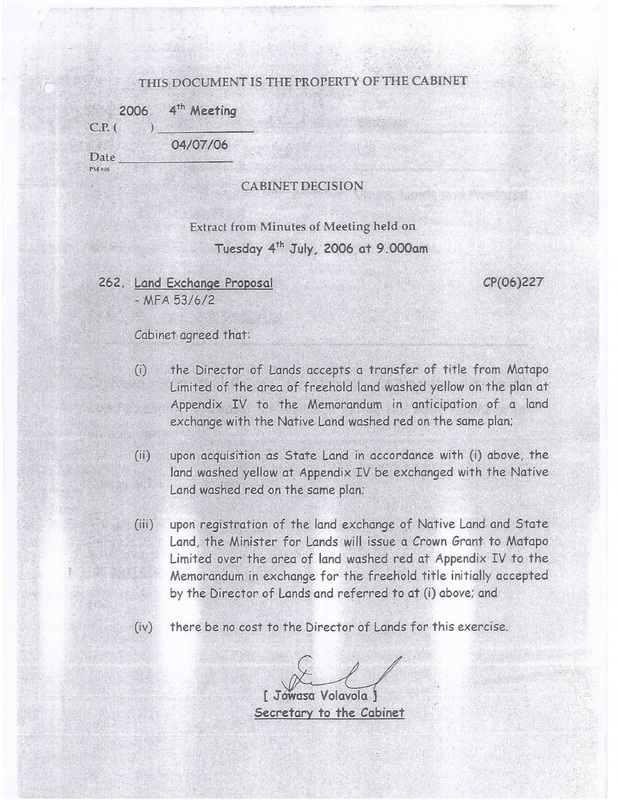
This section makes it mandatory for Parliament and Cabinet to ensure, through legislative and other measures, that landowners receive a fair and equitable return from the lease of their lands. He also conveniently ignores section 30 of the Constitution which expressly states the landowners are entitled to receive a fair share of royalties for the extraction of minerals from their land or seabed. Kotobalavu also fails to acknowledge that section 28(2) of the Constitution clearly states that any iTaukei land which is acquired by the State for a public purpose must be returned to the iTaukei landowners if the land is no longer required by the State for that purpose. This section, together with the amendments made by the Bainimarama Government to the State Lands Act, will now prevent iTaukei lands from being converted into freehold land or being alienated. This is exactly what was done by the SVT in the 1990s and the SDL in 2006 when they surreptitiously connived to permanently alienate iTaukei land and have it converted to freehold land.

Interestingly, Kotobalavu fails to mention that during both terms of the SVT and SDL governments, he was a senior civil servant and indeed he was the Permanent secretary in the Prime Minister’s Office – the chief advisor to Qarase and his Cabinet on policies, at the time when Qarase and his Cabinet connived to permanently deprive the iTaukei landowners at Momi of their customary land. None of the previous constitutions provided the protections to the landowners which are now contained in the Constitution. In fact, these protections are now for the first time entrenched in the Bill of the Rights chapter of the Constitution. Indeed, the much harped about 1990 Constitution and 1997 Constitution which contained the now much maligned entrenched provisions allowed this conversion of iTaukei lands into freehold to take place.

Rather than properly highlighting the rights and protections of the iTaukei landowners which are safeguarded in the Constitution, Kotobalavu misleads and misinforms with his mistaken and selective references to the Land Use Decree 2010 and the Regulations made thereunder (“Decree”). In his politically-motivated analysis written in a pseudo-academic manner, Kotobalavu purports to argue that landowners’ protection under the Constitution is undermined because of the Decree. Even a first year law student would be able to tell that the Constitution is the supreme law of the land and all other laws are subservient to it. If there is a law that is contrary to the Constitution, then that law would either need to be amended or repealed.

His selective references to the rights and protections safeguarded in the Constitution, and his omission of the key provisions of the Decree shows a complete disregard of the stated objectives of the Decree. He makes reference to previous cases where iTaukei landowners have instituted proceedings in Court and challenged TLTB. Such a simple-minded comparison with previous cases involving TLTB, together with his omission of pertinent sections of the Decree shows that Kotobalavu does not understand the correct legal principles and/or does not want to understand them for the purposes of his own agenda.

Kotobalavu has quoted section 11 of the Decree. But he has failed to quote other pertinent sections of the Decree. Section 3 of the Decree, which is the first substantive section, states that principal objective of the Decree is to ensure that iTaukei land is utilised “in a manner that is in the best interests of the iTaukei landowners”. By not citing this section, Kotobalavu wants to mislead the reader to believe that the interests of the iTaukei landowners will in some way be subservient to the economic interests.

Section 5 of the Decree goes further to state that the ownership of any iTaukei land designated under the Decree shall always remain with the iTaukei owners. This section was not cited by Kotobalavu in his “analysis”.
In addition, section 11 of the Decree explicitly provides that any lease issued over an iTaukei land must at all times take into consideration the best interests of the iTaukei landowners. He further fails to mention that the Decree expressly requires that a minimum of 60 per cent of the members of the landowning unit MUST provide their consent before any iTaukei land can be designated under the Decree.

No land can ever be designated by the Prime Minister until and unless 60 per cent of the iTaukei landowning unit members provide their consent. In his attempt to undermine the benefits of the Decree, Kotobalavu conveniently fails to mention that under TLTB leasing regime which hitherto has been the only manner in which iTaukei land could be leased, TLTB is only required to get majority consent for lease of any reserved land. For all other lands which are not reserved, TLTB only undertakes consultations with the landowners. TLTB is not required to obtain majority consent of the landowners for leasing their lands. The extent of the consultation depends on TLTB. Any decision to lease, and who to lease to, is then made by TLTB.

Indeed, section 14(6)(b) of the iTaukei Lands Trust Act states that “notwithstanding anything contained in any other sections of the Act, a lease may be granted with or without the consent of the iTaukei owners, whether the land is inside or outside a iTaukei reserve, and a lease may be for such purposes and subject to such terms and conditions as the Board thinks fit.”

Any person comparing the two leasing regimes, will clearly note that under the Decree, it is the landowning unit that has the complete say on whether the land will be designated under the Decree. At least 60 per cent of the members of the landowning unit must clearly provide their consent.

The Decree is much more consultative with the landowners, unlike the rather draconian procedures with respect to TLTB, which have been in place since the colonial days, and no Government has sought to modernise these laws to provide for better consultation with the iTaukei landowners. These also include post-1987 and post-2000 Governments, which claimed to serve the best interests of iTaukei landowners, yet did nothing to provide for greater involvement of the iTaukei landowners with respect to the use of their lands.
Kotobalavu completely ignores the fact that under the Decree, each landowning unit elects up to five trustees and also prepare a Deed of Trust for their duties and functions. The Decree requires the Director of Lands to undertake a proper professional survey of the land, acting at all times in the best interests of the iTaukei landowners.

The Decree also sets out a clear procedure for the assessment of fair market rent, which will be wholly paid to the landowners. Kotobalavu fails to take cognisance of the fact that in the assessment of the rent, the trustees of the landowning unit have the right to disagree with the assessment. If parties are unable to reach agreement on the fair market rent, the trustees of the iTaukei landowning unit have the express right to refer the assessment to the Prime Minister, who then appoints an independent expert valuer to undertake an independent assessment of the fair market rent.

The form of the lease issued over any designated land is also expressly provided in the Decree. Any person reading the terms and conditions of the leases will note that the best interests of the iTaukei landowners are taken into consideration at all times, who also have a say, not just in the fair market rent of the land but also in the terms and conditions under which the lease is issued, the use to which the land will be put to and the person/company to whom the lease will be issued to.

These provisions and policies ensure that the interests of the iTaukei landowners will always be the main consideration with respect to any lease issued under the Decree. Given the above, by excluding the jurisdiction of the courts from challenging the designation of land under the Decree, the Decree protects the majority (60 per cent) voice of the iTaukei landowners and the trustees of the iTaukei landowning unit, who have the right to be heard on matters such as the designation of the land or the fair market rent payable on their land. The Decree prevents any disgruntled or politically-motivated individual or minority landowner in bringing court cases against the decisions made by the majority of the members of the landowning unit, and thereby frustrating the majority of the landowners of the full enjoyment of the benefits from the lease of their land.

Kotobalavu should note that the protections and safeguards provided in the Decree to the iTaukei landowners are much more than what is provided to the iTaukei landowners under the TLTB laws and policies. For this reason, it is not surprising that so many iTaukei landowners have been frustrated with the management of their lands by TLTB. Indeed, leases have been issued without proper consent. The landowners have been at times ignored on the assessment of rent, and the use to which the land has been put to. The notoriety of the TLTB bureaucracy has irritated many landowners and other stakeholders. Under the chairmanship of the Prime Minister, many of these long outstanding issues and archaic provisions are being addressed. The Decree has provided the optimum ability to address these issues firsthand.

For these reasons, so many landowning units are freely designating or considering to designate their lands under the Decree. Not a single landowning unit has had any issues with the designation of their lands.
These landowning units are now enjoying full market rents for the lease of their lands. Every single cent of the money collected in rent is paid to the iTaukei landowning unit, unlike TLTB which takes a percentage as poundage.

If Kotobalavu properly reads the provisions of the Decrees in its entirety and in their proper context and without a jaundiced approach, even he will not be able to deny the benefits of the Decree for the iTaukei landowners.
Kotobalavu’s article, like the commentaries of a few others in our society including some politicians, cannot be taken seriously because they are written or made with a malicious intent, have an ulterior agenda and lacks intellectual honesty. In this instance, Kotobalavu’s article is designed to mislead the iTaukei landowners in particular and the Fijian population in general."

7 Comments

FIJIFIRST Party delays release of its candidate list - for its general secretary Aiyaz Khaiyum still wired to 'drip' at Suva Private Hospital 

24/7/2014

4 Comments

 
PictureGolden Point Resort in Ra where Khaiyum was kept for two nights

By VICTOR LAL

We can confirm that FijiFirst general secretary Aiyaz Sayed Khaiyum is still in the intensive care unit at the top-class Suva Private Hospital. As revealed by Fijileaks, Khaiyum was taken ill in the western division. He was kept at the Golden Point Resort for two days. The resort's owner is a supporter and financier of FijiFirst party. A tourist at the resort said Khaiyum was "shivering like a Fijian banana leaf from high fever". Dr Mon Maung Moon from Tavua Hospital attended to Khaiyum and after two days at the resort he was transferred to the Suva Private Hospital. Sources inside FijiFirst said they were all kept in the dark and no communication is allowed with Khaiyum. The party sources say they are very nervous about his health and the 'health' of the party which Khaiyum had secretly registered as far as 2009 in preparation for the forthcoming September election.

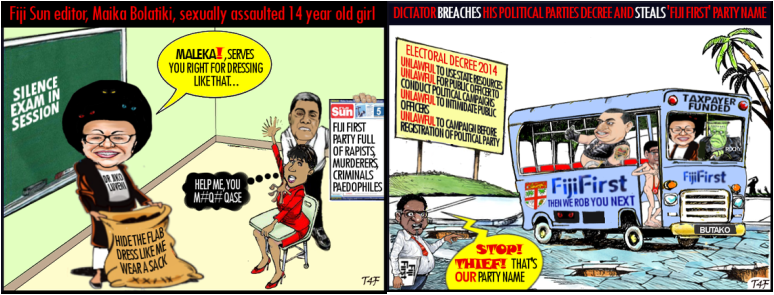
BAG OF SURPRISES? FijiFirst Party President Dr Jiko Luveni has stated that she has encouraged several women to join the party and people will be surprised when they announce their candidates.
Luveni said women should not be intimidated if they want to run for parliament. She said the country has a constitution that encourages equality and a no discrimination policy.The FijiFirst Party is expected to announce 19 proposed candidates tomorrow: Source - Fijivillage, 24/7/2014

Fijileaks Editor: While Aiyaz Khaiyum is being treated at the Suva Private Hospital, billed as Fiji's finest private medical facility, his fellow-citizens are languishing in regime hospitals with not enough medicines, and told to even bring their own bed sheets and cutlery. We wish Khaiyum a speedy recovery, for his fate and that of his party must be decided at the September polls. The voters can't wait to give him a dose of his own medicine at the polls.

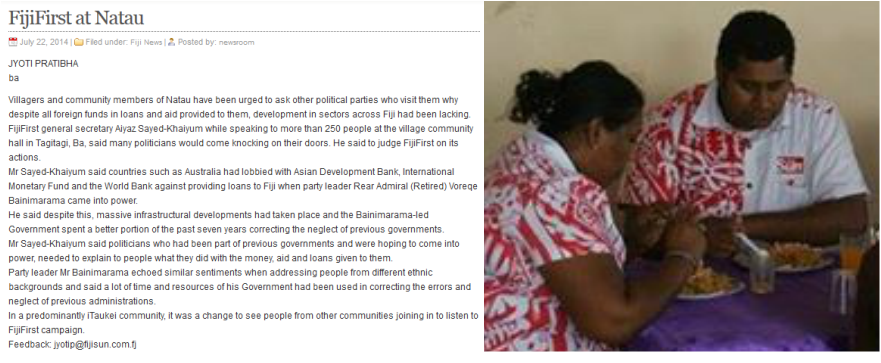
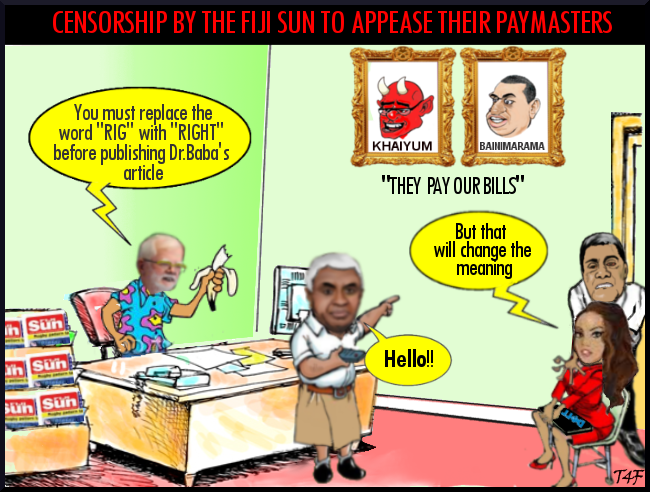
Meanwhile, neither the regime's propaganda rag sheet Fiji Sun nor its western correspondent Jyoti Pratibha nor the paper's 'Coconut Wireless' reported that Khaiyum had fallen ill during FijiFirst's campaign in the western division. Typically, it 'fed' the readers with regime propaganda while Pratibha and other Sun free chows were seen 'feeding' themselves with food supplied by FijiFirst party.

Picture
FREE FIJIFIRST PARTY CHOW: He who feeds the Fiji Sun calls the tune
Picture
Picture
Picture
Picture
4 Comments

Aiyaz Khaiyum reportedly in hospital as Ratu Timoci Vesikula reveals: "Why we changed land ownership during the Rabuka government"

23/7/2014

2 Comments

 
Picture
FiJILEAKS has been passed the following: "AG became very sick while on campaign trip which included Ba, Tavua and Ra. He was not present at Ra meeting on Tuesday. After Ba and Tavua meet, he became very sick and stayed back for two days at a Rakiraki resort. On Tuesday afternoon he was transported to Suva and around 11 pm admitted to Suva Private Hospital. Still admitted at Suva Private intensive care unit. Only close family members allowed."

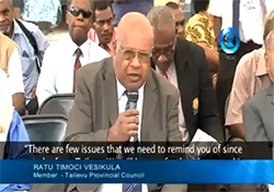
VESIKULA - WHY WE CHANGED LAND OWNERSHIP:

Ratu Timoci Vesikula, Fijian Affairs Minister in Rabuka's government admits some native lands were changed to crown, and some later changed to freehold, but for good reasons. Now a Social Democratic Liberal Party (SODELPA) supporter, Rt Timoci said among these is the Denarau land where nine hotels are now situated. Rt Timoci said changes made to Denarau would not be argued by the landowners- the people of Narewa in Nadi as they are now reaping the benefits of the changes. “An undeveloped Denarau would give you scattered pieces of mangrove swamps,” Rt Timoci said. “Many have been said about what the Tui Cakau- Ratu Naiqama Lalabalavu and I did during our term. “We are chiefs in our own rights and we wouldn’t do anything to cause harm to our lands because the decrees will also include us and our land,” Rt Timoci told SODELPA followers during the party’s manifesto launch. He said because the islets at Denarau were scattered and this also meant that native lands, crown land and freehold lands were not grouped together, they had to change some leases to allow them to group lands of the same ownership type together. "To do this, the only way was to change some native land to crown and some to freehold and vice versa. “This enabled us to put all native lands together on a beachfront. “This is what you see now on Denarau Island, you have the native lands which are where the nine hotels like Hilton, Raddison, and Sheraton are all sitting, the crown lands are all on one spot and the freehold lands are all in another spot.” Rt Timoci said if that was not done, the people of Narewa would not be enjoying the lease money that they now receive from the nine hotels on Denarau. Source: Fijilive
Picture
"Khaiyum’s claim that he has protected iTaukei land ownership better than before is based on his claim that he has banned land swaps like the one at Denarau. Under this swap small parcels of native were swapped for Crown land. This was done so that there would be viable sites for tourism to be leased to developers. Ratu Timoci Vesikula has explained all this in the Fiji Live report on the link below. As a result of this swap the NLTB were able to “put all native lands together on a beachfront”. Without the swap Narewa landowners would have had scattered plots of mangrove rather than a consolidated block with beachfront on which hotels could be built.  Khaiyum hopes this will be too hard for iTaukei minds to get around, no doubt assuming that everyone would have as much trouble following at his so-called ‘boss’. Denarau has brought a lot of money to Narewa landowners and this is what Khaiyum would outlaw in the name of protecting their land rights. Denarau is a good example of development where everyone benefits. Landowners get good rent and Nadi has a magnet drawing tourists and giving jobs to a lot of people from Nadi, not just in Denarau but all around the area."

Picture
Bainimarama on Vesikula:

"The only reason he wanted to talk bodly in that meeting was because he's trying to claim the title of Turaga na Ratu from Verata. He's not entitled to that. There's only Turaga na Ratu which is Tu Voka (Ratu Iferemi Gavoka). But Vesikula wants to tell people that he's Ratu from Verata - what nonsense." Bainimarama in a recent Mai Life interview.

2 Comments

POLITICS OF FEAR: Bainimarama is playing on crude Indo-Fijian fears of the ghosts of 1987 and 2000 coups - his non-racial Fiji is soothing music to the victims' ears; SODELPA must be seen to care for all!

23/7/2014

1 Comment


After all, in 1987, the young Aiyaz Sayed Khaiyum was part of the inner circle of Indo-Fijians determined not to be reduced to second-class citizens in the land of their birth - he was one of the bomb-makers while other Indo-Fijians were prepared to meet Rabuka's violence with violence; that was in 1987; in 2006, unlike the Indo-Fijians, the paramount chiefs and church leaders failed to stand up to defend what they claim are their cherished institutions, giving Bainimarama/Khaiyum unfettered space to rule and oppress us for the next eight years!

Picture
Picture
Picture
Picture
Picture
Picture
Picture
Picture
SPICING up Bainimarama's campaign and falling for non-racial Fiji slogan of Fijifirst Party
Picture
Peter Waqavonovono challenges Bainimarama on indigenous rights, defends political parties speaking up on indigenous issues!

"Comments made today by the Fiji First Party Leader and Fiji Prime Minister unelect Frank Bainimarama on the Fiji Labour Party, People's Democratic Party and National Federation Party having a desire to fight for Indigenous Rights must not go unchallenged.

Frank Bainimarama has used this opportunity to once again discredit the plea of the Indigenous People of Fiji and we have spoken through the Peoples Charter and the Yash Ghai Commission, we want our Great Council of Chiefs back, we want more protection of Indigenous Rights, we want a more relevant and feasible platform to raise our issues as Indigenous People and we asked for affirmative actions aimed at alleviating our Indigenous People out of poverty or social insecurity.  Frank Bainimarama has blocked our voices and has shoved decrees and a Constitution down our throats, of which he expects us to accept.

Frank Bainimarama has given us a opportunity to now as a nation categorically choose to move into a Democracy, it is no surprise that the people who used the Peoples Charter and Yash Ghai Platforms will once again use this opportunity to speak through their political leaders.

All political parties have the right to demand that Indigenous People are given more protection, to tell political parties that they should only deal with Indians or IndoFijians is Racist and a defeat of the Open, Free and Fair elections Bainimarama is promoting.  Bainimarama also choose to name the party leaders of NFP PDP & FLP making reference that they were not Indigenous and so should not speak for the interests of the iTaukei , this is RACISM and he owes these political parties an apology, better still He should just step down if he cant accept that we disagree with he's laws. The regimes Attorney General and General Secretary of the Fiji First Party, also spoke out of line commenting on Great Council of Chiefs using insensitive language to label the pleas of the indigenous people void. This type of insensitivity is a shock to the value and respect we have for the Vanua.

Indigenous People also have a right to join any political party they wish, and to systematically proclaim that SODELPA is a iTaukei Party and call us Racist is a blantant refusal to accept that Indigenous People are wanting change and want to depart from he's style of leadership immediately.

I am the President of the SODELPA Youth Wing, I can assure you we have Fiji Citizens of all ethnicities in our Party. They all are served by the Party equally and they all ascribe to the Party Manifesto and Principles. I also have relatives and close friends standing as candidates and actively supporting other Parties, I am encouraged and don't question their principles and I am happy that they are using their Parties to lobby for solutions to our Indigenous issues. This is Fiji, its a small country and we are still Family. We cannot enter this new chapter of our Democratic History with Lies and unnecessary fear mongering." - Peter Waqavonovono


1 Comment

Fact and Fiction about i-Taukei Land Ownership: Kotobalavu responds to Fiji Sun's 'simplistic and subjective conclusion' that native land is SAFE under Bai/Kai Constitution of 2013

22/7/2014

2 Comments

 
Picture
HOW RELIABLE IS THE ASSURANCE ON INDIGENOUS LANDOWNERSHIP IN ARTICLE 28 OF BAINIMARAMA AND SAIYAD-KHAIYUM’S 2013 CONSTITUTION?

[Response to Fiji Sun comment]

By Jioji Kotobalavu

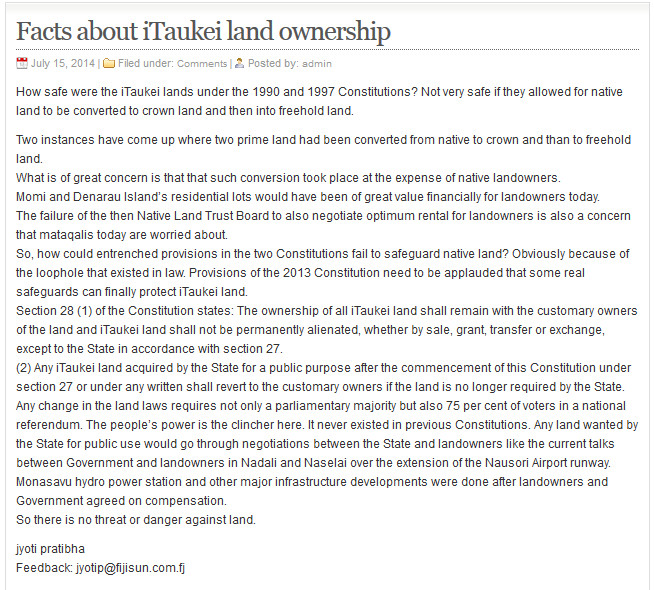
Under the heading “Facts about i-Taukei land ownership” Fiji Sun editorial writer Jyoti Pratibha stated [F/S July 15] that “there is no threat or danger against [indigenous customary-owned] land”.

According to her, this is in light of the assurance given in the 2013 Constitution under Article 28 that i-Taukei, Rotuman and Banaban customary-owned land shall remain with them and cannot be permanently alienated.

It is surprising that the Fiji Sun has come to this very simplistic and subjective conclusion without considering other relevant facts in order to establish what the truth really is about the protection of indigenous communal land rights under the Bainimarama/Saiyad-Khaiyum 2013 Constitution and their Land Use Decree 2010.

Had they conducted more research on the matter, they would have found that the objective truth is quite different.

So what is the objective truth about the purported assurance under Article 28?

Any intelligent and politically unbiased objective observer knows that to determine whether in reality this Article 28 purported assurance can be trusted as being reliable and dependable, it must be looked at from the perspective specifically of the indigenous landowners. And here, the real test of the efficacy of this assurance is whether the indigenous landowners can freely exercise the associated and secondary rights that derive from their customary ownership of their communal land. The most important of these is their right under the common law to seek the protection of the courts in circumstances where they consider and can adduce evidence to support their application that the public authorities concerned, be it the NLTB under the Native Land Trust Act, or the Prime Minister under the Land Use Decree 2010, have not properly discharged their statutory and fiduciary duty to ensure that the best interests of the landowners are securely safeguarded in the land lease, or logging concession, or mineral/underground water extraction licence which these public authorities have granted on their land.  

In the precedent-setting case of Narawa and Matanabua v NLTB (2004) it was established by the Supreme Court that a landowning Mataqali as an unincorporated collective proprietary entity has the legal standing under the common law to apply to the courts for a judicial determination and redress of grievances they may have vis-à-vis the NLTB about contractual dealings by the NLTB over its customary-owned land.

Today, when a lease, concession or licence is granted by the Native Land Trust Board under the Native Land Trust Act, a landowning Mataqali may still freely exercise this common law right to seek the protection of the courts if it is considers that the NLTB is not properly discharging its statutory and fiduciary duty to look after their best interests.

But what about the Land Use Decree 2010? Can a landowning Mataqali exercise the same common law rights under this Decree to obtain judicial protection for their landownership rights?

The Decree expressly states under section 6 (2) that the power of the Prime Minister under section 10 to grant leases of up to 99 years is discretionary, and in exercising this power he is required under section 11 to “take into consideration at all times the best interest of the land owners and the overall wellbeing of the economy.”

This power of a public authority is administrative and the courts have interpreted its discretionary character to imply a common law duty by the authority concerned to consult those whose rights or legitimate interests may be directly affected by the specific issue or question under consideration, and for their views to be taken fairly into consideration, before the authority makes a final decision. The objective of this administrative law provision is to ensure that no person is denied procedural justice and fair treatment by those who exercise public power.

These expressed and implied meanings of the provisions of the Land Use Decree confer on the indigenous landowners two possible bases upon which they can bring proceedings in court against the Prime Minister.

Firstly, the landowning Mataqalis in a land lease granted by the Prime Minister under the Decree may apply for a judicial review of the Prime Minister’s decision if all the members have not been consulted and they are not happy with the terms of the lease granted. The application is for the court, on the evidence presented, to quash the Prime Minister’s decision on the grounds either of illegality, or acting unreasonably and irrationally, or for denial of natural justice to the Mataqalis concerned.

The inference here is that it may not be enough to satisfy the requirement for procedural justice for the Prime to act solely on the consent of 60 percent of the Mataqali members in the transfer of their land to the Government’s Land Bank to be dealt with by the Prime Minister under the Land Use Decree. In fact, depending on the consent of only 60 per cent of the Mataqali members is contrary to the traditional way of indigenous Fijian decision-making by collective consensus. If the Prime Minister, for example, is contemplating granting a 99-year lease it would actually be prudent for him, in the interest of procedural justice and fairness to the landowners, to first consult and obtain the consent of all the Mataqali members by collective consensus. It would be very important to do this not only because it is the right of the landowners under the common law to be consulted, but also because it would be in their best interests to give them the opportunity to fully comprehend the consequence of this long term lease to the land maintenance needs of their Mataqali members, now and in the future. Under the NLTB, the land maintenance need of the Mataqali is always considered as the paramount consideration.

In the Narawa and Matanabua v NLTB (2004) case cited above, the Supreme Court had emphasized the point that for a Mataqali to have legal standing before the court the members must give their collective and unanimous consent to the common cause to be pursued and who is to represent them in this.           

Secondly, in the event a lease has been granted with the consent of the landowners but that in the course of the lease implementation, the leaseholder, for example, has consistently and unreasonably failed to pay the required rent, or has breached the lease conditions by building permanent structures on the Mataqali land without the requisite prior approval of the landowners, and the Lands Department has done little to rectify the problem, the landowning Mataqalis may sue the Prime Minister with a claim for damages, alleging breach by him of his statutory and fiduciary duty to safeguard the best interests of the landowners.

So in the context of the purported assurance under Articles 28 of the 2013 Constitution, the question that the indigenous landowners are entitled to ask is whether this assurance is really of practical utilitarian value to them when at the same time Bainimarama and Saiyad-Khaiyum, as the promulgators of the Constitution and the Decree, have also effectively denied the landowners their common law right to seek the protection of the courts for their customary proprietary rights.

Consider the following:


[1] Section 15 of the Land Use Decree clearly stipulates that no court, tribunal or commission shall have any jurisdiction to accept, hear and determine any challenge or claim against a decision of any Minister or state official under this Decree. This totally denies the indigenous landowners the right of access to a court in order to seek judicial protection for their rights derived from their common and collective customary ownership of their land. It means that the Mataqali members cannot exercise their common law rights under the Decree, which they can freely do under the Native Land Trust Act and Native Lands Act.

[2] Article 16 of the 2013 Constitution gives every person in Fiji the right to apply to the courts for a judicial review of decisions by those in public authority if these decisions allegedly violate or adversely affect their rights under the Bill of Rights. This right however does not come into effect until after the first sitting of the first Parliament elected under this Constitution. It effectively means that no one has the right to apply for judicial review of any action or decision by the Prime Minister or any other public office holder in the government or a state agency until after the general elections in September. But for indigenous landowners this right of access to the courts for judicial review is totally and permanently denied to them by the operation of section 15 of the Land Use Decree.   Where then is the right to equal citizenry which we are told is the foundation upon which the 2013 Constitution is built? Why are indigenous landowners being relegated to lesser rights than owners of freehold land in seeking judicial protection of their proprietary rights? Where is the right to equal access to the courts, or to the equal protection of the law? In short, why are indigenous landowners being differentiated from other citizens and discriminated against in the exercise by them of their common law rights derived from their proprietary rights by custom to their communal land?   

[3] And even if indigenous landowners were allowed equal access to the courts for judicial review of, or substantive appeal against, a decision or action by the current government in relation to their customary land, Chapter 10 of the 2013 Constitution would render them futile and ineffectual because it irrevocably grants absolute and unconditional immunity to Bainimarama, Saiyad-Khaiyum and others in the current government from criminal prosecution and civil liability from all their decisions and actions.

So when you consider together the operational effects and consequences of the restriction on the jurisdiction of the courts under section 15 of the Land Use Decree, the blanket immunity from civil liability under Chapter 10 of the 2013 Constitution, and the time limitation on the coming into effect of the right to apply for judicial review under Article 16 of the Constitution, it is unequivocally clear that the Article 28 assurance on indigenous landownership cannot be regarded as being reliable and trustworthy. It can only be so if section 15 of the Land Use Decree is revoked and if the immunity provision of the 2013 Constitution is removed. But it is doubtful whether Bainimarama and Saiyad-Khaiyum will ever agree to this because they are dependent on these provisions for their self-protection.

Undoubtedly, the best protection for the landowners is to return the administration of all dealings on their land to the Native Land Trust Board under the Native Land Trust Act. In addition, the 2013 Constitution must be amended to incorporate into it Articles 185 and 186 in the 1997 Constitution. These two 1997 Constitution provisions entrench all legislation pertaining to indigenous group rights and provide specific mandate to Parliament to enact laws for the application of customary laws and processes.

Fijileaks Editor: Kotobalavu sent his response a while ago but the pro-regime propagandist Fiji Sun is yet to publish it.

Picture

From Fijileaks Archive:

Picture
MEDIA RELEASE
By L.Qarase
PROTECTION OF NATIVE LAND


The Attorney –General, Mr. Aiyaz Sayed Khaiyum, has travelled throughout the country telling people that Government’s draft Constitution provides better protection for native land than the 1997 Constitution. This is simply not true and it is a blatant lie. Mr. Khaiyum has told the lie so often that his colleagues in Government, including the Prime Minister, Commodore Voreqe Bainimarama, have come to believe him.

The truth is this: the 1997 Constitution provides for the entrenchment of certain laws covering group rights. These laws include the Fijian Affairs Act, the Native Land Trust Act, the Agricultural Landlord and Tenant Act (ALTA), the Rotuma Land Act etc. Amendments to these Acts would require special majority voting in Parliament, particularly in the Senate. In the Senate, any amendments must be approved by at least 9 out of the 14 members who represent the Great Council of Chiefs. Under this provision it would be difficult to amend any of the entrenched legislation. And if any amendment is passed it would mean that the amendment has the support of the great majority of the people of Fiji.

Under Government’s draft Constitution there is no provision to entrench the rights of indigenous Fijians to their resources and other group rights. In other words the entrenched laws will be like other laws which require simple majority votes in Parliament to effect amendments or even the repeal of laws. Where then is the greater protection claimed by Mr. Khaiyum? There is none! Mr. Khaiyum has argued that this protection is contained in the Bill of Rights. As chief legal adviser to Government the Attorney- General should know better. The Bill of Rights provides for rights of individual citizens, not group rights. Native Land is owned communally, and not by individual indigenous Fijians. His argument, therefore, is false and invalid. Without the entrenchment of laws relating to indigenous Fijian rights it would be fairly simple to take these rights away from them. Indigenous Fijian rights to their land, for example, will be at the whim of the Government in power, since a simple majority in Parliament would be required to effect changes.

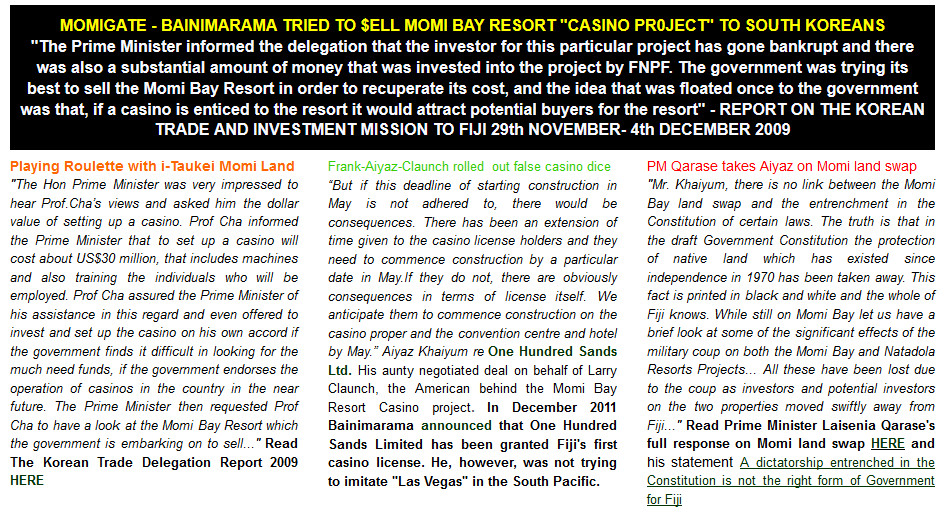
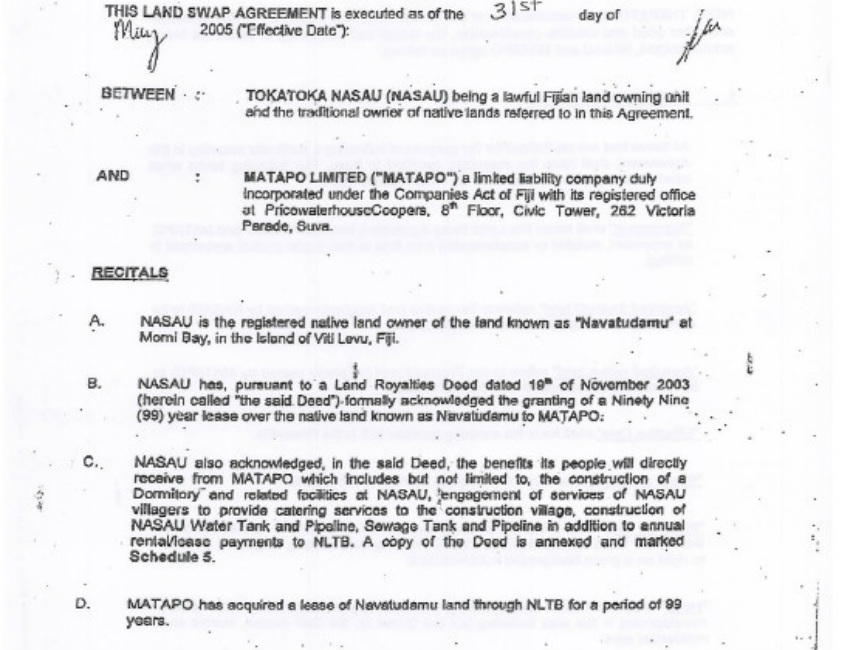
The Attorney General has cunningly diverted attention from the issue of “entrenched legislation” to the land swap or exchange in the Momi Bay Project. The land transaction in question involved the swap or exchange of 68.7 hectares of native land owned by Tokatoka Nasau with freehold land of equivalent area and value owned by Matapo Limited, the developer of Momi Bay Resort Project. Upon exchange the native land was to be converted to freehold and the Matapo freehold was to be converted to native land and registered under Tokatoka Nasau. There was no loss of native land in the transaction because of the equivalent freehold land in exchange. The land swap was made with the voluntary agreement of the two parties involved, Matapo Limited and Tokatoka Nasau. The NLTB gave its consent to the transaction and the Government of the day sanctioned
the land swap under the Land Transfer Act. The terms and conditions of the land swap are recorded in an Agreement between the two parties dated 31st May, 2005. The landowners were obviously satisfied and happy with the benefits they were going to receive which include the following:

· An equivalent land area was exchanged for native land, hence
there was no loss of land;
· The landowners were paid a premium for the transaction;
· The landowners were to become shareholders in the operating
company of the golf course;
· Higher rental income to landowners;
· Jobs priority for landowners and so on.


In addition the agreement reached between Matapo Limited and Tokatoka Nasau was going to make a huge contribution to the overall success of the Momi Bay Resort Project. Mr. Khaiyum, there is no link between the Momi Bay land swap and the entrenchment in the Constitution of certain laws. The truth is that in the draft Government Constitution the protection of native land which has existed since independence in 1970 has been taken away. This fact is printed in black and white and the whole of Fiji knows. While still on Momi Bay let us have a brief look at some of the significant effects of the military coup on both the Momi Bay and Natadola Resorts Projects. Developments on both properties were proceeding well. Projections were that by 2010 – 2012 three to four 5 – star hotels would be operating at Natadola and two or three 5 – 6 star hotels plus a Marina at Momi Bay. About 10,000 direct and indirect jobs would have been created; tens of millions of dollars were to flow into Government revenue annually by way of VAT, PAYE and corporate taxes. All these have been lost due to the coup as investors and potential investors on the two properties moved swiftly away from Fiji.

The absence of adequate protection of native land in the proposed Constitution is a major flaw. There are many other significant provisions which are repugnant and unacceptable in a modern democratic society. The bottom line is that the proposed Constitution will entrench the current dictatorship and for this reason alone it should be totally rejected by the people of Fiji.
Picture
Picture
2 Comments

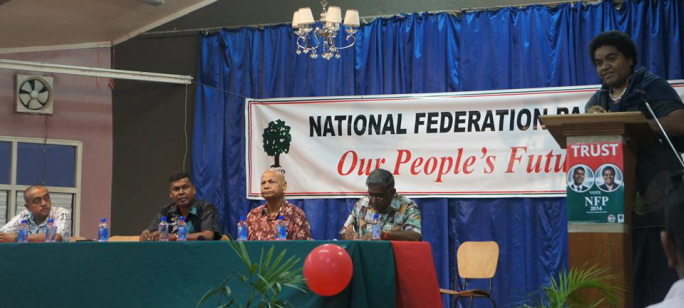
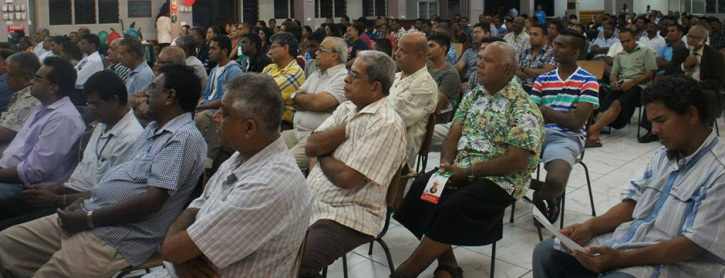
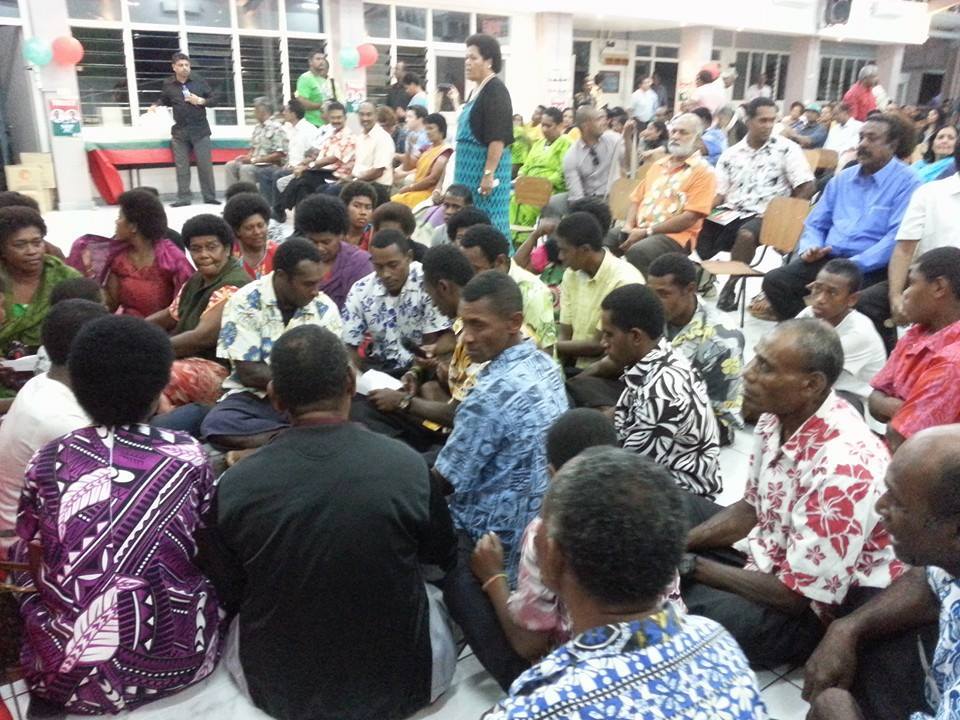
NFP Manifesto OUT: "We are a party with a proven track record. Our achievements are permanent milestones. As a party born out of the struggle for dignity and justice of our ordinary citizens, NFP is once again ready as ever to honestly serve our nation"

21/7/2014

0 Comments

 
Picture
PictureREADY to take NFP into the election
NFP President TUPOU DRAUNIDALO:

"Fellow Fiji Islanders, Party supporters, workers, volunteers, stalwarts and, invited guests. I have great pleasure in welcoming you too this evening to the launch of our party Manifesto for the 2014 General Elections.

I will speak in both the English and Fijian language today.

Since our election at the end of March, the party leader and i have travelled around the country and met very many people to gauge your views, leading up to the elections.

I have referred to these meetings as the listening tours and, information sessions.

Your views have guided us in the drafting of this party manifesto. It is what it is – the big picture statements of what we will do after we are elected to government.

I wish to deal with two issues that have come through strongly to me during the listening and information tours. I have had the pleasure of reading the Leader’s speech and he addresses the same and other issues of relevance to the manifesto.

The first, i wish to address is the land issue. As you all know, our party proposes the ‘Master Lease’ concept.

I read a message late last night from a relative who promptly informed me that a candidate from her neighbouring village in Nadroga was equating our Master Lease policy to the Land Bank initiative of the interim administration.

I laughed it off but i was also flattered by that sure sign of desperation and ‘clutching at straws’ - because you wouldn’t need to mislead people if the facts are on your side.

Ladies and Gentlemen, our Master Lease policy is a “leasing” policy - for the government to “lease” all available “agricultural” lands from the Native Land Trust Board.

It does not deal with commercial or special purpose leases.

The master lease, like all leases, will be negotiated between the government as intending lessee and the Native Land Trust Board as legal owner and “Trustee” for the Taukei in the landowning units in the Vola ni Kawa Bula.

As an indigenous person, i trust the Native Land Trust Board to carry out its duties as Trustee -  independently and competently in the best interest of its beneficiaries.

That is the reason why the Board was set up. To jealously guard the interests of beneficiary landowners in the handling of all matters to do with their very valuable resource.

If some erstwhile members of the other political parties cannot trust the Board to carry out those duties in the negotiation of leases between the Board and the government then i suggest that they look inwardly first at their own conduct while in government or at their policies before they go further because their insecurities may spring from their own experiences with the Board as a first hurdle to removing the plank from their eyes.

Back to the policy, i would have thought that the negotiation of lease term, payment, management positions for landowners, scholarship trust funds for landowners, joint venture status for landowners and the like under the Master Lease would be easier for the landowners and their lawyers through the Board to negotiate with their own government needing their support then it would be to negotiate with individual farmers or parties who come to the negotiation table without the resources, clout and political interest of the central government.
I hope that the lawyers for the landowning units are paying close attention to what i have just said. But I cannot say anymore as i will be sitting at the other end of the table in the negotiations for leasing under this policy.

Our manifesto also clearly states that a National Federation Party government will not use the powers of “compulsory acquisition” over any land including native land as allowed under sections 27 and 28 of the military constitution, 2013.

No other political party has made these commitments of dialogue, agreement, investment and respect to the native landowners. Investment in their communities and investment for the future. Respect for their ownership of native lands and respect for their Trustee, the Native Land Trust Board.
Ladies and gentlemen, the National Federation Party is a fifty one year old conservative party of principle and consistency.

We do not believe in cheap political tricks and cheap talk. We urge you to judge us on our 51 year old record. We are the party that agreed to and worked hard for the enshrinement of indigenous rights in the 1970 and 1997 constitutions.

We are the party that negotiated ALTO and ALTA with the Alliance government. We are the party that gave Fiji its biggest current investor – the FNPF. We are the party that gave Fiji the Housing Authority to provide housing for very, very many Fiji islanders especially the Taukei.

We are the party that has never supported any coup in this country because we respect the rule of law and the inherent principles of natural justice and human rights and freedoms; peaceful negotiation and cooperation.

And i urge the people of Fiji to also judge the other political parties on their record. Have they been consistent and principled? Have they always supported the rule of law? Have they had a history of addressing land issues calmly and sensitively, with respect and dignity for landowners together with human compassion and respect for the multiracial tenant community? Have they been able to calmly and rationally deal with the other political parties in parliament for the betterment of Fiji?

The NFP has.

The NFP shall continue in that vein.

After 51years – it’s hard to kill old habits.

Next ladies and gentlemen, i wish to address the second issue i have taken away from the hustings - another issue dear to my heart as a youngish person with a few more decades to live in this country, god willing.

It saddens me no end to hear so many of my generation speak of their disillusionment with the body politic in this country.

It saddens me because i know that feeling well. You see, we turned 14 or thereabouts, give or take five to ten years, when the first coup happened in 1987.

Our whole lives lay ahead of us and all we got was 27 years of the coup culture. The leaders of this country responsible for the coup culture failed us.

That coup culture robbed our generation of life under the rule of law and democratic governance.

You may ask, why and how is that so important?

I like to tell the story of Fiji and New Zealand and Mauritius in 1986 that our leader also tells the hustings. Fiji was on the track to be on par with New Zealand on important economic indicators and ahead of Mauritius.

At present, if we take the three hour flight to New Zealand and some more hours to Mauritius – we will all see that those two countries have move forward ahead of Fiji, leaps and bounds on the important social, political and economic factors.

Their economy (employment, wages, dollar strength, investment levels), political foundation and social services – hospitals, schools, water, housing and roads are much better than hours (and they do not get fixed in anticipation of general elections).

If you ask how and why, ladies gentlemen - there is a very simple answer – they have not had military coups instigated by selfish, short sighted and incompetent politicians to disrupt their progress and maturity.

The next question would be, how does the National Federation Party propose to tackle that matter?
Ladies and gentlemen, we have been telling voters right around the country that the first step is for you to not vote for the coup maker as that will send all of the wrong signals to the military camp.

There are captains, majors and colonels sitting in the camp and as history has shown in this country and other countries that have had military coups – they watch carefully and take their cue from how the electorate, you the masses treat a usurper from their ranks.

If you elect the usurper, you embolden others with that thinking ‘If he can do it and get away with it, so can i – and I need not worry as the electorate will later legitimise me through elections.’

Believe me, that is not the message we wish to send to the military camp.

Just as importantly - if you do not vote at all, you will be sending the same message to the military camp.

You will be raising the white flag of surrender on behalf of the children of Fiji.

Our manifesto states that we will support continual and relevant training for our armed forces on their role under a democratic government. That is, to take this coup culture mentality out of their ethos.

They need to know that we the people are their masters and we speak through general elections to defer to our elected leaders to run the country for us.

Yes, i also have relatives and friends in the uniform and my father proudly wore that uniform for many, many years and distinguished himself there.

And so i wish to speak directly, firmly but with a lot of love to the armed forces when i say the following – when you put on that uniform, you are no longer just our relative, family or friend – you are also subject to very particular laws of this country.

And like me and every other citizen including our leaders and chiefs – you are beneath the law. The law is above you and each and every one of us.

If the Queen of England humbly subjects herself to the laws of her country and the sovereignty of her people then i humbly suggest to you that you do the same.

As the great English Judge, Lord Denning once commented ‘Be you ever so high, the law is above you’.

Only when you do that, will you allow this country to flourish socially and economically as a democratic country.

Yours is not a position from which you second guess the elected government of the day. Your role is to follow orders that come from the elected cabinet who represent the people.

Again, that is said with a lot of love.

And i am sure that the men and women in uniform would be proud to play their proper role in ensuring that the coup culture ends so that social, economic and political development progresses – uninterrupted.

As our Leader has previously said, we welcome the commander’s assurances to respect the result of the general elections.

Before i end under this heading i also wish to tell the people of Fiji that we must always speak our minds to each other.

Being in a state of denial or burying our heads in the sand and wishing things would just go away won’t do any good. We have to make things happen.

For all of those reasons, we urge the people of Fiji to vote wisely. Look at the history of our party and look at the history of the other parties that are standing in these elections. Look at our policies and the policies of the other parties. Look at our candidates and the candidates of the other parties.

Compare and contrast us then do your civic duty to your country and to the children of this country, for now and into the future – Go and Vote.

Thank you very much."

Tupou Draunidalo
President
NFP


Picture
Picture
Picture
Professor Biman Prasad, NFP Leader:

"After 8 years of military rule, on September 17 the people of Fiji will have an opportunity to decide which political party should form our Government. In deciding how to cast your vote, I appeal to you to carefully consider the following: Which party puts the nation ahead of the self-interest of its leaders? Which party can be trusted to rebuild our democracy? Which Party has a solid economic plan to create stable and well-paying jobs? Which Party has a plan to reduce the price of food, medicine and transport?  Which Party has a credible plan to help our country to avoid the pain and suffering of further coups?

I am deeply honoured to present the Manifesto of the National Federation Party to you today. This document helps you decide on these questions. I urge you to carefully read this.

Ladies and Gentlemen, the 2014 Manifesto of the NFP is a different document. Unlike the Fiji First Party and others, I and the NFP do not pretend that we know what is best for you and your families. This manifesto is not written by spin doctors and hired professionals. My party has travelled the breath and the width of the country; we have held hundreds of meetings, and have received hundreds of submissions on what you think is best for you and for our country.

The manifesto amplifies your voice. It responds to your concerns. It captures your aspiration. The days where leaders can turn up to your homes and villages and tell you what is best for you, your children or your parents are well over.    

More than amplifying your voice, the manifesto is a compact. It is a compact between you and the NFP. It is a compact between our citizens and me personally. The manifesto presents practical plans that we will bring into Government. It is a document you must use to hold me and the NFP accountable. I will use this compact to ensure that all our MP’s and officials use all their influences to bring the programs to fruition in the new parliament.  

Beneath these carefully crafted feasible programs for Government, the manifesto is linked to our founding principles of good governance and respect for our fundamental human rights. The NFP has stood by these principles for 50 years – not because we cannot change but because our core values of democracy, fairness, and equal human rights do not change with time. They withstand the test of time.  

The NFP is not tainted by its support for coups or collusion with coup makers. We are committed to our pledge to serve all our peoples through an accountable government. To do so we need to restore our democracy. We need to rebuild government institutions. We need to reignite the commitment of our civil servants so that they give their best to providing services and solutions to the problems our people face.  From these we will deliver a strong economy. From the strong economy we will begin to reduce the many hardships our people face.  This Manifesto - your Manifesto is a start of that journey.

It is my firm belief that the people of Fiji will decisively vote for a change in this election. The status-quo of low growth, rising cost of living, high levels of unemployment, deteriorating health services and facilities, poor infrastructure, inconsistent economic policies and lack of good governance is unacceptable to the people. The exasperation of the people with the status-quo is understandable and they are in no mood to suffer any more.
 I will not summarize the manifesto. It is there for you to read and absorb.  In short, the NFP’s manifesto responds to each of the areas in which Fijians are seeking a transformation.
Exactly what NFP will do for you is in this Manifesto.  Briefly:
•    Govern fairly for all Fijians
•    Create more jobs, decent jobs, and increase productivity
•    Immediately reduce VAT from 15% to 10% and reduce import duties on essential food items to reduce the   cost of living for all families
•    Establish national guidelines for child protection, not just emergency ad hoc measures
•    Provide not just fee free education but quality education that will include children with disabilities and more funding for scholarships for students from underprivileged families
•    Increase funding for aged care and increase social pension
•    Funding to promote indigenous culture and tradition.
•    Protect freedom of speech and support an open media.  
•    Promote just, fair and humane labour practices, first repealing the Essential National Industries (Employment) Decree and amending the Administration of Justice Decree to restore full collective bargaining rights and access to justice for workers and trade unions, including police and prison officers; and restore Public Service Log of Claims (LOC) award
•    Review and establish national minimum wages and conditions including redundancies.
•    Remove restrictions related to political party and electoral decrees.
•    Introduce a national medical and life insurance scheme.
•    Restore retirement age to 60 in the civil service.
•    Institute a fully transparent system of all procurement of all goods and services by Government.
•    Make timely assessments of government’s financial performance and table Auditor General’s Report.

In a nutshell:

NFP will provide good governance, a transparent system free of corruption that will have sound fiscal policies that will build a strong economy to provide decent jobs for decent pay with good productivity, with special measures to protect and promote youth, and develop an environment that allows all people to pursue their aspirations with real prospects of success.
Trust Team NFP – this Manifesto is your guarantee of good government.

The NFP under my leadership will promote sound and not populist policies that will build a strong and stable economy, generate decent jobs for our young, develop an environment that allows all our people to pursue their aspirations and realize their dreams here in Fiji – not abroad.

NFP believes that our manifesto will lead to a credible and stable government after the election.  We believe Fiji will attract significant funding, grants and investment from our development partners. We project that Fiji could attract an estimated billion dollars in grants and investment over the next four years. NFP’s manifesto contains policies which will guarantee a sustained economic growth rate of more than 5 percent per annum which will translate into more productive and decent jobs and thereby reducing the number of people living below the poverty line. We will put Fiji back on the path of renewed prosperity.

What the NFP offers is a team you can trust:  a team that knows what it will take to deliver this manifesto; a team that knows what it takes to succeed.  

I am leading a team that represents all walks of national life: people with background in farming, in civil services, in law, in commerce, in education and more.   My team includes economists, gender specialists, ecologists, youth advocates, religious leaders, writers, social workers and experienced politicians.  My team has the people and the skills that are needed to get our country moving again. My team knows what it will take to kick start our economy. My team knows the hard work that lies ahead.

My team represents our great country. It includes men and women; it has leaders from our villages, from the distant islands and from our towns and cities. They hold different faiths and beliefs. But what unites them all is a shared common regard for the important values and principles of democracy; of giving their best to realize the vision that this manifesto outlines.

This dynamic, multiracial, multi-faith team is united in a firm belief that ‘we can and we will make it work’. TRUST us. We will deliver. This country will be great once again. Once again we will shine light to the world. The Pope John Paul said of us many years ago: ‘Fiji the way the world should be’. We will get there once again.
 
To the media assembled here, I once again remind you of your sacred duty. Please give the NFP a fair space to project its manifesto nationally.  Please give all parties a fair space to project their manifestos as well. Help our voters need make informed choices.   In restoring our democracy, a lot rides on you.

I also call for a national debate of leaders on their respective manifestos. This is necessary for the people to decide in an open, transparent and accountable way to choose their next government. I especially call upon the Bainimarama government to stop the intimidation of the media organisations and journalists. This government continues to harp about the developments that have occurred in this country for the last 7 years then they should not fear. They should let go their controls on the election process. They should let the Electoral Commission do its work independently. The Election Commission has become a compliant, ineffective body which stands by and accepts the decision by the government. In fact they seem to have gone into hiding.

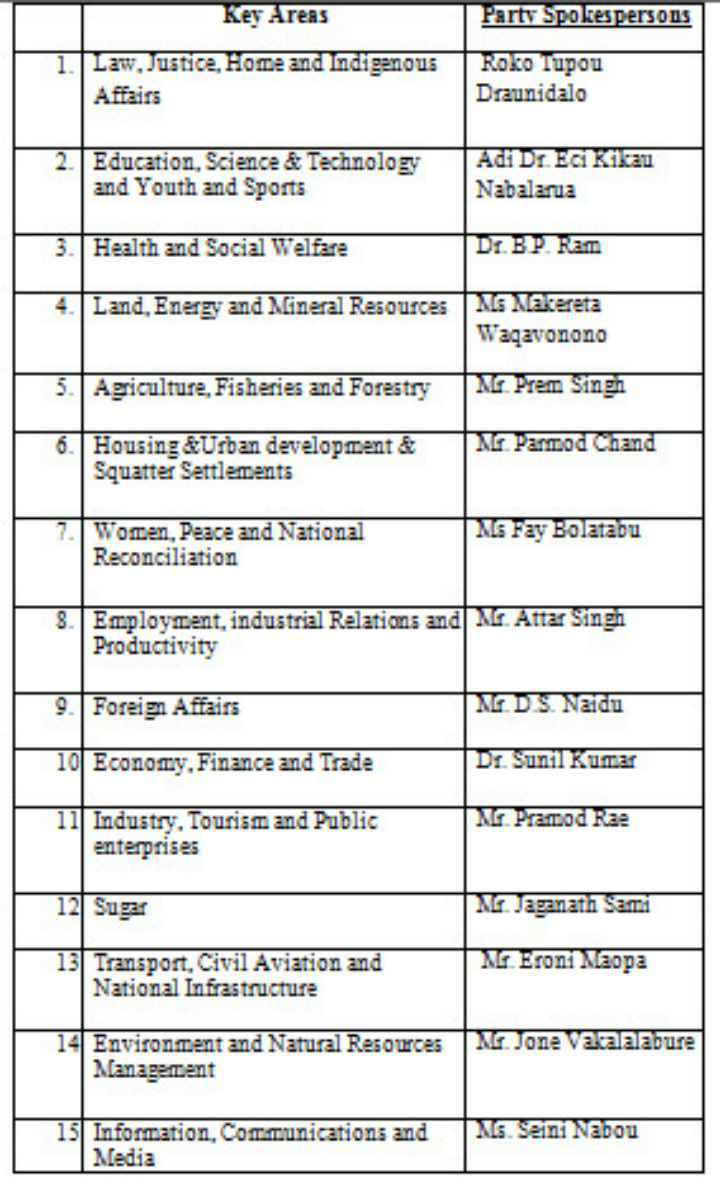
Today, Ladies and Gentlemen, I am also pleased to announce our party spokespersons for the different areas. This will allow the party to articulate its policies in more detail to the people of Fiji and again I would implore upon the media to talk to our spokespersons on specific areas that our manifesto addresses.

Thank you and god bless this great country of ours."


Picture
0 Comments

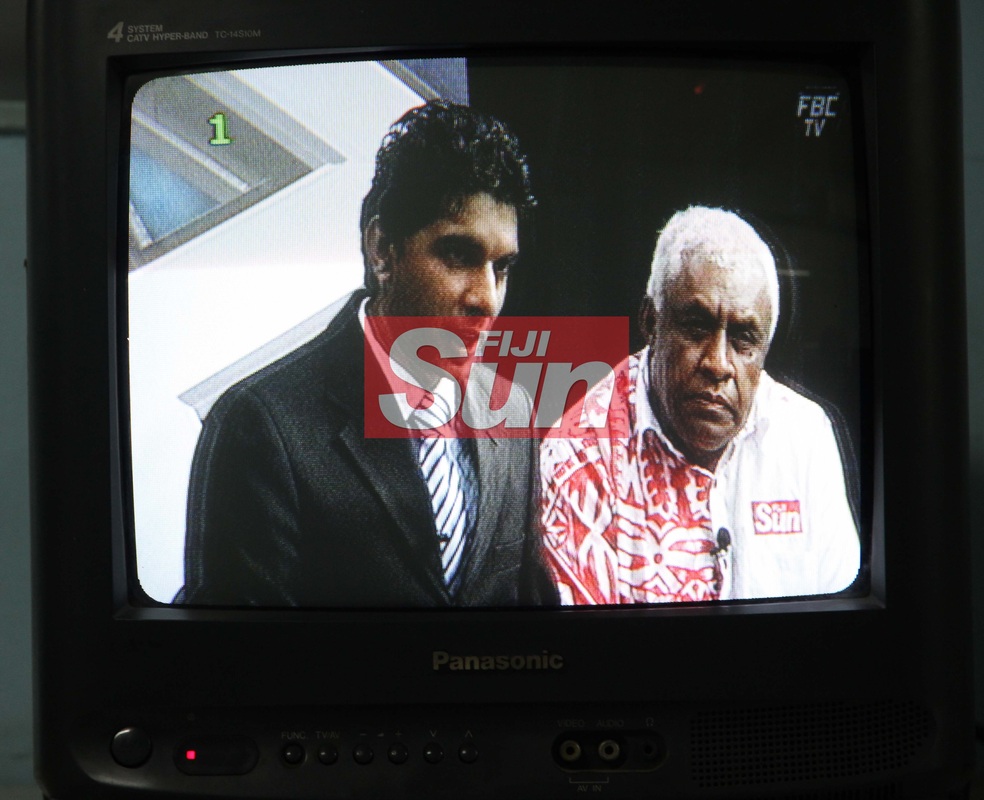
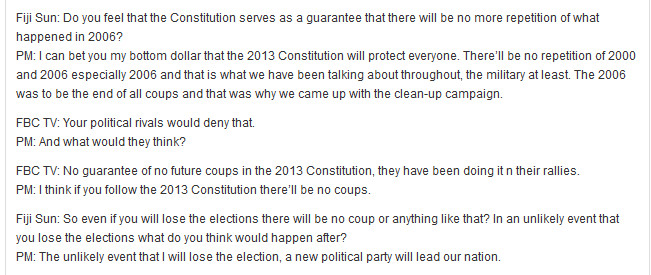
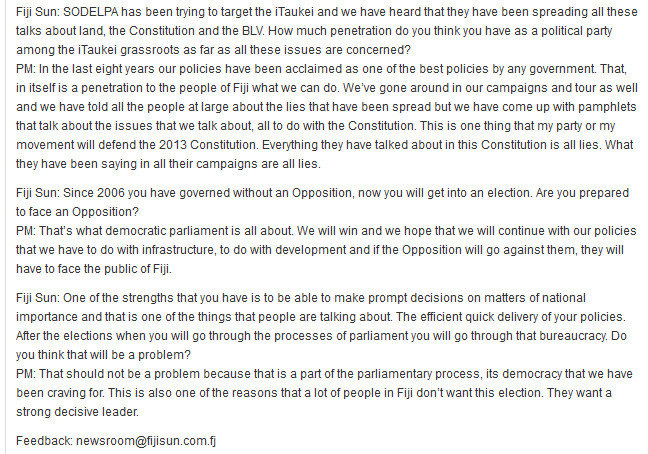
WHY IS THIS MAN CHAIRING A TV DEBATE? Fiji Sun sends Johnny-Come-Lately journalist to "grill" their pet dictator on forthcoming election - recall MIDA's attack on "bloody foreign journalists"

20/7/2014

1 Comment

 
Picture
HARD TRUTH - Delaibatiki on Delaibatiki:

FIJI SUN:
You had a successful career in New Zealand – what has brought you back to Fiji? 26 October 2013:

"I first went to New Zealand after the 1987 military coups. The old Fiji Sun of which I was the last editor closed. In 1991 we returned to Fiji to take up a position as editor of the Fiji Daily Post and returned to New Zealand in 1996. I had a young family then. I always believe that everything in life happens with a purpose. When we moved to Hamilton, Asenaca, my wife and I had one big priority, to ensure our 11 children received the best education we could afford. The plan was that once they received their university degrees, got qualified, secured jobs and started their own families that we, as a couple, would return to Fiji and spend the rest our lives in the land of our birth. We have no more children living with us now. So in a way, we are free. They are all independent now doing their own thing. So everything we have planned for has come to pass. The process of relocating to Fiji has already started. We have a property and other assets in New Zealand that we need to dispose of. We also have a small Sydney-based news website business catering for Fiji people living overseas that we are developing. But Fiji is our passion. We love Fiji. How can we forget our roots? We want to put back something into the country. I accepted the Fiji SUN offer to train its young journalists because this is a wonderful opportunity for me to share my experiences and train them to become better journalists. They have exciting talents."
http://www.fijileaks.com/home/prodigal-sons-or-bloody-foreigners-if-craddock-and-thompson-are-bloody-foreigners-who-have-no-idea-about-fiji-what-about-lomas-and-delaibatiki-who-returned-to-fiji-to-edit-fiji-sun-after-many-years-away
Picture
Picture
Picture
Picture

Fijileaks: Coup was no 'Clean Up Campaign' but 'Cover Up Exercise:

Picture
Picture
Picture
Picture
Picture
Picture
Picture
Picture
Picture
Picture
Picture
Picture
1 Comment

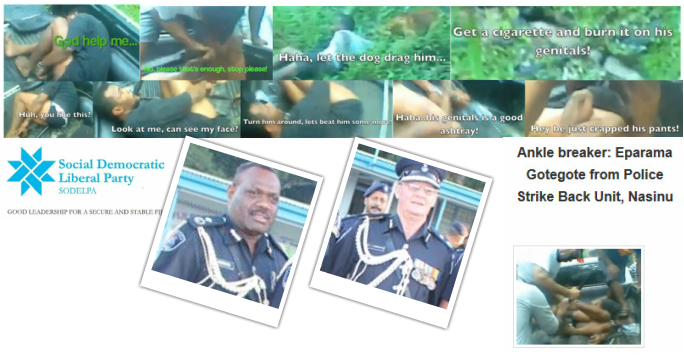
The bad old South African apartheid laws now on display in Fiji: Sodelpa wants answers from new police chief on why investigations closed on the horrific beating and torture of escaped prisoner & one another!

20/7/2014

4 Comments

 
Picture
 A BLOW TO THE RULE OF LAW

Statement, July 20 2014

The SDL Leader Ro Teimumu Kepa said today that the decision to halt investigations into the horrific beating and torture of two men last year is a massive blow to the rule of law. The new Police Commissioner owes the people of Fiji an explanation? Does this mean the government now seeking election condones violence?  It can have no other meaning.

In the absence of a satisfactory explanation from the Commissioner, the police force, under its new commissioner, is compromised.

The government and the police had promised the nation there would be a full investigation into this serious crime.

It involved a prolonged attack by members of the security forces on an escaped prisoner and the man who reportedly harbored him. The assault was seen worldwide on You Tube. Prime Minister Voreqe Bainimarama said he stood by his men who were doing their duty.

And now, 16 months later, without any charges being laid or an explanation the police chief of operations, ACP Rusiate Tudravu, announces (Fiji village 18/07/2014) the investigation has been closed and there will be no further comment. This is not ‘good enough’ we demand an explanation from the Police Commissioner.

Ro Teimumu said a SODELPA government will reopen the investigation and ensure the culprits are brought to justice. We want to know what kind of inquiry was conducted and how many people were interviewed?

As elections draw near the rule of law is an issue in the election campaign and it is a keystone for Fiji’s progress.

Prime Minister Voreqe Bainimarama will have to explain the policy of his Fiji First Party on the application of the law.  He must explain this in view of the closing down of investigations into the savagery of the attack on the two men last year without a conclusive outcome and due process fully applied.

Authorized By: SODELPA


“Well if closing the investigation means that no-one has been held to account, then I think that’s really another black mark in terms of accountability and
the rule of law in Fiji.”
Grant Bayldon of Amnesty International


Mother of the beaten victim: "They treated my son like an animal...ISA na luvequ! Oilei turaga! Sa mosi dina na yaloqu, na cava beka e leqa
(Oh my son! Oh Lord! My heart is in pain, what is the problem)"

FAIR OR FOUL RESPONSE: THE BEATING AND BRUTALITY HAD DIVIDED OPINIONS:
"This is not an apologia for excessive use of force on the part of the police, as doubtless some of Grubsheet’s critics will argue. Yet there seems little doubt that certain elements of the criminal class in Fiji have a sense of entitlement that poses a very real threat – even in relatively peaceful times – to the rights of all citizens to not only feel, but be, secure and unmolested. This demands a particular resolve on the part of the authorities and some excesses are doubtless inevitable. They can’t be condoned but they can at least be understood, set against a social background in which violence has been an accepted feature for so long...when we were watching that video of those prisoners being degraded and were appalled, we were also watching something of ourselves."  Graham Davis in Grubsheet, 7 March 2013, TACKLING A CULTURE OF VIOLENCE.  Read full opinion HERE
4 Comments
<<Previous
Forward>>
    Contact Email
    ​[email protected]
    Picture
    Picture
    Picture

    Archives

    March 2026
    February 2026
    January 2026
    December 2025
    November 2025
    October 2025
    September 2025
    August 2025
    July 2025
    June 2025
    May 2025
    April 2025
    March 2025
    February 2025
    January 2025
    December 2024
    November 2024
    October 2024
    September 2024
    August 2024
    July 2024
    June 2024
    May 2024
    April 2024
    March 2024
    February 2024
    January 2024
    December 2023
    November 2023
    October 2023
    September 2023
    August 2023
    July 2023
    June 2023
    May 2023
    April 2023
    March 2023
    February 2023
    January 2023
    December 2022
    November 2022
    October 2022
    September 2022
    August 2022
    July 2022
    June 2022
    May 2022
    April 2022
    March 2022
    February 2022
    January 2022
    December 2021
    November 2021
    October 2021
    September 2021
    August 2021
    July 2021
    June 2021
    May 2021
    April 2021
    March 2021
    February 2021
    January 2021
    December 2020
    November 2020
    October 2020
    September 2020
    August 2020
    July 2020
    June 2020
    December 2018
    November 2018
    October 2018
    January 2018
    December 2017
    November 2017
    October 2017
    September 2017
    August 2017
    July 2017
    June 2017
    May 2017
    April 2017
    March 2017
    February 2017
    January 2017
    December 2016
    November 2016
    October 2016
    September 2016
    August 2016
    July 2016
    June 2016
    May 2016
    April 2016
    March 2016
    February 2016
    January 2016
    December 2015
    November 2015
    October 2015
    September 2015
    August 2015
    July 2015
    June 2015
    May 2015
    April 2015
    March 2015
    February 2015
    January 2015
    December 2014
    November 2014
    October 2014
    September 2014
    August 2014
    July 2014
    June 2014
    May 2014
    April 2014
    March 2014
    February 2014
    January 2014
    December 2013
    November 2013
    October 2013
    September 2013
    August 2013
    July 2013
    June 2013
    May 2013
    April 2013
    March 2013
    February 2013
    January 2013
    December 2012
    October 2012
    September 2012