Fijileaks
  • Home
  • Archive Home
  • In-depth Analysis
    • BOI Report into George Speight and others beatings
  • Documents
  • Opinion
  • CRC Submissions
  • Features
  • Archive

Wadan Narsey: Khaiyum cherry-picking Fiji Bureau of Statistics STATS

17/8/2017

3 Comments

 
Picture
By WADAN NARSEY

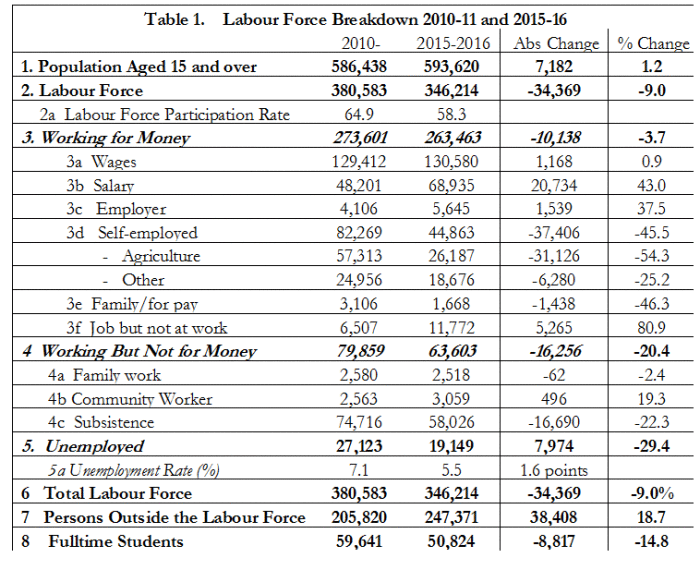
The Fiji Bureau of Statistics has released the Preliminary Findings from their 2015-16 Employment and Unemployment Survey (EUS) (FBoS Release No: 34, 2017 (7 August 2017) from which I present their Table 1 (with line numbers added by me to help the reader).


A Media Release from the Ministry of Information, then reported the Minister for Economy (Mr. Aiyaz Khaiyum) using this FBS Preliminary findings to draw a number of glowing conclusions not justified by the statistics at all, except for No. 1, 5 and 6 below, with my comments in brackets.
  1. Fiji’s unemployment rate has declined from 7.1 per cent in 2010-2011 to 5.5 per cent in 2015-2016, the lowest unemployment rate on record over the last 15 years (Line 5a). (CAREFUL!)
  2. This was clear evidence that the record growth achieved by the Fijian economy was inclusive, and that ordinary Fijians were feeling the full benefits of Fiji’s economic development. (NOT SUPPORTED)
  3. The strong economic management and consistent policies … targeted investment in infrastructure and service delivery, have already brought us eight straight years of economic growth … translated directly into more jobs and new investment opportunities for the Fijian people. (NOT SUPPORTED)
  4. The number of employers in Fiji in 2015-2016 increased by 37 per cent from 2010-2011 (Line 7)…. a major victory for Government’s pro-growth policies that have supported private sector activity in the Fijian economy. (CAREFUL!)
  5. The statistics on school participation showed that while 3,500 persons aged 6 to 17 had dropped out of school in 2010-11, only 3,182 persons had dropped out in 2015-16. (CORRECT)
  6. The percentage of dropouts that had left the education system due to financial constraints had also dramatically dropped from 31.9 per cent in 2010-2011 to 4.8 per cent in 2015-2016. (CORRECT)
  7. The Minister for Labour (Mr. Jone Usamate) then also commented that “the findings depicted that Government policies were effective… it shows that these policies are beginning to work because unemployment is reducing”.   (NOT SUPPORTED)

Unfortunately, nearly all these Bainimarama Government claims (except that on education) look very shaky when one examines the detailed FBS preliminary findings more closely as in Table 1.

Beware the definitions
I remind the readers that the statistics provided by the FBS Press Release are based on very strict ILO advised definitions, which can trap the unwary.
First, all the employment numbers given in the tables in the FBS Press Release relate only to those aged 15 years and over, not to those 14 and under children in Fiji who may be working.   
The “Labour Force” is defined by the ILO as “those who are working or are available for work”.
The “Unemployed” are those who say they are “available for work, and actively looking for work”.
Let me start with the “good news” which I think are quite credible.

Good news on education
Claims 5 and 6 on the progress in education are probably sound and as I would have expected.  The Bainimarama Government’s freeing up of secondary and tertiary education “for those who qualify” must have reduced dropouts from school.
The result that students who have dropped out for financial reasons has declined from 32% to 5%  (another table) is quite credible.

Doubtful Claims 2 and 3:  Few Jobs Created
Unfortunately, the FBS Preliminary release does not support the claims by Minister Khaiyum and Minister Usamate that the massive infrastructure investments and high economic growth of the last five years has created a great number of jobs.  Indeed the statistics in Table 1 suggest the opposite.
Line 3 in Table 1 shows that those “Working for Money”  has declined between 2010-11 and 2015-16 by a large 10,138 or 3.7%.
The massive two billion of infrastructure spending and high rates of economic growth have not translated into cash economy jobs.
Indeed, those working for wages (Line 3a) has increased by a mere 1,168 over the five years (or just 233 jobs per year) or less than 1 percent over a five year period. This is a shockingly small increase in jobs given the rates of increase of GDP.
Those working for salary has increased by 20,734 and a large 43% (Line 3b) but I suspect these were probably largely in the public sector or in one of the few private economy growth areas such as tourism.
In any case, these job increases are the middle income or upper income jobs, not at the low income level were wage jobs usually are.  Remember that there are twice as many wage earners in Fiji than salary earners (compare Lines 3a and 3b).
So Khaiyum’s claim that their economic growth was “inclusive” and for “ordinary Fijians” is not supported by the data.
Equally worrying is that those who are “Working But Not For Money” (Line 4) or Family work, Community Worker and Subsistence declined by a massive 16,256 or massive 20%.  Subsistence workers declined by 16,690 while Community Workers increased by a mere 496 (Line 16).
Overall, the data indicates that the Labour Force (Line 2 and 6) declined by a huge 34,000 or 9%. This is an extraordinary result given that the 15 and over age group has increased over the period (slightly by 1%).

Claim 4   Number of Employers
Khaiyum correctly quotes the FBS result that the number of “employers” increased by 37.5% (Line 3c).
However, his claim that this was “a major victory for Government’s pro-growth policies that have supported private sector activity in the Fijian economy” is on very shaky grounds indeed.  The “employers” category in the survey covers a mere 1% of those employed and the 37.5% percentage increase over 5 years amounts to a total of 1,539 only (Line 3c) and most are the very small employers in the informal sector.
It would not surprise me if this number also includes some who have started their own small businesses after being retired by the Bainimarama Government at the age of 55.
The overall reality is that this increase in numbers of small employers, did not bring about any great increase in jobs in the economy while those who are classified as “Self-employed” (Line 3d) fell by a massive 37, 406, both in Agriculture (-31,126) and Other areas (-6,280).
These numbers all taken together suggest that far from the private sector being dynamic and growing, it has been contracting between 2010-11 and 2015-16.

Claim 1:  The Unemployment Rate
Yes, the “Unemployed” as technically defined by ILO may have declined  from 7.1% to 5.5%, a decline of 7,974 persons.  But I remind you about how the “Unemployed” is defined by FBS and ILO:  those who are not working and “Looking for Work”.
But what about all those simply stopped looking for work because there is no work available? That will explain far better the hundreds of unemployed persons (mostly youth) who are hanging around all the major city centers and highly visible.
While the narrowly defined “Unemployment Rate” shows that it is declining, the harsh reality is that it is not through any great increase in the number of jobs.
The reality also is that a large number of so-called “Employed” persons (especially those “Working But Not For Money”) are significantly “underemployed”, working only part of the day, week, month or year.
From the 2010-11 EUS data which I have analyzed, the extent of this underemployment was more than 30% of the Labor Force, NOT the 7% or 5% officially “Unemployed”.
It is a terrible pity that Fiji’s political leaders are focusing only on the little bits of data that suits their propaganda purpose, coming out of the Fiji Bureau of Statistics, while ignoring the real substantive results.
Thankfully, such cherry-picking of FBS statistics to suit political purposes, is all too easily caught out.

Postscript 1      A rich data source underutilized
These Employment and Unemployment surveys are treasure troves of information on not just employment and unemployment, but also underemployment, gender inequalities in incomes, hours of work done in paid and unpaid household work, on time spent on leisure activities like religious activities, sports, kava drinking, television and video, and even reading.
My Report on the 2010-11 Employment and Unemployment Survey (Fiji Women and Men at Work and Leisure), financed by AusAID, was ready for publication in 2013.  That Report was full of policy recommendations which would have been of great use not just to the Minister for Labour and Employment creation, but also the Minister for Women, Youth and Health and civil societies.
That valuable report was not published because the Minister for Economy refused to give permission, probably because it had some negative results on employment creation between 2005 and 2011.
It is tragic for Fiji that politicians have prevented the public from accessing the reports that their taxpayer (and donor) funds have paid for, another “First in the history of Fiji” for the Bainimarama Government.
Four years later, it is still not published while the Preliminary Findings from the 2015-16 EUS is now slowly dribbling out from the FBS.
Do these Ministers have the courage to demand that the FBS to make available to them that 2013 Report and indeed have it published so that civil society can make use of this valuable source of information, paid for by taxpayers?

Postscript 2   Another example of localization reversed
The only Fijian expert on analyzing such household surveys has been  banned from analyzing that survey data, writing the reports and organizing the national workshops at which Government and NGO stakeholders could discuss the valuable findings.
Because of the Bainimarama Government wish to control the official statistics, the FBS has now gone back to being dependent on foreign experts, usually from WB and ILO, who come and go, without any accountability to the people of Fiji.
Who knows when the Final Reports from the 2015-16 EUS will come out?

Postscript 3      Where is the Final Report from the 2013-14 HIES
I remind the public that there is still no Final Report from the 2013-14 HIES which was being analyzed by the World Bank, apart from some initial poverty results.
No policy recommendations have been brought out on poverty, income distribution,  or food security, or the myriad other fascinating aspects which HIES data can reveal.
See my Report on the 2008-09 HIES) and the many workshops I ran in conjunction with Dr Mahendra Reddy (then at FNU). To date, there have been no workshops run on the results from the 2013-14 HIES results.

Who knows what is in those statistics that this Bainimarama Government does not want the public to see?

It seems that nobody in the Bainimarama Government or the public cares at all.


3 Comments

The Chinese Disappeared: One impending story that never made the Front Page, for Fiji Sun publisher Hunter was kidnapped and deported

10/8/2017

9 Comments

 
Picture

In 2008, after a year long investigation, I was ready to reveal the visa scam involving Chinese prostitutes who had come on student visas into Fiji, had enrolled in a few units at the Fiji National University, and had later disappeared into the world of crime and prostitution. I was also ready to reveal the identities of top policemen, politicians, and bureaucrats who were providing protection to these "Ladies of the Night". Hopefully, we will be able to retrieve the original investigation and publish the details in Fijileaks. I believe the haste with which the recent group of Chinese were whisked out of Fiji was to cover the tracks of LOCALS who might have been party to the alleged crimes.
Any tips: [email protected]

Picture
9 Comments

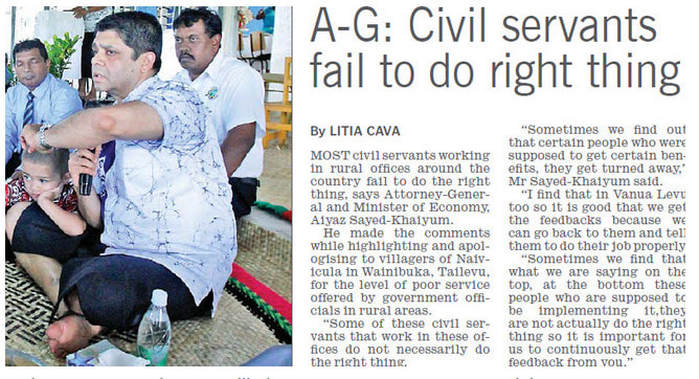
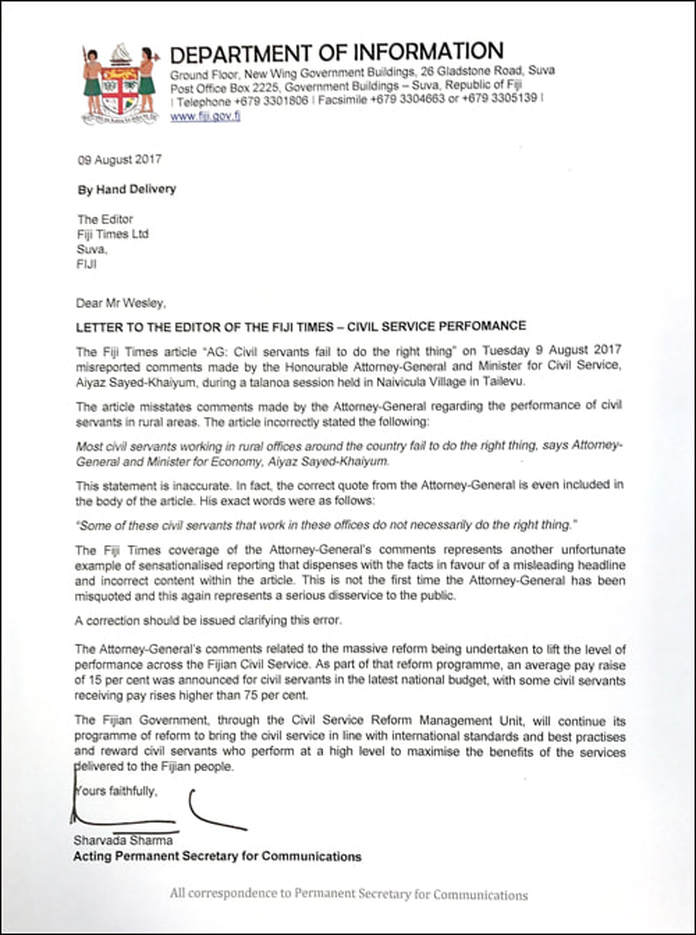
BACKBITING CIVIL SERVANTS? No, says Solicitor-General Sharma, as he calls on Fiji Times to correct an article on Khaiyum and civil servants

10/8/2017

13 Comments

 
Picture

“The Fiji Times coverage of the Attorney-General’s comments represents another unfortunate example of sensationalised reporting that dispenses with the facts in favour of a misleading headline and incorrect content within the article.” The Solicitor-General Sharvada Sharma, in his capacity as acting Permanent Secretary for Communications, said that this was not the first time Aiyaz Khaiyum had been misquoted by Fiji Times, and that “represents a serious disservice to the public”.

Picture
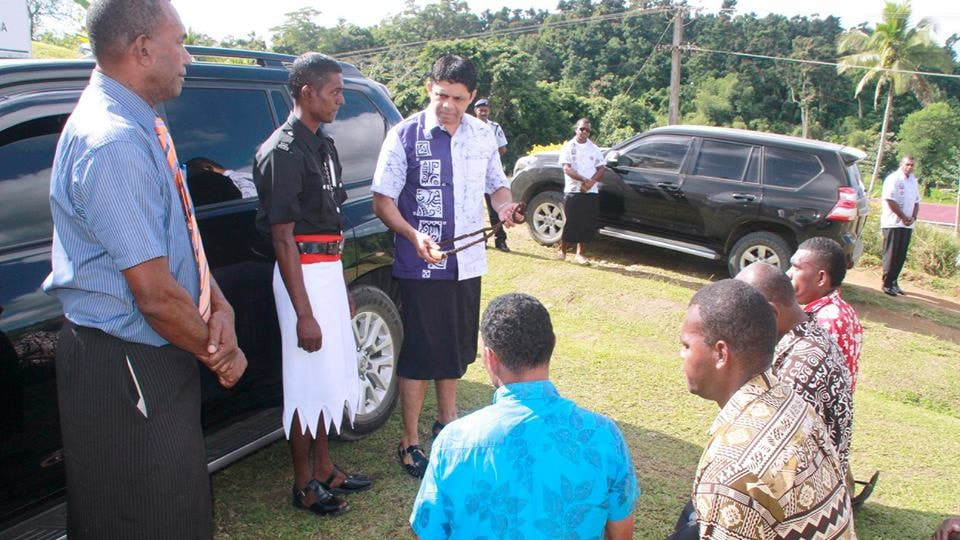
Khaiyum visiting Naivicula Village in Tailevu
Picture
Picture

The Fiji Times has printed a correction and an apology, and the original story is no longer available online.
Fijileaks: We cannot understand why reporters, fully aware of the draconian Media Decree in place, are not using tape recorders, like in the old days, or even recording speeches and interviews on their mobile phones, to avoid misreporting? However, whatever was said or not, we believe come the general election, FFP will get a political beating at the polls from the 55 plus retired civil servants, their relatives, friends, and sympathizers.
And that other COUPIST Rabuka will also get a drubbing at the polls:

Picture
Picture
Picture
13 Comments

BURGLED: Fiji Labour Party the latest victim of soaring crime rise in Fiji

10/8/2017

8 Comments

 
Picture
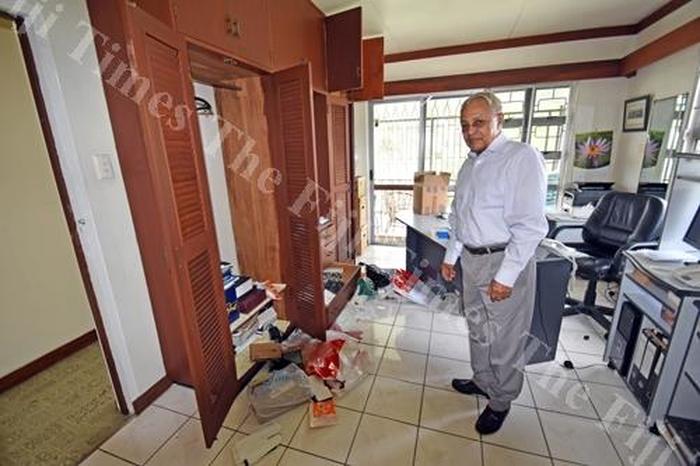
Fiji Labour Party leader Mahendra Chaudhry looks at ruins of the break-in at his office in Varani Street.

THE Fiji Labour Party office was burgled on Monday, however, party leader Mahendra Chaudhry clarified no valuables were lost in the heist. Mr Chaudhry confirmed yesterday a police report had been filed on the break-in: Source - The Fiji Times, 9 August 2017

Picture
Fiji Labour Party: Shocking lack of Police manpower in the West

It is a shocking revelation that the Police Force has less than 50% of the manpower it needs to maintain law and order in the Western Division, says Labour Leader Mahendra Chaudhry.

He was referring to statistics revealed by the Divisional Police Commander Western SP Marika Yalimaiwai at a Crime Prevention Committee consultation in Ba this week (FT 4/8).

SP Yalimaiwai said he needed 2043 officers to adequately maintain law and order in the Western Division, but had to make do with only 999 officers.

“No wonder the crime rate in the country is so high. We suspect the situation is similar in the central, northern and eastern divisions. SP Yalimaiwai says the shortage of manpower is putting a strain on police posts forcing them to close down a number of posts,” Mr Chaudhry said.

FLP had expressed concern a few months back at the closure of a number of police posts around the country despite the fact that the crime rate is so high.

Mr Chaudhry expressed concern that people’s safety and security were getting a low priority when it should be the major concern of any government.

“There is no excuse for not providing adequate funds for the manpower requirements of the Police Force. If government can provide a subsidy of $18m for Fiji Airways when it is making good money and $10m for the Natadola International Golf tournament and $11.6m to the Fiji Broadcasting Commission – it should be able to fork out enough money to provide the Police Force with the manpower it needs.

“The maintenance of law and order and people’s security is a prime concern of all our communities. Government must find the money to provide adequate manpower in all the divisions so that the Police can do their job effectively, said Mr Chaudhry.

After all, our top brass in government are giving themselves around the clock security at their homes and wherever they are. The ordinary folks deserve similar protection for their families,” he said.

Picture
8 Comments

Professor Wadan Narsey: “Fiji going backwards- a mere footpath”...The horrible dangers of allocating excessive amounts of taxpayers’ money to the Fiji Roads Authority (FRA)...given the LACK of CAPACITY in Fiji

9/8/2017

9 Comments


"It is a pity that local professionals do not have the courage to complain to the Bainimarama Government, the “First Fiji Government” to replace locals by expatriates, reversing decades of localization. But appointing whites was part of the Bainimarama strategy of appointing clearly visible white faces as part of his government, to give the “right message” to the international viewers and the local Fiji people with their typical colonized mentalities: any white is better than any black or brown or yellow. Not forgetting of course, that with expatriate here on work permits given by the Government, any expatriate not “playing the game” that Bainimarama or Khaiyum wanted, could be sent packing. As indeed, many have been...While the lovely photo in the Fiji Times shows a sahib in a Fijian sulu, you can be sure that his salary is well above the salary of the average SCC foreman who supervises the building of footpaths in Suva."

Picture

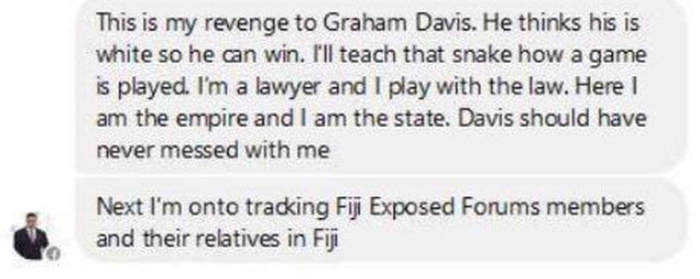
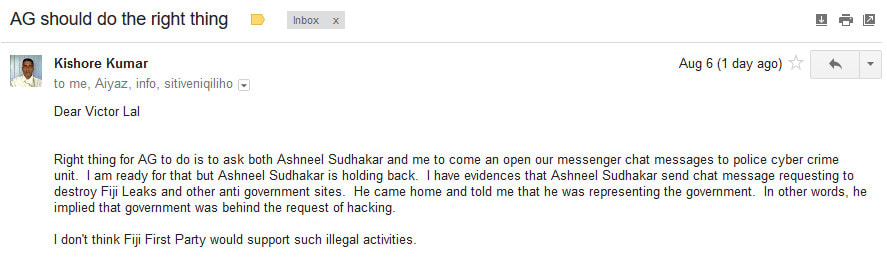
Fijileaks to Narsey: GOD forbid, if Rabuka comes to power as SODELPA prime minister, he will round up "Brown Sahibs in Sulu" - the Kai Indias- and deport all of them out of Fiji, for Fiji belongs to native Fijians and all the jobs should go to them, as he did from 1987 to 1999 when in power. Don't forget Rabuka brought the "White Fellas" to draft his decrees and the racist 1990 Constitution. He also brought mainland Chinese into Fiji to act as a buffer against Indo-Fijian businessmen. Rabuka destroyed the Fiji Public Service Commission. Sadly, it has become very common to scapegoat WHITES for all of Fiji's ills, the most notorious was the recent revelation by one Kishore Kumar who alleged that FFP Government Whip ASHNEEL SUDHAKAR wanted to destroy Graham Davis because he (Davis) has "control of PM's mind"; another former top diplomat made similar jibes against Davis, and now Narsey adds: "It is a pity that local professionals do not have the courage to complain to the Bainimarama Government, the “First Fiji Government” to replace locals by expatriates, reversing decades of localization. We saw that with...the use of American propaganda company Qorvis"; below, Kishore Kumar's allegation against FFP Government Whip Ashneel Sudhakar - re Graham Davis:

Picture

ROBINGATE SACKING UPDATE: We will bring more on COP23 and Nair, which has all the elements of racism and resentment towards white expatriate appointments, even though appointments were on MERIT

Picture
Picture
Picture

Picture
"Fiji going backwards - a mere footpath"

By PROFESSOR WADAN NARSEY

For several years now, I have been writing articles (some published and some censored in the “bad old days”)  trying to warn Fiji people about the horrible dangers of allocating excessive amounts of taxpayers’ money to the Fiji Roads Authority (FRA).


I had tried to explain that: such massive allocations could not be spent efficiently, given the lack of capacity in Fiji; that most were not economically justifiable (i.e. the economic rates of return lower than the cost of borrowing); that there would be large wastage with companies making extra profits; or hiring staff at salaries far too large by Fiji standards.

But even intelligent members of the public have not understood that with the $500 million per year to FRA (or more than $2 billion over a four year period), even 10% wastage would lead to the huge loss of $200 million of taxpayers’ funds (virtually the cost of the NBF disaster in 1997 dollar terms), all to be paid by the current and future generations through the Public Debt.

Well the Fiji Times of 3 August 2017 has a news item about a small FRA project, a footpath, which explains the same arguments, in an easily understandable way.

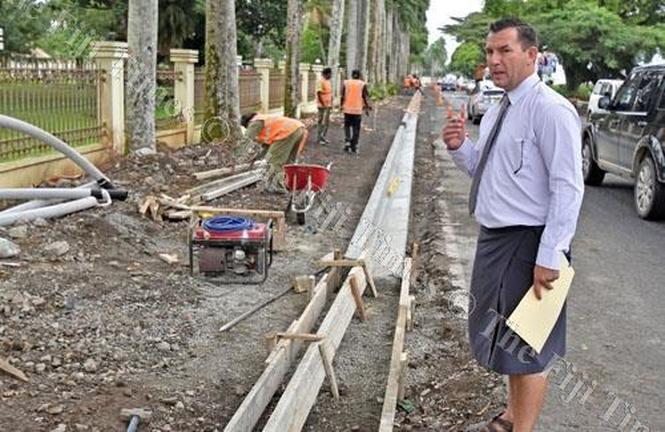
The news item (with an interesting picture attached) was on the FRA footpath upgrading project along Queen Elizabeth Drive, supposed to cost taxpayers, the tidy sum of just over $3 million.

Really?
Project Objectives

The news item said that the project “will improve the road surface for motorists and provide easy access for pedestrians once it is completed”.

It all sound like progress, doesn’t it? Until you think about it a bit more.

Suva residents well know that right opposite that new footpath is an already an excellent wide footpath,  built by Suva City Council, going all the way to Suva Point.

It is an even more pleasant walk given that is right beside the sea, and has a low wall on which people can sit in comfort, and have their snacks or chats or just enjoy the sea breeze.

So clearly, the new footpath is relatively unnecessary.

Project Cost
Any Tom, Dick and Harry, or my carpenter friend Ali, will know that such a footpath, say half a kilometer or 500 meters long, can be built for less than $200 thousands.

Let us add another $100,000 for the PVC pipes, electricity lines and a few lamp posts along the way (which could equally have built on the side of the footpath next to the sea).

Let us add another $100,000 for contractors extra profit because there is a builders’ shortage now that most local contractors are building classrooms.

We are looking at $400 thousands maximum, which our Suva City Council workers could easily have done themselves, without any great fan fare.

Why is FRA spending $3.4  millions on building a footpath for Fiji taxpayers or some $3 million extra?

Why are $3.4 million being spent on a totally unnecessary footpath, whose “Internal Rate of Return” would be close to zero, and certainly less than the 7% average rate of interest Fiji taxpayers are paying on their Public Debt?

Why FRA involvement
One can understand if FRA is called in to oversee the design and construction of the King’s Highway going along the Wainibuka River where recently constructed roads have been washed away by floods (probably because of bad planning and design).

But why on earth would this expensive organization FRA, headed by expatriates, be asked to build a footpath in Suva City?

If at all, why not ask SCC to build it?

Did President Jioji Konrote demand that FRA must build it because it is just outside his boundary fence and perhaps he wants Suva people to walk that much closer in order to admire the Government grounds?

I doubt if that sensible man would ever demand such a wastage of funds for cosmetic purposes.

Was the footpath so complicated in design that it needed valuable time of the general manager network operations and maintenance Mr. Aram Goes?

While the lovely photo in the Fiji Times shows a sahib in a Fijian sulu, you can be sure that his salary is well above the salary of the average SCC foreman who supervises the building of footpaths in Suva.

What part of the $3.4 million is going to pay for the high salaries of FRA staff, who are all far most costly than the average PWD staff in the old days.

Some of us might even remember that not too long ago when the FRA cash was really flowing, there were white fellows from NZ sweeping the gravel, driving the rollers, and filling in the potholes, whose total number was periodically announced on national TV by the FRA Chief Executive Officer, another “First” for Fiji.

How stupid of the PWD never to have announced that annual number for fifty years they were in existence.

Alternative uses for $3 million
The Fiji news media has been carrying stories for years about shortages of medicines, kidney dialysis machines, classrooms, teachers, nurses and doctors, etc.

The Minister of Health has probably been begging the Minister of Finance for sums like the $3.4 million being wasted on a footpath by the Bainimarama Government.

Unfortunately, this is not an isolated incident of FRA using massive amounts of money in the beautification of Suva.

A couple of years ago I pointed out that in an effort to use up large amounts of unused money allocated to them in the budget, FRA had spent massive amounts opposite USP next to the Cost U Less outlet, digging up and building new footpaths and roads.

I would guarantee that would have wasted at least another five million dollars.

But apply the same analysis to a total allocation of $2 billion these last five years, and assume that 10% has been wasted unnecessarily, then you are looking at $200 million of taxpayers funds gone down the drain.  That is roughly the cost of the NBF disaster in dollar terms.

Imagine what the desperately poor people in Fiji could do with an extra $200 million today?

Or the Minister for Health or Social Welfare?

Will the public should ask Mr. Dinesh Patel, the Chairman of the FRA Board, why the FRA is involved in building such an unnecessary and costly footpath?

Will the public ask the Bainimarama Government how much has been wasted by the FRA these last five years?
The answer of course is NO.

The public is too busy  writing Letters to the Editor on more important issues such as rugby sevens and grog gangs.

Postscript      
Expatriates now doing what locals used to do


It is a pity that local professionals do not have the courage to complain to the Bainimarama Government, the “First Fiji Government” to replace locals by expatriates, reversing decades of localization.

We saw that with the PS Information, the use of American propaganda company Qorvis, CEOs of Air Pacific (Fiji Airways now), PWD and many other government departments and public enterprises and their boards.

Many such appointments were not particular better than good appointable locals and some were distinctly worse, some being yame yame tabe tabe conmen and women disappearing over the horizon having made their ill-gotten gains.

But appointing whites was part of the Bainimarama strategy of appointing clearly visible white faces as part of his government, to give the “right message” to the international viewers and the local Fiji people with their typical colonized mentalities: any white is better than any black or brown or yellow.

Not forgetting of course, that with expatriate here on work permits given by the Government, any expatriate not “playing the game” that Bainimarama or Khaiyum wanted, could be sent packing.

As indeed, many have been.

Local appointments might fight unfair orders or dismissals, but even that is rare (remember the brave but futile fightback against the Fiji TV dismissals?).

It has not helped that the Public Service Commission has had pathetic members who have totally refused to deal with many backward steps taken on the civil service by the Bainimarama Government, such as the ridiculous 55 year retirement rule.

Fiji managers and executives have plumbed record depths of cowardice never known before in Fiji.

Picture
9 Comments

DEVIL NEVER SLEEPS: RABUKA exploits INDIGENOUS RIGHTS DAY to question non-native Fijian loyalty while he is hiding behind IMMUNITY

8/8/2017

8 Comments


It was Rabuka who opened floodgate to Chinese with his LOOK NORTH POLICY, and with eyes blindfolded to their criminality, after 1987 coups

Picture
Picture

“Every non-indigenous family in Fiji has an Indigenous family connection in their motherland, who will be living close to their tribal land and religious sites etc. And, should any wish to visit their motherland, they would find that their tribal rights and rites continue to prevail in their places of origin. Fiji is that motherland for Indigenous Fijians who want their culture, language, lands and resources protected as recognised in the UN Declaration on the Rights of Indigenous Peoples declared 10 years ago by the member nations of the United Nations.” - Sitiveni Rabuka on Indigenous Rights Day, August 2017

Victor Lal to Sitiveni Rabuka:
" I cannot trace my family links to India and I have no interest whatsoever to keep searching in vain. Fiji is my HOME. As I told the BBC TV in 1987, you should bloody pack your suitcase and go back from Suva to your ancestral home in Vanualevu. After all, SUVA is my ancestral home, and home to all Fijians who live (and had lived) cheek by jowl until you and Speight came to claim it as YOURS. I thought you might have reformed but I forgot that the DEVIL in you and your advisers never SLEEPS. You and your racist bunch caused irreparable damage to indigenous peoples cause around the world with your 1987 coups in the name of bogus indigenous rights. I wonder if Chief Lutunasobasoba's spirit is residing in Fiji or his ancestral and spiritual home in Tanganyika [Tanzania]?"

We are tired of being lectured by this political rapist who muscled his way to power on bogus indigenous rights that Fiji belongs to native Fijians. It was such talk that saw the "Guns of Lautoka" flood into Fiji, with a stark warning to this thug in 1988: 'Peaceful Co-Existence or Violent Co-Annihilation". My mother and her sisters are long dead since the 1987 coups but we will never allow another generation of Indo-Fijian women to be raped, beaten, uprooted from their lands or driven into EXILE  with his slogan of indigenous rights. NEVER AGAIN! The coward had been hiding from the military since the 2006 coup, while it was we, who took on another coupist Frank Bainimarama, on behalf of all Fijians! As we have argued previously, SODELPA deliberately dumped Ro Teimumu Kepa for Rabuka to whip up native Fijian racism

8 August 2017

The Social Democratic and Liberal Party (SODELPA) Leader, Former Prime Minister Sitiveni L Rabuka today urged the FijiFirst Government, that has governed Fiji for the last eleven years since the 2006 coup d’etat, to respect the fundamental human and group rights of Fiji’s indigenous Fijians, as first peoples and natives of Fiji.

He made specific mention of the recent issuance of 99 year leases by the Government through the TLTB and the plans by the Government to color-code villages as a means to deny them development assistance. Rabuka also confirmed that SODELPA respects the human rights of all peoples in Fiji, and said that recognising indigenous rights does not mean limiting the rights of other communities in Fiji.

Rabuka said that SODELPA’s founding document and guiding principles affirm the freedom and dignity of all religions and religious denominations and the right of opinion and belief. It is an important objective of the Party to protect, enhance and promote the economic, social and human development of all communities and to secure their future in the Fiji Islands.

“Fijians should not lose sight of our common goal and desire for a peaceful and prosperous Fiji despite the best efforts of Bainimarama’s government to derail our efforts,” he said.

“SODELPA recognises the equality and indivisibility of all human rights, and the international human rights discourse and system similarly confirm that all human rights, whether indigenous rights, or minority rights, have equal status, in international law. One cannot promote one set of rights over another.”

“The mere fact that indigenous Fijians are the numerical majority in Fiji does not disqualify them from asserting their human rights as recognised in the UN DRIP, ILO 169 and as affirmed by the UN CERD Committee. Nowhere in international law, neither in the UNDRIP or ILO 169 is numerical majority listed as a disqualifier for the assertion of indigenous rights or a licence for a government to breach their internationally recognised human rights.”

“Lest we forget, the indigenous Africans in South Africa were for many years oppressed by the European minority population by force of guns, the regular application of torture and the enforcement of racist apartheid laws. The whole world recognised the plight of native South Africans, despite their numerical majority.”

“Every non-indigenous family in Fiji has an Indigenous family connection in their motherland, who will be living close to their tribal land and religious sites etc. And, should any wish to visit their motherland, they would find that their tribal rights and rites continue to prevail in their places of origin. Fiji is that motherland for Indigenous Fijians who want their culture, language, lands and resources protected as recognised in the UN Declaration on the Rights of Indigenous Peoples declared 10 years ago by the member nations of the United Nations.”

“I can say with confidence that my party the Social Democratic Liberal Party has since its inception called for respect for the rights of all ethnic communities in Fiji, for only together can we flourish as a nation, as individuals and reach our highest potential. SODELPA is for all the people of Fiji who call Fiji home, who have contributed to its development. All communities bring different talents, skills and assets to contribute to our nation’s development, and SODELPA is against stereotyping and discrimination in all its forms.”


“SODELPA supports the human rights of every person in Fiji, as well as the rights of all communities in Fiji. SODELPA also recognises the rights of the indigenous people of Fiji, as recognised in international treaties like the International Labour Organisation Convention No. 169 on the Rights of Indigenous and Tribal Peoples, as well as the United Nations Declaration on the Rights of Indigenous Peoples (UNDRIP). Recognition of the rights of indigenous people of Fiji is in harmony with the party's welcoming and recognition of the many ethnic communities who have made Fiji their home.”

“Indigenous Rights are also human rights, as are women's rights, as well as the rights of the disabled and the rights of children, for example. The international community recognises the rights of indigenous peoples to manage their land and resources, as well as to their identity, their culture and traditions, and their indigenous institutions.”

“In supporting indigenous rights, SODELPA does not seek to place indigenous rights above the human rights of members of Fiji’s minority ethnic communities, given the indivisibility and equality of human rights. In the same vein, SODELPA recognises that the fact that the indigenous community are the majority population, does not mean they lose their entitlement to their indigenous rights, in particular their rights to be consulted, and to give their free, prior informed consent to changes affecting their land, culture and resources, which is at the heart of their grievance of the last eleven years of the Bainimarama Government.”

“Fiji is at a crossroads and there are many wounds that need healing. Peace is possible for our beloved nation if we all learn to understand each other’s needs for peace, security, belonging and prosperity, to reconcile our differences and encourage peace amongst all our communities for the betterment of our future generations. Peace and progress are only possible if we work together.”

“As Party Leader of the Social Democratic Liberal Party, I want to reassure all the minority religious and ethnic communities in Fiji, that SODELPA is committed to assuring their security in Fiji. I want to reassure you of our acceptance, that you too belong to Fiji, with the indigenous Fijians. I also want to reassure you that SODELPA is committed to the path of peace in Fiji, and to promote respect and partnership amongst our communities. We respect and appreciate your contributions to Fiji. We want to work together with you, for a more peaceful, prosperous Fiji, now and for our future generations.”

“To our indigenous community, I say SODELPA understands very well your needs for proper management and for safeguards for all you hold dear. SODELPA has a vision for the development of your resources, for partnerships and greater return on the development of your resources and for the proper safeguards of all that you hold dear. SODELPA has a vision to reduce dependency on the government to promote more self-reliance. SODELPA will promote closer inter-ethnic cooperation, partnership and goodwill, which will be the mainstay of a lasting peace that will prevent future political crises.”

“Various changes and laws have been imposed on the people of Fiji without their consent, over the last eleven years of the Bainimarama Government. This includes the imposition of the 2013 Constitution Decree, and various decrees that limit human rights like the Public Order Amendment Decree of 2012, and the Essential National Industries Decree.”

“Further, the suspension of the Great Council of Chiefs in 2007, the termination of the Great Council of Chiefs Regulations in 2008, the authority given to the Minister for Fijian Affairs to appoint all members of the Fijian Affairs Board, the termination of the existence of the Council of Chiefs in the Fijian Affairs Act in 2012 and their representatives from the Native Land Trust Board, the establishment of the Land Bank through the Land Use Decree, are examples of changes and laws that were forced on the people of Fiji, and those affecting the indigenous community were imposed without the free, prior and informed consent (FPIC) of the indigenous people of Fiji. The Land Use Decree can alienate Fijian land for up to 99 years and the landowners are prohibited from challenging the government in court, including further 99 year extensions, under that Decree. These are examples of the way that Fijians have lost control of the management of their land, over the last eleven years.”

“The removal of the name Fijian from the native indigenous Fijians, and the imposition of ‘iTaukei’ on the native community by Decree, was also done without their free, prior and informed consent. Free, prior and informed consent is a requirement of the UN Declaration on the Rights of Indigenous Peoples.”

“The right of the indigenous people of Fiji to be consulted on the changes to the laws and policies regarding their way of life and resources was not respected by the government and the UN Committee (CERD) recognised this breach and sought an explanation from the Government, which still has not rectified these grave breaches. The government has continued to ignore its obligations under the UN Declaration on the Rights of Indigenous Peoples (UN DRIP) and changes continue to be implemented today without that free, prior and informed consent, to the dismay of the indigenous people of Fiji.”

Significance of the 2017 International Indigenous Peoples Day

Rabuka said this tenth anniversary of the International Declaration on Indigenous Rights, passed by resolution of the United Nations General Assembly in 2007, is an opportune time to review how Fiji’s indigenous Fijians had fared over the last eleven years of the Bainimarama Government.

“The Declaration is the most comprehensive international instrument on the rights of indigenous peoples. It embodies global consensus on the rights of indigenous peoples and establishes a universal framework of minimum standards for their survival, dignity and well-being. It elaborates on existing human rights standards and fundamental freedoms, as they apply to the specific situation of indigenous peoples.”

Rabuka said the UN International Day for Indigenous Peoples, celebrated annually on August 9th offers an opportunity for the government to review its policies, and to comply with the UN Declaration on the Rights of Indigenous Peoples (UNDRIP), in particular the right to free, prior, informed consent. Rabuka said that the right to free, prior informed consent requires the Government to consult in good faith, with the indigenous people before decisions are made to change their native administrative structures, to the administration of their land and fisheries resources, to any matter that concerns them.

The UNDRIP requires the Government to consult and cooperate in good faith with the indigenous peoples through their representative institutions, in order to obtain their free, prior and informed consent before adopting and implementing legislative or administrative measures that may affect them (article 19).

Nothing about us, to be decided, without us

The international human rights doctrine or requirement of consent is that the consent of indigenous peoples must be freely given, that is given after full disclosure of the effects of any changes, and that informed consent is given given prior to the proposed change, can be summarised as Nothing about us, to be decided, without us.

“Over the last eleven years of the Bainimarama Government, many changes have been effected without consultation and without the free, prior informed consent of the indigenous Fijians. This was recognised in 2012 by the UN Committee on Racial Discrimination (UNCERD) which advised Fiji to explain the 12 Decrees that affect indigenous Fijians, which were imposed without their consent. Todate, the Fiji Government is yet to reply to the UNCERD and in fact, since 2012, another 12 Decrees and laws have been imposed without the free, prior, informed consent of indigenous Fijians. So there are 24 such Decrees and Laws now.”

“The grievances of indigenous Fijians were reviewed by the UN Committee on the Elimination of Racism (UNCERD) at its 2012 session. The UN CERD Committee instructed the then Fiji military regime in Recommendation no. 14 to ensure effective consultation with the indigenous people of Fiji. It instructed the government to obtain the free, prior and informed consent of Fiji’s indigenous community to issues affecting them and their identity, ways of living and resources in line with the CERD treaty, the UN Declaration on the Rights of Indigenous Peoples and the ILO Convention No. 169 on Indigenous and Tribal Peoples, which Fiji ratified in 1989. The CERD Committee also sought the explanation of the military regime on the dissolution of the Bose Levu Vakaturaga (Council of Chiefs).”

“The government has continued to ignore its obligations under the UN Declaration on the Rights of Indigenous Peoples (UN DRIP) to consult fully and to obtain the free, prior and informed consent of the indigenous people of Fiji to changes made in the 24 Decrees affecting indigenous communities, resources and welfare and these changes continue to be implemented today without that free, prior and informed consent, to the dismay of the indigenous people of Fiji.”

99 year leases

Rabuka expressed concern that Fiji’s Minister for Economy has started handing out 99 year lease titles or virtual freehold titles on native land, issued by the Native Land Trust Board, now called the iTaukei Land Trust Board (TLTB), on the authority of the Prime Minister Voreqe Bainimarama. Rabuka said SODELPA is concerned whether TLTB consulted landowners and properly assessed their need for land, in the longer term, or whether TLTB secured the leases after pressure was applied by the Prime Minister. Bainimarama is now Chairman of the TLTB and appoints the members of the TLTB Board, without reference to the voice of landowners, the Bose Levu Vakaturaga (BLV), a change brought about by Decree and without the participation of the people's’ representatives in Parliament.

“A SODELPA Government would apply the cautionary principle and seek assurance that the Native Land Trust Board, has carefully and properly carried out its important fiduciary duty, to ascertain the needs of the landowners whose land has now been leased on 99 year terms, or virtual freehold. The fiduciary responsibility vested in the TLTB is not to be taken lightly or overridden by the central government. The TLTB’s fiduciary's responsibilities or duties to landowners are both ethical and legal. The Native Lands Trust Act (Cap 134) confers on the TLTB in its fiduciary duty, as Trustee of all native lands, this fiduciary duty requires the TLTB to act in the best interest of its principal, the landowners, whose assets or land they are managing.”

“Indigenous landowner's vested the legal ownership of their land in 1940 in the TLTB, a central body that administers native land in trust. That consent was obtained by the late Ratu Sir Lala Sukuna after an arduous trek across Fiji, from the coast to the highlands, to the remote islands of Fiji. That consent and trust given in 1940 imposes a sacred and fiduciary duty that should not be taken lightly or for granted by the central government of Fiji.”

“The Fiji Sun of June 24, 2017 quotes the Minister for Economy expressing gratitude to the Prime Minister for the 99 year agricultural leases. The question that has to be asked is whether the TLTB properly followed its procedures and properly discharged its fiduciary duty to the landowners, in particular their needs for land for their future generations, in the issuance of these 99 year lease titles. Or was the TLTB pressured by the Prime Minister and Minister for Economy to issue these 99 year agricultural leases?”

“SODELPA seeks assurance from the TLTB that the Native Lands Trust Act requirements in section 9 for the TLTB to ensure the adequacy of land for the sustenance of the landowning units before they issue a lease. How did the NLTB carry out the assessment of the needs of the landowning units before the leases were approved?”

“Section 9 of the Native Land Trust Act, Cap 134 provides that: No native land shall be dealt with by way of lease or license under the provision of this Act unless the Board is satisfied that the land proposed to be made the subject of such lease or license is not being beneficially occupied by the Fijian owners and is not likely during the currency of such lease or license to be required by the Fijian owners for their use, maintenance and support.” (emphasis ours)

“The Prime Minister and the central government now have extraordinary control over the TLTB given that he is Chairman of the Board, having removed the President as Chairman of the TLTB Board of Trustees and being the appointing authority of TLTB board trustees by Decree. Previously, the Bose Levu Vakaturaga and the Fijian Affairs Board appointed TLTB trustees.”

“99 year leases are often called ‘virtual freehold’, because a 99 year lease means two to three future generations of landowners, will not have a say in these leases. Those who approve this lease, will pass away long before the 99 year leases expire. A SODELPA Government would ensure the review by TLTB of these leases after every 30 years, to ascertain the land and livelihood needs of the landowners, before further extension.”

Color Coding of Villages

Rabuka also expressed concern that the Taukei Fijian Affairs Ministry is planning to label and color code Taukei indigenous Fijian villages, as a prerequisite to the grant of government development assistance. Rabuka said this is another example of the government’s heavy-handed authoritarian tendencies coming to the fore once again, without the consultation and consent of the many vanua in Fiji. Rabuka said the concept of labelling villages by color was a grave insult to the indigenous people of Fiji and is discriminatory because it is being applied only to indigenous communities.

“The color coding proposed by Deputy Secretary for Taukei Fijian Affairs Colonel Apakuki Kurusiga, which he is announcing at various provincial council meetings, is discriminatory to the indigenous community, given that it is being applied to their community alone. It is a punitive measure, that punishes villages on a subjective and not objective criteria, and may be abused by the FijiFirst government to punish villages which may not support the FijiFirst party politically.”

“Will villages whose voting record show they do not vote for FijiFirst be coded red and denied development? Soon after the 2014 elections, Bainimarama announced that the government would prioritise development projects for those communities that supported FFP policies in the 2014 elections. This was reported in the Fiji Sun of October 26, 2014. The denial of development assistance also happened during the interim government to certain villages whose leaders criticised the Peoples Charter. Given this track record of the denial of development assistance to those who have a different political opinion to Bainiamara, we have to ask whether color coding is a signal to all communities to support FijiFirst or lose development assistance from the government?”

“This color coding exercise is inhumane and goes against all principles of assisting those who need it the most. By this exercise, villages coded red are unlikely to receive assistance, meaning that they will not be helped, a measure that punishes those who need it the most. It is also a breach of the right to development and misuse of government resources because it is the duty of all governments to progressively develop the nation on a non-discriminatory basis.”

“The colour coding plan is a serious breach of Fiji’s obligations as a signatory to the ILO Treaty No. 169, the Convention on the Rights of Indigenous and Tribal Peoples and the United Nations Declaration on the Rights of Indigenous Peoples (UNDRIP). Indigenous rights are human rights and the disrespect shown by the FijiFirst Government to the indigenous peoples of Fiji, and the continuing breach of their human rights, is the height of hypocrisy for a government that espouses equality and non-discrimination.”

“The ILO Convention 169 and UNDRIP require that the free, prior and informed consent of the indigenous people be sought and obtained before any measure like color coding is imposed. Media reports show that indigenous leaders have expressed the need for proper consultations on color coding.”

“I urge the Minister for Fijian Affairs and Prime Minister to rescind this policy, because the development funds are not his personal funds, but are contributed by all the people of Fiji who pay direct and indirect taxes on all the goods and services they purchase, including those whose villages may be labelled red and denied assistance.”
ENDS

Picture
Picture
Picture
FROM THE ARCHIVES

STANDING UP FOR 'IMMIGRANT RIGHTS'

In search of ancestral heritage in Fiji - Who is an 'Indigenous' Fijian?

By VICTOR LAL

Fiji's Daily Post, 2000; written during George Speight's failed coup:


The present crisis in Fiji has once again raised the ugly spectre of a civil war in Fiji between native Fijians and Indo-Fijians. It is, therefore legitimate to ask:

Who is an indigenous Fijian?

How many centuries will it take for the so-called 'immigrant' races in Fiji (the Indo-Fijians, Chinese, and Europeans) to become natives?


Fiji -Three-Legged Stool

The great Fijian leader Ratu Sir Lala Sukuna described Fiji as a Three-Legged Stool comprising Fijians, Europeans and Indo-Fijians (not to forget the Chinese and Rotumans). According to official Fiji government publication (Fiji Today, 1998), the Fijians are descendants of the great chief Lutunasobasoba, who led his people across the seas to the new land of Fiji. They landed in a great canoe, the Kaunitoni, on the west coast of Viti Levu, at a place which is now called Vuda, and they travelled inland in search of lands to settle until they reached the mountains of Nakauvadra. There they built a house for the old chief, who died shortly afterwards entreating his children from his dying couch to go forth and populate the land. This they did and many of the tribes of Fiji today trace their descent from the children of Lutunasobasoba. Most authorities agree that people came into the Pacific from Southeast Asia via Indonesia. Here the Melanesians and the Polynesians mixed to create a highly developed society long before the arrival of the Europeans.

The European discoveries of the Fiji group were accidental. The first Europeans to land and live among the Fijians were shipwrecked sailors and runaway convicts from the Australian penal settlements. Sandalwood traders and missionaries came by the mid 19th Century.

From 1879 to 1916 Indo-Fijians were introduced as indentured labourers to work on the sugar plantations. Their history, however, will record that their own displacement from British India prevented the dispossession of the Fijians in colonial Fiji.

Indeed, by a happy irony, the indentured Indian was uprooted specifically to prevent the Fijian way of life from disintegrating. The above official history of the Fiji Islanders (as everyone is known now) thus shows that we are all former migrants to the Fiji islands. It is in this context that we can ask the question: who is indigenous?

Definition of Indigenous Peoples and Related Terms

According to the International Labour Organisation (ILO) Convention 107 (1957);  Article 1 provides that the Convention applies to:

(a) members of tribal or semi-tribal populations in independent countries whose social and economic conditions are at a less advanced stage than the stage reached by the other sections of the national community, and whose status is regulated wholly or partially by their own customs or traditions or by special laws or regulations;

(b) members of tribal or semi-tribal populations in independent countries which are registered as indigenous on account of their descent from the populations which inhabited the country, or a geographical region to which the country belongs, at the time of conquest or consolation and which, irrespective of their legal status, live more in conformity with the social, economic and cultural institutions of that time than with the institutions of the nation to which they belong. Furthermore, ILO's Convention 169 (1989);

Article 1(1) stipulates that the Convention applies to

(a) tribal peoples in independent countries whose social, cultural and economic conditions distinguish them from other sections of the national community, and whose status is regulated wholly or partially by their own customs or traditions or by special laws or regulations;

(b) peoples in independent countries who are regarded as indigenous on account of their descent from the populations which inhabited the country, or a geographical region to which the country belongs, at the time of conquest or colonisation or the establishment of present state boundaries and who, irrespective of their legal status, retain some or all of their own social, economic, cultural and political institutions.

The World Bank policy on indigenous peoples are as follows: 'Tribal peoples are ethnic groups typically with stable, low-energy, sustained yield economic systems, as exemplified by hunter gatherers, shifting or semi-permanent farmers, herders, or fishermen.' They exhibit in varying degree many of the following characteristics:

(a) geographically isolated or semi-isolated;

(b) unacculturated or only partly acculturated into norms of the dominant society

(c) non-monetized, or only partly monetized; production largely for subsistence, and independent of the national economic system;

(d) ethnically distinct from the national society;

(e) non-literate and without a written language;

(f) linguistically distinct from the wider society;

(g) identifying closely with one particular territory;

(h) having an economic lifestyle largely dependent on the specific natural environment;

(i) possessing indigenous political leadership, but little or no national representation, and few, if any, political rights as individuals or collectively, partly because they do not participate in the political process; and

(j) having loose tenure over their traditional lands, which for the most part is not accepted by the dominant society nor accommodated by its courts; and having weak enforcement capabilities against encroachers, even when tribal areas have been delineated.

It is thus clear that the Fijians do not, by any stretch of the imagination, fall into such categories. Although a minority for several decades, the Fijians never suffered the effects of dispossession, discrimination and political marginalization. In fact, it was the Fijian chiefly leaders who enjoyed sustained political control of the country since independence, and still communally own 83% of the land (now a weapon of political blackmail), dominate the Fiji army, and the Great Council of Chiefs' nominees in the Senate have a veto over any Bill affecting Fijian land, custom or tradition.

The entrenched land rights makes it impossible for any dispossession to take place without the consent of the chiefs. It is, therefore, absurd to liken the position of Fijians today to that of the Aztecs, the Incas, the Mayans and the Aborigines.

Minorities in International Law

The 1990 post-coup Constitution-makers had invoked the doctrine of indigenous supremacy to enable Fijians to enjoy more rights than other races and to institute a new system of domination and inequality.

The central idea of the ILO conventions however was to institute an order that guaranteed equally fundamental rights including equality of franchise. In fact, if any group(s) which might have a legal claim in international law are the minority communities (Indo-Fijians, Chinese, Europeans and Others in Fiji).

It is they, the international lawyers could claim, who need constitutional and political safeguards for the possible violation of their rights under various international legal conventions, including the Universal Declaration of Human Rights, which states that all persons are 'equal in dignity and rights' and that this should not be abridged on the basis of 'race, colour, sex, language, religion, political or other opinion, national or social origin, property, birth, or other status (article 2).

These prohibitions are repeated in several other conventions including Articles 2, 3 and 26 of the International Covenant on Civil and Political Rights; Article 3 of the International Covenant on Economic, Social and Cultural Rights and Article 5 of the International Convention for the Elimination of all Forms of Racial Discrimination.

Fiji is a signatory to these various conventions. As a matter of fact, whenever the question of constitutional reform had been considered during British rule, the Fijian leaders based their claim not as indigenous peoples but as a minority fighting to maintain a separate identity. In the process, the Indo-Fijian bourgeoise leaders went along with their Fijian counterparts, totally oblivious to future population trends which led to Indo-Fijians becoming a minority in Fiji.

In short, if there were any losers in the long, tortuous, and complex struggle for political power in the 1970s, it was not the pettit-bourgeois Indo-Fijian leaders but the ordinary descendants of indentured Indo-Fijians. The so-called 'Passenger Indians' remained unscathed in economic terms. Thereafter, what Fiji witnessed for the next two decades, was the politics of race until the rise, demise, and rise of the multi-racial Fiji Labour Party in 1987 and 1999.

What Fiji is witnessing in the formation of the Foundation of the Fijian Indigenous Peoples, threats of repatriation of Indo-Fijians and 'blood will flow' in the wake of ALTA debates, and the exclusion of the Prime Minister from the Great Council of Chiefs, is an attempt by a mindless minority to revert back to the era of racial bigotry and racial politics in Fiji.

Moreover, what some Fijians believe to be their ancient heritage is a colonial legacy. Like the deep cleavages existing within the Indo-Fijian community, pre-colonial Fijian society consisted of a series of tribes and tribal confederacies that were frequently in conflict with each other. Tribes in eastern Fiji were heavily influenced by Polynesians from Tonga, and developed a very hierarchical Polynesian-style social structure with great power in the hands of hereditary chiefs.

The social structure of western Fijian tribes was more egalitarian, as is the Melanesian custom. In 1874 Britain accepted the cession of authority in Fiji to the British Crown by the eastern chiefs. The new colonial authorities succeeded in bringing all Fijians under the control of a single government for the first time. The British largely ruled through the existing chiefs, greatly enhancing chiefly authority over Fijian commoners. They also established the dialect and traditions of one eastern tribe as the norm for the entire country.

A rather romantic view of traditional Fijian society prevailed, and laws were passed to reinforce communal land ownership.

The Indigenous/Immigrant Debate

In 1976 the current president Ratu Mara, then prime minister, while rejecting a suggestion in the Senate by Senator Inoke Tabua, later a leading Taukei member, that 100,000 Indo-Fijians should be deported, made a pertinent statement: 'It is now being suggested that there are sections of citizens of Fiji, particularly the Indians, who have not the same rights as any others. I do not see that. If I made a mistake at the Conference (1970), please do not support me at this forthcoming election (1977). I would rather square my conscience with God then to be voted back into Parliament under false pretences. If you start removing Indians, the next ones will be the Chinese, the third ones will be the Europeans, and the fourth will be the Lauans.'

The Lauans, who are descendants of Tongans, settled in Fiji in the 19th century with their chief Ma'afu, a relative of the King of Tonga. Ma'afu, who settled in Fiji in 1848, thirty-one years before the arrival of the first batch of Indo-Fijians to Fiji, established himself at Lakeba as the leader of the Tongan community in Fiji. According to the historian Peter France, the Tui Nayau, who controlled the Lau islands from Cicia in the north to Ono in the south, was at this time an old man, corpulent, and severely afflicted by elephantiasis. With his company of Tongan fighting men, Ma'afu became military representative of Tui Nayau and extended his authority by conquering, in the name of Christianity, the islands of the Moala group; these were thenceforth accepted as being part of Lau.

The islands north of Cicia owed allegiance to Tui Cakau but, when this chief visited Lakeba in 1850, he accepted a canoe as a gift from Ma'afu and gave him, in return, rights of levy over them. In 1855 Ma'afu put down a religious war in Vanuabalavu and assumed control over the island, taking up residence at Lomaloma. His position in Fiji at this time was that of representative of King George of Tonga, the head of the Tongan community in Fiji, and the owner of the island of Vanuabalavu. He extended his influence throughout Vanua Levu by alliance with Tui Cakau and Tui Bua. He then defeated Ritova, Tui Macuata, and installed a chief more susceptible to his influence as head of the chiefdom.

Ma'afu was the most powerful influence in north-eastern Fiji when, in 1859, the first cession proposal was made. Consul Pritchard reminded Ma'afu that, as the country had been ceded to England, future attempts to extend his authority would bring him into conflict, not with mere Fijian chiefs, but with the British Government. Ma'afu signed a document to the effect that he was in Fiji solely to manage and control Tongans and had no claim to chiefly authority over Fijians.

After the first offer of cession was rejected, however, he resumed his attempts to secure a position of leadership and, in 1867, he appeared to have succeeded in uniting the provinces of Vanua Levu and Lau by creating the Tovata. On the collapse of this confederation he declared that he would have no further dealings with Fijian chiefs and retired to his estates on Vanuabalavu. Tui Nayau raised the Tongan flag at Lakeba and Ma'afu began to assume control over the Lau group, under the excuse that its chief had declared it to be Tongan, and not Fijian, territory.

In June 1868, however, the Tongan Parliament ordered the flag to be hauled down and instructed Ma'afu to cease from involving the Tongan Government in Fijian affairs. This meant that he could not continue to exercise control by virtue of his authority as a Tongan chief, but had to be accepted as a chief in Fiji. A meeting of the chiefs of Lau was held at Lakeba, in February 1869, at which he was installed as a Fijian chief, taking the title of Tui Lau (now held by Ratu Mara); his connection with the Tongan government was severed; a vessel was sent to Fiji from Tonga, proclaiming that Tongans who remained in Fiji would no longer be under the protection of the Tongan Government and offering passages to those who wished to return. Tongan lands in Fiji were made over to Ma'afu and he was accepted by the chiefs of Bua and Cakaudrove, in May 1869, as a chief of Fiji, having authority over Fijians. He played a leading part in the offer of Cession in 1874.

Some radical Fijians therefore assert that because of his family background, Ratu Mara does not have the automatic right to champion Fijian rights.. As a matter of fact, the case of Lauans is instructive to our indigenous/immigrant debate. In 1987 Ratu Mara, unlike a decade ago, began to assert paramounty rights on behalf of the Fijians in the new post-coup Constitution, saying that 'special rights for indigenous peoples are not something new and are provided for under international law'.

He reminded his critics of the fate of other indigenous peoples saying that 'the Fijian people are all too aware of the destiny of the indigenous Aztecs of Mexico, the Incas of Peru, the Mayas of Central America, the Caribs of Trinidad, the Amerindians of Guyana, the Maoris of New Zealand, and the Aborigines of Australia'. From these arguments, Ratu Mara concluded that Fijians must be awarded majority representation in Parliament and control of the government as 'an affirmative action to guarantee and protect the rights and aspirations of the Fijian people against other communities'.

He argued that Fijians had settled in the islands over 3,500 years ago, and this fact entitled them to paramount control of Fiji. He, however, did not explain or justify why his predecessor, Ma'afu as Tui Lau, could lay claim to Fijian paramounty and Indo-Fijians not for equality, when he (Ma'afu) had been in Fiji for 26 years only before the Deed of Cession of 1874, and not 3,500 years.

The Tui Bua, Vakawaletabua, also had personal links with Tonga: his mother was Tongan and he had been placed in peaceful occupation of his chiefdom of Bua by Tongan force of arms. In 1862, he visited Tonga, with Ma'afu. A Treaty of Friendship between King George of Tonga and Tui Bua was signed on 3 January 1865. This provided for perpetual peace between Tonga and Bua and for reciprocal rights of settlement. It also provided that the Civil Service of each state would make available its employment opportunities to the nationals of the other: any Tongan settling in Bua was declared to be eligible 'for appointment to any Government situation that may be vacant', with the same privilege applying to a Buan settling in Tonga.

It is therefore not surprising that Jone Dakuvula, a cousin and former press secretary to Sitiveni Rabuka, had also asked during the two coups in 1987: 'What is so special about us descendants of the many waves of early settler groups in Fiji that our political rights to be the government must be greater and secured unaccountably, compared to the descendants of later settlers?' Dakuvula further argued that the people did not want an apartheid-type regime because the Indo-Fijians were no longer foreigners, but part of the Fijian polity. Why should they accept diminution of their political rights in their own country; the country of their birth?.

The current prime minister Chaudhry had also stated his position: 'We have a fight on our hands and I believe in dealing with it until the matter is resolved one way or the other. I was born here. I am not a foreigner here. I have every right to fight for this country. We are not going to subjugate ourselves to a constitution of this kind (the 1990 Constitution), signing away all our rights and agreeing to be slaves.' In a cruel twist of fate, he went on to become the first prime minister of Indo-Fijian origin.

Perhaps the speech of Ratu Sukuna to the Great Council of Chiefs in 1936 is worth repeating: 'Let us not ignore the fact that there is another community settled here in our midst. I refer to the Indians. They have increased more rapidly than we. They have become producers on our soil. They are continuously striving to better themselves. Although they are a different race, yet we are each a unit in the British Empire. They have shouldered many burdens that have helped Fiji onward. We have derived much money from them by way of rents. A large proportion of our prosperity is derived from their labour.'

A central figure in the 1987 Fiji coups has defended the island nation's Indo-Fijian population as fully fledged Pacific Islanders. More recently, Ratu Mara criticised an international Pacific Island conference held in Auckland for excluding Indo-Fijians. Ratu Mara, the keynote speaker at Pacific Vision, a four-day conference, said that, "This is a conference of the Pacific communities in New Zealand, yet the Pacific Vision literature I have read appears to have an omission. There is no reference that I could see to the Indians from Fiji. Fiji Indians are full citizens. They are officially designated as Fiji islanders and one, the Honourable Mahendra Chaudhry, is now prime minister. They may have a distinct and different appearance and characteristics and been late arrivals, but islanders they are."

The Fijians and Non-Fijians: 'Marooned at Home'

On 14 May 1987, the Indo-Fijians awoke to mark the 108th anniversary of the arrival, aboard the sailing ship Leonidas, of the first Indo-Fijian 'coolies' in Fijian waters. In fact, that day was to see the arrest of all their progress- from plantation to parliament- when Sitiveni Rabuka and his henchmen overthrew the multi-racial Labour government. The Fijian coup d'etat also raised the fundamental question: how many generation should the Indo-Fijian community (and other non-Fijian races) wait to become 'natives'?.

We have already recalled the Tongan Parliament's reaction to Ma'afu's status in Fiji. The following declaration of the late Prime Minister of India, Jawarharlal Nehru, has a similar echo. He raised the issue of citizenship, including that of the Indo-Fijians, in the Indian Parliament on 8 March 1948: 'Now these Indians abroad? Are they Indian citizens or not? If not, then our interest in them becomes cultural and humanitarian, not political. Take the Indians of Fiji and Mauritius: are they going to retain their nationality, or will they become Fiji nationals or Mauritians? Of course, the two things do not go together. Either they get the franchise as nationals of other country, or treat them as Indians minus the franchise and ask for them the most favourable treatment.'

As a matter of fact, the majority of the descendants of Indo-Fijian labourers had lost contact with 'Mother India' long ago.

The following declaration of an ex-indentured woman labourer Rangamma, in 1979, who arrived in Fiji with her parents a century ago, in 1899, still applies to the Indo-Fijians today: 'Fiji is my place. There is nobody in India for me.'

It is equally true of the descendants of the great chief Lutunasobasoba, who cannot be expected to return 'home' from the coast of Vuda and the mountains of Nakauvadra, to a land far to the west in the great canoe, the Kaunitoni. Or the small but significant Fiji-born Chinese community to mainland China. As we gear up to greet the dawn of a new century, we have reached that tide in the affairs of men

Which, taken at the flood, leads on to fortune;
Omitted, all the voyage of their life
Is bound in shallows and in miseries.


It is to be sincerely hoped that we will collectively judge each other not on the basis of our colour or ancestry but by the content of our character.

The coup leader George Speight has certainly failed the test of character and some have even expressed doubt about his "indigenous" colour. He alone has the chance to redeem himself from his mindless act.

Fiji, says the tourist poster, is 'the way the rest of the world should be'.

Let us keep it that way in the 21st Century.

Picture
Picture
Picture

We CANNOT, and MUST NOT, allow Rabuka to exploit Indigenous Rights slogan to return to POWER in Fiji. Cry the Beloved Country!

Victor Lal, "Fighting Over Fiji: The Indigenous/Immigrant Rights Debate in the Fijian Context", chapter in the book:

Picture

“It was a matter of cultural survival. Sink or Swim. There was no way we were going to go down. The Indians had become an unbearable presence in Fiji. The Hindus and Muslims are pagans who must be converted to Christianity, for if not, they convert us, and we all become pagans like them.” - Sitiveni Rabuka shortly after the 1987 coups

Picture
8 Comments

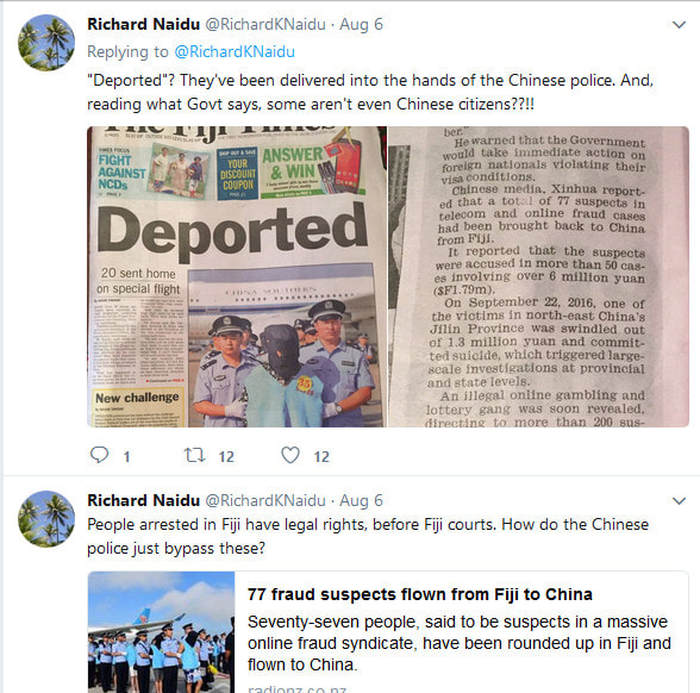
The Chinese nationals should have been prosecuted for breach of visa conditions, and any other crimes, before being handed back to China

7/8/2017

3 Comments


Police and  China Embassy issue joint statement on 77 whisked to China

Picture
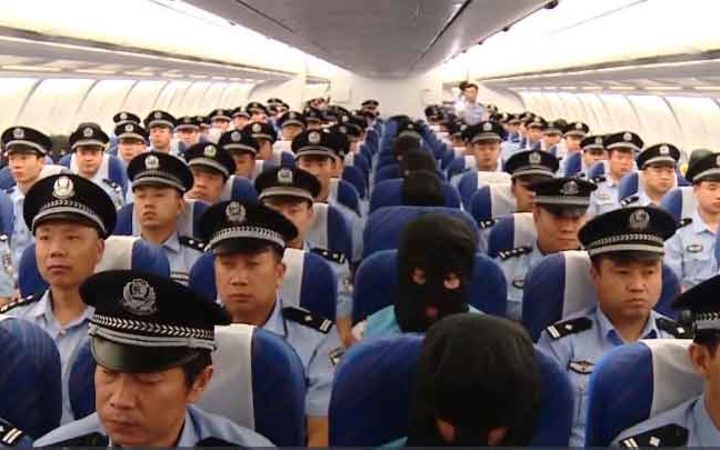
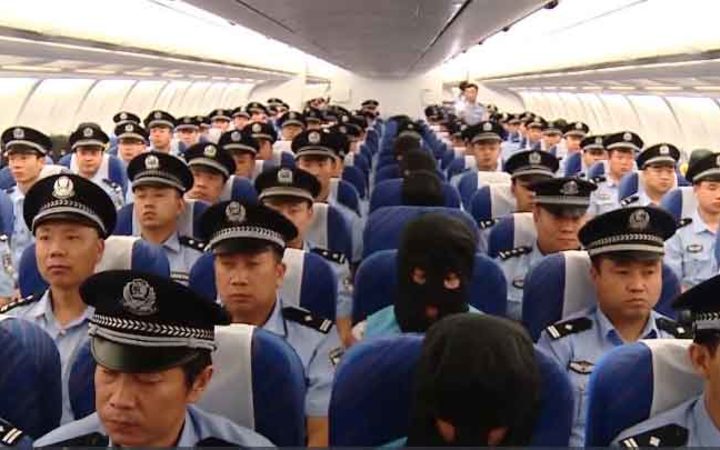
A joint operation between Fijian and Chinese law enforcement agencies under an existing Memorandum of Understanding of police cooperation has resulted in the removal of 77 Chinese nationals who were found to be in breach of their visa conditions.

A request for assistance was extended to the Fiji Police Force from the People’s Republic of China’s Ministry of Public Security regarding the group’s alleged involvement in certain illegal activities which were in breach of their visa conditions.

The Fiji Police Force and the Department of Immigration facilitated the protocol and approval was sought from relevant authorities whereby the investigation into the alleged activities began.

The month long operation has seen Fijian law enforcement agencies deal with the alleged breaches in visa conditions in accordance with relevant laws and regulations of Fiji.

Following a thorough investigation conducted by the three law enforcement agencies, we can confirm that no Fijian was a victim of the group’s alleged illegal activities.

These 77 Chinese nationals have been sent back to China from Fiji on Aug. 4, 2017. It is reported that the above mentioned Chinese nationals are suspected to be involved in more than 50 telecom and online fraud cases targeting Chinese citizens in China amounting to more than 6 million yuan (892,000 U.S. dollars). The case is under further investigation in China.

The successful outcome of the collaboration under the MOU is a testament of the two countries ongoing commitment in maintaining law and order in our respective countries.

It shows the importance of strengthening law enforcement cooperation between our two countries.


Source: Fiji Police Force Media Cell 

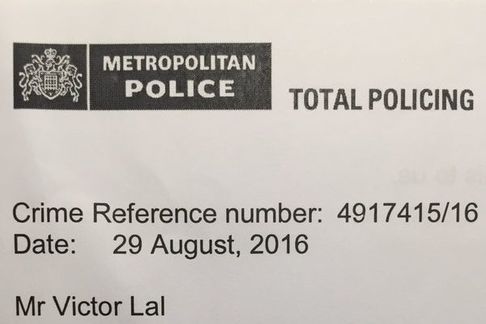
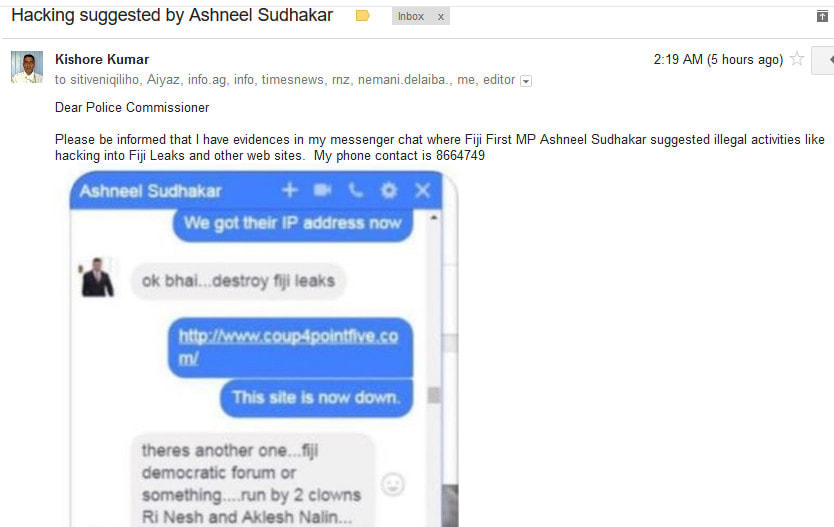
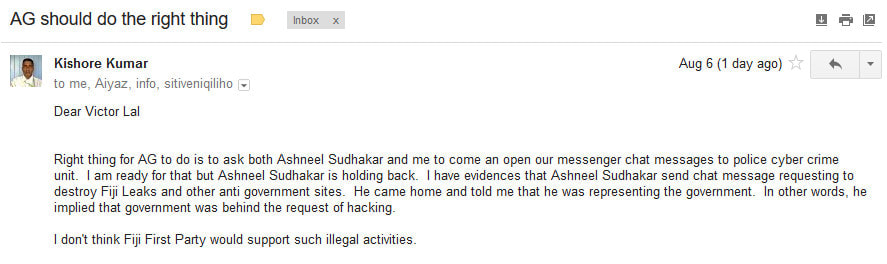
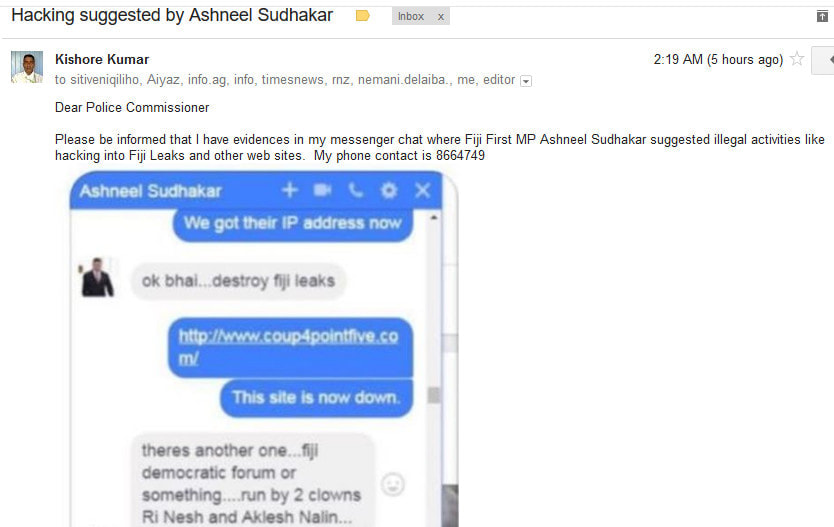
Fijileaks: This month, last August, Fijileaks was hacked and brought down. When will Fiji Police and the Government of Fiji co-operate with British, Norwegian, and American authorities to bring the hackers to justice, starting with the arrest and interrogation of FFP Government Whip and chairman of Justice, Law and Order Committee Ashneel Sudhakar, who is accused by Kishore Kumar of being the mastermind behind the hacking?

Picture
Picture

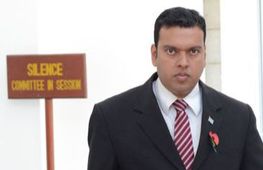
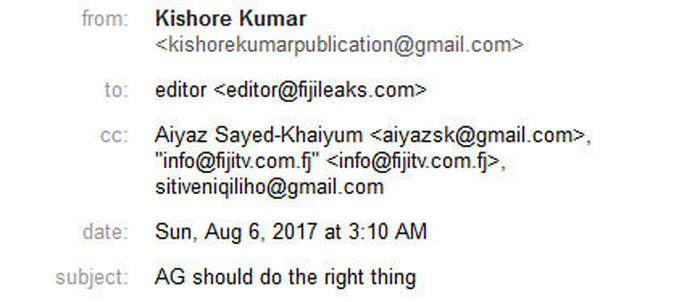
Fijileaks HACKING SUSPECT: Kishore Kumar calls on Attorney-General Aiyaz Sayed Khaiyum and Police Commissioner Sitiveni Qihilo to ask him (Kumar) and FFP Government Whip ASHNEEL SUDHAKAR, the chairman of Law, Justice and Order Committee, to bring their phones for inspection by the Fiji Police Cyber Crime Unit, to establish who is telling the TRUTH about the hacking of Fijileaks; Kumar claims Sudhakar was behind the hacking of Fijileaks

Picture
Picture
Picture
3 Comments

"There is no space for them to board the bus on the road". The detention centre which held 77 Chinese before they were whisked away to China

7/8/2017

2 Comments

 
2 Comments

RENDITION? As Chinese government secretly grabs 77 suspected fraudsters from Fiji and flies them back to China, NFP calls on Fiji government for full disclosure on arrest and supervised 'repatriation'

7/8/2017

4 Comments


Fijileaks HACKING SUSPECT: Kishore Kumar calls on Attorney-General Aiyaz Sayed Khaiyum and Police Commissioner Sitiveni Qihilo to ask him (Kumar) and FFP Government Whip ASHNEEL SUDHAKAR, the chairman of Law, Justice and Order Committee, to bring their phones for inspection by the Fiji Police Cyber Crime Unit, to establish who is telling the TRUTH about the hacking of Fijileaks

Picture
Picture
Picture
Picture
Picture
Picture
Picture

Rendition: the practice of sending a foreign criminal or terrorist suspect covertly to be interrogated in a country with less rigorous regulations for the humane treatment of prisoners. Origin - early 17th century: from obsolete French, from rendre ‘give back, render’

Picture
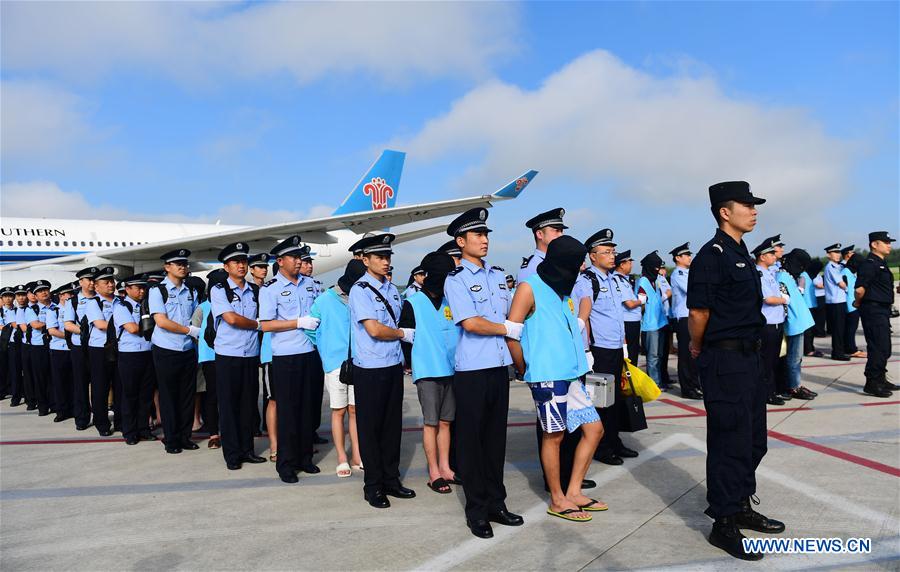
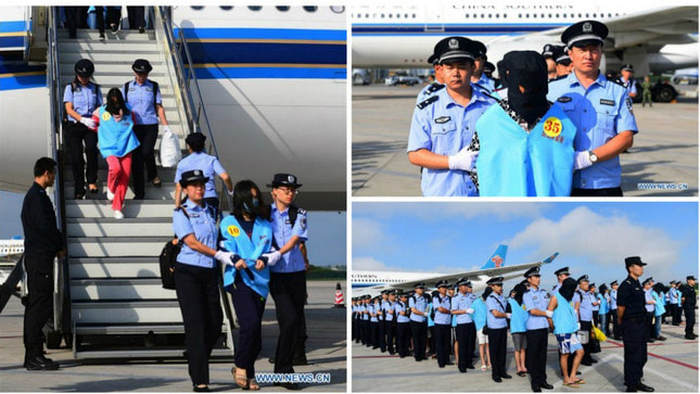
A team of Chinese police at the Nadi International Airport.
Picture
The Chinese suspects in telecom and online fraud cases arrive at Changchun Longjia International Airport, Changchun, northeast China’s Jilin Province, Aug. 5, 2017
Picture
Picture
NFP calls for full disclosure on arrest and supervised repatriation of Chinese
 
The Leader of the National Federation Party, Professor Biman Prasad has called on the Prime Minister and Minister for Immigration to provide full disclosures to all Fiji citizens on the details surrounding the arrest and supervised repatriation of 77 Chinese from Fiji on a chartered Chinese flight.
 
“What exactly is the extent of this? Were they Dual Citizens holding Fiji Passports? Were their human rights amply upheld during detention? How long has this manner of transnational crime been occurring? Are there any further details? Is this limited to telecom scams or were there also other illegal activities? What measures will the Government urgently implement to ensure there is no repetition?” Professor Prasad asked.
 
Professor Prasad said the Fiji First Government needs to be transparent and accountable with this issue for it involves Fiji’s border security, domestic security, as well as the immigration policies that the Government has implemented.
 
“The supervised repatriation of such a large number of Chinese people from Fiji on a chartered China Southern Airlines plane, with an even greater number of Chinese security personnel to escort them back to China has made international headlines, yet here in Fiji we have not heard a single word from this Government.”
 
“This is unprecedented and has never occurred under the watch of any Government.”
 
“I am urging the Prime Minister who is also the responsible minister for Immigration and his Fiji First Government to clearly and honestly come forward with the facts on this case of public interest.”
 
“The Chinese authorities are reportedly saying that this supervised repatriation involves individuals that are involved in telecom fraud, with dens being busted in Fiji.”
 
“There are however many lingering questions that the Government needs to answer for the sake of transparency and accountability of an issue of such a magnitude.”
 
“In May this year the Parliamentary Standing Committee on Foreign Affairs and Defence tabled their report recommending that Fiji ratify the UN Convention Against Transnational Crime and 3 Protocols. One of the “Challenges” raised in the report by FRCA, DPP, the RFMF and Immigration Department is that they all said they needed to strengthen their collective collaboration. The lack of this collaboration has been laid bare for all to see."
 
“Then the other challenge in the report is that the Immigration Department suggested that they take back the primary line because they are better specialised, is highly problematic as this role is now undertaken by FRCA. This is now a serious indictment on the porosity of our borders and it falls on the Government to come clean.”
 
 “If this issue is not resolved and responded to quickly, the global community and their expectations on Fiji as a responsible State will not look very kindly on us and any global initiatives we advocate.”
 
Authorised by:
Professor Biman Prasad
NFP Leader


4 Comments

NFP leader Biman Prasad to the VHP (Fiji) Fiji National Hindu Youth Conference: 'Let me urge you not to allow yourselves to be fooled by self-centred leaders who promise us chaand ka tukrah or piece of moon'

5/8/2017

5 Comments


"Its a pleasure to be invited by VHP. I was actually very happy when I received the invitation because these days, and probably for the first time in Fiji's history, there is a reluctance on the part of organizations to invite Opposition figures like us to speak. So whenever I get an invitation to speak, I don't miss that opportunity. But I want to especially thank
Mr Jay Dayal for his invitation today."
Professor Biman Prasad

Picture

https://www.facebook.com/Biman-Prasad-1384487778458529/

" In the old days, one's word was your bond. If you had an agreement to buy or exchange something, we shake hands, exchange goods or services or money, and the deal was sealed. There was an important element of trust that when you walked away after shaking hands, each person would make good on that agreement. That same currency of your word and the trust that you place on someone based on their word, holds true today. If pledges are made to you as a voter in good faith, it is your explicit right to expect those promises to happen. The current Government is coming thick and fast at the 11th hour with carrots and lollies, why would you reward deception with further trust? Allow me now to inject some cold hard truths into this room. While you are here to deliberate on many different issues pertinent to your development and hopefully accelerated growth as young people, there is a 13 year old boy urgently seeking a kidney donation at the hospital. A 50 year old mother died in the Lautoka Hospital early last week after being allegedly overdosed with morphine. The poor and ordinary citizens of our nation have been paying VAT on basic food items after it was re-imposed by this Government contrary to its promise three years ago not to do so. The majority of our people are being hit from all sides with a crippling cost of living leading to unhealthy but cheap food choices and ill-health. The health and education systems are falling apart -- is this what you deserve as a taxpayer? These are just a few of the many fundamental issues affecting the people, particularly our youth." - Professor Biman Prasad to Fiji National Hindu Youth Conference

"The Philosophy of Hinduism is one of inclusivity, secularism and universality. The Universal good is what is the dharma of every Hindu and I guess for every human being. In the Hindu epic, Mahabarata, it is stated that vigilance is the main attribute of good governance. In the epic Ramayan, we look for real examples of leadership and good governance. Many of you young people can derive the virtues of order, loyalty, compassion, discipline, duty, deferred gratification and respect from these two great Hindu scriptures."

“THE POWER OF THE YOUNG IN OUR SOCIETY”

ADDRESS BY NFP LEADER PROFESSOR BIMAN PRASAD
VHP CONFERENCE
SATURDAY, AUGUST 5, 2017
 

Friends, today in looking around the room I am pleased to see a number of young people in the room. I also note the presence of parents, aunts, uncles and grandparents -- the thoughts that I share with you today are for you too, as cause perhaps for reflection and further discussion.
 
What I have chosen to speak on today, is on you, our youth and the issue of governance. It is not my intention to lecture or finger-wag our young people, but rather to challenge you to be better. To surpass the levels of governance that you see all around you today -- whether that is at school, at work, in your community groups and even at the national leadership level.
 
The Philosophy of Hinduism is one of inclusivity, secularism and universality. The Universal good is what is the dharma of every Hindu and I guess for every human being. In the Hindu epic, Mahabarata, it is stated that vigilance is the main attribute of good governance. In the epic Ramayan, we look for real examples of leadership and good governance. Many of you young people can derive the virtues of order, loyalty, compassion, discipline, duty, deferred gratification and respect from these two great Hindu scriptures.
 
We often talk about the strength of our young people. But even I as a Party Leader have had to re-orient much of my leanings and adjust to what it means to let our young people lead -- or at the very least, feel comfortable enough to tell me what they think very frankly. Thankfully my experience as a teacher and university professor has held me in very good stead. It is much too easy to talk about the strength of our young, but actually much harder to harness that energy towards an outcome or a compromise that heeds your concerns.
 
That said, please do not confuse my thoughts as an excuse to hold back. On the contrary!!Keep stepping forward. Keep asking critical questions - especially the hard ones. Keep demanding accountability for the decisions made in your name. That too is not an excuse for arrogant demands but is more of a challenge to you, to make fully informed comments politely -- in honour of the values you were instilled with from birth -- but very firmly all the same.
 
Let me also press you to discipline yourselves to differentiate the truth from lies – just like the knowledge that you should pursue as students from your teachers. Start distilling the big words against the realities that you see and feel everyday. Allow your minds to rule over emotional blackmail.
 
In the arena of politics and Parliament where you will see many debates on issue of national interest and laws taking place, it is the arena for the contest of ideas. "No one has a monopoly over good ideas" -- these are the words of one of my many mentors who has since passed on -- that I had the privilege to work under, namely Mr Savenaca Siwatibau, when he was the Vice Chancellor at the University of the South Pacific, and I was Head of Economics.
 
In that arena of Parliament, the contest of ideas is played out and the referee who is charged with keeping this contest rigorous yet civil, is our Speaker. Let me just take a quick poll around the room today -- raise your hands if you have ever gone to Parliament just to watch the proceedings? Raise your hands, if you at least watch the parliamentary proceedings on television or livestream?
 
Young people, allow me to gently remind you: the people you put in Parliament through your vote should represent your concerns. They should act on your behalf and actively promote what is in your best interest because that must be the least of your expectations as someone who promoted them from an ordinary citizen, to an Honourable Member of the highest court of the land which is Parliament. But is that happening? Let me urge you not to allow yourselves to be fooled by self-centred leaders who promise us chaand ka tukrah or a piece of the moon.
 
In the old days, one's word was your bond. If you had an agreement to buy or exchange something, we shake hands, exchange goods or services or money, and the deal was sealed. There was an important element of trust that when you walked away after shaking hands, each person would make good on that agreement. That same currency of your word and the trust that you place on someone based on their word, holds true today. If pledges are made to you as a voter in good faith, it is your explicit right to expect those promises to happen. The current Government is coming thick and fast at the 11th hour with carrots and lollies, why would you reward deception with further trust?
 
Allow me now to inject some cold hard truths into this room. While you are here to deliberate on many different issues pertinent to your development and hopefully accelerated growth as young people, there is a 13 year old boy urgently seeking a kidney donation at the hospital. A 50 year old mother died in the Lautoka Hospital early last week after being allegedly overdosed with morphine.
 
The poor and ordinary citizens of our nation have been paying VAT on basic food items after it was re-imposed by this Government contrary to its promise three years ago not to do so.
 
The majority of our people are being hit from all sides with a crippling cost of living leading to unhealthy but cheap food choices and ill-health. The health and education systems are falling apart -- is this what you deserve as a taxpayer?
 
These are just a few of the many fundamental issues affecting the people, particularly our youth.
 
Then there is a son of Fiji and highly acclaimed academic and historian, Professor Brij Lal and his wife Dr Padma Narsey Lal who have been unjustly exiled and denied entry back into the country of his forefathers to at least launch his recent publication.
 
As a party, we have repeatedly urged Government to lift the ban on both of them. But Government claims they are a threat to our national security.
 
How can an historian who true to his profession champions democracy and speaks out against military coups and together with his wife who has done commendable work in collating data on or sugar industry and suggesting solutions as well as working as a consultant for IUCN, engaged in mangrove conservation and planting be a threat to our security and overcome our well-equipped military and a police force led by a senior military officer? The mind boggles.
 
Professor Lal has contributed to this nation in no small measure. One example is his role as one of the three Commissioners whose report commonly known as the Reeves Report led to the formulation of the highly acclaimed 1997 Constitution that was abrogated by the leaders of the current government in April 2009 while they were unelected and installed into power at the barrel of the gun.
 
I believe that as responsible citizens, we should be at least concerned about what is going around us, for failure to do so will be at our own peril and might I add, a bleak future for our children and grandchildren.
 
Believe me when I say what is happening in the political arena these days is prolonging and escalating our pain and misery. 
 
We may all appear to be joyous and happy but are we really genuinely so?
 
The painful reality is that we do not know what the future holds for us as we wake up each morning. Each day is like buying time but it is also escalating or misery and suffering. We all may appear to be full of joy and happiness but are we genuinely happy?
 
Are we certain about what the future holds for us and our children? Are we sure that tomorrow’s sunrise will bring us a brighter day full of hope and not doom and gloom?
 
Unfortunately, the answer to the above questions is – NO WE ARE NOT SURE ABOUT WHAT THE FUTURE HOLDS FOR US AS A COMMUNITY AND COUNTRY.
 
I believe the time has come for all of us to stand up and be counted. We should no longer allow ourselves to be fooled by anyone who makes false promises and gives us pie-in-the-sky ideas to resolve our problems.
 
For example, if I promise you something, you have the right to ask me how the promise will be fulfilled. The same goes for others, whether they are social, cultural or political leaders.
 
We must start learning to differentiate the truth from lies – just like the knowledge that the students get from the teachers. We have to start to compare issues with reality, to make informed decisions with a clear frame of mind instead of letting emotions dictate your conscience.
 
This is the greatest challenge facing all of us today and together we have to overcome this challenge for the sake of our children and future generations.
 
And this is where or youth should be concerned with governance because it is their future that is being determined by policies enforced through Decrees and Promulgations or since October 2014, passed in Parliament.
 
Let me challenge you again as young people privileged with education -- you have a moral and more importantly a spiritual duty to care for your fellow men, women and children. The very important discussions that you will have today, the presenters who will grace your presence, must be centred with that frame in mind. The greater good of those not so privileged needs a contest of idea's that often will not be in the confines of this room. An enlarged and more diverse collection of idea's and hearts is the way forward -- we cannot grow as a People of Fiji, if the levels of development and growth are disjointed and non-uniform.
 
You may have noticed in the Budget that was just passed that there was an appearance of it being people-centred.
 
Yes, increasing the tax threshold from $16,000 to $30,000 is positive but those already on the $16,000 tax threshold from the last year’s budget, are still reeling from the high cost of living but what they can be thankful for is reductions in costs to readymade towels and baby wipes. Do these things fill stomachs?
 
Fiji today needs leaders who are bold, honest with the ability and credibility to tackle our many problems. We need men and women who can provide sound and sensible leadership, but these people are not plucked out of thin air. They are grown and nurtured in groups like this. Let me further encourage you to have a political view and defend it in your own contest of ideas.
 
The task for securing for all of us a peaceful, stable and prosperous future lies on the shoulders of you too as young leaders. Let me strongly urge you to stand up and be counted.
 
Young people, in closing. I know that you know what is happening around you. The governance issues that you see daily are not how leaders should behave. When you raise your hand up to lead, you must be aware that the level of scrutiny around you will be heightened.
You sacrifice yourself to even the micro levels of scrutiny in the way you do things because you are accountable to those who put you into power. Be about ideas and effecting change for the betterment of others. Harness your power and energy here as a collective for the next 2 days and let that spill-over outwards to enlarge your circle and your quest for better.
 
Arm yourselves with truth and justice and care for those who are disadvantaged -- you do not have to be taught that. It is inherent in you as a human being, nurtured by the values in our families and strengthened by your spiritual guidance.
 
I thank you and wish you well in your deliberations.
 
"Then there is a son of Fiji and highly acclaimed academic and historian, Professor Brij Lal and his wife Dr Padma Narsey Lal who have been unjustly exiled and denied entry back into the country of his forefathers to at least launch his recent publication. As a party, we have repeatedly urged Government to lift the ban on both of them. But Government claims they are a threat to our national security. How can an historian who true to his profession champions democracy and speaks out against military coups and together with his wife who has done commendable work in collating data on or sugar industry and suggesting solutions as well as working as a consultant for IUCN, engaged in mangrove conservation and planting be a threat to our security and overcome our well-equipped military and a police force led by a senior military officer? The mind boggles. Professor Lal has contributed to this nation in no small measure. One example is his role as one of the three Commissioners whose report commonly known as the Reeves Report led to the formulation of the highly acclaimed 1997 Constitution that was abrogated by the leaders of the current government in April 2009 while they were unelected and installed into power at the barrel of the gun. I believe that as responsible citizens, we should be at least concerned about what is going around us, for failure to do so will be at our own peril and might I add, a bleak future for our children and grandchildren. Believe me when I say what is happening in the political arena these days is prolonging and escalating our pain and misery. " NFP leader to Fiji National Hindu Youth Conference
Picture
Picture

"I believe that as responsible citizens, we should be at least concerned about what is going around us, for failure to do so will be at our own peril and might I add, a bleak future for our children and grandchildren. Believe me when I say what is happening in the political arena these days is prolonging and escalating our pain and misery."
Professor Biman Prasad


"We should not discriminate against any of our fellow Fijians"  Bainimarama while speaking at the fundraiser for the redevelopment of the Shree Sanatan Dharam Pratinidhi Sabha Rewa Branch; this weekend the NFP leader Biman Prasad had told a VHP (Fiji) National Hindu Youth Conference that "The Philosophy of Hinduism is one of
inclusivity, secularism and universality"

Picture
Picture
From Fijivillage News, 6 August 2017

As Fijians we should not discriminate against any of our fellow Fijians on the basis of their religion, ethnicity, race, province or social status.


This was stressed by Prime Minister Voreqe Bainimarama while speaking at the fundraiser for the redevelopment of the Shree Sanatan Dharam Pratinidhi Sabha Rewa Branch.

Bainimarama says he believes that every Fijian regardless of our background, our beliefs, our status, where we live  deserves an equal role in the progress of our nation and an equal share in the prosperity we bring to our shores.

He says we should all work together so that we appoint the best people irrespective of their background to deliver the best service to our people.
 
Seek% buffered00:00Current time00:58VolumeBainimarama stressed that this is why the government appoints people to positions whether as Ministers, CEO, board members or civil servants on merit.

He adds when we appoint people on merit, we will get the job done well and we will also ensure that all Fijians get the best outcome.

The Prime Minister also said that he had admiration and appreciation for the Sanatan community in Fiji saying any young person in Fiji who has attended a Sanatan educational institution or spent time within their community knows full well that their contributions to Fiji have made our nation a better place to call home.

The development plans for the Sanatan Dharam Pratinidhi Sabha Rewa Branch include a new temple, multipurpose hall, and Ashram.

It will also be constructing a museum that will tell the stories and the history of the Girmitya in Fiji.

Picture
5 Comments
<<Previous
Forward>>
    Contact Email
    ​[email protected]
    Picture
    Picture
    Picture

    Archives

    July 2026
    June 2026
    May 2026
    April 2026
    March 2026
    February 2026
    January 2026
    December 2025
    November 2025
    October 2025
    September 2025
    August 2025
    July 2025
    June 2025
    May 2025
    April 2025
    March 2025
    February 2025
    January 2025
    December 2024
    November 2024
    October 2024
    September 2024
    August 2024
    July 2024
    June 2024
    May 2024
    April 2024
    March 2024
    February 2024
    January 2024
    December 2023
    November 2023
    October 2023
    September 2023
    August 2023
    July 2023
    June 2023
    May 2023
    April 2023
    March 2023
    February 2023
    January 2023
    December 2022
    November 2022
    October 2022
    September 2022
    August 2022
    July 2022
    June 2022
    May 2022
    April 2022
    March 2022
    February 2022
    January 2022
    December 2021
    November 2021
    October 2021
    September 2021
    August 2021
    July 2021
    June 2021
    May 2021
    April 2021
    March 2021
    February 2021
    January 2021
    December 2020
    November 2020
    October 2020
    September 2020
    August 2020
    July 2020
    June 2020
    December 2018
    November 2018
    October 2018
    January 2018
    December 2017
    November 2017
    October 2017
    September 2017
    August 2017
    July 2017
    June 2017
    May 2017
    April 2017
    March 2017
    February 2017
    January 2017
    December 2016
    November 2016
    October 2016
    September 2016
    August 2016
    July 2016
    June 2016
    May 2016
    April 2016
    March 2016
    February 2016
    January 2016
    December 2015
    November 2015
    October 2015
    September 2015
    August 2015
    July 2015
    June 2015
    May 2015
    April 2015
    March 2015
    February 2015
    January 2015
    December 2014
    November 2014
    October 2014
    September 2014
    August 2014
    July 2014
    June 2014
    May 2014
    April 2014
    March 2014
    February 2014
    January 2014
    December 2013
    November 2013
    October 2013
    September 2013
    August 2013
    July 2013
    June 2013
    May 2013
    April 2013
    March 2013
    February 2013
    January 2013
    December 2012
    October 2012
    September 2012