

Fijileaks
  • Home
  • Archive Home
  • In-depth Analysis
    • BOI Report into George Speight and others beatings
  • Documents
  • Opinion
  • CRC Submissions
  • Features
  • Archive

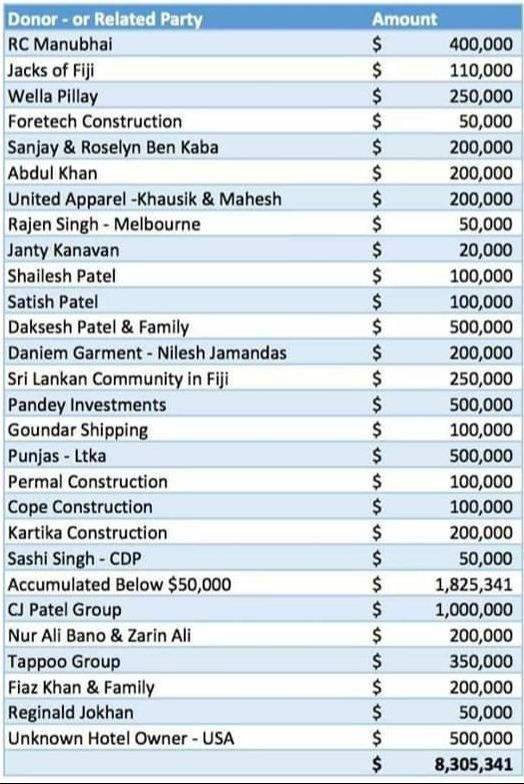
FTUC wants thorough investigation over alleged FFP DONORS LIST

9/11/2018

0 Comments

 
Picture
Picture
Picture
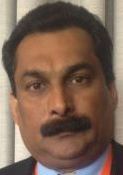
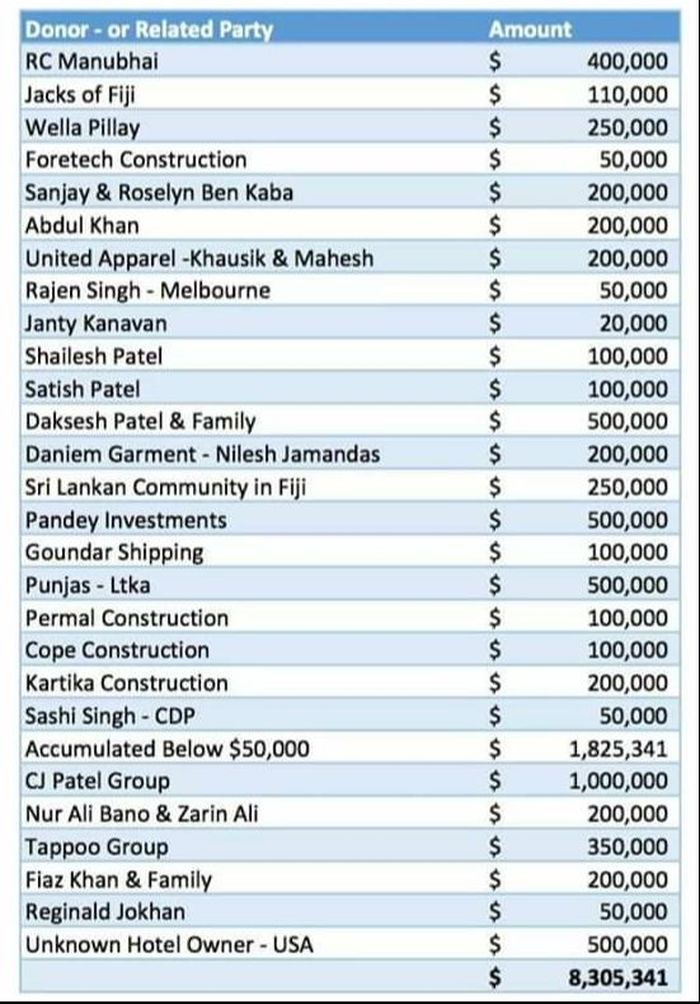
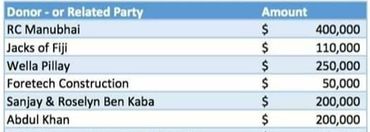
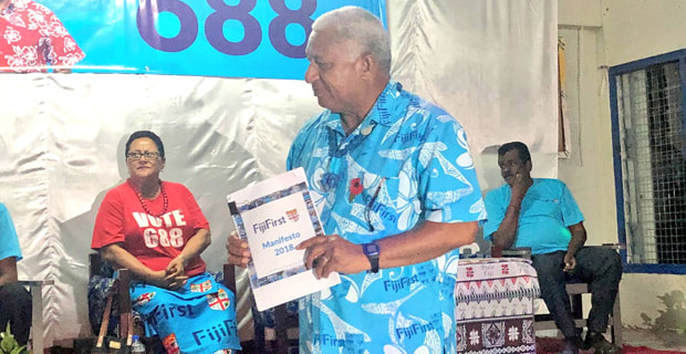
Former FSC CEO Abdul Khan allegedly donated $200,000
PictureFelix Anthony
Investigate

Collusion and Corruption – FTUC


The FTUC is deeply concerned at the revelations of contributions to the incumbent Governing Party (FFP) by some employers and business around the country. The alleged amounts are shockingly excessive and borders on corruption. The FTUC notes that some Garment Manufacturers are amongst those that have allegedly given contributions to the Governing Party.

​These are some Manufacturers who recently claimed that they cannot afford a minimum wage of $4 and threatened to close factories causing huge unemployment yet can afford to contribute to Government’s re-election campaign by giving exorbitant amounts of money. We note also that none of the contributors have denied the allegations nor has the Governing Party. This is rather disturbing and goes against the grains of transparency, accountability and good governance.


The FTUC notes that a complaint has been lodged to the Supervisor of Elections.

(SOE) and Fiji Revenue and Customs Service (FRCS), who appear to have either refused to act upon the complaint or are protecting the Governing Party and their contributors. This is very concerning. We demand a response from all involved in these allegations and authorities responsible to monitor such behavior and enforce the laws. These laws are applicable to all and not just Trade Unions or opposition political parties.We also note that the media has not reported on this matter or sought any answers again. Another demonstration of media bias and or intimidation of the media.

The FTUC is further concerned as there appears to be collusion between some businesses and governing party to keep the National Minimum Wage to extreme poverty levels. These are some businesses that deny their workers Freedom of Association and the Right to Collective Bargaining. It is now becoming clearer as to why the Ministry of Labor enforcement is so weak in some areas and why the Ministry is slow to act on any reports. Workers need answers to these allegations and not silence from those supposedly involved, hoping that such behavior will be acceptable or forgotten.

The FTUC notes that Trade Unions and their officials are not allowed to participate in the political process yet some Employers are not only allowed but also contribute financially huge amounts of cash to the ruling party. This is grossly unfair. This practice of some businesses funding the ruling party and the ruling party accepting such funding undermines democracy and is grossly unfair to workers of Fiji and puts workers at immense disadvantage.

The FTUC demands answers.

Felix Anthony
National Secretary
.

Fijileaks to Bainimarama's Terror Thug and 3FIR Land Force Commander Ben Naliva: We will ensure Bainimarama-Khaiyum won't reach you on
​15 November, for you to COUP if FFP loses the election. DREAM ON!!!  
Picture
Picture
Picture

Picture

Who is Who on the alleged LIST
*The Unknown Hotel Owner, USA. Is he JAY SINGH, who bid for Momi Bay during auction of the Momi project? Singh also owns substantial property for resort development in Wailoaloa, where both Khaiyum and Bainimarama owned plots of land. He is reportedly a good buddy of Bainimarama.
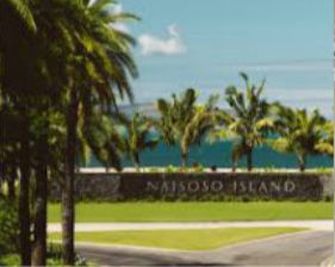
*Pandey Investments. Currently NZ based hoteliers and developers (originally from Malaysia).They allegedly used Fiji Development Bank (FDB) loans for hotel project on Naisoso Island. Bob Lowres, owner of Relcorp (Fiji) allegedly did the same; he used Aiyaz Khaiyum and former FDB chairman John Prasad to obtain
$23.8miilion from FDB for Naisoso development. Re Pandey: Is it legal for non-residents to donate $500,000 to FFP?

*Shashi Singh, CDP: He is CDP director and chairman of FBC, run by Khaiyum's brother Riyaz Khaiyum.

*R C Manubhai Group: 4 Directorships of Boards; Rajesh, Dinesh, Ashok and Bhavesh Patels'. FDB Deputy Chair, FRA Chair, LTA and WAF Chair. The Group allegedly earned close to $100million Cyclone and Flood assistance via Mpaisa from FFP government. Pandey Group in joint venture, Peppers hotel in Naisoso, with Patels'
​

*Foretech Construction:
Directors, Umendra Kumar and Praveen Prakash. Foretech renovated Aiyaz Khaiyum's Vunakece Rd residence in 2014. All major Government and Statutory bodies construction contracts, including FijiAirways new building at Namaka, Nadi. 


*Dekesh Patel: Son of Vinod Patel, former NFP treasurer and MP), based in Sydney. Chairman of EFL (FEA). Allegedly earned more than $100million from Cyclone Winston, Flood, and Farm Mpaisa based assistance to victims. 

*C J Patel Group: Well-known, own Fiji Sun

Picture

MORE TO COME BEFORE POLL


Sanjay Kaba: FFP chief fund-raiser and also member of Constitutional Commission, FRA, member, FNPF Board member; Partner, HKJacobs, etc, etc, etc. Allegedly decides on awarding of contracts, engineers, architects, etc to donors. Conflict of Interest. His uncle Jay Lal, FFP Nadi fundraiser Ajay Rangia's wife, both members of the Fiji Electoral Commission.

*United Apparel:
Owned by Ramesh Solanki, based overseas. Mahesh Patel, general manager operations. Largest garment factory in Nadawa, Nasinu.

*Janty Kanavan: 
​
Kanavan papers, Bondwell Computers. Special legislation in Khaiyum's Budget to protect Janty Kanavan's CD's with increased duty on importers.

*Satish Patel: FFP fundraiser. Service engineer - Edison Consulting (operates from HLKJacobs office, Vanua House. Major services engineer with FNPF and Government contracts.

*Wella Pillay:  Geckos Trucking, Mobil Fiji cartage of fuel, sea barges, construction and equipment hire ltd, water cartage contracts to islands, Fiji Pine Bua contract logging and cartage to Lautoka, Directorship, FDB

*Kartika Construction: Awarded FNU Labasa contract, $40m.

​*Shailesh Patel: IT professional based in Australia. Operates from HLKJacobs and FFP Office.

Picture
Picture
Picture
Picture
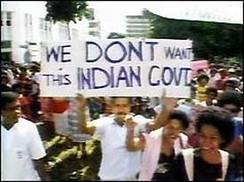
Bainimarama praying with Speight

FRANK BAINIMARAMA: "I had abrogated the 1997 Constitution because I was satisfied that people engaged in the events of May 19 [the 2000 George Speight coup] were of the perception that the document [1997 Constitution of Fiji] had watered down the interests of indigenous Fijians. Whether or not those perceptions accorded with reality was not MY principal consideration. The perceptions were genuinely held by largely unsophisticated Fijians, not equipped to adequately comprehend the niceties and
technicalities of the Constitution.”
 -
The then RFMF Commander Frank Bainimarama in his  affidavit before the
Fiji Court of Appeal, February 2001; he colluded with the Great Council of Chiefs and REFUSED to reinstall the Mahendra Chaudhry Government in 2001 despite a ruling from the then Fiji Court of Appeal Judge Anthony Gates. Laisenia Qarase was put in charge of Fiji
Picture
Picture
Picture

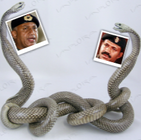
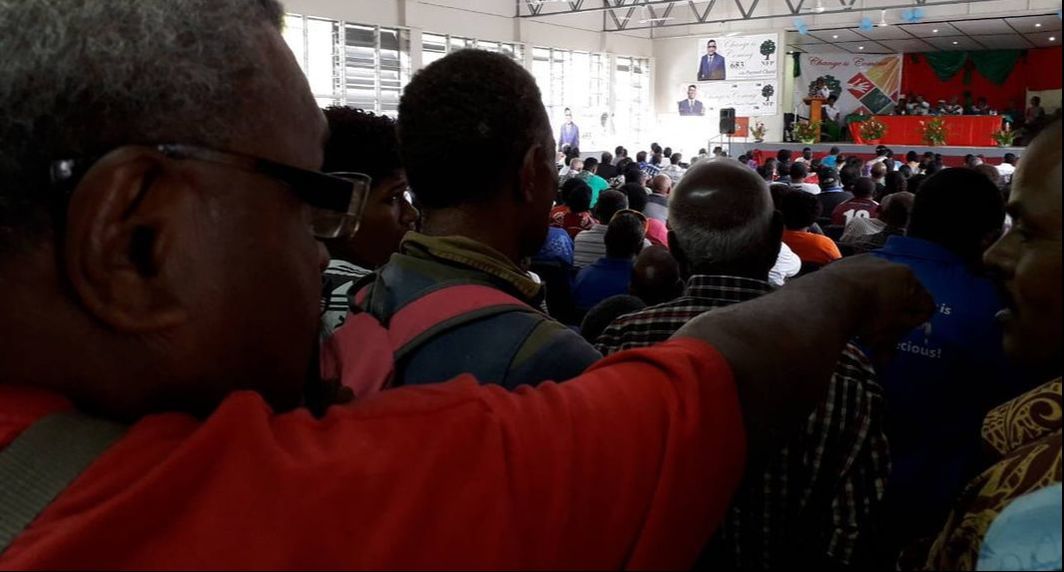
AS the two SNAKES debate their COUPS, Hundreds attend NFP's Manifesto launch in Labasa, and later turn up at airport to farewell Leader
Picture
We are the party setting the agenda in this campaign. We have laid out clearly what we will do.  And because we have been in touch with people, we know what to do.
  • We will implement a $5 per hour minimum living wage
  • We will pay fair prices to our cane growers, including a minimum guaranteed price of
  • $100 per tonne of cane
  • We will make 15 food items VAT-free and reduce VAT on medicines, kerosene and
  • a range of other critical products
  • We will change the face of university education
  • We will spend $200 million a year on housing
  • We will reform our health and education systems.
And tonight one behalf of Team NFP, I proudly announce the 15 basic food items that will be made VAT free or zero-rated. You must remember that 6 basic food items plus kerosene were VAT free, until  FijiFirst in
a gross betrayal of its 2014 election promise, re-imposed 9% VAT on them.

But do not worry.  We are addressing your greatest concern, which is the exorbitantly high cost of living. 
Picture

FINALLY, FIJIFIRST RELEASES BUDGET:
'We will continue with our previous policies' 
VAT to remain at 9%
Picture
Picture
READ here FFP BUDGET
0 Comments

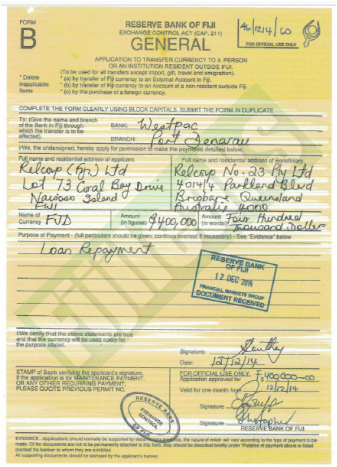
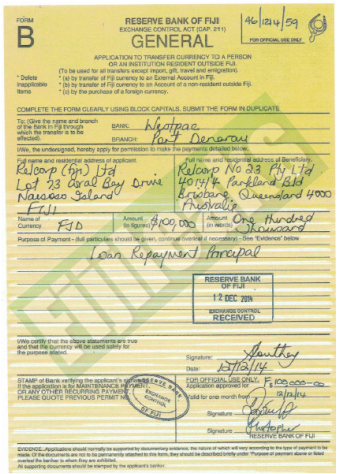
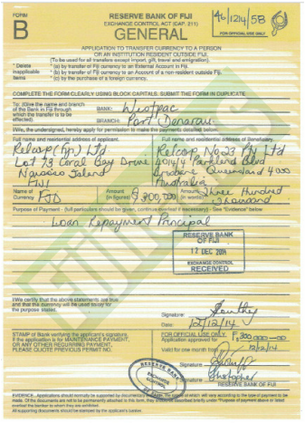
NAISOSOGATE: Long Overdue! "GIVE ME BACK MY $A1.5million which I gave you six years ago to buy Naisoso Island". Khaiyum's buddy Bob Lowres of Investment Fiji Ltd and Naisoso yet to PAY UP alleged DEBT

8/11/2018

0 Comments


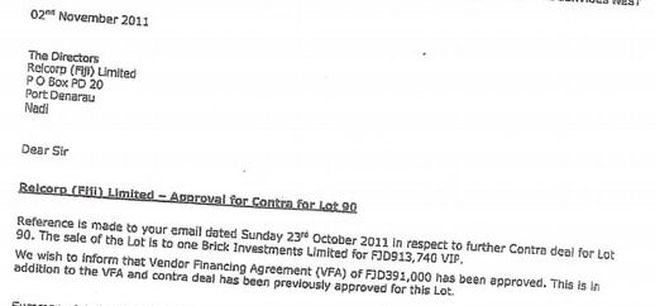
NAISOSOGATE 2: Did Bob Lowres undersell a plot of land to Nur Bano Ali's Brick Investments Ltd; Aliz Pacific handles Relcorp (Fiji) Ltd and Lowres business empire in Fiji

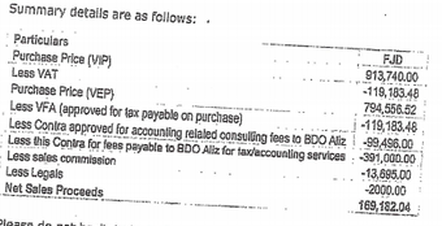
​The $391,000 (see details below) is unbelievably unusual so
what services could possibly warrant this kind of payment? 
In essence, that is a massive discount for
'Future Services' outside of accounting

Picture
Picture
Picture

Fijileaks: The first three are normal: Purchase Price, VEP, and VIP. 
The fourth one of $119, 183.48 is also normal.  But a few purchasers of plots at Naisoso did this and then immediately claimed VAT. 
 We ask FFP Minister for Finance Aiyaz Sayed Khaiyum: 
Why should VAT be claimed when it is just a block of land?
  It is not an income producing activity! 

The $99,496 is unusual but it could be argued that it is also normal; simply part of the payment if Contra for accounting fees which obviously get charged monthly.  
The $391,000 is unbelievably unusual so
what services could possibly warrant this kind of payment. 
In essence, that is a massive discount for
"Future Services outside of accounting" 

Picture
Picture
Aliz Pacific files 2013 Annual Returns for Relcorp (Fiji)
Picture
Picture
Picture

'GIVE ME BACK MY $A1.5MILLION WHICH I GAVE YOU SIX YEARS AGO TO DEVELOP NAISOSO ISLAND':

​SUPREME COURT OF QUEENSLAND

REGISTRY:
Brisbane NUMBER: -57.23 of 2016 


Plaintiff  __________, an individual resident in the State of Queensland

AND

First Defendant:  Relcorp No 23 Pty Ltd (A.C.N. 106 394 343) AND

Second Defendant:  Robert Edward Lowres

CLAIM


The plaintiff claims:

1. $1,353,817.34 from the first defendant as a debt;

2. $10,895.50 from the first defendant as a debt for expenses incurred to 24 May 2016;

3. $1,364,712.84 from the second defendant as money payable under the Guarantees;

4. Interest pursuant to the terms of the Loans at the rate of $223.60 per day, or in the alternative pursuant to section 58 of the Civil Proceedings Act 2011; and

5. Costs, on the indemnity basis:

(a) from the first defendant under the Second Loan; and

(b) from the second defendant, under the Guarantees, or on such other basis as the Court considers appropriate.


The plaintiff makes this claim in reliance on the facts alleged in the attached Statement of Claim.

The Supreme Court of Queensland, Brisbane Registry has the jurisdiction to decide this claim.

ISSUED WITH THE AUTHORITY OF THE SUPREME COURT OF QUEENSLAND And filed in the Brisbane Registry on 7 May 2016: 

STATEMENT OF CLAIM

The claim in this proceeding is made in reliance on the following facts:

1. At all material times, the plaintiff was and is an individual resident in the State of Queensland.

2. At all material times, the first defendant: (a) was and is a company duly incorporated pursuant to the Corporations Act 2001 (Cth) (b) carried on a business of property development; (c) was and is part of the Relcorp group of companies.

3. At all material times, Relcorp No. 3 Pty Ltd (A.C.N. 093 651 328) ("Relcorp No 3"): (a) was a company duly incorporated pursuant to the Corporations Act 2001 (Cth) (b) carried on a business of property development;

At all material times, the second defendant:

(a) was and is an individual who has resided in the State of Queensland, the State of Melbourne and in the Republic of Fiji;

(b) was and is a director of the first defendant;

(c) was and is the sole shareholder of the first defendant;

(d) was the sole director and company secretary of Relcorp No 3;

(e) was a shareholder of Relcorp No 3;

(f) was the sole director and company secretary of Relcorp No 6;

(g) engaged in the activity of property development through the Relcorp group of companies. 

The First Loan 

On or about 15 August 2001 the plaintiff, Relcorp No 3 and the second defendant entered into an agreement in the State of Queensland (the "First Loan"), relevantly under which:

(a) the plaintiff agreed to loan to Relcorp No 3 the sum of $145,000 for a term of 12 months from the date of the loan of the funds;

(b) Relcorp No 3 agreed to pay the plaintiff a 30% return on the loaned funds; and

(c) the second defendant guaranteed the performance of the obligations of Relcorp No 3 (the "First Loan Guarantee").

Pursuant to the First Loan, the plaintiff loaned to Relcorp No 3 the sum of $145,000 on 24 August 2001.

In breach of the First Loan, Relcorp No 3 failed to repay the amount of the loan and the 30% return (or any part thereof) on or by 24 August 2002.

In or about August or September 2002 the plaintiff and the second defendant, on behalf of Relcorp No 3 on his own behalf as guarantor, agreed to continue the First Loan on the same terms and conditions at an ongoing rate of 30% per annum.

On 11 August 2006 Relcorp No 3 paid to the plaintiff the sum of $150,000 in part payment of the outstanding balance of the First Loan.

As at the date of 11 August 2006, the debt of Relcorp No 3 to the plaintiff under the First Loan was as follows:

Loan Principal:     $145,000.00
Accrued Interest:  $215,950.68
Total:                      $360,950.98
Part payment 11/08/2006: ($150,000.00)
Outstanding as at 11/08/2006: $210,950.68


The Second Loan

In or about March or April 2002 the plaintiff, Relcorp No 6 and the second defendant entered into a loan agreement in the State of Queensland (the "Second Loan" and, collectively with the First Loan, the "Loans"), relevantly under which:

(a) the plaintiff (defined under the Second Loan as "Lender") agreed to loan to Relcorp No 6 (defined under the Second Loan as "Borrower") the sum of $500,000 (defined under the Second Loan as the "advance") for a term of 12 months from the date of the loan of the funds;

(b) Relcorp No 6 agreed to pay the plaintiff interest on the secured money (as defined) at the rate of 20% per annum;

(c) the second defendant guaranteed the performance of the obligations of Relcorp No 6 (the "Second Loan Guarantee" and collectively with the First Loan Guarantee, the "Guarantees");

(d) by the terms of a written agreement signed by the plaintiff, Relcorp No 6 and the second defendant, titled "Loan Agreement": "

Pursuant to the Second Loan, the plaintiff loaned to Relcorp No 6 the sum of $500,000 on 11 April 2002.

In breach of the Second Loan, Relcorp No 6 failed to repay the secured money, including the advance and the interest (or any part thereof), on or by 11 April 2003. Such failure was an event of default under the Second Loan. 15.

In late April 2003, the plaintiff and the second defendant, on behalf of Relcorp No 6 and on his own behalf as guarantor, agreed to continue the Second Loan on the same terms and conditions at an ongoing rate of 20% per annum.

As at the date of 21 March 2007, the debt of Relcorp No 6 to the plaintiff under the Second Loan was as follows:

Loan Principal:       $500,000.00
Accrued Interest:    $494,246.58
Outstanding as at 21/03/2007: $994,246.58


Partial Repayment and Recapitalization of the Loans

In or about December 2006, the plaintiff requested that the Loans be repaid in full by Relcorp No 3 and Relcorp No 6.  

In or about January 2007, the plaintiff, Relcorp No 3, Relcorp No 6 and the second defendant agreed to amend the Loans, on the following basis:

(a) Relcorp No 6 would make a payment to the plaintiff under the Second Loan of $600,000;

(b) Upon the making of the payment referred to in subparagraph (a):

(i) the balance of the First Loan, including accrued interest, would be re-capitalised with interest thereafter payable at the reduced rate of 20% per annum;
(ii) the balance of the Second Loan, including accrued interest, would be re-capitalised with interest thereafter payable at the reduced rate of 10% per annum;

(c) the Loans would be repayable on 60 days notice from the plaintiff.

On 21 March 2007, pursuant to the Loans as amended:

(a) Relcorp No 6 paid to the plaintiff the sum of $600,000 in part payment of the outstanding balance of the Second Loan;
(b) The outstanding balance of the First Loan, $210,950.68, was recapitalised under the First Loan;
(c) The outstanding balance of the Second Loan, $394,246.58 (being $994,246.58 less the payment of $600,000 on 21 March 2007) was re-capitalised under the Second Loan.

Restructure and Acknowledgment of Debt 20.

On or about 19 September 2003 the first defendant was incorporated.

On or prior to 24 September 2007 the first defendant agreed to assume the obligations of Relcorp No 6 to the plaintiff under the Second Loan (the "Second Loan Assumption").  

The plaintiff: (a) is a beneficiary of the Second Loan Assumption; and (b) accepted the Second Loan Assumption; or (c) further or in the alternative, hereby accepts the Second Loan Assumption. 

In the premises, pursuant to section 55 of the Property Law Act (Qld) 1974 the plaintiff is entitled to enforce the Second Loan Assumption against the first defendant.

On or about 24 September 2007 Relcorp No 6 was voluntarily deregistered.

On or prior to 29 March 2010 the first defendant agreed to assume the obligations of Relcorp No 3 to the plaintiff under the Second Loan (the "First Loan Assumption"). 

The plaintiff:

(a) is a beneficiary of the First Loan Assumption; and 
(b) accepted the First Loan Assumption;
or (c) further or in the alternative, hereby accepts the First Loan Assumption. 

In the premises, pursuant to section 55 of the Property Law Act (Qld) 1974 the plaintiff is entitled to enforce the First Loan Assumption against the first defendant. 28.

On or prior to 29 March 2010 Relcorp No 3 was voluntarily deregistered.

The second defendant, on behalf of the first defendant and on his own behalf as guarantor:

(a) Acknowledged and affirmed the debt of the first defendant to the plaintiff for the Loans;

(b) Acknowledged and affirmed his obligations as guarantor to the plaintiff for the Loans under the Guarantees;

Particulars

(i) By email from the second defendant to the plaintiff on 18 October 2013;
(ii) Verbally from the second defendant to the plaintiff on or about: (A) late October 2013, (B) early 2014; (C) mid 2014; and (D) December 2015.

Demand and Debt 

On 23 July 2013 the plaintiff gave written notice to the second defendant on behalf of each of the Relcorp group companies, including the first plaintiff, and in his personal capacity as guarantor, demanding payment of the Loans within 60 days.

In breach of the Loans as amended, the first defendant failed to pay to the plaintiff the debt payable thereunder within the time stipulated or at all. The failure is a default event under the Second Loan.

In the premises the first defendant is indebted to the plaintiff for the amount of $1,353,817.34 (as at 24 May 2016), as set out in Schedule A.

The second defendant has not paid that amount or any part of it to the plaintiff.

That amount is due and payable by the second defendant to the plaintiff pursuant to the Guarantees.

Pursuant to the Loans, the first defendant's debt to the plaintiff continues to accrue interest at $223.60 per day, as set out in Schedule A, which interest is due and payable by the first defendant and the second defendant to the plaintiff. 

Recovery of Costs

To the date hereof, the plaintiff has incurred the following expenses in connection with a default event (as particularised in paragraph 31 of this Statement of Claim), within the meaning of clause 8.3 of the Second Loan:

(a) Accountancy fees and expenses: $1,710.50

(b) Legal fees and expenses (on an indemnity basis): $9,185.00 

("Recovery Costs to Date") 

In the premises, the first defendant is indebted to the plaintiff for the amount of the Recovery Costs to Date.

The second defendant has not paid that amount or any part of it to the plaintiff.

That amount is due and payable by the second defendant to the plaintiff pursuant to the Guarantees.

As to the plaintiff's future expenses in recovery of the debt due and payable under the Loans:

(a) such expenses will be incurred by the plaintiff in connection with a default event within the meaning of clause 8.3 of the Second Loan;

(b) in the premises, the plaintiff is entitled to be indemnified for those expenses from the first defendant; and

(c) the plaintiff is entitled to be indemnified for those expenses from the second defendant pursuant to the Guarantees. 

The plaintiff claims the following relief:

1. $1,353,817.34 from the first defendant as a debt;

2. $10,895.50 from the first defendant as a debt for expenses incurred to 24 May 2016;

3. $1,364,712.84 from the second defendant as money payable under the Guarantees;

4. Interest pursuant to the terms of the Loans at the rate of $223.60 per day, or in the alternative pursuant to section 58 of the Civil Proceedings Act 2011; and

5. Costs, on the indemnity basis:

(a) from the first defendant under the Second Loan; and

(b) from the second defendant, under the Guarantees,

or on such other basis as the Court considers appropriate. Signed: Description:

CARTER NEWELL, solicitors for the Plaintiff 

Signed: Description: CARTER NEWELL solicitors for the Plaintiff

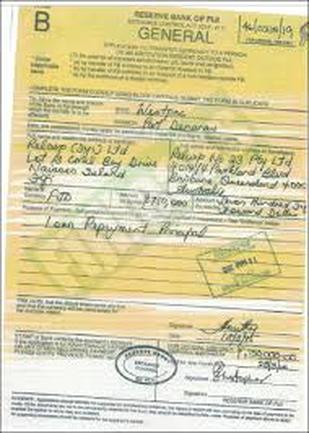
Fijileaks: RESERVE BANK OF FIJI nor NUR BANO ALI have commented on these money transfers
Picture
Picture
Picture
Picture
0 Comments

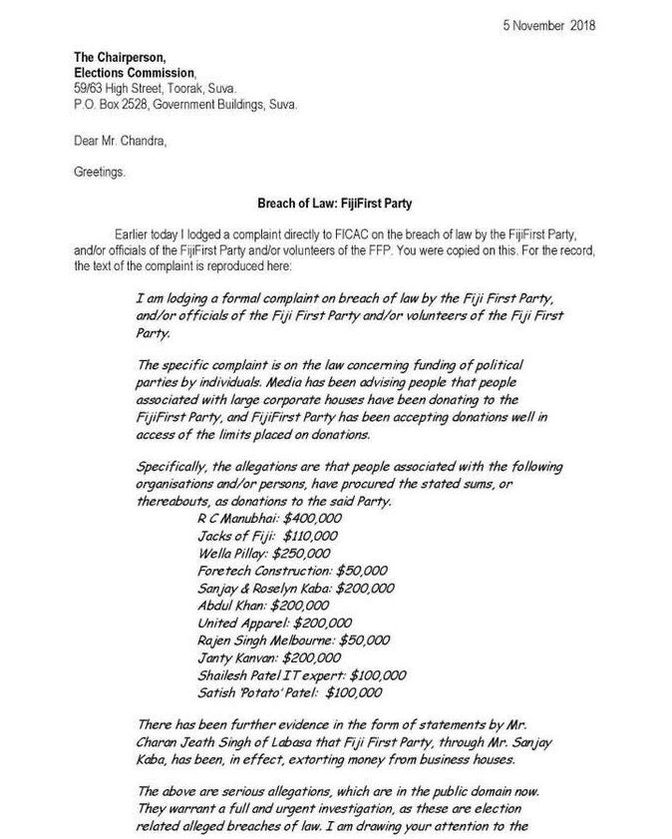
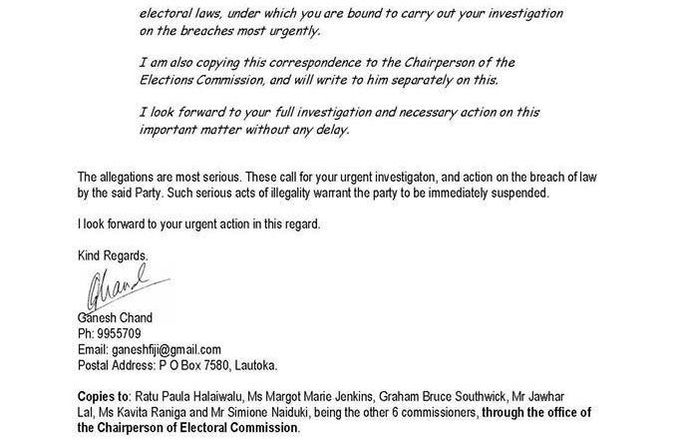
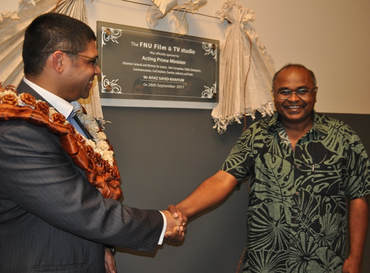
HANDSHAKE TO HANDOVER OF DONOR LIST: Former Vice-Chancellor of FNU, Dr Ganesh Chand, takes the lead and reports matter to FICAC

7/11/2018

0 Comments

 
Picture
Picture
Picture
Picture
Picture
0 Comments

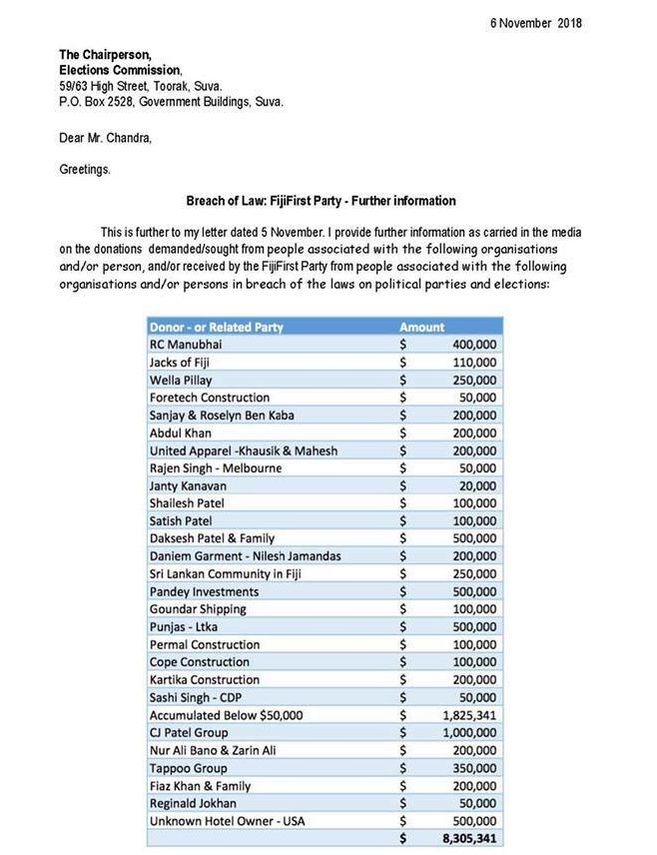
FFP and the 'Robber Baron' DONORS: FICAC, Elections Supervisor, The DONORS, and FFP general secretary Khaiyum refuse to admit or deny to Fijileaks if this is the LIST containing their party donors: $8MILLION plus!

6/11/2018

0 Comments


We will reveal Who is Who on the LIST, and how they are inter-connected with FFP via Government contracts, Appointment to Boards, etc, etc, etc
If the list is genuine, and we have no doubt that it is, for why else hide from our questions, than one that instantly catches our attention is COPE CONSTRUCTION that allegedly gave FFP $100,000 in donation.
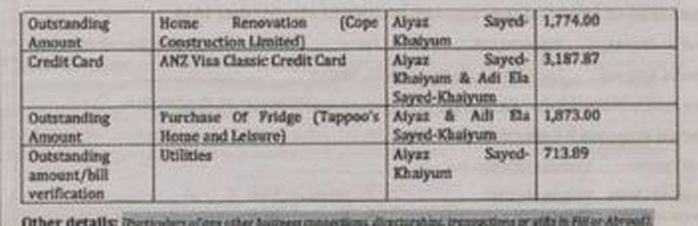
​In his Assets and Declarations, Khaiyum lists he owes COPE $1,774 for home renovation that had cost him thousands of dollars. Its worth pointing out that most of the Tropical Winston school reconstruction
​contract was given to COPE, running into millions of dollars. We may recall NFP candidate and Labasa businessman Charan Jeath Singh  recently revealed how FFP fund-raiser Sanjay Kaba had advised him that Singh's family can cheat the electoral decree by giving the maximum
ten thousand dollars each to FFP. Poor Khaiyum, he also owes Tappoo's House and Leisure $1,873 for a FRIDGE he bought from the company

Picture
Picture

Fijileaks: To those pleading with us to back SODELPA under Sitiveni Rabuka, we say NEVER. There is no way we can afford or allow him to drag us back to 1987 - 1997. He must be held responsible for his crimes against Indo-Fijians, urban native Fijians and Others. He is a SNAKE who has wriggled his way into politics. If so, ask us to endorse Bainimarama. We still hold Rabuka responsible for the collapse of the NBF, even if Bainimarama's own family benefitted from it. Rabuka's family did not have to borrow from the NBF. Rabuka was already looting from the national coffers big time. And bankrolled by wealthy businessmen. He was the unlicensed captain of the NBF ship which hit the reef, opening up a hole in the hull of the bank for his kai vata coupists and others in the name of 'affirmative action for native Fijians' to steal over $350,000 of taxpayers money
​
"Rabuka had appointed Visanti Makrava in December 1987, at the point of a gun. Makrava entered the NBF headquarters in Suva with a group of soldiers saying he had been appointed by the Brigadier, as Rabuka was then. At the time Makrava was manager of the NBF's Samabula branch where the army did its banking...The other link Rabuka had with the bank was through his friend and former army commander, Paul Manueli, who had become NBF chairman in January 1988. He was to stay in that position until June 1992 when he left to become Rabuka's Minister of Finance...Makrava certainly did Rabuka no favours when he was reported to have said, "If I open my mouth, half the Government goes, including the leader.": 
http://www.coupfourandahalf.com/2010/05/fnpf-saga-and-ghost-of-collapsed.html
http://www.coupfourandahalf.com/2010/07/more-of-fijis-elite-families-caught-up.html
http://www.coupfourandahalf.com/2010/07/mara-clan-and-collapsed-national-bank.html
http://www.coupfourandahalf.com/2010/09/national-bank-of-fiji-debtors-list.html
http://www.coupfourandahalf.com/2010/05/teleni-and-wife-borrowed-over-60000.html
http://www.coupfourandahalf.com/2010/05/ganilau-another-to-have-borrowed-from.html
http://www.fijicoupin2006.com/2010/07/yatu-lau-class-shareholders-and-nbf.html
http://www.coupfourandahalf.com/2010/05/bainimaramas-foreign-minister-inoke.html
http://www.coupfourandahalf.com/2010/06/coup-apologist-ema-druavesi-and.html

0 Comments

INHUMAN PRISONER RIGHTS while FFP boasting of recent appointment to UN Human Rights Council. But what can we expect when convicted KILLER FRANCIS KEAN had been appointed the Prisons Commissioner

6/11/2018

0 Comments


Fijileaks: Now, we know why ASHWIN RAJ, the regime appointed lackey and Director of Fiji Human Rights Commission wants to regulate social media, to hide what is really happening under the FFP government


Picture
Jagath Karunaratne
Picture

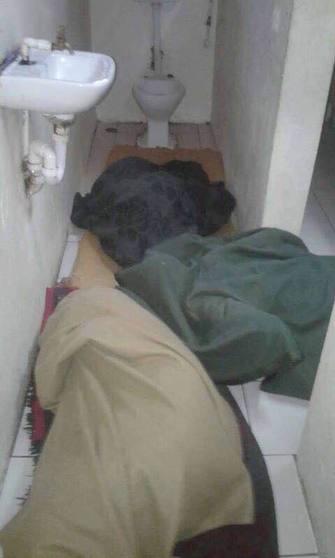
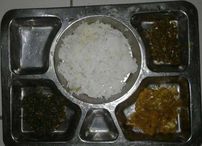
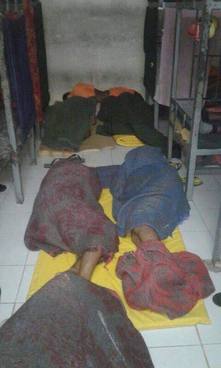
Jagath Karunaratne, on his Facebook posting: "Did my heart sink with familiar memories of the prison life on the eve of another beautiful Diwali, certainly yes. The rusted USB handed over to me this morning by an unknown person contained these photos. I know for a fact that they are from inside prisons. I have been there and no better person can vouch for that.

The 3 meals, sleeping conditions, the mattresses, blankets and bed sheets are way too familiar. They cannot vote, therefore no politician will talk about them.

​They are criminals, therefore they deserve to be treated so, is the common attitude. I was in Police custody charged for sedition during the Diwali in 2011.

I, Mosese Bulitavu and few other remand prisoners use to climb on the cell doors just to get a glimpse of Diwali festivities outside.
We just sat there listening to the fireworks in a cell block filled with urine smell while the rest of the world draped themselves with beautiful clothes, distributing sweets, hugging each other wishing happy diwali with the spirit of good over evil and overcoming darkness with light..."

Freedom Alliance Party Leader Jagath Karunaratne, Facebook, 5 November 2018  

Many prison guards have informed Fijileaks that even they have been thrown into the prison cells for making minor mistakes on the job

Picture
Picture
Picture

Let us hear what the motor-mouth FFP lackey and Khaiyum's side-kick Ashwin Raj has to say on these photos. Change MUST come on 14 November so we can hold HIM and others to account. All airports and seaports must be shutdown on the 15 November to prevent them from ESCAPING. They must sleep on the same prison floors as these prisoners, to make sure NEVER again Fiji hears from them!!!!!!!! 

Picture
Picture

"On Saturday the 30th of December, 2006 Mr. Samuel Whippy married Ms. Ateca Bainimarama at the Sacred Heart Cathedral in Suva. The wedding reception was held at the Royal Suva Yacht Club. John Whippy a relative of the groom attended the reception. Francis Bulewa Kean, Commander of the Fiji Naval Forces and uncle to the bride joined the celebration. During the course of the evening several fights broke out between guests. The deceased was involved in some of those fights. He was drunk. At about 2.00am John Whippy left the Yacht Club with Peter and Samuel Whippy. They talked. The groom bade them farewell. Peter went to get a taxi to take both him and John home. When the taxi pulled up Peter sat in the back seat and he told John Whippy to get into the car. As John Whippy was assisted to the taxi he was in an ugly drunken mood. I accept he used vulgar language that provoked Mr. Kean into firmly telling him to mind his language and go home. In his drunkenness the deceased ignored this direction and kept up his belligerent tirade.  Francis Kean  then left the Suva Yacht Club and ran towards Mr. John Whippy yelling in Fijian, "Stop that taxi." The accused then came up to John Whippy and punched him three times in the face. John Whippy first hit his head against the taxi light then fell heavily to the ground on his back. While he was lying on the ground  Francis Kean  kicked him on the chest. The accused was dragged away by an unidentified woman but returned to kick John Whippy’s head. Asaeli Duvusole intervened and grabbed the accused warning him to do no more harm. John Whippy lay unmoving by the side of the taxi. A Corporal of the Fiji Military Forces checked his pulse he could find none. John Whippy was lifted into the taxi and quickly taken to the Colonial War Memorial Hospital. Doctor Ashika Lata Sen saw John at 1.46am. He did not have either a pulse or cardiac rhythm and he was not breathing. Despite her best efforts to resuscitate him John Whippy did not revive. He was pronounced dead at 2.20am on 31st December 2006. Mr. Kean, John Whippy’s life was precious and its value should not be underestimated. There must be exceptional circumstances before the court can suspend a term of imprisonment. I have searched for those circumstances in your case but can find none. An immediate prison sentence must be imposed. You are sentenced to
eighteen (18) months in jail."

Gerard Winter
JUDGE
At Suva
Friday 26th October, 2007

Picture

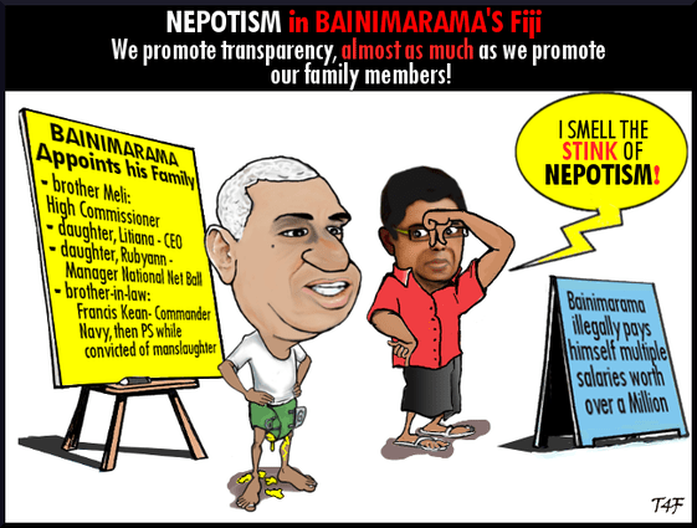
FFP leader and Prime Minister Bainimarama's convicted killer brother-in-law appointed Commissioner of Prisons. Its not RACISM but NEPOTISM and DESPOTISM that Fiji needs to VOTE OUT on 14 November to make sure that never again a convicted KILLER becomes new Prisons Commissioner.  CHANGE IS COMING! It will NOT come under
Coupist Sitiveni Rabuka (it will never come, for he himself escaped the PRISON CELLS) but under the NATIONAL FEDERATION PARTY
​leadership of Professor Biman Prasad

Picture

NFP MEDIA RELEASE: April 3, 2017: Ashwin Raj must be SACKED from his position

The National Federation Party has called for the immediate dismissal of Ashwin Raj in both his positions as Chair of the Media Industry and Development Authority (MIDA) and Director of the Fiji Human Rights and Anti-Discrimination Commission (FHRADC), following his suggestions to stifle freedom of speech on national television.

Party Leader, Professor Biman Prasad, said that the suggestions on Sunday night 2nd April) by Mr Raj on FBCTV Current Affairs Show For the Record, where he urged the State to pursue the regulation of social media are shocking and must be condemned in the strongest terms.

“The NFP strongly condemns these suggestions to the State by Mr Raj, which we know are all being said under the pretext of “responsibility.”

“It is chilling, unconstitutional and could be easily wielded as an instrument to again stifle the voices of the people of Fiji.”

“What we find further disturbing are his pointed attacks on political parties and then the further justification of these attacks, to bring in regulation over social media.”

“The NFP sees this as a blatant attempt to stifle the voices of political parties in the lead-up to elections next year.”

“Fiji already has in place a heavily regulated media industry, with draconian laws, and penalties.”
“There is no need to introduce further laws to stifle civil liberties. There is instead a great need to repeal these laws.”

Professor Prasad added that citizens had taken to Mr Raj himself, their complaints on communal antagonism against FBCTV for the program Wasea Basha.

“However Mr Raj merely brushed these off as not meeting the “threshold for inciting communal discord.”

“It seems he has conveniently changed his mind on what such a “threshold” constitutes when this has concerned the State and its representatives”

“We are also appalled with the false accusations and political commentary that have emerged from Mr Raj in defending the statement of Fiji’s Ambassador to Geneva, Nazhat Shameem at the 34th Session of the Human Rights Council.”

“His statement was based on an inaccurate lengthy version of the Ambassador’s statement, which the Fiji Mission in Geneva continued to have on its website and furthermore made some serious political commentary and opinion of what he thinks is true.”

“He continued to drive that agenda on Sunday night on FBCTV.”

“As the Director of a constitutionally independent commission, Mr Raj had cast inaccurate, political aspersions on opposition political parties, without checking the basic facts, including the true record of the speech.”

“The fact that a public servant in the Director of the FHRADC, has come into the political scene, falsely accusing opposition political parties of his own opinionated conclusion, contradicts the behaviour expected of pubic servants which explicitly demand political neutrality and impartiality.”

“They contravene the constitutional values and principles expected of public servants who should display high standards of behavior, including professional ethics and integrity.”

“I call on the Chairperson and members of the FHRADC who are constitutionally responsible for the promotion, protection, observation, of human rights, to take a proactive interest in the work of the commission and its officers, particularly its Director.”
​
“Mr Raj should be terminated from his positions to allow other more worthy, neutral and independent Fijians to apply for the position. His utterances and accusations are damning where he has crossed the line as a public servant acting as a mouthpiece for a political agenda.”
 
Authorised by: –
Professor Biman Prasad
NFP Leader
Picture
Picture
0 Comments

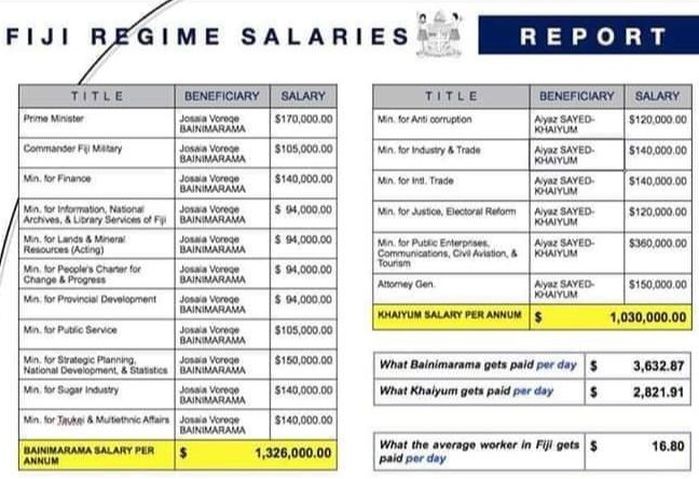
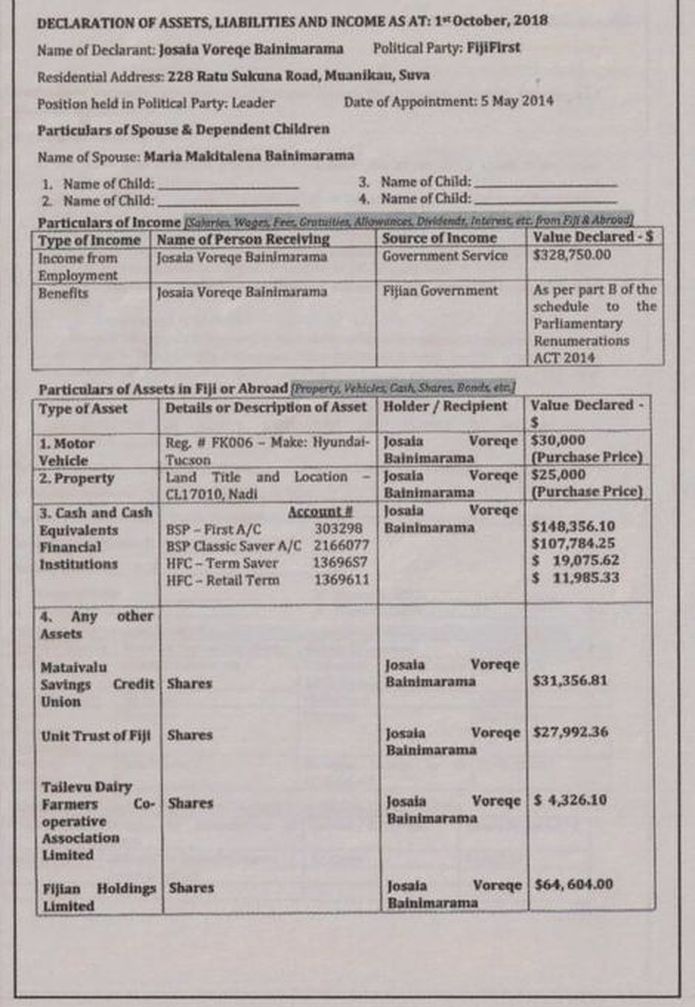
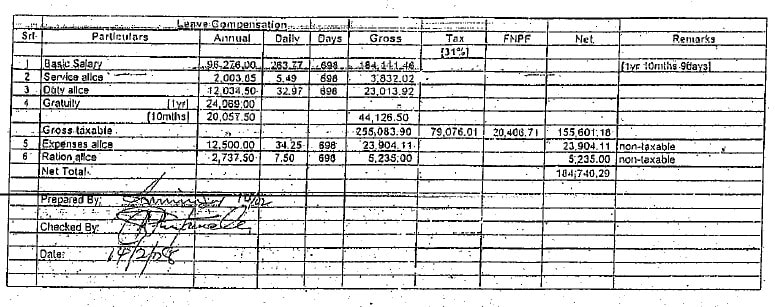
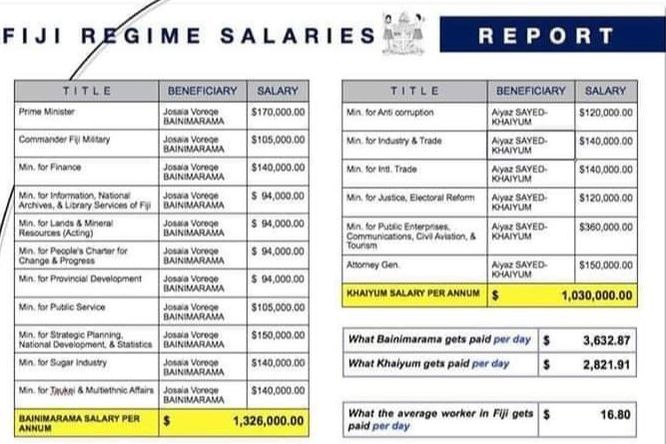
THE DEVIL IS NOT IN THE DETAILS: As workers are refused $5 an hour, their tax money saw Bainimarama's salary jump in four years by $50,000, so he declared to Fiji Elections Office (2014: $278,750; 2018: $328,750)

5/11/2018

0 Comments


Unlike 2014, he has left blank the BENEFITS; in 2014 he claimed he was getting $20,000 for entertainment (taralala) allowance, and $28,000 in other allowances. Surprisingly, like 2014, four years later, in 2018 the plot of land he valued at $25,000 is the same (cleverly noted as purchase price). He has $31,356.81 in the RFMF Mataivalu Savings Credit Union (Auditor-General refused permission to audit), whose chairman is his brother-in-law and convicted killer and jailbird (released without serving his sentence) - FRANCIS KEAN.
Last week, ​FFP leader Bainimarama was exhorting the voters: 
“Please vote for us not because we are related. Vote for us because of what we can do for you. That’s the most important thing.” 

Picture
Picture
Picture

Fijileaks: According to Mataivalu Saving's Credit Union website, only serving members of the RFMF can be members to obtain loans and other privileges, so WHY is Bainimarama still listing his assets of $31,356.81 with MSCU 
MSCU website: A milestone decision reached at the SGM of 2009 was that
membership of MSCU only be available to Serving members of the RFMF and civilian staff at MSCU. The exercise to terminate the members not meeting this criterion has been successfully concluded. And, how come Kean is the chairman? The MSCU have over the years assisted several organizations in major development loans including the formation of Homelink Security Services: mscu.com.fj/Default.aspx

Picture

FOUR years later, Bainimarama is yet to answer
​Fijileaks questions 


​FIJILEAKS TO BAINIMARAMA (3/7/2014):


1.   HAVE YOU declared what the loan of $246,380 is for from TSB Bank, when it was drawn, given the fact that there is no corresponding liability against that declared loan?

2.   Then what is the declaration for the loan of $55392 remaining balance, given the fact that YOU show substantial bank balance of $353,000 across 3 separate accounts?

3.   How does YOUR asset tally up with YOUR income salary and is the bank balance included for the back pay you received? If not then show YOUR  bank statements with evidence of it being paid back.

4.   Where is YOUR FNPF statement printouts for past 8 years as YOU have not declared your FNPF funds as your  assets as super funds?

Picture
THE 2014 declaration of assets and liabilities of the leader of the FijiFirst Party Voreqe Bainimarama, published in the regime's  shows that Bainimarama:

(1) had a total income of $278,750.

From that money, $230,000 is what he receives as annual salary for being Prime Minister, $20,000 for entertainment allowanceand other allowances $28,750.

The declaration also shows that Bainimarama has:

(2) three banks accounts in BSP;

he has 
$51,207 in one account;

 $101,968 in his cheque account;

​
 and $104,815 in a term deposit account.

He also has $26,042 in a Mataivalu Savings account and $14,443 with the Unit Trust.

His total liabilities are $301,772.88 and total net assets $51,704.60.

He has also declared a Hyundai Tuscon vehicle valued at $30,000 and a property in Nadi valued at $25,000. 
Picture
Picture
Aiyaz Khaiyum says this is all fake figures but they have never made public their pay slips
0 Comments

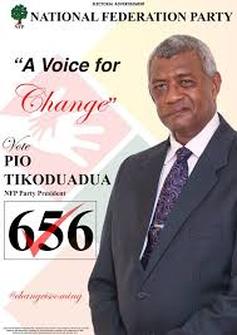
BEAUTY and BEAST: There is something really rotten in Bainimarama's twisted head. Was he referring to Tikoduadua's face from STROKE when he claimed comparing Tikoduadua to Khaiuym was like beauty & beast?

5/11/2018

0 Comments


NFP president Pio Tikoduadua’s attempt to compare himself with Attorney-General Aiyaz Sayed-Khaiyum was “like beauty and the beast”. Frank Bainimarama, reported in The Fiji Times, 5 November 2018 

Picture
Picture
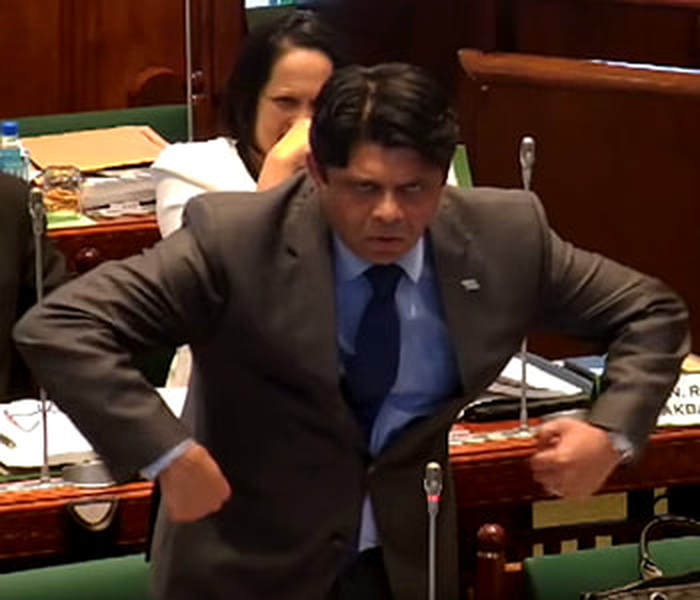
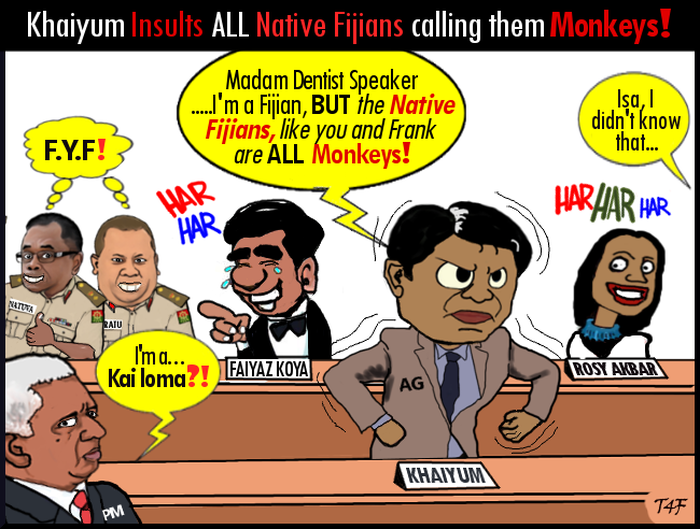
Beastly monkey grunt raised fears of his mental state of mind
Picture
GRUNTING MONKEY GESTURE in Fijijan parliament resulted in several cartoon sketches and comments
Picture
Picture
Picture
Picture
Picture
0 Comments

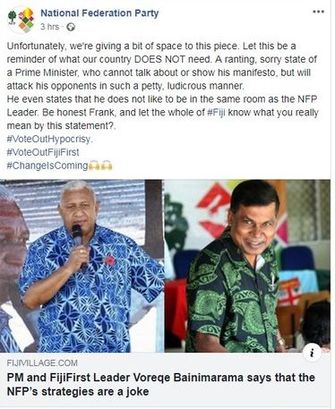
RACIST TALK echoing coupist Rabuka in 1987: 'I HATE being in the same ROOM as [the NFP leader] Biman Prasad, says FFP leader Bainimarama; Rabuka: 'Hindus, Muslims are pagans, let us convert them as Christians'

4/11/2018

0 Comments

 
Picture

Fijileaks: Frank Bainimarama revealed his FRANK dislike for Prasad at FijiFirst FAMILY Fun Day rally in Labasa. He told the voters he can NEVER be in the SAME ROOM as the Labasa- born NFP leader Prasad. He HATES Prasad's presence around him. What happened to Bainimarama-Khaiyum's mantra that under FFP, Fiji is one big 'family', with no hatred and division - no more 1987 and 2000 politics of hate and discrimination? We wonder if FFP leader Frank Bainimarama will walk out of the ROOM if Mr Prasad came with his DEAR WIFE,
​Dr Rajni Chand? Dr Chand on her husband:
“He is strong, trustworthy, intelligent and a faithful leader. We are life partners and we’ve always been together and I’m his closest and strongest supporter.”

Picture
Picture
Picture
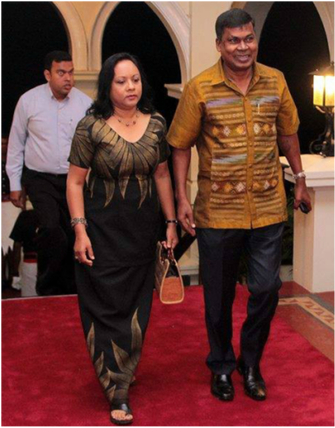
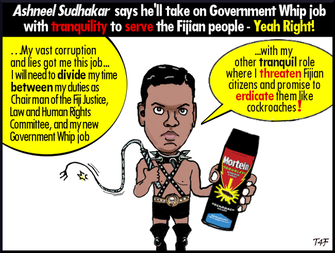
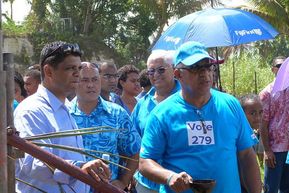
Professor Biman Prasad and his wife followed by FFP Government Whip Ashneel Sudhakar walking behind them
Picture
Picture

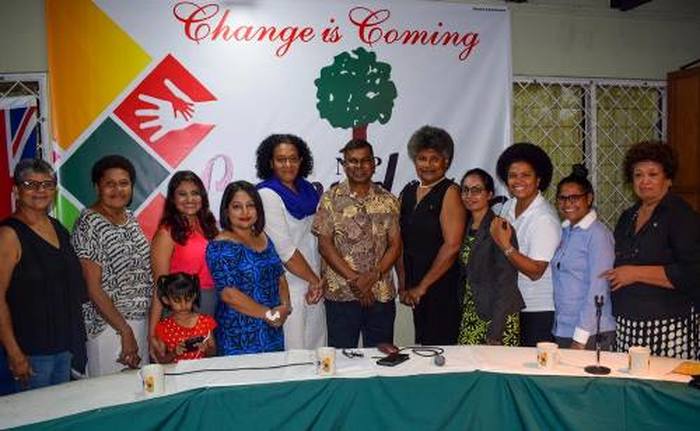
WOMEN POWER: Professor Prasad (below photo) in the same ROOM with his NFP women candidates for the 2018 elections.

Picture
WOMEN POWER: NFP's women candidates ready to take on FFP's Bainimarama and Khaiyum
Picture
Picture

BLACKMAIL: FICAC, Khaiyum's dancing PEACOCK, should investigate Bainimarama for inciting racial and political hatred (and even possible FFP violence) against the NFP leader Prasad. Bainimarama should also be investigated for claiming that villagers of Vunidogoloa in Cakaudrove did not vote for him in 2014 despite him assisting them. He was threatening voters that he has the ways and means of finding out who voted, and who did not, for FFP

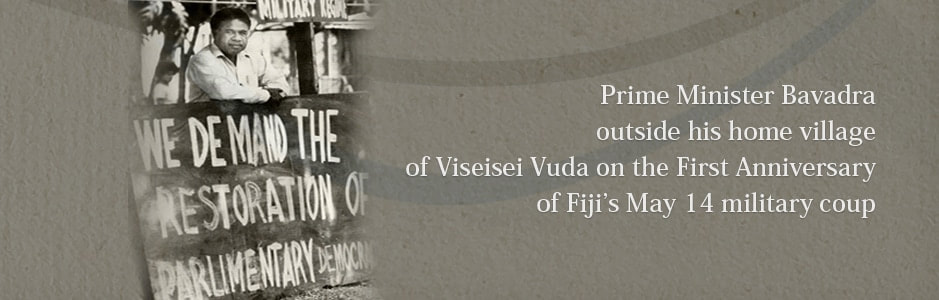
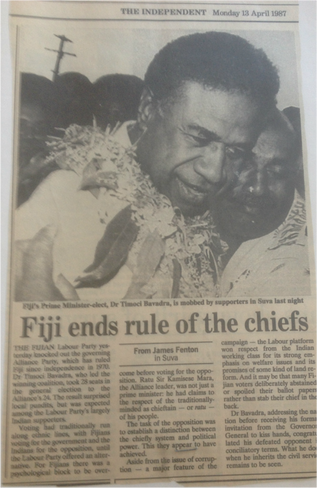
THE RACIST AND POLITICAL ATTACKS ON NFP LEADER is a clear sign that NFP has emerged as the party - the 1987 Bavadra Fever - to topple FFP and become the largest party in power. SODELPA will rue its misguided policies (Fijileaks gets shivers every time Niko Nawaikula, who played a key role at the NLTB in evicting Indo-Fijian farmers, opens his big mouth under the guise of indigenous rights claims), and is fighting the election on its outdated past nationalist slogans!

​Aiyaz Khaiyum's cunning ploy to insert in his 2013 Constitution the NO COALITION clause before general election has come to bite his bottom. Aware of the power of coalitions that toppled previous Fijian governments, he ensured there was going to be no coalitions against FFP in the 2014 elections. 
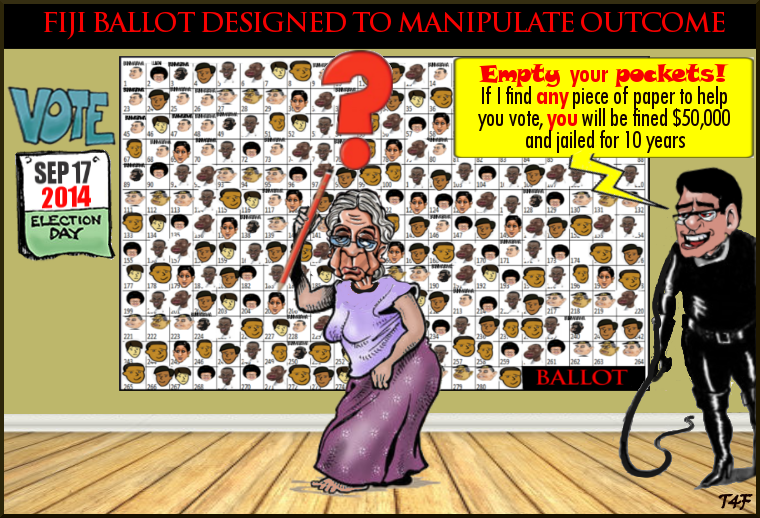
​Worst, he removed the name of candidates and party symbols from the ballot papers,    

Picture

and prevents voters from walking into the voting booth with a piece of paper in their hand or pocket. If anyone is found breaching his decree, he or she will be fined $50,000 and jailed for TEN years. In the God-given belief that he is the GODFATHER of Fiji, he has even banned Indo-Fijians from entering their country of birth. Now, he and Bainimarama - the twin faces of worst evil
​(and a host of other arrogant beneficiaries) - fear the NFP is the only party that can, and will, end their tyranny, despotism, and nepotism inflicted on the silent majority for the last 12 years
​

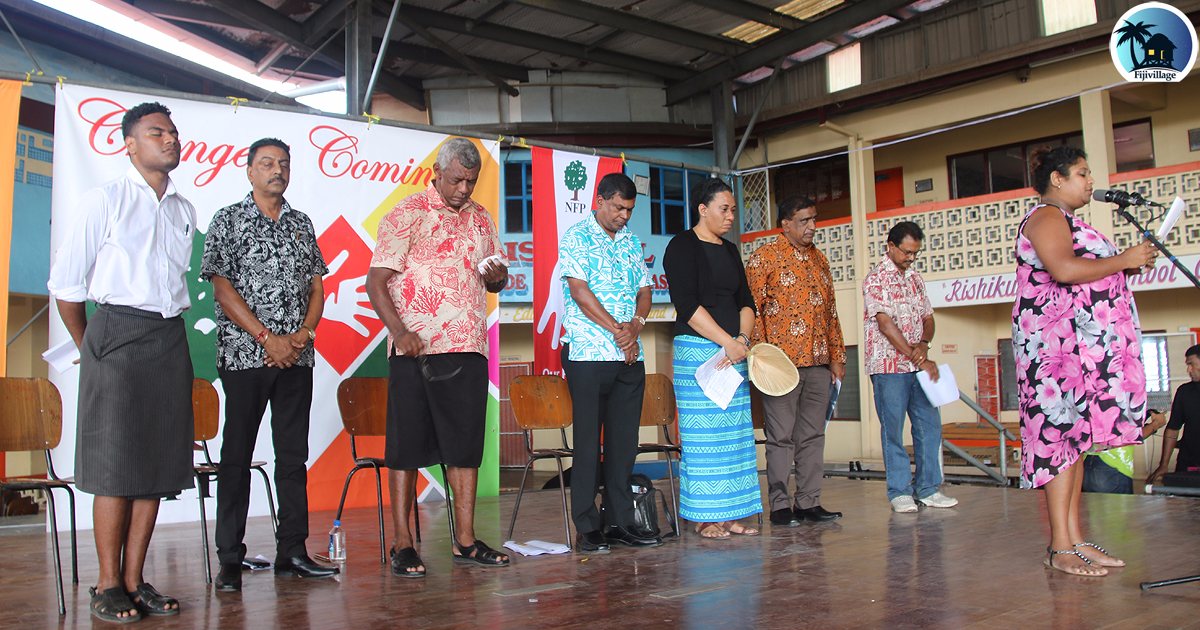
The NFP is a truly multi-racial team under Professor Prasad, made up of native Fijians, Indo-Fijians, Rotumans, Fijian Chinese and Other candidates for the 2018 general election

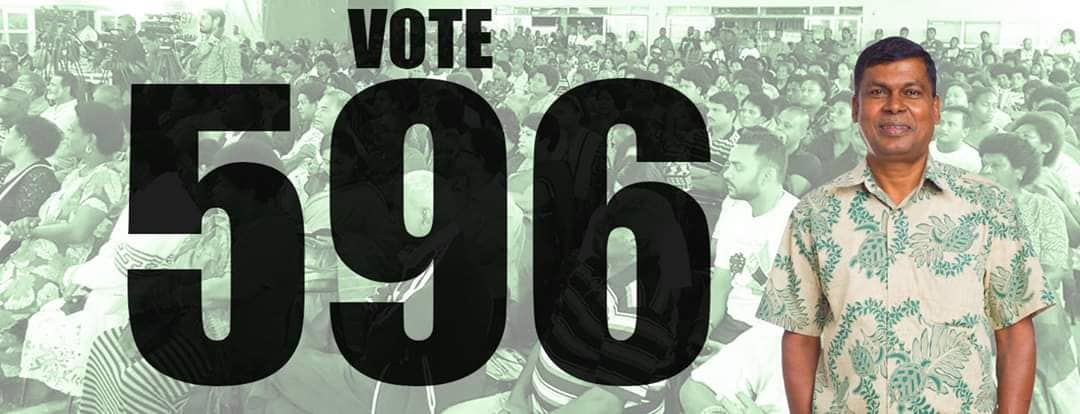
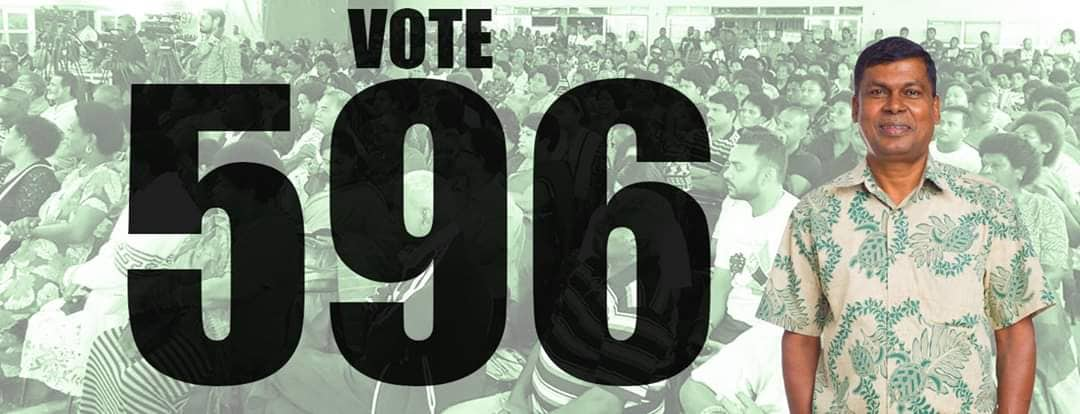
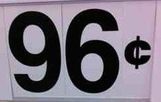
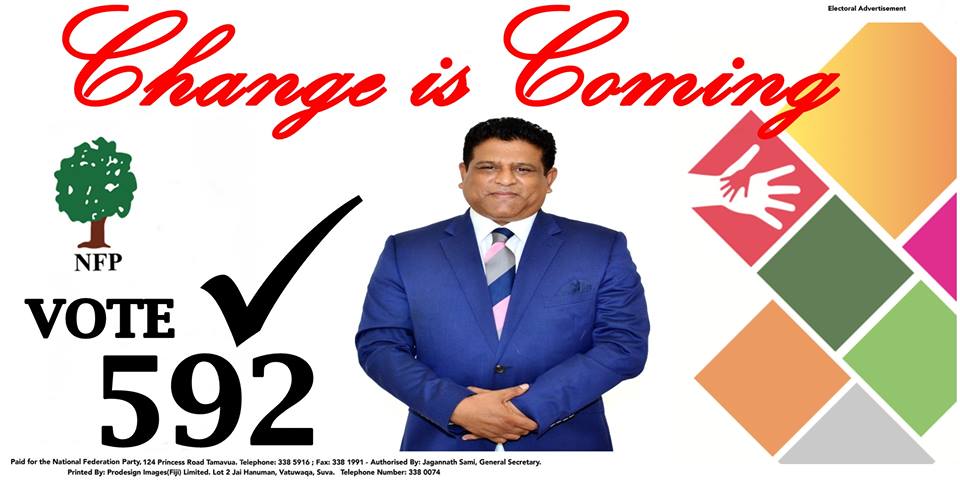
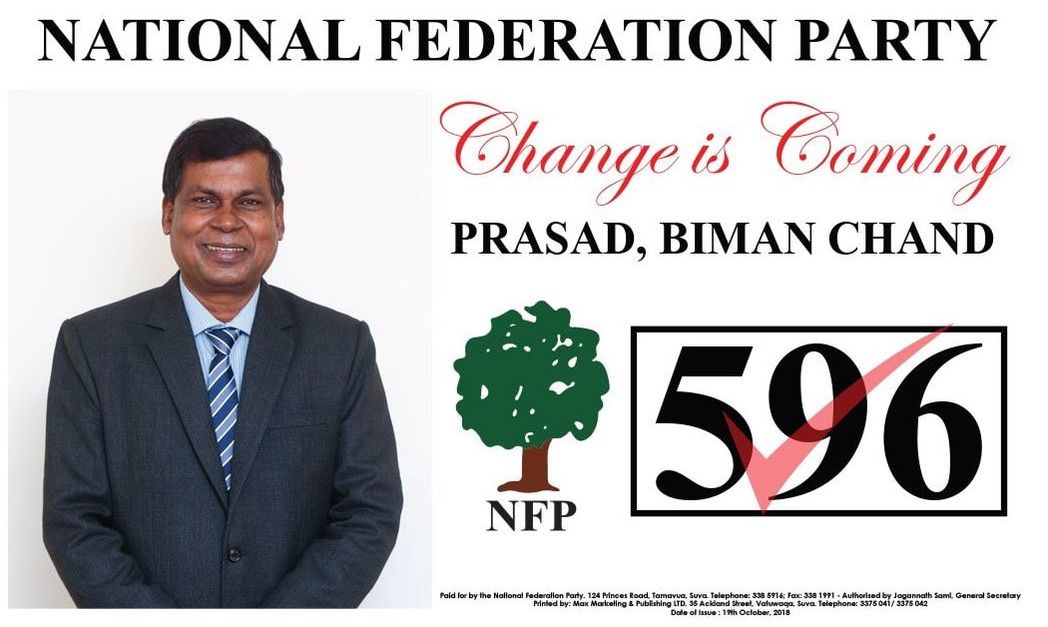
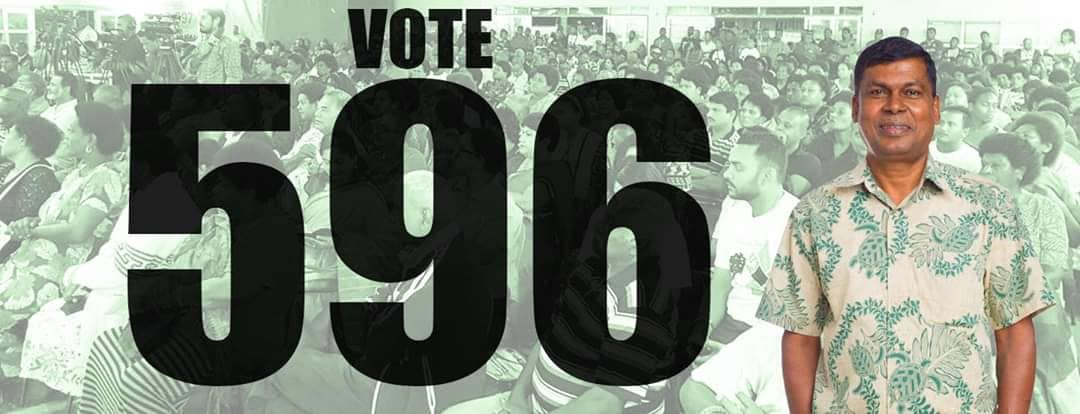
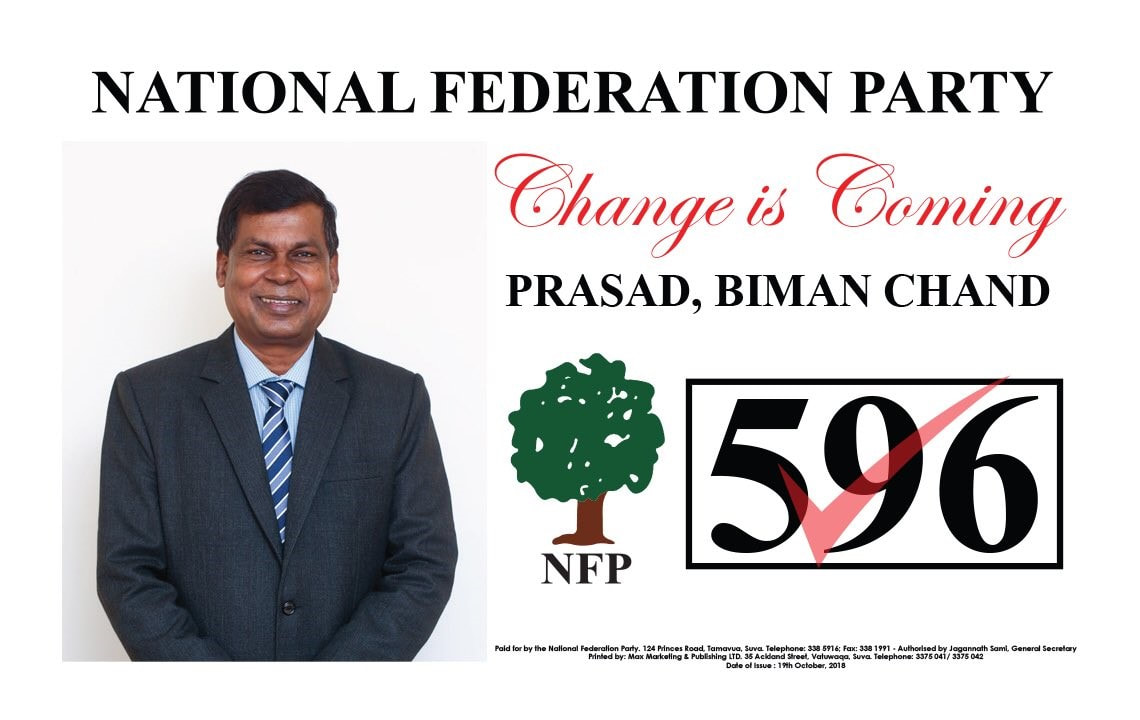
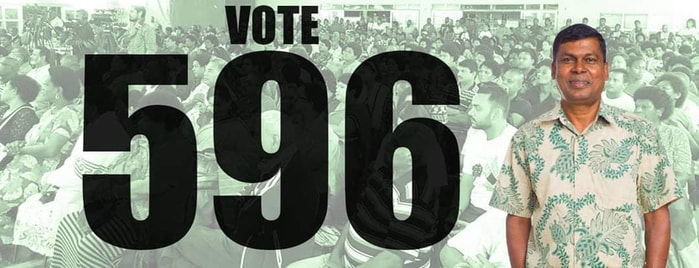
​KRISHNA DATT: REMEMBER $5 and just add 96 cents to vote for 596

Picture
Picture
Picture

NFP is now the only PARTY which has ROOM for all the races in FIJI

Picture
ALL RELIGIONS:
NFP VICE-PRESIDENT Siddiq Faizal Koya
Picture
Picture
Picture

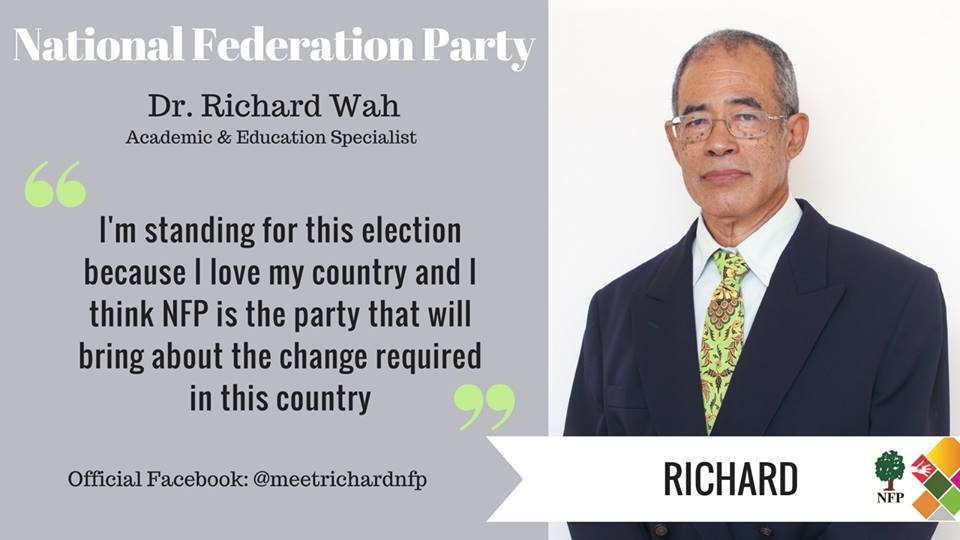
God bless Fiji. Vote NFP. FFP MUST GO. WE WILL MAKE FIJI SAFE, STABLE AND A FEARLESS COMMUNITY. NFP candidate Dr Richard Wah

Picture

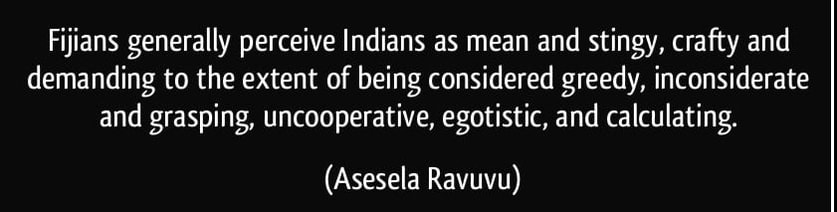
SITIVENI RABUKA had appointed the late Professor Asesela Ravuvu to chair the Committee which came up with the racist 1990 Constitution that disenfranchised Indo-Fijians, Others, and native Fijians from urban areas

Picture

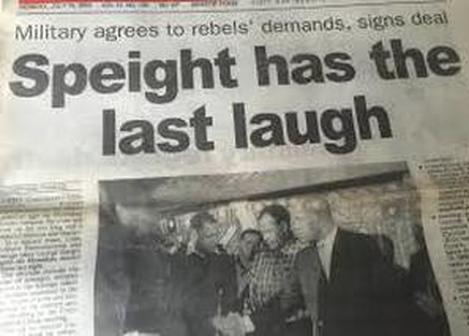
And remember GEORGE SPEIGHT, who claimed that he removed Mahendra Chaudhry from power and as Prime Minister because the Indo-Fijians smelled differently

Picture

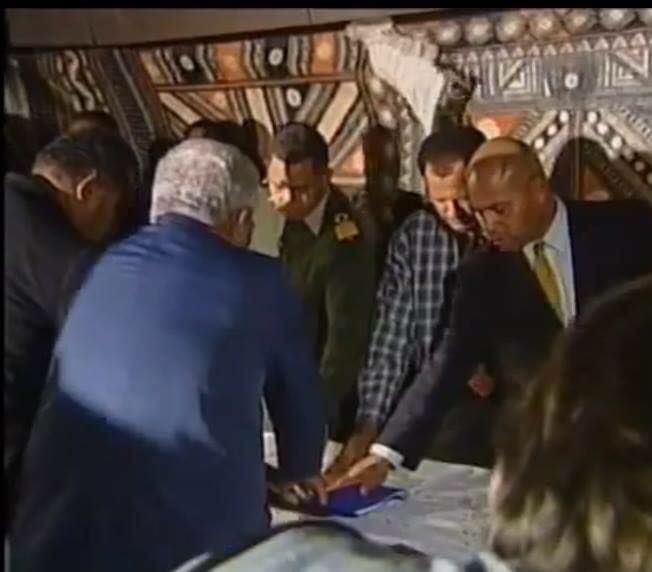
Bainimarama and Speight shaking hands after Speight overthrew the Chaudhry government; Bainimarama brought in Qarase to run Fiji

Fijileaks: POLITICAL ROAD TO NOWHERE for FFP:
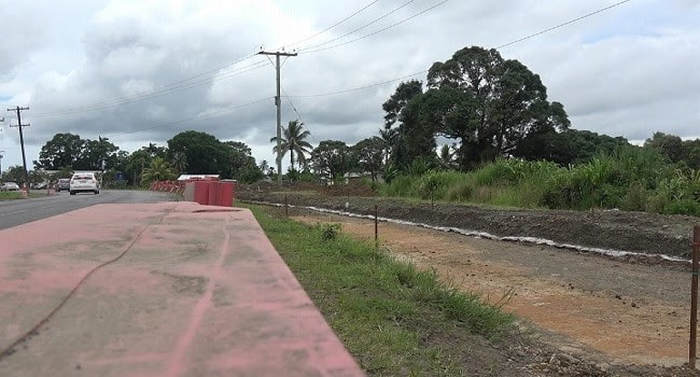
Bainimarama and Khaiyum should inform voters why this road needs to be done again. This road was done a few years ago by the Chinese and Malaysian company Naim. It cost millions.
WHO IS RESPONSIBLE? FijiFirst Party and Bainimarama-Khaiyum?
​The money wasted could have been used to fix the rotten health system and on education, and on the poor who are struggling under FFP

Picture
FRA expected to reconstruct road between Korovou and Rakiraki

Around 50 kilometres of road between Korovou and Rakiraki on the Kings road is expected to be reconstructed.

Chief Executive, Jonathan Moore says they’ve noticed that the road condition is rapidly deteriorating.
Moore admits it’s now even difficult to manage with potholes and patch repairs as the area needs a total review and reconstruction over the next few years.
He says survey work is currently being carried out.

” It won’t be starting until the middle of next year anyway because we doing the surveys now. We have to do the land search to make sure there is no acquisition required and it is a very very difficult area to work in. You right next to the river and for the long lengths of the road , you got river one side and you got the mountain on the other side so there is lot of geotechnical things to do and we are not going to do this in a rushed way . It’s going to be done properly for a long term. This needs to be a 25-year road not a five- year road or ten year road.”

​Moore says certain roads along the Kings road between Rakiraki and Ba also need upgrading. Source: FBC

Picture

THERE IS ROOM FOR EVERYONE IN THE NATIONAL FEDERATION PARTY. ALL WELCOME. PLEASE JUST WALK INTO THE ROOM. WE WILL NOT WALK OUT OF
​THE ROOM

SODELPA should have been led by Ro Teimumu KEPA!!!

Picture
Picture
Picture
0 Comments

REMEMBER $5 and just add 96 cents at the end (596) for NFP leader BIMAN PRASAD, the veteran politician Krishna Datt told over 2,000 supporters: "We must bring an end to the two men dictatorship of Fiji"

3/11/2018

0 Comments


Fijileaks: And remember to make sure the Father of Dictatorship SITIVENI RABUKA is KICKED OUT. THE SNAKE WILL COME BACK TO BITE US

Picture
REMARKS AT 2018 MANIFESTO LAUNCH VUNIMONO COMMUNITY HALL, NAUSORI THURSDAY, NOVEMBER 1, 2018 BY NFP LEADER PROFESSOR BIMAN PRASAD

Welcome to the launch of our manifesto. I will try to be brief in my comments tonight. Because this is a document we want people to take away and read.

The manifesto has some of our ideas for government.  We had meetings with many people, all over Fiji, for many months. We listened to them. Our NFP candidates also listened and talked to the NFP leadership.
We received so many ideas. We could not put them all into this document. So these are the main plans we have for government.  But we have many more.

When the Prime Minister announced the election and launched his election campaign, he promised a campaign of ideas.

Then – nothing. No ideas. Nothing from Fiji First. Nothing except attacks on the opposition parties.   Fiji First is just reacting to what NFP has to say.

We talk about increasing the minimum wage. They say they will “study” it.  We talk about change. They say nothing needs to change.
We disagree.  We say – change is coming.

We are the party setting the agenda in this campaign. We have laid out clearly what we will do.  And because we have been in touch with people, we know what to do.
  • We will implement a $5 per hour minimum living wage
  • We will pay fair prices to our cane growers, including a minimum guaranteed price of $100 per tonne of cane
  • We will make 15 food items VAT-free and reduce VAT on medicines, kerosene and a range of other critical products
  • We will change the face of university education
  • We will spend $200 million a year on housing
  • We will reform our health and education systems.
And tonight one behalf of Team NFP, I proudly announce the 15 basic food items that will be made VAT free or zero-rated. You must remember that 6 basic food items plus kerosene were VAT free, until  Fiji First in a gross betrayal of its 2014 election promise, re-imposed 9% VAT on them.
But do not worry.  We are addressing your greatest concern, which is the exorbitantly high cost of living. The 15 basic food items are: –
  1. Rice
  2. Flour
  3. Cooking Oil
  4. Tinned Fish
  5. Tea
  6. Powdered milk and liquid milk
  7. Butter
  8. Noodles
  9. Potatoes
  10. Onion
  11. Garlic
  12. Canned Tuna
  13. Locally Produced Eggs
  14. Bread
  15. Locally Produced Frozen Chicken
Additionally, NFP will make VAT FREE the following:
  1. Prescription medication
  2. Kerosene
  3. Women’s sanitary products
  4. Baby milk formula 
  5. Diapers 
  6. Toilet paper
  7. Soap 
  8. Imported fruits
NFP will also REDUCE DUTY  on imported:
  • Lamb products 
  • Ghee
  • School shoes 
  • School bags
As well as
  • Reduce by 20% Excise Duty on locally produced Beer and Spirits
On the Social Welfare Pension, Ladies and Gentlemen, We will increase social welfare allowances for our poorest people, the sick and intellectually handicapped below the threshold of $30.000.  Social Welfare allowances for the ages will be increased as follows:
Age group                   Allowances
60 – 65 yrs                    $100 per month
65 – 70 yrs                    $200 per month
Over 70 yrs                  $300 per month
 
The benefits of a growing economy should be available to all and not just the rich getting richer.  Hardworking Fijians deserve to eat healthy and have the basic necessities of life.

These ideas have come from months of listening and consulting.  Because that is how every government should operate.

Today’s Fiji Times carries a report with the headline “Wife shares daily struggles. Bimla Wati of Wailea Settlement in Vatuwaqa says and I quote, “Sometimes my husband and I have to fast so our son can eat because we don’t have any food”. This is because her husband earns only $70 a week as a grasscutter and has no formal employment.

Why has Fiji First said nothing? Because they do not yet know what their policies are. They are waiting for the Attorney-General to think up more gimmicks and more freebies.

So we do not really care what the Government says now.  They are yesterday’s story. We are tomorrow’s.  We have listened, and we have learned.  And we are ready to deliver.

Today Attar Singh and I had a meeting with the garment manufacturers who criticised our minimum wage policy. We had a good conversation. We have not agreed on everything – not yet. But we are talking to each other. We are working together. And that is exactly how we want it to be – with everybody.

We offer our plans for government to the people of Fiji with humility and a strong sense of purpose.  Fiji has had years of two-man rule, propped up by propaganda and handouts.

We want something different. We want a strong, proud, vibrant Fiji in which we are working together and expressing our views passionately on what we want. We want a smart Fiji where we are combining our talents for the common interest. We want a compassionate Fiji where we never lose sight of the most vulnerable people in our society and we are ready to support them.

This is how we want Fiji to change. And we say again – change is coming.

Ladies and gentlemen in a NORMAL democracy the convention and indeed the practice is that once an election is announced the outgoing government gives the country a STATE OF THE NATION report and fully discloses the government’s finances, revenue and expenditure performance, budget position, accumulated surpluses or deficits as the case may be.

But we know we are not in a normal democracy.  The hallmark of the Bainimarama government has been secrecy.  They have withheld or kept as closely guarded secrets the vital statistics and data which should be in the public domain.  Where they have disclosed the data has been obsolete and unreliable.
In these circumstances all opposition parties have to rely on our own estimates and projections for as we plan our policies.

We therefore ask that our Manifesto be read with that cautionary note.

Be that as it may, the majority of the policies outlined in our Manifesto and other policy statements are cost neutral and will be funded by budgetary realignments.

Ladies and gentlemen an NFP government will allocate over one billion dollars over the next four years on our package of policies and measures for reduction in the cost of living, improving public health care and education. 

There will be no new taxes as the revenue reduction and additional expenditure will be funded from within the budget and from savings outlined in the manifesto especially in curtailing government extravagance and abuse, making the public service more efficient and further improving revenue collection.

Government’s capital expenditures will be reprioritised with an additional $200 million allocation to provide critical housing support to the most vulnerable in our society.

We will ensure there is greater transparency and accountability in the use of public funds.

Ladies and gentlemen our Manifesto is about re-empowering our people with fundamental freedoms and the ability to live and work with dignity.

The combined effect of the policies and measures are targeted at achieving GDP growth rate above 4% a year over the next four years.  We will create at least 5000 new public sector jobs over the next four years.  And at least 10,000 in the private sector.

After four years of thoroughly scrutinising Government policies in Parliament, we can confidently say that this Government not, transparent, not accountable and is dictatorial.

Many, many, of our questions and Motions on national interest, transparency, accountability and good governance,  did not even reach the floor of Parliament after being rejected by the Business Committee determining the proceedings of parliament.

But that is history. Because a new dawn with clear blue skies and a night filled with glittering stars will start on 15th November.

Light will prevail over darkness, good will triumph over evil, unity will prevail over division.

Change is coming
Change is inevitable
Badlaao nischit hai
Ena yaco na veisau
God bless NFP
God bless Fiji

http://nfpfiji.com/wp-content/uploads/2014/07/OPLMAni.pdf
Picture
Picture
Picture
Picture
“Every time we shrug when we hear of another midnight raid, the cries of terrorized women and children, then somewhere in Fiji another potential [Klaus] Barbie [The Nazi Butcher of Lyon in France] is getting a start in life,” said the former Methodist communications secretary in 1987, the Reverend Akuila Yabaki

FLP's Aman-Ravindra Singh: Bainimarama, Rabuka behind 2000 coup, 31 May 2018: 
https://www.stuff.co.nz/indian-stuff/tarana/104368584/Bainimarama-Rabuka-behind-2000-coup-says-Fiji-lawyer

Fijileaks: Aman- Ravindra Singh was Crown prosecutor in Rabuka's
2 November mutiny trial. The judgment was set to be delivered on
8 December 2006. Why did Frank Bainimarama execute the coup three days before the judgment, on 5 December 2006?  Was it to provoke the sitting JUDGE to return a non-guilty verdict, to save his partner in
​COUP crime stretching back to 1987. CRY THE BELOVED COUNTRY!

Picture
Picture
Picture

AND, just read the latest from the coupist, who escaped the hangman's noose for TREASON. The Son of a GUN gave himself and his treasonous coup conspirators IMMUNITY in the 1990 Constitution he had
imposed at the barrel of a gun after overthrowing and imprisoning Dr Timoci Bavadra, Krishna Datt, and others, and the IMMUNITY continues to protect both of them: Rabuka and Bainimarama in 2013 Constitution

MAJOR GENERAL (given by him, remember he was just a bloody petty third-ranking officer in 1987)  SLR VS REAR ADMIRAL JVB – 2018 FIJI ELECTIONS

Major General Rabuka told this story while campaigning at Lautoka today 3rd November 2018
LOL 😂
“As I seat here and look out into the sea, I remember vividly one afternoon I was lying in the captain’s cabin of a patrol boat, when I was thrown out of the comfortable bed I was in onto the floor. Everybody was running around. I walked out, and somebody said “Sir ni vakatotolo!” (Sir, hurry up!). I told him “Officers don’t run, they make the men panic”. So I walked. I realised that we had hit a reef. And down came the captain of the patrol boat. 

SLR: What happened?. 

Captain: Sir we hit the reef. 

SLR: How can you hit the reef? You have all the equipment on board. 

Captain: It was an accident Sir.

SLR: Why?

Captain: The helmsman was looking at a traffic light in Lautoka, and thought it was the leading light coming into the harbour.

The captain is our Prime Minister today.
​
So when I felt that Fiji has hit the reef, I decided to come back.”
Picture
0 Comments

VOTE LOSER: Rabuka says in 100 days after SODELPA comes to power, it will restore Great Council of Chiefs. Frankly speaking, ordinary native Fijians will not fall for this empty floating 'Bottle Picker's forked tongue

2/11/2018

0 Comments


Fijileaks: We make no apology for reiterating our position that the Great Council of Chiefs can only be brought back it it is willing to be reformed, to meet the modern needs of native Fijians in the 21st Century. Sadly, it brought its own demise by not only refusing to reform but terrorizing other races. Now, Rabuka who started the downward spiral and inflicted suffering on all the races is back, playing politics with GCC

Picture

HE destroyed the Great Council of Chiefs by becoming the chairman of the august chiefly body, paving the way for Ratu Epeli Ganilau as Minister for Fijian Affairs, and Ratu Epeli Nailatikau, as President, to abolish the GCC in 2012. We must not blame Aiyaz Sayed Khaiyum or Frank Bainimarama - blame Rabuka

Excerpt: The greatest shock of all was the recent election of Rabuka as the first 'independent' chairman of the Great Council of Chiefs. It is not surprising therefore to read of Ratu Mara's expressed concerns. Shortly after the first coup Rabuka wanted to exclude commoners from the Great Council of Chiefs altogether: 'I respect chiefs. I do not like the composition of the Great Council of Chiefs. There are so many non-chiefs there who will try to dictate the resolutions of the Great Council of Chiefs. The Chiefs are so humble, their personalities and their character do not make them forceful enough when they discuss matters. They will agree, they will compromise…whereas those who are not Chiefs in there tend to be very, very selfish.' After Rabuka secured the prime ministership, he however began to develop ideological justifications for his ambitions. In August 1991, while professing to be a loyal commoner, he wondered whether it was appropriate for chiefs to involve themselves in electoral politics. Their proper role was at the local village level, because 'when it comes to politics, the chiefs do not have the mandate of the people'. While counting himself  as an ideal candidate for leadership he reiterated that 'there are a lot of capable commoners who can play a very, very important role in the Fiji of the next decade'. He pointed out that 'the dominance of customary chiefs in government is coming to an end' and soon 'aristocracy' would be replaced by 'meritocracy'. 

We reproduce Victor Lal's opinion piece from Fiji's Daily Post, August 2000, and which was reproduced in Fijileaks on 17 March 2015

Picture
By VICTOR LAL
Fiji's Daily Post, July 2000

The Fijian Commoners will be imprisoned by George Speight and Chiefs’ escapades: 'One dead, the other powerless to be born'.

​
The failed businessman turned rebel coup leader, George Speight, might have succeeded in ousting a democratically elected government and escaping criminal charges but in the process he and his henchmen have set back the progress and development of ordinary Fijian commoners. 

In their crude racist submission to the Great Council of Chiefs, the group have once again silenced the voices of their ordinary fellowmen who seemed to have been coming out of the shadow of their chiefs.

​In stripping Mahendra Chaudhry of his political power, the group have, in fact, stripped the ordinary Fijian of his or her power. 

For once again, it is the traditional chiefs who are being called upon to decide the fate of the Fijians and non-Fijians alike: the very role they were groomed to perform during Fiji’s turbulent history.


The Circus Showman and Educated Mule

In the old and dusty records of the British Colonial governors experiences, stored in the vaults of Rhodes House, the University of Oxford's library on Colonial and Imperial studies, I found the following letter to the Colonial Office in London from one of the many governors to Fiji, Sir George O' Brien. The letter, written from Government House in Suva, is dated the 14th of December 1897. The subject matter is Britain's policy of governing Fiji through the native chiefs. Governor O'Brien, who successfully argued against the federation of Fiji with New Zealand and Australia, wanted to express his mind on 'native policy' in a few words privately. And he did indeed, in a language which made me cringe on the first reading of his letter. ​​


The Governor O’Brien’s Letter

The colonial governor O'Brien begins his letter by informing the Colonial Office that 'the situation in Fiji reminds one of nothing so much as the story of the circus showman & and his educated mule.' He continues the letter in the following vein: ''Ladies & gentlemen'', he (the showman) is reported to have said, ''you see before you a most remarkable animal - an educated mule. I have educated him myself. For the last 15 years I have done nothing but educate him. And the consequence is that I am in the proud position to-night, as I shall presently show you, of being able to make him do anything I like.'' Governor O'Brien continues:

'So with the Fiji Government and the Chiefs. After many years of governing Fiji through the chiefs we are able to make them do anything we  like.' 

It is not surprising, therefore, that some radical native Fijians have branded the chiefs as 'colonial or bureaucratic chiefs'. Others have accused them of being experts at political manipulation; they are fronts for big-time multi-national companies and commission agents, they promote racial hatred; they thwart every genuine move towards national cohesion and democracy; in short, theirs is, in many senses, a role actually subversive of the unity, progress and stability of this country. They have held back the economic, educational, and political progress of commoner Fijians. The very existence of these traditional rulers is inconsistent with the main goal of our struggles and efforts: building a united country, democracy, and a just, fair and stable political order. 

Some claim that the Great Council of Chiefs, based as it is on inheritance, is not only thoroughly undemocratic, but most of those who man it are part of the tiny class of Fijians whose activities are some of the main causes of the country's racial problems. If democracy is to grow and flourish, its roots must be planted in a healthy, vibrant soil, and not on a murky and undemocratic foundation. The radical Fijians claim that at the grass-roots level, democratic structures, specifically democratically elected village, district, and local government councils and committees, manned by the elected representatives of the people should be established to decide matters of Fijian and national concern.

The defenders of the chiefs, on the other hand, have welcomed them as 'boundary-keepers' or mediators between different races who have used their authority and prestige, not to mention the strong weapon of coercion at their disposal, to stabilise crisis situations, and only to re-establish their chiefly control of Fiji. 

Understandably, the deposed President and the paramount chief of Lau, Ratu Sir Kamisese Mara was concerned with the way politicians played with the lives of his people during the last elections. Addressing a meeting of the Lau Provincial Council in Moala, Ratu Mara said these were evident in the statements made, in which chief's were insulted. In a sombre tone, the President and Tui Lau, Ratu Mara asked why statements such as 'don't elect your chiefs but elect a commoner because its easier to deal with them' were made to his people only. And according to Ratu Mara, the situation was worsened when the leader making those statements said nothing about other high chiefs from other provinces. He named numerous provinces whose high chiefs also contested the May elections. 

Ratu Mara was referring to statement by the former Prime Minister and leader of the Soqosoqo ni Vakavulewa ni Taukei (SVT), Sitiveni Rabuka, now the chairman of the Great Council of Chiefs. The former PM had made such statements saying it is easier for the common people to approach commoner parliamentarians with their needs than it is to go to chiefs for help. Ratu Mara said he has been dwelling on the issue for quite sometime and has reminded his people, that those who are chosen to lead in government must always respect their chiefs. He asked the meeting to discuss ways in which all the chiefs in the province could support each other. 


Traditional Authority in Colonial Era

British colonial rule was established following the Deed of Cession in 1874 whereby Fiji became a possession and dependency of the British Crown. In Ratu Seru Cakobau's words, the self-styled 'King of Fiji', the British were called upon to 'exercise a watchful control over the welfare of his children and people; and who, having survived the barbaric law and age, are now submitting themselves under Her Majesty's rule to civilization'. Of the several factors that had compelled the Fijian chiefs to pass their country to the British Crown, one was the menacing threat from the restless white settlers. Soon after the Deed of Cession the British government appointed the aristocratic Sir Arthur Gordon Hamilton (later Lord Stanmore), as the first Governor of Fiji. 

The youngest son of the forth Earl of Aberdeen, in Scotland, Gordon, who had earlier ruled Trinidad (1886-70) and Mauritius (1870-74), arrived in Fiji with a reputation-although his true intentions have since been closely questioned-as 'an uncompromising guardian of native rights', and his influence can still be found in the land policies in Fiji. He also introduced a new ethnic group into Fiji-the indentured Indian labourers-in order to provide a work force for the colony's cane fields, while simultaneously safeguarding Fijian culture through the chiefs.

Consequently, the chiefs-Fiji's traditional rulers-were recognized by the British colonial government. Through the system of indirect rule, evolved by Lord Lugard in West Africa, and applied by his successors elsewhere, separate Fijian institutions were established to facilitate ruling them. These institutions, while creating a 'state within a state', gave the Fijian chiefs limited powers to rule their subjects, and to deeply influence the subsequent history of the colony. The objectives underlying Gordon's policies were similar to those which had given rise to colonial practices elsewhere: a divide and rule policy whereby the colonial government divided in order to rule what it integrated in order to exploit.

The partnership between the chiefs and Gordon not only enabled, according to the historian R. T. Robertson, 'the domination of the eastern chiefs particularly over the west, but it also resulted in the rise of a new type of bureaucratic chief, aware of the need to adjust to the demands of the colonial state if they were to achieve their class aims'. Others have written elsewhere that the ruling Fijian class had greatly benefited from colonial education, as the Council of Chiefs demanded that Fijian commoners should not receive education in the English language. The result was that very few Fijians, mostly of chiefly rank, entered the civil service as junior members of the 'bureaucratic bourgeoisie'. The white planters of the colonial era, however, condemned Gordon's native policy, and saw one of the most powerful chiefs in Fiji as only fit to be a white man's gardener. But the chiefs saw their roles through a different mirror-as guardians of the commoner Fijians.


It must be pointed out that the Deed of Cession was never universally accepted by Fijians, especially those of western and central Viti Levu. These people were the first to rebel against the colonial order, 'believing that it implied also domination by eastern chiefs who had signed the Deed of Cession'. 

Chiefs in Post-Independent Fiji 

When Fiji became an independent nation on 10 October 1970, it was the traditional eastern chiefs in the Alliance Party who took control of the nation's political leadership, with only two brief interruptions in 1977 and 1987. It was only in the recent elections that the chiefs found themselves not at the helm of government. The first high-profile challenge to chiefly rule came from one Apolosi Nawai [described as the Rasputin of the Pacific], who was banished to the island of Rotuma in 1917, 1930 and 1940 for portraying himself as the Messiah of the Fijian people. The demise of Nawai, however, failed to discourage other Fijians from taking up the challenge. 

In the 1960s it was Apisai Tora who was in the forefront of western dissent against the eastern chiefs; in the 1980s it was Ratu Osea Gavidi and his Western United Front. But in 1973, the late Sakeasi Butadroka, a former Assistant Minister in the Alliance government, declared an all-out verbal war on Ratu Mara. The legitimacy of chiefly rule, based on traditional norms, faced an internal challenge. Butadroka himself is from a non-chiefly background and hails from Rewa province whose paramount chief is Adi Lady Lala Mara. But Butadroka described his dispute with Ratu Mara as a political one claiming that 'European politics and traditional matters are two different things'. 

He went on to state that 'in traditional matters I greatly respect this man of noble birth and I have also reverence and try at all times do what is right'. Thus Butadroka (a man who had 'lost his senses', according to Ratu Mara) permanently revolutionized Fiji's politics, paving the way for other disgruntled Fijians to follow suit in the future. He had finally broken the tenuous thread of political tolerance for the chiefs, and the effects were to be felt in the future, especially during elections in Fiji. 

In the 1987 general election, Dr Tupeni Baba, than the chief spokesman for the NFP/FLP Coalition, offered the following explanation as to why the Fijians were no longer going to elect people merely because they were chiefs: 'The Fijians have always viewed the Alliance as being the Fijian party. That base is being eroded. For the first time Fijians are being offered a list of credible Fijians standing against the Alliance. These Fijians can match the Alliance on its own front. They have comparable experience and now-how. For the first time there are Fijians who are willing to sacrifice their jobs and positions. Fijians will no longer elect people merely because they are chiefs.'


The Coalition seemed to have caught the Fijian people's imagination. The message to them was clear, as the late Prime Minister Dr Timoci Bavadra told one Fijian political gathering: 'There is a need to realize the difference between the traditional role and our democratic rights as citizens of this country.' He also called on the Alliance Party to stop employing abuse of Fijian tradition as a means of furthering its political ambitions. In a statement apparently directed at other Fijians caught in the traditional struggle, Bavadra made his position clear: 'I have great respect for both my great uncles, the Tui Vuda and the Taukei Nakelo in so far as the traditional chiefly system is concerned. But I beg to differ from both of them as far as political belief and standing are concerned…My loyalty to the Tui Vuda as chief of the Vanua is unshakable. But as far as my political affiliation is concerned I owe allegiance to my party. We belong to two different parties and we have different ideologies.' Moreover, the sorry state of the Fijian's plight must be blamed on the Alliance, for it was under the Alliance government that the Fijian remained in the economic backwater. The Alliance hit back with a vengeance.

Some leading Alliance candidates demonstrated the resurgence of Fijian nationalism in a bewildering variety of pronouncements. For example, Ratu David Tonganivalu warned that the Fijian chiefs must remain a force for moderation, balance and fair play against such extremism. He said the chiefs were a 'bulwark' of security for all and custodians of Fijian identity, land and culture. Ratu David, himself a high chief, said to remove chiefs would 'pave way for instability'. Ratu Mara also joined the political fray. Declaring that 'I will not yield to the vaulting ambitions of a power-crazy gang of amateurs-none of whom has run anything-not even a bingo', charged that there was an FLP ploy to destroy the chiefly system.

Dr Baba, speaking for FLP, denied these charges. He accused Ratu Mara and others of attempting to reverse the tide of history in order to prevent the old Fijian order from dying, saying it was a desperate bid by Ratu Mara to cling to power, and added that political manipulation of Fijian people's emotions on the eve of a general election devalued democratic leadership. Whether the Alliance was attempting to reverse the tide of history or not is questionable, but one thing is clear; history was not only repeating itself but had come full swing, except that the main players now were Fijian commoners versus the chiefs. In the past, it was the Indo-Fijian politicians who used to take the Fijian chiefs to task over political and traditional authority. The establishment and perpetuation of the separate Fijian Administration however made it extremely difficult for them to establish alternative bases of legitimacy.

The Chiefs and the Indians 

The Indo-Fijians are all chiefs and no commoners. In the context of Fijian politics, therefore, their political leaders have always found themselves caught in the conflicting traditional, bureaucratic, and charismatic forms of authority in Fiji. The Indo-Fijian leaders had agreed to confer veto power to the chiefs in the Senate during the 1970 Constitutional Talks in London, which meant that for the first time in Fiji's history, the Great Council of Chiefs suddenly enjoyed its say in the mainstream of Fijian politics. In the old colonial days, much of what was deliberated was often decided in advance by judicious consultation between the chiefs and the colonial administrators. 

Ironically, in post-independent Fiji it was the very Indo-Fijian leaders who attracted virulent criticism whenever they condemned the 'political chiefs' in the Alliance Party or their traditional institution-the Great Council of Chiefs. 

In the 1982 general election the Indo-Fijian leaders were accused of collaborating with the infamous 'Four Corners' programme on elections in Fiji which claimed that the present leaders of Fiji were descendants of the Fijian chiefs who 'clubbed and ate their way to power'. But the most vicious attack on the Indo-Fijian leaders was made in the Senate where one Fijian senator, Inoke Tabua, stoutly defended Ratu Mara, his paramount chief. He warned: 'I want to make it clear in this House that whoever hates my chief, I hate him too. I do not want to make enemies but to a 'Kai Lau' like me, if someone is against my chief he is also against me and my family right to the grave.'

Tabua refused to isolate politics from chieftaincy. Understandably, as Ratu Mara himself had told the Royal Commission of Inquiry into the 1982 election that his evidence should be considered and treated in the light of his three main roles in Fiji: 'On the one hand I live, think and act as an ordinary citizen of this State and also as a chief in the Fijian traditional social system. I am also a politician and leader of the Alliance Party, which is closely interested in these proceedings. And, lastly, I am Prime Minister of this State and leader of its government.' It was these three roles that dominated the sentiments and minds of Fijians when it came to passing judgement on the actions of Indo-Fijian leaders during the general election. They invoked their traditional ties with their chiefs to condemn the Indo-Fijian leaders.

The Ra Provincial Council and the Great Council of Chiefs, through two resolutions, tried to reassure the Fijian people of their determination that Fijians should, and always would, rule Fiji. The first tentative step was taken during a meeting of the Ra Provincial Council which resolved that the offices of Governor-General and Prime Minister must be reserved for Fijians and that this should be the subject of constitutional changes, a demand first voiced by Butadroka's FNP in the 1970s. 

The Council also proposed that the composition of the House of Representatives should be two-third Fijian and one-third all other races. The Council also resolved that the two resolutions be forwarded for inclusion on the agenda of the Great Council of Chiefs meeting scheduled for November 1982. Council members were of the opinion that the issues should be discussed at the Bau meeting, when the chiefs from the various traditional Fijian confederacies discussed issues of Fijian interests. 


Both resolutions were condemned by the Western United Front (WUF) and the NFP, then in a Coalition pact for the 1982 election. The WUF expressed surprise that some Fijians still felt so strongly about the last general election and dismissed as totally unfounded the allegations that the Fijians and their traditional systems had thereby been insulted. WUF also considered that there was nothing derogatory in the 'Four Corners' programme. While linking the programme with the Alliance's involvement with the Carroll team, WUF's general-secretary said, 'Cannibalism was part of life in Fiji in the early days and we Fijians are descendants of cannibals. What is wrong with that? Only powerful chiefs in those days enjoyed on bokolas. I cannot find why some Fijians are annoyed about the Four Corners programme'. 

The Great Council of Chiefs moved to endorse the two manifestly racist resolutions thus presenting itself in the eyes of the Indo-Fijian community as the political champion and promoter of Fijian nationalism, as preached by the FNP. The resolutions were finally passed despite the abstention from Ratu Mara and then Deputy Prime Minister, Ratu Penaia, who pointed out that to change the Fiji Constitution required the consent of a two-thirds majority in both Houses. The role of Ratu Mara, who abstained from voting, did nothing to allay Indo-Fijian fears. As an NFP/WUF Coalition statement later charged: 'It should be apparent even to a political novice that the whole exercise was carefully stage-managed to intimidate non-Fijians, especially Indians and the Fijian supporters of the Coalition'. 

It also expressed surprise that Ratu Mara had abstained from voting rather than opposing the two resolutions. Ratu Mara replied angrily that he 'was is no way obligated to his political party to say what he did or said in the Council'. It was during the debate on the resolution that trade unionist Gavoka had likened Indo-Fijians to dogs; and Mrs Irene Jai Narayan, branding the Bau resolution as racist, went on to state: 'To liken Indians to dogs…is a grave and unwarranted provocation to the entire Indian community. It is now obvious that those indulging in the abuse of Indians are not reacting to any so-called insults…[but] because the NFP/WUF Coalition dared to challenge for power in the last general election and came within a whisker of wresting it from the Alliance.' 

Mrs Narayan further observed: 'It is indeed curious that the controversial motion came up while the Prime Minister claims that the worst insults he received were from Fijians themselves, why the focus of attack and resolution adopted by the Great Council of Chiefs have been designed to rob of the few rights they (Indians) have left to live in the country of their birth.' Clearly, the statement continued, racial policies espoused by the FNP leader, the commoner Butadroka, had found greater favour with the chiefs than had the so-called multi-racial policies of the paramount chiefs leading the Alliance Party.

Another Fijian senator, Ratu Tevita Vakalalabure, warned that unless Indo-Fijians united with Fijians and if what happened in the 1982 general elections was repeated at the next, probably 1987 election, 'Blood will flow, whether you like it or not. I can still start it. It touched me, and also touched my culture, tradition and my people. We have carried this burden too long'. The political maverick Apisai Tora also entered the fray, claiming in Parliament that the action of the NFP in the 1982 election was a show of arrogance (viavialevu) and insults heaped on the Fijian chiefs could only be made by people belonging to the lowest caste (kaisi bokola botoboto). Tora's passionate outburst however came as no surprise to many political observers who had closely followed his political career. 

In 1977 he had hit out at the chiefly system in Fiji and said many Fijians were getting 'fed up' with the 'archaic' system, and that Fijian chiefs were using chiefly status to gain and keep power. He had also told another political rally in September 1977 that the Fijian chiefs were out to 'threaten' Indo-Fijians by indirectly telling people not to vote for the then leader of the NPF, Koya. 'Do not subjugate the future of Fiji in the hands of the power-hungry Ratu Sir Kamisese Mara. And whatever provocation people are under we do not want any violence in this (1977) election'.

It is not surprising therefore that a decade later the rightful place of the  chiefs in the national life of the Fijians again became a burning issue when the Fiji Labour Party went into coalition with the Alliance Party's political arch rivals, the NFP. But it was also to herald the arrival of a military-cum civilian dictatorship following the two military coups in 1987. In fact, the writing was already on the walls, as a Fiji Sun editorial had feared shortly after the Bau meeting in 1982:

'The Great Council of Chiefs has passed an incredible resolution calling for a constitutional change which, if it occurred, would change Fiji overnight from a democracy to an autocracy, or even a dictatorship. It is a horrendous thought. For many years Fiji has been held up to the world as a multi-racial society which works-where two races with widely disparate religions, culture and ethnic backgrounds have lived and worked harmoniously for a hundred years. Now, with a stroke of a pen, a group of our most respected elders and statesmen are prepared to throw all that away and march backwards into the 19th Century and beyond.’

The failed businessman turned rebel coup leader, George Speight, might have succeeded in ousting a democratically elected government and escaping criminal charges but in the process he and his henchmen have set back the progress and development of ordinary Fijian commoners.

The Fijian Commoners will be imprisoned by George Speight and Chiefs’ escapades: 'One dead, the other powerless to be born'.​

Fijileaks: We make no apology for reiterating our position that the Great Council of Councils can only be brought back if it is willing to be totally reformed, to meet the modern needs of native Fijians in the 21st 
Century. Sadly, it brought its own demise by not only refusing to reform but terrorizing other races. Now, Rabuka who started the downward spiral and suffering for all the races is back, talking on GCC
Picture
Picture
0 Comments
<<Previous
Forward>>
    Contact Email
    ​[email protected]
    Picture
    Picture
    Picture

    Archives

    May 2026
    April 2026
    March 2026
    February 2026
    January 2026
    December 2025
    November 2025
    October 2025
    September 2025
    August 2025
    July 2025
    June 2025
    May 2025
    April 2025
    March 2025
    February 2025
    January 2025
    December 2024
    November 2024
    October 2024
    September 2024
    August 2024
    July 2024
    June 2024
    May 2024
    April 2024
    March 2024
    February 2024
    January 2024
    December 2023
    November 2023
    October 2023
    September 2023
    August 2023
    July 2023
    June 2023
    May 2023
    April 2023
    March 2023
    February 2023
    January 2023
    December 2022
    November 2022
    October 2022
    September 2022
    August 2022
    July 2022
    June 2022
    May 2022
    April 2022
    March 2022
    February 2022
    January 2022
    December 2021
    November 2021
    October 2021
    September 2021
    August 2021
    July 2021
    June 2021
    May 2021
    April 2021
    March 2021
    February 2021
    January 2021
    December 2020
    November 2020
    October 2020
    September 2020
    August 2020
    July 2020
    June 2020
    December 2018
    November 2018
    October 2018
    January 2018
    December 2017
    November 2017
    October 2017
    September 2017
    August 2017
    July 2017
    June 2017
    May 2017
    April 2017
    March 2017
    February 2017
    January 2017
    December 2016
    November 2016
    October 2016
    September 2016
    August 2016
    July 2016
    June 2016
    May 2016
    April 2016
    March 2016
    February 2016
    January 2016
    December 2015
    November 2015
    October 2015
    September 2015
    August 2015
    July 2015
    June 2015
    May 2015
    April 2015
    March 2015
    February 2015
    January 2015
    December 2014
    November 2014
    October 2014
    September 2014
    August 2014
    July 2014
    June 2014
    May 2014
    April 2014
    March 2014
    February 2014
    January 2014
    December 2013
    November 2013
    October 2013
    September 2013
    August 2013
    July 2013
    June 2013
    May 2013
    April 2013
    March 2013
    February 2013
    January 2013
    December 2012
    October 2012
    September 2012