Fijileaks
  • Home
  • Archive Home
  • In-depth Analysis
    • BOI Report into George Speight and others beatings
  • Documents
  • Opinion
  • CRC Submissions
  • Features
  • Archive

TURBULENT TIMES according to Opposition and yet TEBBUTT-TIMES polls claim Bainimarama NUMBER ONE choice for PM and most YOUTH rooting for HIM. Does that mean Opposition barking is having no BITE?

18/2/2017

7 Comments


"VOREQE Bainimarama still remains the preferred choice for prime minister if the general election is held in Fiji tomorrow, according to the latest Tebbutt-Times poll." - The Fiji Times, 18 February 2018

Picture
From The Fiji Times, 18 February 2017

No. 1 CHOICE

VOREQE Bainimarama still remains the preferred choice for prime minister if the general election is held in Fiji tomorrow, according to the latest Tebbutt-Times poll.


Mr Bainimarama leads Social Democratic Liberal Party (SODELPA) leader Sitiveni Rabuka and National Federation Party (NFP) leader Professor Biman Prasad by a significant margin.

The FijiFirst leader was chosen by 44 per cent of those surveyed and holds a higher proportion than the nearest competitor across gender, ethnicity, age, and all geographic divisions.

This year's poll was conducted from February 4-7 by internationally-accredited world standard market researcher, Tebbutt Research, from a national sample of 982 adults 18 years and over.

Those interviewed were asked the question: "If there was an election held in Fiji tomorrow, who would you prefer to see succeed as prime minister?"

In 2014, eight days before the September 14 General Election, a similar Tebbutt-Times poll revealed that 49 per cent showed support for Mr Bainimarama as preferred choice for prime minister.

In August 2014, the same poll conducted from a random national sample of 1004 adults 18 years and over showed an 82 per cent support for him as the preferred choice for PM.

In the new poll, Mr Bainimarama was chosen by a majority (54 per cent) of Fijians of Indian descent, over a quarter (29 per cent) of iTaukei, and almost half (48 per cent) of other ethnicities — making him the ideal choice as the preferred PM.

Mr Rabuka is the clear second choice, with 11 per cent preference.

His support comes predominantly from iTaukei (25 per cent) and those in the Central Division (15 per cent) were more likely to name him as preferred PM than those in the Northern and Eastern divisions (10 per cent) or the Western Division (8 per cent).

Prof Prasad trailed on this with 1 per cent support, with majority of his support coming from Fijians of Indian descent.

At this early stage, more than 1 in 3 (36 per cent) are unsure who they want to see succeed as prime minister in the next election, while 5 per cent refused to answer the question. On the question of preferred PM, there were no significant differences between male and female respondents, or between those in urban areas versus rural locations.

Young choose Bainimarama for PM in poll

MORE young people in the country prefer FijiFirst leader Voreqe Bainimarama as their choice for prime minister if Fiji was to have an election tomorrow.

According to the Tebbutt-Times poll, younger people (18-29 years of age) were slightly more likely to choose Mr Bainimarama as their ideal choice for prime minister.

The poll also revealed that people 45-years and over were less likely to choose "someone else" (1.2 per cent) compared with those 18-44 years (5.2 per cent).

According to the poll, there was no other age difference that was significant. Majority of the support for Mr Bainimarama preferred the PM came from the Northern/Eastern divisions (48 per cent), followed by the Western Division (46 per cent) and Central Division (39 per cent).

Social Democratic Liberal Party (SODELPA) leader Sitiveni Rabuka's majority support was garnered from the Central Division (15 per cent), followed by Northern/Eastern Divisions (10 per cent) and 8 per cent in the Western Division.

National Federation Party leader Professor Biman Prasad's support was from the Western (1 per cent) and Northern/Eastern Divisions (1 per cent).

Fijileaks: We still have grave reservations about Tebbutt-Times Polls, and we publish from the archives the long-running controversy about polls:

Picture
A-G questions Tebbutt Times poll

THE Tebbutt Times poll on the national flag is an avenue to seek and voice people's opinion, The Fiji Times editor-in-chief, Fred Wesley said yesterday.


Attorney-General and Communications Minister, Aiyaz Sayed-Khaiyum, in a press conference yesterday, questioned the credibility of the poll, in particular, Tebbutt Research.

"Even prior to the election they (Tebbutt Research) made a number of predictions through The Fiji Times and they were incorrect and in fact, they got it completely wrong," Mr Sayed-Khaiyum said.

Of concern to him was the sample size and the manner in which the sample size was distributed.

"Obviously your ability to get a response from a sample size from landline and on mobile phone is again limited.

"How was the age determined? They (Tebbutt Research) said they talked about rural urban, what percentage of it was from the rural areas and what percentage of it was from urban?

"What were those urban and rural areas? So you see, just because a poll was published it doesn't make it necessarily correct.

"And as we know that this poll is being conducted through The Fiji Times, previously it's been proven to be wrong on a number of occasions so we take it with a pinch of salt.

"The feedback that we've been receiving is that a lot more Fijians are now engaged with the flag issue."

The minister admitted though there was a vakamalua attitude, more people were getting engaged who may necessarily not participated previously.

"So they are saying OK we don't like the 23 (new flag designs), some people are saying 'but this is the type of flag we want, can you please change it'.

"I'm sure when the submission at the end of this month closes, the Prime Minister as minister responsible, will make comments on that further more."

But Wesley said the Tebbutt research was conducted in a credible manner and that the newspaper reported its results.

"Obviously everybody is entitled to their opinion. What is also important is the fact that there are numbers to work with. There is a base for us to work from and people had an opportunity to speak their minds. Then there is the bit about stimulating discussion on the flag issue which is clearly a very important one for many people. We are not taking a side in this debate. We are merely providing an avenue for people to voice their opinions which many are doing already," said Wesley.

Tebbutt researcher, Tim Wilson said the company had been conducting polls in Fiji since 1992. "In every case the poll has been done in accordance with industry guidelines and global best practice." Source: Fiji Times, 29 June 2015

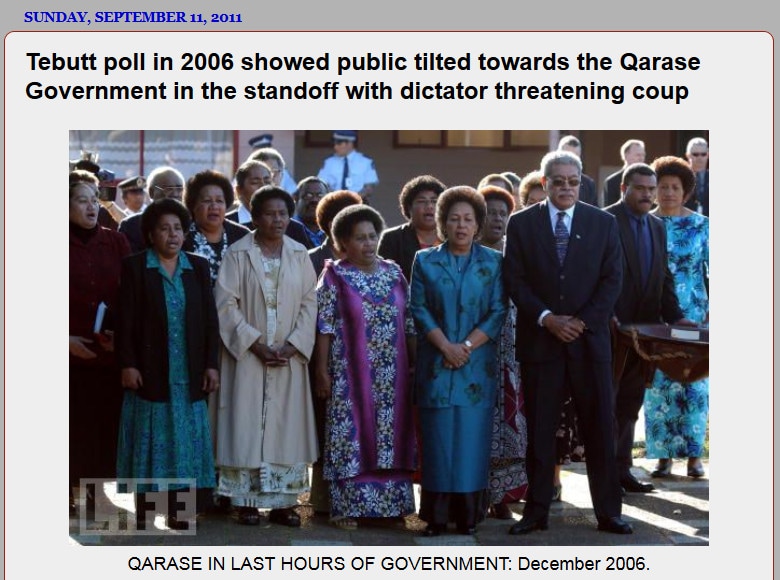
From Coupfourpointfive, 11 September 2011
Picture
Picture
The Lowry Institute in Australia, which has released the opinion poll results, said the result is the voice of the people of Fiji. The Institute’s Jenny Heyward-Jones says that while some may not like what they see in the results, the poll was conducted in an independent manner to find out what the people of Fiji think.
 
The poll report stated that Bainimarama has good support from 66% of the people polled, and 65% of the people believe Fiji is heading in the right direction. An overwhelming 95% of people support the right to vote in a free election, and around half of the people feel the government is doing a good job making progress to elections. 83% of the people surveyed believe Fiji should be left alone to sort out its return to democracy, and sanctions against the country should be lifted. 96% said the right to a media free from censorship is important to them.

 
The opinion poll had surveyed 1,032 people.

 
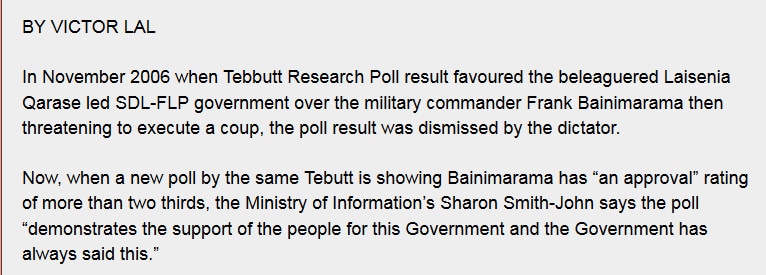
What did the Tebbutt Poll tell dictator Bainimarama in 2006

On 17 November 2006, at the height of a dangerous standoff between army commander Bainimarama and the Qarase led multi-party government, Tebbutt was commissioned, in part, by the Fiji Times to gauge public opinion in Fiji. Polling took place via personal interviews across Fiji between 14 and15 November, with a sample of 1018 adults. 

 
Here are some of the questions and answers:

“Who do you believe is in the right in the current standoff between the Military and the Government?”

The overall results showed 45% favouring the Government; 36% the Military; 6% both; 4% neither; others unsure.  By ethnic group, 67% of Fijians favoured the Government and only 18% favoured the Military; 54% of Indo-Fijians favoured the Military and only 24% favoured the Government.  By region, the Suva area was pretty evenly split: 42% Government; 38% Military.  In the West, the split was 51% Government; 31% Military.

PM Laisenia Qarase had strong Fijian backing; Bainimarama did not in the poll.

 
The poll also asked how good a job leaders were doing. Overall, PM Qarase had 57% approval and 23% disapproval.  He received 81% support from Fijians, with only 5% disapproving; Indo-Fijians showed 40% disapproval, with 34% approval. 

 
Overall, Bainimarama had 51% approval and 31% disapproval. He received only 30% approval from Fijians, with 53% disapproving; Indo-Fijians showed 71% approval and only 12% disapproval. 

 
Police Commissioner Andrew Hughes had public backing

Despite the dictator screaming for the resignation of Australian, Andrew Hughes (right), the Police Commissioner, Hughes received 79% approval and 7% disapproval, with all segments overwhelmingly positive. As we know, Bainimarama wanted Hughes out of Fiji because the Police Commissioner was pressing for various investigations into the dictator’s conduct since the 2000 mutiny, deaths and murders etc.


Chaudhry and Beddoes showed strong approval rating

The then Leader of Opposition Mick Beddoes also had strong figures, with overall 56% approval and 12% disapproval.  FLP leader Mahendra Chaudhry had 42% approval and 27% disapproval.  As expected, Chaudhry was favored by a majority of Indo-Fijians, but by only 30% of Fijians.

 
The Tebbutt Poll results reconfirmed the election results from May 2006: that a large majority of Fijians backed the SDL-FLP Qarase Government. 

 
The very high approval rating for Police Commissioner Hughes was another signal to Bainimarama that at least the demand for Hughes to resign was going against the public will. The only way Bainimarama could stop various criminal charges against him was to ignore the Tebbutt Poll results, and execute a coup on 5 December 2006 to save his skin.

 
How should one read the two Tebbutt Opinion Polls? One was conducted in a democracy and the recent one in a dictatorship.

Picture
Caz Tebbutt (middle) and the polls
Polls Apart

Raw Fiji News - 14 September 2011


BY VICTOR LAL AND RUSSELL HUNTER

We’ll leave the methodology argument on the Lowry poll to Dr Wadan Narsey and others who are qualified to comment. But there’s another angle to this that has been overlooked. Consider this. If in the unlikely event that Ms Jenny Hayward-Jones, Program Director of the Myer Foundation Melanesia Program at the Lowry Institute, got her declared wish that the poll found the people of Fiji resolutely (or even slightly) opposed to the illegal regime, what then? It would not have been published – anywhere.

The military would have seen to that.
And Caz Tebbutt’s business would have been targeted. Her clients would have been “counselled”, her researchers pressured to reveal, wherever possible, the identities of those who spoke against the regime. These people would have been “counselled” also. And in Frank’s Fiji we all know what that would entail. But for Ms Hayward-Jones’s and the Lowry Institute’s information there would have been beatings at the very least.

There could have been but one outcome for this poll and that alone makes it unreliable. But take into account the pervasive atmosphere of fear that exists in Fiji and it becomes impossible to conduct a meaningful poll of opinion there. Indeed, as other commentators have suggested, it’s surprising that even a few people expressed dissent. Caz has a business to run, people to employ.

And perhaps for those reasons among others she has been a public supporter of the illegal dictatorship.

She’s of course entitled to hold that opinion.
We do not suggest that this poll was rigged. There’s no evidence to support any such allegation and we do not believe that Caz would be party to such a device. But she didn’t have to be for the reason stated above.

When the Tebbutt-Times poll was still operating, Caz several times declined to conduct a poll on contentious issues, fearing that the powers that be would shoot the messenger. In hindsight she was probably right. She would have done better to adopt the same approach with this one.

Disclosure: Russell Hunter was editor-in-chief of the Fiji Times from 1997 to 2003 and was intimately involved in the planning of the Tebbutt-Times polls.
7 Comments

GANGING UP on Supervisor of Elections Saneem and Attorney-General Khaiyum is just leaking HOT AIR; VOTERS are still waiting for EVIDENCE from the parties who claimed that the 2014 election was rigged by FFP

17/2/2017

5 Comments


Fijileaks: We would like to see a statement declaring that if Saneem does not step down as Election Supervisor
and Khaiyum as Election Minister,
"WE WILL BOYCOTT THE ELECTION"; Sitiveni Rabuka is the last person to lecture us on elections and democracy

One of the signatories to the joint statement, Lynda Tabuya, president, Peoples Democratic Party (PDP) is rumoured to be crossing over to SODELPA

OPPOSITION PARTIES’ JOINT STATEMENT ON ELECTIONS SUPERVISOR AND AMENDMENTS TO THE ELECTORAL DECREE

17 February 2017

The Leaders of the Social Democratic Liberal Party, National Federation Party, Fiji Labour Party, the Peoples’ Democratic Party and the Fiji United Freedom Party issued this joint statement today

In a joint statement issued following a meeting on Thursday 16th February, the leaders of the five Opposition Parties called for the removal of the Supervisor of Elections and the scrapping  of the elections portfolio assigned to the Attorney General.

“Free and fair elections are not possible in a situation where the ruling Fiji First Party is exercising extraordinary control over the electoral machinery and the electoral process,” the leaders said.

Supervisor of Elections

The Leaders said Mohammed Saneem’s initial appointment in 2013 had been questioned as he did not meet the minimum qualifications required for the position, as advertised.

The previous Electoral Commission has drawn attention to the impropriety of his appointment in its Annual Report for 2014 (para 3.1) in which it pointed out that Saneem’s name was submitted by the Attorney General Aiyaz Sayed-Khaiyum after he had informed the Commission  “that overseas applicants who had applied for the position were either not suitable or were not available due to the passage of time.  

“However, the Commissioners expressed some reservations in the manner the position of Supervisor of Elections had been allowed to protract for such a long period since applications for the position had been advertised in 2013”.

The Commission then suggested to the Attorney General that the position be re-advertised. This was not done and Saneem was appointed despite the Commission’s reservation.

Hence the Electoral Commissioners appeared to have no choice but to accept the recommendation of the Attorney General as the Minister for Election for Saneem to be appointed as Supervisor of Elections.  

Subsequent rulings by the Supervisor particularly in relation to the eligibility of political party candidates nominated for the 2014 election showed his clear bias towards the Fiji First Party. He made decisions knowing that they were wrong and then defied the rulings of the Electoral Commission on a mere technicality.  
 
The recent Appeals Court ruling has only confirmed Mr. Saneem’s unsuitability for this important constitutional office. The Leaders said that it is unprecedented for a Supervisor to boldly defy the Electoral Commission.

2017 Amendment to Electoral Decree

The Leaders also objected to the recent amendment to the Electoral Decree which was fast tracked through Parliament last week, appointing the Supervisor of Elections as secretary to the Electoral Commission.

The amendments also prescribe powers to the Supervisor to overturn the results of the count of a ballot box by a Presiding Officer and to do a recount. The amendments also impose limitations and impediments on the Electoral Commission in the conduct of its constitutionally mandated work.

“The amendment compromises the Electoral Commission which is the appeals body from the decisions of the Supervisor and is a subversion of the independence of both the Supervisor and the Commission which are two separate bodies with separate constitutional functions.

“It was aimed at ensuring the newly appointed Electoral Commission remained subservient to the recently disgraced Supervisor of Elections,” the Leaders said.  

The current situation has the Fiji First General Secretary actually controlling and commandeering the process and making the rules as we move towards the next general elections.

The rushed amendment also subverts the parliamentary process and interferes with the work of the Parliamentary Standing Committee on Law and Justice which is still reviewing the report of the Multinational Observer Group (MOG) on the 2014 Elections. The Leader’s maintain that the bill should not have come to the House until the report of the Standing Committee on the same issue was tabled.

The MOG report includes recommendations for improvement of the electoral processes, laws and procedures, which many political parties agree with. The Attorney General has cherry picked and decided to implement only three of the thirty-eight MOG recommendations in the recent fast-tracked amendment to the Electoral Decree.
Minister for Elections

In calling for the Elections ministerial portfolio to be scrapped, the Leaders said:

“The portfolio has been held by Attorney General Aiyaz Khaiyum since 2008. It is wrong in principle for the General Secretary of the ruling party to hold the elections portfolio at the same time as being Attorney General drafting laws and changing the rules for elections in which he will participate.

“The current situation allows the Fiji First General Secretary to actually control the process and make the rules as we move towards the next general elections, a serious conflict of interest that the Prime Minister must remedy to assure the people of Fiji that their right to vote in free and fair elections is not being compromised by the Attorney General controlling the electoral process.

“Free and fair elections require that all political parties operate on the same level playing field, and have access to information about the upcoming elections at the same time.  

“Both the Supervisor of Elections and the Electoral Commission are constitutional offices and as such, should be independent of the executive arm. Besides, both the Prime Minister and the Attorney General hold office in their political party and will likely contest the next elections.”

The Leaders pointed out that in the past there was no ministerial portfolio for elections.  For  necessary administrative accountability, the Prime Minister only tabled the Elections Office submissions for budgetary allocations. The PM’s administrative responsibility ended there. He did not exercise control over the elections office or advise the Electoral Commission, or otherwise interfere with its operations.  

The Leaders also rejected several provisions of the Electoral and Voter Registration Decrees promulgated unilaterally by the Bainimarama administration in March 2014 just 6 months before the elections.

These matters will be pursued and more concrete actions deliberated on by the Party Leaders in the coming weeks.  

Authorised by:      
         
  • Social Democratic Liberal Party (SODELPA) Party Leader Major General (Ret’d) S.L. Rabuka
  • Fiji Labour Party (FLP) Leader Mr. Mahendra P Chaudhry
  • National Federation Party (NFP) Leader Dr. Biman Prasad
  • Peoples Democratic Party (PDP) Party President Ms. Lynda Tabuya
  • Fiji United Freedom Party (FUFP) Party Leader Mr. Jagath Karunaratne
5 Comments

THE ARC OF JUSTICE HAS NOT BENT TOWARDS Fiji Times general manager and publisher: Fiji Appeal Court declines to grant Hank Arts leave to travel to New Zealand to give his step-daughter away at the altarĀ 

17/2/2017

8 Comments

 
Picture
Court of Appeal: Arts' security undertaking offers no comfort

FIJI Times general manager and publisher Hank Arts will not be able to give his daughter away at the altar tomorrow after the Court of Appeal dismissed his application for leave to appeal the High Court's decision in refusing an application for a variation of bail conditions.

Arts had applied for variation of bail conditions in the Suva Magistrates Court on August 31 last year to allow him to travel to New Zealand for a medical review between October 20-30 last year, and between February 15 and March 15 this year to attend his step-daughter's wedding.

That was refused.

He further applied to the High Court last October for the same two purposes, which was also refused.

Arts then appealed to the Court of Appeal after his dissatisfaction with that decision.

In his Notice of Appeal filed on February 9, he appealed on the grounds that:

-          The learned judge wrongly put the burden on Arts to prove that he would return to Fiji instead of requiring the State to establish that he would not return;
-          The learned judge wrongly found the security offered by Arts to ensure his return to Fiji was insufficient;
-          The learned judge failed to give any consideration that Arts had proposed two sureties who were prepared to stay in Fiji during his absence overseas, and abide by any conditions that the court would deem fit to impose to ensure his return to Fiji;
-          The learned judge misinterpreted Dr Ivan Connell's (Arts' doctor) opinion by holding that Arts' medical review was not imperative and essential; and
-          Arts reserved the right to raise further grounds of appeal at the hearing of this application.

In their ruling today, the three-member bench led by Justice William Calanchini, observed that neither reason for seeking a bail variation to enable Arts' travel to New Zealand could be described as "necessary or pressing".

Justice Calanchini said there was no material before either the High Court or the Court of Appeal to indicate the purposes of the medical review could not be performed by appropriate medical practitioners in Fiji once a copy of Arts' file or a report had been provided by Dr Connell on Arts' authorisation.

"As the learned High Court judge has concluded, the appellant's personal circumstances are such that the risk of not returning to Fiji and hence the object of the bail condition being frustrated is considerable and cannot be outweighed by the security undertakings to which reference has been made in the appellant's submission," Justice Calanchini said.

Arts, 68, and has been the general manager and publisher for Fiji Times for the past five years, owns two leases over iTaukei land at Vuda and Lami.

The Vuda property is valued at $2million and $728,000 for the Lami property.

The court noted that Arts did not own freehold land and that the two leasehold properties appeared to be his only assets.

"It does appear that under the provisions of the iTaukei Land Act Cap 133 and the Transfer of Land Act Cap 131, there are issues as to the effectiveness of those two properties being offered as security undertaking."
The court noted Arts was a New Zealand citizen and his right to remain there indefinitely could not be ignored.
 
The court also noted his family ties there and that his wife and almost all his family were presently in NZ for the wedding.

"It is not difficult to conclude that the risk of not returning to Fiji and surrendering himself into custody and appearing in court when next called to do so outweighs the desire on the part of the appellant to attend to his step-daughter's wedding.

"Furthermore, neither the sureties nor the security undertakings in this case provide the comfort that is necessary to vary the bail conditions and allow the appellant to travel to New Zealand."

Justice Calanchini said Arts had not demonstrated any error in the exercise of the learned judge's discretion and there was no material before the Court of Appeal that would require the Court to disturb the decision of the court below.

The trial proper will begin next month. Source: The Fiji Times, 17 February 2017

In their ruling, the three-member bench led by Justice William Calanchini, observed that neither reason [health review and daughter's wedding] for seeking a bail variation to enable Arts' travel to New Zealand could be described as "necessary or pressing"; The court also noted Arts' family ties there and that his wife and almost all his family were presently in NZ for the wedding. "It is not difficult to conclude that the risk of not returning to Fiji and surrendering himself into custody and appearing in court when next called to do so outweighs the desire on the part of the appellant to attend to his step-daughter's wedding." -
Justice William Calanchini, who came to Fiji to prosecute the November 2000 mutineers, and has not gone BACK to AUSTRALIA; he is now President of the Fiji Court of Appeal after his predecessor Justice Gordon Ward was booted out of Fiji following the 2006 coup

Picture
Picture
Picture
Picture

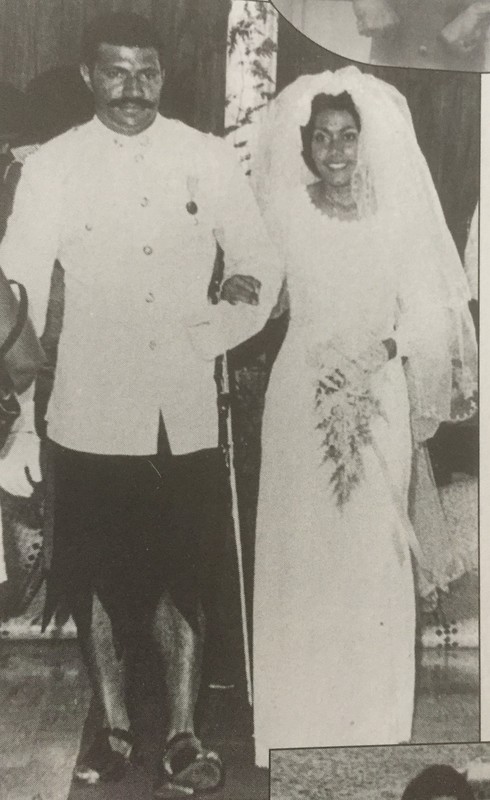
They are all hiding behind this Godfather of Coups IMMUNITY, who was boasting about his own WEDDING in the book RABUKA OF FIJI:

Picture

Fijileaks: We have stressed many times before, and repeat, that this COUPIST should renounce his IMMUNITY and face the ARC OF JUSTICE instead of leading SODELPA in the election. It is wrong to blame Aiyaz Khaiyum and Frank Bainimarama. The man who should be held to account for destroying the once proud Fijian judiciary is
SITIVENI LIGAMAMADA RABUKA:

Picture
Picture
Picture

COMING SOON: Why this coupist and criminal RABUKA should be in PRISON and not in PARLIAMENT: "In my opinion the Prime Minister's (Rabuka) action as regard the events leading up to the execution of the Deed (the Stephens Affair) were not only improper but prima facie illegal"- Justice Sir Ronald Kermode, Commission of Inquiry into the Deed of Settlement dated 19.09.92  between Anthony Frederick Stephens and the Attorney-General of Fiji

http://www.fijileaks.com/home/hanking-for-arts-scalp-high-court-rejects-fiji-times-publisher-hank-arts-bail-application-for-travel-to-new-zealand-for-wedding-and-medical-check-up-and-yet-fbc-ceo-and-announcer-remain-free-for-racial-jibes

8 Comments

Fijileaks: It is time Aiyaz Khaiyum hung his "Toppi" - HAT - as Minister for Elections, and passed a law that NO sitting Parliamentarian should be remotely involved in conducting 2018 and future elections - a Fiji FIRST!

16/2/2017

8 Comments


One of the new Electoral Commission members confided to Fijileaks that he had no choice but to say YES to Khaiyum when he [Khaiyum] phoned him and offered him the position on the Commission; he feared retaliation if he had snubbed the offer

Picture

Coming soon: The Kermode Report and Rabuka-Stephens Affair, and why this "Bandit" Rabuka, who is hiding behind IMMUNITY, should be held to account; in 1987, the late Judge Ghananand Mishra said:
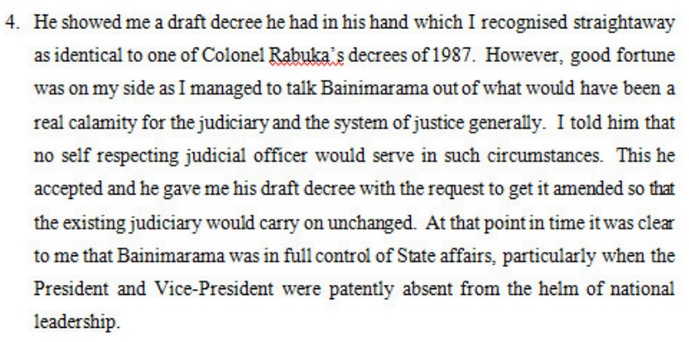
"I will not serve under those bandits"; he resigned from the High Court;
also how SODELPA MP and prominent chief obtained a piece of LAND from one of his subjects and is now on the Public Accounts Committee

Picture

Fijileaks: Our founding Editor-in-Chief VICTOR LAL is weighing your requests for him to resume analysis and commentary on topics of interests as he did for nearly thirty years in the Daily Post and Fiji Sun

Picture
Picture
February 16, 2017
MEDIA RELEASE

 
Response to the Attorney General on the role of Minister for Elections
 
The Attorney General and Minister for Elections is himself again misinforming the people on this issue. There has NEVER BEEN anything like him in any previous government.
 
The Attorney General cannot run away from the fact that he is the Minister for Elections, and the General Secretary and Registered Officer (one who deals directly on behalf of his party with the Elections Office), for the Fiji First Party. This is what is really unprecedented. The AG’s feeble claim that previous Prime Minister’s were Election Ministers, and therefore his holding of the portfolio is not wrong, is baseless desperation.
 
No other Minister for Elections ever interfered with the Electoral process like the Attorney General. His authority was requested by the previous Electoral Commission to seek independent legal advice. The Commission in its 2014 Annual Report states the Minister for Elections (AG) did not respond to their repeated requests, as evident from the Commission’s Report provided below:
 
Only last week (9th February) in Parliament the Attorney General imputed improper motives against the former Chairman of the Electoral Commission during the debate on the Electoral Bill. He cast aspersions on the former Chairman’s professional judgment when the former Chairman was not there to defend himself.
 
The AG said in Parliament:
“...it is completely unprecedented for the Electoral Commission to not get a legal opinion, should they require legal opinion form the Solicitor-General.
 
The Solicitor-General is also an independent office now appointed by the Judicial Services Commission, which is an independent body to get legal opinion. Instead the former Chairman of the Electoral Commission went and brought a legal opinion from outside and from someone who he has done a lot of work with and continues to do so.”
 
This is yet another example of the AG riding roughshod over people as a publicly compromised Elections Minister, while he concurrently wears the hat of General Secretary and Registered Officer of Fiji First.
 
More importantly, never has there been a Minister for Elections legally empowered by Decrees in their capacity as party leaders. This Minister is required to deal with the Elections Office frequently in his capacity as Registered Officer and General Secretary under both the Political Parties (Registration, Conduct, Funding and Disclosures) Decree and the Electoral Decree.
 
Therefore this is a clear conflict of interest.
 
a) Dedicated portfolio title as “Minister of Elections.”

Only the Fiji First Government has decided that it will give a portfolio or a title as “Minister of Elections” to a Cabinet Minister. Additionally this Cabinet Minister is holding the operational position of General Secretary of Fiji First Party dealing with the day-to-day functions of his party. 
Other Prime Ministers had the Elections Office and other constitutional offices (such as Parliament) under its administrative wing for purely administrative purposes like budget allocation where it is listed separately, but under the umbrella of the PM’s Office.
 
b) Public Commentaries and Opposing the independent Electoral Commission in seeking independent legal counsel in the midst of an election
The Attorney General and Minister for Elections even went to the extent of publicly opposing the independent right of the Electoral Commission to seek its own independent counsel.
 
The AG said “it is really a pity that the Electoral Commission didn’t see it fit to get an opinion from the Solicitor-General.”[1]
 
That was the most inappropriate remark to be made in the midst of Fiji’s 2014 General Elections. He, as Minster for Elections, while wearing the hat of Attorney-General (and as General Secretary and Registered Officer of Fiji First) basically urged that the Electoral Commission should have sought the advice of his own official lawyer -- the Solicitor-General -- on a dispute that involved the political parties. And that initial case in the High Court, which ruled in favour of the Supervisor, benefitted his own political party – Fiji First -- in the final candidate list.
 
If the Attorney General and Minister for Elections was not trying to interfere in the work of the Electoral Commission through the media, then what exactly was he trying to prove at that critical time?
 
c) Prescriptive Amendments to the Electoral Amendment Bill.
The manner in which last week’s electoral amendments were rushed through Parliament, the timing of these amendments and the substance of them left much to be desired.  The NFP spoke at length on them in Parliament.
 
An important aspect is that these amendments were presented to Parliament at a time when a new Electoral Commission had just been appointed.
 
Where was the former Electoral Commission in driving these amendments? Who and which body was heavily involved in drafting these amendments and what manner of data were the amendments based on?
 
It is the Electoral Commission alone that is constitutionally mandated for the registration of voters and the conduct of free and fair elections (Sec 75 (2)), but it appears that there was a vacuum in place when these amendments were conducted and sought.
 
For the sake of a free and fair election next year and the integrity of the process, the NFP calls on Mr Aiyaz Sayed-Khaiyum to stand down from this portfolio. We also call again on the Prime Minister to take over the portfolio of Minister for Elections and ensure that his Government gives the Fiji Electoral Commission, the latitude and independence it deserves which is constitutionally enshrined.
 
Authorised by:
 
Professor Biman Prasad
NFP Leader

[1]
http://pacific.scoop.co.nz/2014/08/fiji-elections-list-dispute-could-have-been-solved-without-courts-says-minister/


8 Comments

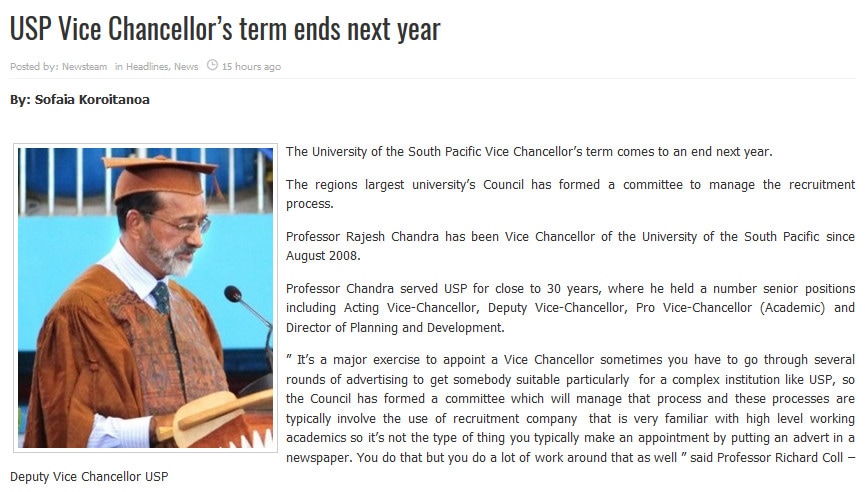
NO PRIZE FOR GUESSING: Vice-Chancellor Rajesh Chandra comes out of cold to welcome his USP staff members - damage limitation message

16/2/2017

11 Comments

 
Picture
Welcome Message to Staff from the Vice-Chancellor and President

I wish to welcome all of you warmly back to the University for yet another crucial year. To all those who have joined us for the first time, a very warm welcome to our unique and wonderful university. I hope that you are, as I am, starting the new year refreshed and determined to carry out your work with increased vigour  and in particular to complete Strategic Plan implementation on schedule.  

In 2016, we achieved many things, but much remains to be done and we have two years remaining in the SP to accomplish that.     It is worth reflecting on the fact that a decade ago USP was in a dire financial situation; no one would have imagined then that, just ten  years later, we would have had operating surpluses every year; secured a US$ 19 million soft loan from ADB to develop the Regional Campuses (with Kiribati Campus already done and Solomon Islands campus on track); attained accreditation for 18 programmes and have the accreditation process underway with WSCUS; offer dozens of highly-regarded professional and technical education programmes in addition to Higher Education,  introduced new programmes;  exercise a clear regional ICT leadership role, to name just a few of our many accomplishments.

The reputation of the University nationally, regionally and internationally has gone up beyond our expectations—and your contributions have been crucial in this. We have worked as a team to bring USP from a precarious financial situation with low staff morale ten years ago to being on the cusp of attaining excellence.  We have proven that, with determination and diligence, and working together cohesively, we are capable of great things and I am confident that we will be outstanding in many, if not all, areas of our operations by our 50th anniversary in 2018.   Let me thank you for all your hard work during 2016.  We have a lot to be proud of, and today we have an institution that is markedly more flexible, resilient, and innovative than ever before.  We started 2016 with tropical cyclones that devastated Fiji and Samoa.  USP staff and students responded by coming together with an outpouring of charity.  USP staff worked to keep all of the University’s own students on track as well as provided support to affected secondary school students.    We ended last year with very large and joyful graduation ceremonies that celebrated larger number and more diverse graduates than ever before.  

We are on track to again increase enrolments this year, and are ready to provide them with high quality education in all our Campuses.  Markedly improved student support services, particularly for students with disabilities, will ensure that those enrolments are successful and complete their programmes on time at USP.    Our student experience, characterized by talented academics, inspiring research, plentiful opportunities for debate and enrichment, access to multicultural activities and friendly sporting and cultural events, is one of USP’s best points, and that student experience is shaped by you, the USP staff.  I am so grateful that USP staff members are committed to offering students the very best educational experience and value for money.  Our Member Countries and their citizens and our development partners count on this commitment that we will always strive to do better.   

The Year Ahead Continuous improvement is one of USP’s core values, so let us all start 2017 thinking about how we can be more effective, efficient and sustainable. We will measure our results at the end of the year based on how much progress we record against our goal of achieving excellence by 2018.   In some areas, this will be challenging, which is why I am asking Priority Area Leaders  to assist one another and to give special attention to functional areas such as Human Resources, which began our Strategic Plan 2013- 2018 period with larger challenges to overcome.  The overhaul of Properties and Facilities started in 2016 to deliver better results in a more efficient manner. We need to ensure that this is fully accomplished.  All service areas need to improve their service delivery to students, staff and to other stakeholders.   All staff have been provided with the resources that they need to deliver on Strategic Plan objectives. 

I look forward to each member of the Senior Management Team to exercising full leadership in their respective priority areas. Delegating is highly important, and I expect all staff to share their workloads wisely so that we can all achieve more while maintaining our commitment to providing the best possible student experience.  I am counting on staff to support their managers, those staff that report to them, and to their colleagues in other sections.  We are a team, and must work as such.   We are engaged in a fundamental re-engineering of our systems in finance, human resources, IT and Student Services to make them more effective, efficient, less bureaucratic, more intelligent, and comparable to best universities in the world. There is digital disruption everywhere globally on an unprecedented scale. We at USP need to harness the power of digitization and artificial intelligence as an intelligent, knowledge institution. As we make progress in these areas—and we need to speed up this work—we will see a smarter, more friendly, user-centred USP.    

Last year’s workshop on risk management felt overwhelmingly that we need to strengthen our culture of prompt, honest and constructive feedback and hold people accountable for their actions and inactions. I wish to ask and require each supervisor/manager/director and SMT to strengthen the culture of accountability. This will be taken into account in their performance management given the centrality of a results and accountability driven culture that is so vital to our achievement of excellence.  

There are numerous events slated for 2017 that will bring international attention to the University and, again, our teamwork will be called in to play.  We expect to assist Fiji, our CROP partners and our member governments in the “2017:  Year of the Pacific Ocean” which will be launched at the UN in June.  We will continue to provide leadership in the areas of ICT, Climate Change, and Pacific Studies.  We must take care to extract maximum leverage from all of our interactions with external parties, and to be highly proactive and professional at all times.  Opportunities to advance our own work or the work of the University for its Region should be promptly identified and raised with managers; if we are always thinking creatively and ambitiously, we will achieve greater things at a much faster rate.      

For example, we must record more meaningful improvements in the area of Human Resources this year.   Systems will be strengthened and HR service delivery, especially in terms of recruitment and responsiveness, should improve.  It is important to me that USP staff are happy and feel valued and incentivised to perform at their best.    Our journey toward WSCUC accreditation continues; whilst this is a long process, it is helpful, and in some areas essential, for our reputation, quality control, linkages with international institutions, and international student and staff recruitment.  Accreditation is a major focus for 2017.    

I will ask more frequently for evidence that progress is being made on accreditation, and I hope to receive regular updates on how the quality of teaching and of research is being improved.  Quality will continue to be
one of USP’s points of distinction; we must have objective evidence of both our quality and our impact in and for the region.    

I thank you sincerely for all that you are doing to make USP the region’s best university.  I hope that I can soon thank you for shaping USP into one of the world’s best universities.  I believe in thinking big and striving, rather than setting easily achievable goals and accomplishing them easily just to “look good”.  Our region deserves and needs the best education and research to adapt to Climate Change and literally stay afloat in our highly-competitive globalized world.    We are facing formidable challenges as we near the end of the current Strategic Plan. As we take inspiration from USP’s mission statement, we must look at our own work and ask whether it is the best, or all, that we can do.  If, as individual staff members, we can do more or better, I hope that we will resolve to deliver.   

I also hope that cooperation will be the order of the day, as by working together, we will meet our objectives much faster and uncover greater efficiencies.  Please share your ideas as to how we can all do better with your supervisors, and if you feel that you need greater support to meet your goals, also share that.  We can think creatively to solve any challenges and in particular celebrating our success in 2018-year of our 50th Anniversary and working towards development of a dynamic and forward looking  Strategic Plan beyond for the period 2019-2024.  

I am anticipating another very successful year for USP, and look forward to your role in helping to achieve our Strategic Plan goals.  We have a lot to be proud of already but we have to deliver more. Let us ensure that we deliver outstanding results for our stakeholders again in 2017 and beyond.   

Best wishes to you and your families in 2017.  

Professor Rajesh Chandra Vice-Chancellor and President The University of the South Pacific
Headquarters and Laucala Campus
Suva REPUBLIC OF FIJI

Picture
11 Comments

USPGATE: 'It is [claimed] in certain circles that the VCP has spent over $200,000 renovating his own residence over last two years...During the Cyclone Winston his house had light while the USP was in pitch dark"

16/2/2017

1 Comment

 
PicturePatel
COMING SOON:
IT IS TIME TO DRAIN THE SWAMP AT USP AND MAKE USP GREAT AGAIN

Professor Rajesh Chandra's hatchet man - Professor ARVIND PATEL. This man, a close aide and confidant, does all the dirty spade work for Chandra. Patel is accused of lacking the moral character required for a person to hold a top administrative position. He is also accused of misappropriate behaviour with his students and uses abusive language while talking to staff/students.  Furthermore, as per USP rule, staff owning property in Suva are not allowed to stay on campus. Patel owns property all over Suva, including in areas which are at walking distance from USP. In spite of that he stays on campus. He is the Head of Accounting and Finance at USP. He is also currently a member on the USP Council. He is accused of shielding Professor Rajesh Chandra. We will be publishing more on Patel with documents

Also, coming soon - Putting the Knife Into Chand: How
Rajesh Chandra and Education Minister Mahendra Reddy allegedly conspired at the Tiri Restaurant to get rid of Dr Ganesh Chand as Vice Chancellor of the Fiji National University, and for what reasons!


"It is a fact though, that the VC’s residence was brightly lit by generator during and after devastating Tropical Cyclone Winston, presumably while neither he nor his family were even in the country. In contrast, the rest of the campus was pitch-dark. There is nothing legally wrong with either one of these instances. However, leadership is about perceptions and messages. What kind of message did this very well lit house surrounded by complete darkness send to the students, staff and the public during this devastating storm and its aftermath? Meanwhile students did not even have access to food or water due to the imposed curfew, till the VPA made arrangements for it with his own personal funds and initiative. What effect did this have on the morale of the students, faculty, and staff who were within sight and earshot of the residence? Social media posts during the period are quite telling. Are these USP values? When a public university leader shows such extravagance and disregard for other people’s feelings, it puts into question the University’s commitment to its staff and students. University leaders should be seen as embodiment of self-sacrifice, not self-benefit."

Picture

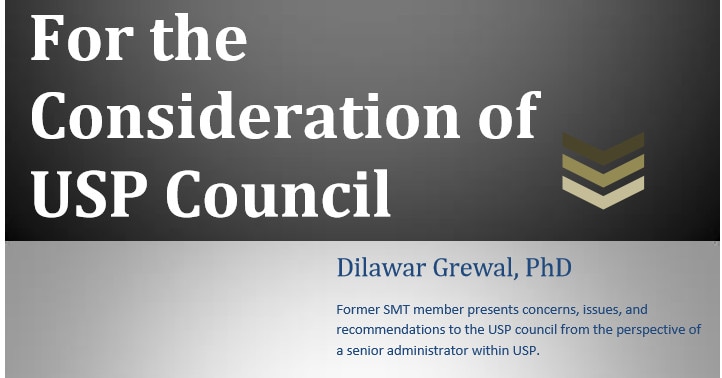
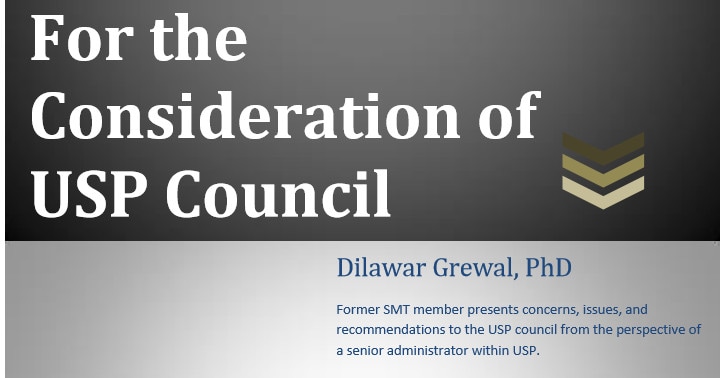
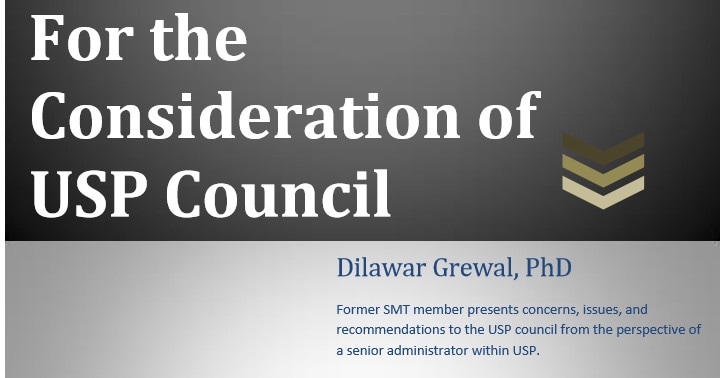
"This document is written with the intent to present specific problems to the Council to consider and remediate. This document is not written with the intent to disparage the University, the VCP, other leaders or anyone else at USP.  It would be counter-productive to either disregard everything in this document by labelling it as musings of an ex-employee or blaming the VCP for everything. It would be prudent for Council to dig deeper and determine for itself the facts and what it wants to do about them as the governing body because the stakes are very high when you consider how lives and futures are affected.  Council, of course, is free to seek additional information, specifics, or discard any and all of the issues presented in this document." - Dr Dilawar Grewal

PictureLifted the rottenness at USP
Special responsibilities of leaders

A. Impact on USP Culture and Atmosphere

The words and actions of any leader of USP have a profound impact on people, as everyone reads meaning into these actions and words. These affect the morale of staff, how they start acting, what they find acceptable, the dynamic between staff, and even retention and recruitment of new staff.

i. Culture of Fear and Silence – There is a significant increase in self-imposed censorship at this seat of learning called USP. People read a message in removal of senior people at the University and the revolving door positions. They read a message when conditions of your continued employment at USP include who you can and cannot talk to. People get afraid. They stop talking.

The culture of USP is changing, and not for the better. The messages people are receiving, whether deliberately intended or otherwise, are a major contributor to this culture change. Loss of trust, loss of comfort, and perception of unknown restrictions or threats at personal and professional levels can only result in the deterioration of the quality of staff, the reputation of the university, and its potential to hire well qualified and hard to recruit staff.

ii. Culture of Favoritism – Look at the minutes of the Senate, Council meetings, even USP Beats, and public speeches given during, say, Open Day etc., and you will find that at USP repeatedly one or two people and departments are highlighted for credit, even when clearly the credit must be shared with others or even belong to others. Contributions and accomplishments of others may be diminished or absolutely ignored for acknowledgement citing it is not about personal accolades in the Pacific. In the least, this creates a perception of favoritism and privileged few.

iii. Censorship of academic freedoms, stifling and disregarding of differing opinions, emphasizes position authority to ensure compliance to personal agendas, not institutional positions - What is the quality of USP administration work environment when the following words are heard from one of the leaders:

“No more discussion, the **** (insert the name of the position that person holds) has spoken.” Or “I am friends with the Director of Immigration. You don’t know the Pacific. I can get any expat deported overnight.” The first example has been heard in more than one meeting and the second is a paraphrase of something said at a specific meeting on May 24th, 2016 by one of the leaders of USP.  Any person holding a leadership position at the University, is just that – a leader; not the owner of USP or its staff. At leadership levels the combined voices of colleagues and peers is in some cases more important and valuable than that of a single leader.  What does it say when one refers to themselves in third person to shut up any discourse with colleagues? Is this acceptable to USP? This affects USP’s reputation when enough people have witnessed it. 

iv. Suitcase staff/expendable expats – International competition is hard on USP. Recruiting is tough, yet USP is hardly doing anything to support long term stays of expat staff or supporting their families to retain staff for longer periods. In fact, the constant threats by administration create an environment where people are not certain how long their job will last, so they do not feel comfortable bringing their families here. The everything-in-a suitcase, expendable-expat expectation is the message people are receiving regarding USP job offers and treatment.

This is significantly detrimental to USP reputation and ability to hire accomplished staff on a long term basis. USP needs expat staff more than expat staff need USP. Leaders at USP should be projecting the image of USP as a welcoming place, rather than a two year stint between jobs for qualified people. Leaders should also follow through on the commitments they make when hiring expat staff, or any staff for that matter, and not make offers that they have no intention of fulfilling. A single well placed article in, say, the Chronicles of Higher Education, on the experience of expats at USP could have a profound effect on whether expats prefer to come to USP or avoid USP for employment. Honor is still a valuable commodity in the world, especially for educational institutions.
 
Another issue with hiring expats from the view point of expendable people on a two year cycle is that the University will become limited to hiring only people who have either already retired from elsewhere or are in transition and not willing to bring their families with them. Short term stay staff affect stability and performance of programs. The University needs long term leaders of programs, research initiatives and development areas. The University also needs younger leaders for their energy, enthusiasm and outlook. Retired personnel bring experience and contacts, but their priorities in life are different at that stage of their lives. Post retirement employment is not the same as mid-life career moves.

v. Leadership issue specifically with the current VCP – It is mentioned in certain circles that the VCP has spent over $200,000 renovating his own residence over the last two years.  Not a word was spoken about this, while the focus was maintained on the renovation of the accommodation for the VPA instead, which was a contractual obligation that was fulfilled for less than 30 days at the end of a two year period. Whether the talk about the amount spent on the VC residence is true or not or even matters is something for Council to look at. It is a fact though, that the VC’s residence was brightly lit by generator during and after devastating Tropical Cyclone Winston, presumably while neither he nor his family were even in the country. In contrast, the rest of the campus was pitch-dark.

There is nothing legally wrong with either one of these instances. However, leadership is about perceptions and messages. What kind of message did this very well lit house surrounded by complete darkness send to the students, staff and the public during this devastating storm and its aftermath? Meanwhile students did not even have access to food or water due to the imposed curfew, till the VPA made arrangements for it with his own personal funds and initiative. What effect did this have on the morale of the students, faculty, and staff who were within sight and earshot of the residence? Social media posts during the period are quite telling. Are these USP values? When a public university leader shows such extravagance and disregard for other people’s feelings, it puts into question the University’s commitment to its staff and students. University leaders should be seen as embodiment of self-sacrifice, not self-benefit.

vi. Relationships with the staff unions, especially USPSU, have been very tenuous for years. Why? How did it get better and why is it going downhill again? These questions are important and have implications for the University.

B. Impact on USP Reputation. 

Things that significantly affect the reputation of the University that Council needs to be aware of:

i. Withholding or delaying payments to vendors and staff - Finance reports to the VCP through the EDF.

There is a long list of vendors and people who have not been paid for very significant lengths of time, even in violation of contracts and the law sometimes. On whose instructions does this happen? Even if no direct instructions were issued, who is responsible when it affects the reputation of the University? USP is not above the laws of the country. USP is a member of the Fiji Commerce and Employers Federation, and as such has pledged to uphold the ILO principles to eliminate forced and compulsory labor. 

And yet, there are numerous examples of USP not paying staff their final pay in a timely fashion as directed by law, payment of repatriation costs, consultant bills etc.; all of which have a direct negative effect on the reputation of USP. An extreme interpretation of the University not paying staff their contractually required passage home on time is that it is a direct violation of Fiji’s Immigration law and could even border on being considered as human trafficking. 

In any case, it is bad business practice and in some cases violation of law. Specific examples can be provided upon request or in consultations.

ii. Revolving door for senior most positions – Following is a list of senior staff that have left USP in the near past. 

a. Munish Malik – Director Finance
b. Susan Kelly – DVC LTSS
c. John Bythell – DVC Research
d. Dilawar Grewal – Vice President Administration
e. Noel Lawlor – Director of Risk and Compliance
f. Heather Stadel – Director HR
g. Franco Gandalfi – Dean FBE
h. Prof Biman Prasad – Dean FBE
i. Prof. Murari Lal – Director PACE-SD
j. Charles Traffey – HoS SoMPA (not a direct report to VCP)

k. Adish Naidu – Director P&F (not a direct report to VCP)

People give all sorts of reasons for leaving in order to not burn bridges with USP, but these are not people who left USP happily. There is a pattern that says something. The pattern continues even after psychometric testing was made a condition of employment of senior staff. Why such a high turnover of senior staff? Any organization would want to get to the bottom of this. It not only costs a lot to hire people at these levels, it affects productivity when positions are vacant, and the pattern sends a message to other people interested in senior positions at USP. Does USP want the reputation that it is not a stable place to work or has a very high turnover?  Do the ensuing lawsuits not damage USP’s reputation in the sector? 

iii. Future state – Given the decision to divert so much money, effort and attention to developing PTAFE in lieu of the academic and research agendas of USP, what is USP going to be known for in the future? Will it be seen as a “career builder” in Fiji and the Pacific or be recognized as an organization for its accreditation in cooking classes and demolishing the vocational studies infrastructure of Fiji?

iv. Professional Development –  Council adopted a clause that says the VCP can take two weeks of all expenses paid Professional Development every year anywhere in the world, even without invitation, and would be paid round the world business class airfares. Compare this to the FJD$6000 per contract period (once every 3-5 years) that is available to academic staff.

What is the message that USP is sending to the staff?  Vice Chancellors come to be Vice Chancellors at the top of their careers. Given the USP pleadings for more money from member countries and the laying off of tens of people in the name of saving money by outsourcing, perhaps Council should look at travel expenditures in a different light. Council might be interested in looking at the top three people on the list of travel expenses incurred by USP and ask the question what benefits have these people specifically brought USP that someone else couldn’t have.

C. Behavioral attributes of leaders
i. Self-promotion 

a. If you pick up any USP Beats magazine or look at the announcements put out for public consumption, a very telling pattern emerges.  Any gracious leader congratulates and highlights his staff. They do not claim credit for other people’s accomplishments and always proclaim and advertise his/her presence.  

b. The saying that there is no “I” in team is quite profound.  A quick search of university communications will demonstrate the paucity of “we” statements in comparison. 

c. How much of the travels of certain people are for self-promotion rather than actually bringing in either additional funds or resources to USP? d. Not sharing credit with subordinates, not bolstering subordinates in their career development, not sharing opportunities, and not mentoring people is not a mark of good supervision and leadership at any level of the University. Leaders nurture and grow institutional assets, including their most valuable asset: their people. 
 
ii. Disrespect


a. Putting down senior managers in meetings, asserting rank, and not valuing the advice of colleagues are all signs of disrespect towards people who have more than a century’s worth of experience between them.
b. Projecting that only certain people know what is best for the University is very disrespectful to others.  People do not want to make decisions when they know those could be publicly overturned without discussion or warning. 
c. Micro managing – meddling by leaders in decisions at all levels in any department creates a culture of disrespect. As an example: If the VCP takes it upon himself to tell a HoS what he/she can or cannot do, it would not only project disrespect, it would also paralyze the HoS and the Dean as functional administrators. Same logic applies to any senior manager and leader in both academic and administrative areas.  

iii. Professionalism of leaders

a. Delaying delivery of or completely withholding contractually obligated benefits from employees may or may not be illegal, but is definitely unethical and unprofessional
b. Ignoring communications and not responding to issues that may be difficult to respond to or possibly point out follies is highly unprofessional for people in leadership positions. Management and leadership is not about comfort and covering up, it is about identifying and fixing issues. 
c. Projecting other senior people as being at a lower status in front of others in meetings is absolutely unacceptable behavior of any leader
d. Bringing personal issues and conditions into professional staff assessments is highly unprofessional and unethical
e. Revising meeting minutes significantly to reflect one’s changed views and in contravention of negotiated positions is unprofessional and unethical
f. Sharing  confidential HR matters in specific details with uninvolved third parties is not only bad practice, but possibly also illegal in some countries

iv. Manipulation of facts

a. Meeting minutes are essential to recording accurately what transpired in that particular meeting. Amending of meeting minutes is limited to the purposes of correcting errors or typographical mistakes or omission of facts. These have to be agreed upon by people present at the original meeting. Amending of meeting minutes is not for the purposes of recording after the fact transition to a new set of facts as per anyone’s convenience.  The risk with this practice is that both people and departments cannot rely upon decisions taken in a meeting or on the process of negotiations within a meeting because it may all change in the next meeting when the meeting minutes are rewritten.
b. Whenever communications and information sharing is strictly controlled within management or between management and governance, accountability and efficiency take a hit. In situations like these singular points of view get projected as collective decisions and distributed leadership and expertise is sacrificed for personal positioning. It actually becomes difficult for peers and subordinates to know what the real situation is around any issue. Combine this with a blame culture and it is a perfect picture of what administrations should not be doing.
c. There is a distinct pattern in meetings with some leaders at USP. For most people accolades are few and far in between. There usually is some sort of an accusation or negative comment, not up for discussion or even substantiated, and then normal conversation. The accolades, unless they are for a handful of people, are rarely recorded in the meeting minutes, and accusations are generally recorded. The pattern is to always keep the other person on the defensive. This kind of approach does not build confidence in the “team” or even between the supervisor and reportee and is counter to best practices in management and leadership.
d. There is almost an art to deflecting responsibility at USP. First, call or tell subordinates to do something, instead of writing it down or sending an email, and have them sign-off on it in order to claim transfer of responsibility and absolving of oneself against all future liability. Whether this actually absolves one of legal obligations and liabilities is suspect at best, but it surely diminishes confidence and trust within the team and the organization.  
 
In Closing

This document is written with the intent to present specific problems to the Council to consider and remediate. This document is not written with the intent to disparage the University, the VCP, other leaders or anyone else at USP.  It would be counter-productive to either disregard everything in this document by labelling it as musings of an ex-employee or blaming the VCP for everything. It would be prudent for Council to dig deeper and determine for itself the facts and what it wants to do about them as the governing body because the stakes are very high when you consider how lives and futures are affected.  Council, of course, is free to seek additional information, specifics, or discard any and all of the issues presented in this document.
 
It may be that there may be simple answers to all the issues raised in this document. However, in that case does it not beg the question that why would members of the senior management team not be privy to the logic and specifics of those answers? A team should have common knowledge and there should be minimal distance between the VCP and the DVCs and VPs. Walls of silence impeding communications between Governance and Management, and between levels of management also are not conducive to building team oriented development of USP. It is not only risky, but also ineffective to let the voice of any one person, in any position including that of the VCP, be the sole voice determining the future of the University.

The infrastructure of USP is diminishing, no matter which way you look at it. Number of programs, full professors, and other markers of a world class university have fallen. Finances are not in good shape even when presented in the best light by the university administration. Processes are ineffective in many areas. The shift from academic and research to investment in vocational studies and training has significant risks associated with it for USP as a university aspiring to be recognized on the world stage. Insistence on absolute control and micro-management of the University by administrative leaders has diminished management at all levels and prevented effective succession planning at many levels. There is high turn-over of senior staff and staff at other levels. All these factors may or may not be of particular concern to Council, but put together, they definitely warrant an in-depth look at the state of affairs of the University.

The University of the South Pacific is a unique institution in the world – not because it is one of the two regional universities in the world, rather because of its role in the region. USP is not just a provider of degrees and certificates, it is an institution that builds hope for future generations in the region, it builds leaders, it builds economic generators, it provides livelihood, and it contributes to national pride, amongst many other things. It is prudent responsibility of the Governance, Management, staff, students, and well-wishers of USP to do everything we can collectively to make this beacon of hope and progress in the Pacific shine even brighter. Personal gain, power, and agendas should have no place in the quest and responsibility to serve the region in the best way possible.

Your time and attention in reading and considering this document is greatly appreciated. The repercussions for speaking up are significant for people. I implore you to open up multiple channels of communications and seek alternate sources of information to draw your own conclusions on the matters mentioned in this document, as well as, matters of equal or greater importance that have not been mentioned here. Hopefully, this will lead to improvements, contributions and actions that make USP even better.

Thank you.  
Vinaka Vakalevu.

1 Comment

USPGATE: 'Should everyone be so afraid of the powers of the VCP that all discourse on any topic can only be in accordance with his viewpoint, lest one be fired for diversity of thought'; Dissension and diversity KEY!

15/2/2017

6 Comments


GOT a story for us? Email us at [email protected]


"There is a fair bit of corruption associated with the Staff Review Process. It has been brought to the attention of the VCP by the VPA that sometimes what the SRC decides is mis-recorded by the HR people or deliberately changed, then what is sent to Payroll does not match what the SRC recommended, and then what gets put onto the Banner system is still different. There have been instances where people rewarded by SRC did not receive their proper rewards or people undeserving of rewards as determined by the SRC have been handsomely rewarded."

Picture

"The VCP enjoys the freedom of issuing statements on any topic, including topics where he clearly may not be an expert, yet the staff is controlled from freely expressing their points of view or even being friends with people with diverse views.  The point to note is that the students we are cultivating at the University today will be the leaders of tomorrow. If their development was within the confines of restricted and censored thoughts and expressions, then you will see the effects later on. Discourse, diversity and expansion of thought should be the benchmark of their education at USP, not absolute control by administration."

PictureDilwar lifts the lid on USP
Academic Freedom
Are Universities present to regurgitate old ideas in classes and make students conform to those ideas? Are Universities present only to make faculty and administrators feel secure? Are Universities afraid of someone else, especially young brains, coming up with new ideas and new ways of thinking? Should everyone be so afraid of the powers of the VCP that all discourse on any topic can only be in accordance with his viewpoint, lest one be fired for diversity of thought?

There is a difference between dissension and diversity of thought. Banning political discussions, actively discouraging discussion on academic or administrative topics through fear mongering, and not organizing or allowing others to organize activities such as open debates and open forums where different ideas can be shared is a disservice to the very essence of a University. Nobody is suggesting that the university become a hotbed of activism, as that is not the primary role of universities, however, promoting diversity of thought and exploring and developing of new ideas is the primary role of universities.

The VCP enjoys the freedom of issuing statements on any topic, including topics where he clearly may not be an expert, yet the staff is controlled from freely expressing their points of view or even being friends with people with diverse views.  The point to note is that the students we are cultivating at the University today will be the leaders of tomorrow. If their development was within the confines of restricted and censored thoughts and expressions, then you will see the effects later on. Discourse, diversity and expansion of thought should be the benchmark of their education at USP, not absolute control by administration.

Academic Freedom Recommendations:

 Promote open forums, debates and activities where people feel free to share all sides of issues in legal, peaceful and constructive ways.

 Take remedial actions to remove the perceived and perpetuated power of the VCP in controlling free discourse and diversity of thought at the University. Staff and students should not be afraid of sharing different points of view and getting shut up or fired by the VCP or administration.

 Empower the Faculty, staff, Professors, students, HOSs and Deans to promote diversity of thought. They can be responsible for the consequences of their voices – it is not the job of the VCP to be the thought police, even if it is to protect the staff or students from the consequences of free speech, freedom of thought and expression – in other words allow Academic Freedom.
 
Staff Review Process:

The staff review process at USP has serious issues and is a source of immense discontent amongst the staff and directly affects the morale of the staff. The main issues with the staff review process are:

 Nobody really knows what they are being evaluated on year to year. The criteria keeps on changing

 The system itself is very subjective. People have to request to be reviewed and this usually happens when they are seeking promotions, bonuses or increments. Non-performers don’t bother asking for reviews and get away with non-performance

 iPerform, the performance management system, is tangential and barely relevant to most of the University staff. The questions are hardly relevant for most positions.

 Supervisors don’t have to do anything to monitor anybody’s performance and provide them with feedback on improvement, yet can demolish any chances of rewards for an employee by literally a one sentence review. Further, it has been observed that supervisors with a poor command of the English language actually hurt the chances of their reportees getting appropriate rewards because the Staff Review Committees look for certain words they think appropriately articulate exemplary staff performance worthy of rewards

 There is a fair bit of corruption associated with the Staff Review Process. It has been brought to the attention of the VCP by the VPA that sometimes what the SRC decides is misrecorded by the HR people or deliberately changed, then what is sent to Payroll does not match what the SRC recommended, and then what gets put onto the Banner system is still different. There have been instances where people rewarded by SRC did not receive their proper rewards or people undeserving of rewards as determined by the SRC have been handsomely rewarded.

A proposal was made to the VCP to seal all SRC minutes, HR recordings of SRC meetings, SRC reports to Payroll, Payroll entries into Banner, and the letters on record sent to Employees in order to identify sources of corruption. However, one obstacle after another was presented to keep the VPA from achieving the desired result of sealing all records. 

 Another issue with the staff review process is that since no remediation plans are presented and evaluated as part of this process, favoritism plays a huge part. Certain people perceived to have power at USP influence the reward system quite dramatically in comparison to an average supervisor. The idea that who you know matters more than what you do is quite prevalent in context of the staff review process. This is not good for staff morale or staff performance. At USP, what benefits staff most? What you know and do? or  Who you know?  

Staff Review Process Recommendations:

 Modify iPerform or replace it with something that is relevant to the various tiers of employee categories at USP. Make it predictable in the sense that employees know a year in advance what is expected of them

 Standardize workload requirements so that people know what they are expected to do

 Put the burden of performance on both the employee and the supervisor. Currently the supervisor has no burden, hence can shift all responsibility to the employee. This leads to corrupt practices.

 Make performance assessment mandatory and not just for people who request it.

 Create a staff review committee system that has independent reviews. For example take out the SMT members from particular committees that review their areas. This will curtail undue influence, reduce favoritism and generate independence and objectivity. Further, tier the system so that high administrators cannot exert undue influence on the system.

 Have record keeping where corrupt practices can be easily identified and action taken.  
 
Supplemental pay

Supplemental pay at USP is an unmitigated joke
.

It is a powerful tool at the disposal of the VCP. Policy requires that in order to grant inducement to anyone, a market analysis must be performed and recommendations made to the VCP who then decides on whether or not to offer inducement, and if offering, then at what level. This is not how it works at USP. You would be hard pressed to find any independent real market study done to determine inducement. In current practice the key criteria is perceived to be how happy the VCP is with you. If he is not happy with you, inducement may disappear or get reduced in your next contract renewal.

On the other hand if you are in favor, you may find yourself being handsomely induced. There is no rhyme or reason that can be replicated to determine consistently who gets inducement and who doesn’t. In the least, this leads to discriminatory practices. Another aspect of this system is fundamentally flawed. If someone has been getting inducement year after year then perhaps it is more prudent to scale that position to that level. If not, then why provide inducement for decades? What standards are being followed and how transparent are they?
 
Giving supplemental pay is wrapped in secrecy at just about all levels of USP, including the top. Who gets supplemental pay, at what percentage, for how long, is hardly ever decided as per any established transparent processes that are visible to the general staff population. There is at least one example at USP where the VCP has approved substantive, i.e. six figure, supplemental pay to a staff member for multiple acting positions at the same time in various areas. In the least this is questionable practice. How can one person be able to take care of 3-4 different positions concurrently in various departments?

Again, there is no process that is followed to determine who is best suited for any acting position and how much should they be paid.  This generates a culture of thinking that if you keep the VCP or certain other people happy, you will be rewarded very handsomely. Even if it doesn’t generate favoritism, it definitely generates the perception of favoritism and sometimes perception is much more powerful than actual practice. If you don’t think perception matters, then consider this: How many times has VP PF&RC been appointed Acting VCP in the past six months in comparison to the two DVCs and what message does this send? All three are peers, but do people perceive the VP PF&RC to have the same power as either of the two DVCs?

This is an example that does not involve money, just perceptions. In case of supplemental pays, it is not only perception that is affected, but also morale and stability.  
 
There is also the practice of putting people into acting positions for years. Acting positions are supposed to be limited interim engagements to tide things over for the purpose of continuity. Acting positions can sometimes be misused to either just reward some people with extra money or to burden others with a substantive extra work for very little supplemental pay. Again, there is no standard process that is followed. Management and administration of departments suffer when acting positions are used in this manner.  

Supplemental Pay Recommendations:

 Strengthen HR policies around supplemental pay, inducements and acting positions. 

 There is no issue in giving Executive Privilege to the VCP around acting positions, however, he should then also be held responsible for fairness of practice. If the VCP is to decide who gets an acting HoS position, then it actually makes the Dean quite ineffective as an administrator. 

 All supplemental pay positions should be internally advertised and made transparent.  Anybody with relevant qualifications/experience should be allowed to apply for these positions.

 The percentage of supplemental pay should be established and enforced by policy, not arbitrary decisions by administration. 

 Conflict of interest should be more closely monitored when appointing people in supplemental pay situations.
 
To be continued


6 Comments

USPGATE: Fijileaks targetted by USP Senate as it sends out notice that all access to social media sites will be blocked from 20 February to staff and students; We say we are not social media site but serious media site

15/2/2017

3 Comments


GOT a story for us? Email us at [email protected]

Picture
Picture

USP takes a leaf out of FNU which blocked Fijileaks some years ago

Picture
Picture
Picture
Picture
PictureGrewal lifts the lid on USP
USPGATE: Over 65 policy

Universities build their reputation on the reputation of academic leaders who are renowned all over the world for their research or teaching. A professor is actually getting into his/her prime when they are in their sixties.

They are at a position to mentor younger academic staff, be a beacon to young students and inspire them to join their field of expertise. Their reputation, experience and contacts build strong programs for generations to come. Retiring staff at 65 is like throwing away diamonds because the carbon is too old and has gone through too much experience. Senior professors shouldn’t be made to mandatorily teach courses and mark papers: their experience should be used to inspire young students in hallmark courses, let TAs mark the papers; building strong research programs through grants and mentoring of young research staff and students; and providing guidance towards the future of the faculty through administrative thought leadership.  

Over 65 policy Recommendations: 

 Remove the over 65 mandatory retirement policy for academic staff (at least full and associate professors)

 Build teaching and research models that allow time and opportunity for senior staff to build strong research and teaching programs

 Give autonomy to faculty. Reduce and limit Administration and VCP’s interference in academic matters. Why hire Heads of Schools when every decision is at the pleasure of the VCP?

Hire strong HoSs and Deans who feel responsible and empowered for paving the future path of the School/Faculty and not pandering to the VCP.

If you need evidence, look at how many HoSs have changed over the last few years. The Dean of Faculty of Business and Economics lasted less than one year. There must be a reason for the lack of stability in the faculty.

3 Comments

USPGATE: 'The primary functions of the University are teaching and research. This is where the top salaries should be going, not to PTAFE instructors, administrators...decisions mustn't be in one person's hand'

14/2/2017

1 Comment


"Why is USP competing with the National Training Center, the numerous vocational colleges distributed all over the country in trying to provide vocational classes instead of tertiary education classes? Why is it that instead of helping the Government of Fiji to bolster the various vocational training institutions all over the country, USP is actually subverting their very existence?  Is the gain of USP-Suva worth the demise of the numerous small colleges all over the country? Is this a vision of excellence that is making USP trying to destroy a working vocational studies and training infrastructure in Fiji by diverting students to its doors?"

Picture
Picture
PTAFE

The Government of Fiji has had the foresight to invest in and develop a distributed structure of education at all levels. Technical colleges all over the country and a national training center at FNU have been supported by the Government to provide vocational and technical education to people who cannot or are not able to attend tertiary education institutions.

The Government of Fiji has shown its strong commitment towards tertiary education by supporting the universities and the students of Fiji via grants, scholarships and loans. The Government of Fiji is the single largest contributor to USP, contributing millions of dollars each year. This commitment and generosity is complemented by the contributions by the other member country governments and donors such as Australia and New Zealand in funding USP each year.

In return, it would be a fair expectation that USP focus on providing quality tertiary and post-graduate education to the citizens, and also develop research that benefits the economies and nations that put their faith in the quality and capabilities of USP. Why is it then that the number of programs at USP are dropping, there is limited research coming out of the university, number of teaching hours are dropping, number of professors are dropping, and the only numbers going up are the PTAFE staff and PTAFE expenses?

Why is USP competing with the National Training Center, the numerous vocational colleges distributed all over the country in trying to provide vocational classes instead of tertiary education classes? Why is it that instead of helping the Government of Fiji to bolster the various vocational training institutions all over the country, USP is actually subverting their very existence?  Is the gain of USP-Suva worth the demise of the numerous small colleges all over the country? Is this a vision of excellence that is making USP trying to destroy a working vocational studies and training infrastructure in Fiji by diverting students to its doors? 

There are very few options for students in Fiji to get a degree in engineering or education or business, yet, USP is limiting even those options further for these students by focusing on the development and exponential expansion of PTAFE instead. Where is the national responsibility (for Fiji and the member countries) of USP? USP pleaded with the member countries that its very existence was threatened if it didn’t get additional recurring monies from the member countries. Once the countries acquiesced and did provide more money to USP out of their tight economies, what did USP prioritize to do with that money? Did it increase its academic offerings or develop a research infrastructure to support the countries?

No, it used that money to build and expand at unprecedented scale a vocational studies and training branch in direct competition with the very valuable, diverse and distributed existing structure supported by the Fiji Government. Is this how the University should be repaying the people and Governments of Fiji and the member nations of USP?   
 
PTAFE is nearly the largest department on campus. Its staff is paid significantly higher than the academic staff, and it is pretty much given a free reign by the VCP to do whatever it wants, while restricting more and more the abilities of the faculties. Look at the minutes of any recent Senate meeting and you will see a pattern emerging – everything related to PTAFE passes and more and more restrictions are put on faculties. If tomorrow the Fiji National University were to start offering comparable salaries to its staff, it is within reason to envision a mass exodus of the remaining professors from USP.  Is this the vision of an excellent university? Do you see the Harvards and the MITs, since USP claims to be an excellent university and these two institutions embody excellence, racing to compete with the technical/vocational/junior colleges?
 
This is not just a matter of prioritizing PTAFE over everything else. This approach is going to have significant impact on the lives of people of the countries that USP serves. USP is more than a University, clearly shown by the commitment of the member and donor country governments to it; USP is a vehicle for progress in the region. People look at USP as the place where they can send their children to not only change their lives, but the lives of the families and the future generations. This institution has an obligation to provide affordable quality tertiary education to the coming generations in this part of the world. Removing programs means future generations have one less choice. Future economies of the region have one more factor impacting them. These are choices that not every other institution can provide, especially not the vocational education and training institutions. USP does not have to monopolize teaching of cooking, there are plenty of places that can do that very efficiently. What these places cannot do is teach engineering or finance or education because they are not a university.  
 
It takes 3 years to get an engineering or an education degree (choose any subject area). It takes much longer to establish renowned quality programs to produce these degrees. It takes one week to set up cooking classes or bartending classes. If Fiji or member countries feel they are beginning to see a shortage of cooks, it can be easily addressed in a time frame of weeks, not so for engineers, medicine, public health, economics, biology, education and the multitude of other programs that have a huge impact on the economies and future of the countries and their citizens.
 
A decision on this monumental change in direction for the University should never have been left in the hands of one person.  

PTAFE Recommendations:


 The Council should form a committee of government and market representatives to decide on the scope and scale of PTAFE. This committee should be the one deciding where PTAFE programs should be offered, in which subject areas and to fulfill which national needs or interests.  This committee should also take into consideration safeguarding small enterprises that already are a part of the distributed network of private and public providers of vocational training. Whether PTAFE should exist at all or at what scale, should be decided by this committee. USP was chartered as an institution of higher (tertiary) education, not as a shop delivering daycare, bartending  and cooking classes.

 Council, through its country representatives, should emphasize on specific areas of tertiary education for development. USP is obliged to serve the needs of the member countries. It should be the responsibility of Governance to make sure that Administration/Management meets its obligations. Council is profoundly kind in giving the University administration ample latitude in how it runs the University; however, it is the responsibility of the Council to rigorously check the direction in which the University is headed. 

 If PTAFE is to exist, Council should charge the VCP with putting into place and enforcing rules that prohibit pilfering the faculties of qualified staff. The primary functions of the University are teaching and research. This is where the top salaries should be going, not to PTAFE instructors and administrators.


1 Comment

USPGATE: '[The] USP owes vendors, ex-employees, and consultants significant amounts of money that do not show up as encumbrances on the budgets. If [they did] it would show [true] picture of USP finances...'

14/2/2017

5 Comments


Fijileaks: We are reliably informed that Maintenance work will be contracted out to crony companies and USP maintenance staff will be made redundant in the next three months; meanwhile, read USP abuses:

"Three quotes from the open market are submitted with the PO. The line SMT signs off on the PO for the lowest amount, and then Procurement will actually go and award it to whoever they please. If the line SMT or the originator of the purchase request catches this, then the response from Procurement is that they went with the “Preferred Vendor”.  It has been brought to the attention of the VCP and the EDF that Procurement does this, sometimes going with the “Preferred Vendor” at multiple times the amount even from the highest quote from the market. When questioned, the answer Procurement often provides is that the “Preferred Vendors” provide better quality service or goods. Nothing quantifiable that could have been written in the bid for quotes, just better!" - Dr Grewal

Picture
Picture
Procurement contracts

The University obviously has policies and limits around purchasing authorities and requirements for competitive bidding. For some purchases of goods and services three quotes have to be secured, for others the tender process has to be followed. In both cases there is a lot of creativity being employed by Purchasing. For example:

 Three quotes from the open market are submitted with the PO. The line SMT signs off on the PO for the lowest amount, and then Procurement will actually go and award it to whoever they please. If the line SMT or the originator of the purchase request catches this, then the response from Procurement is that they went with the “Preferred Vendor”.  It has been brought to the attention of the VCP and the EDF that Procurement does this, sometimes going with the “Preferred Vendor” at multiple times the amount even from the highest quote from the market. When questioned, the answer Procurement often provides is that the “Preferred Vendors” provide better quality service or goods. Nothing quantifiable that could have been written in the bid for quotes, just better!

 The point of tenders is that every vendor is given the exact same information and then the award is based mostly on price and viability. This is not how tendering process is executed at USP. The process around advertising, acceptance of tenders and opening of tenders is solid and how it should be. The difference comes in when the tenders are opened and the decision made. Often times the decision is not based on price, but based on who the university wants to do the job or provide the goods or services. At this point arbitrary new conditions are introduce[d], again, such as “quality” and awards made on the basis of claims made by people based on personal knowledge or preference. If “quality” is such a significant factor, then why is it not an essential part of the EOI advertisement? How is it fair to all vendors when personal knowledge or preference is a criterion used to benefit the awardee?  Isn’t this exactly what the tender process is put in place to avoid?

 Vendors will tell you that two things are going on with quite a few EOIs at USP. One, they won’t even bother to apply because everyone already knows who it is going to be awarded to or, two, there will be cyclic bidding. Cyclic bidding is when a group of vendors are collaborating for repetitive orders by taking turns winning it. In this case say a group of the same five vendors will apply with one bidding low and the others bidding very high. All bids being higher than prevailing market rates. Next time around the same pattern will be followed, except the low bidder will be another one from the group.

 If there is any doubt that there is a lot of creativity being employed in regards to purchasing at USP, ask the VCP himself what are his experiences around “USP Pricing”. He, himself, has been complaining about the “USP Pricing.” Question is what has been done about this?

 Specific Examples: 1) Air conditioners for ITS – 3 quotes received, yet procurement wanted to give it to a specific preferred vendor at nearly twice the highest quote - USP pricing. The Procurement manager argues with the VPA about why he supports the price being nearly 2 times because of its all about quality. The VPA dials the phone on speakerphone, calls the same preferred vendor and asks for a price quote for the exact same model as on the PO and get a price nearly half of what’s being argued by Procurement as the price USP should be paying.

Another example: Three open market bids for some building repair come in the $9200-9800 range. Procurement decides to award it to a preferred vendor for about $24,000. Again, “quality” of work is stated as the reason. Repeatedly POs have been denied in writing by at least one line SMT, and procurement still goes ahead and awards/pays them. So, why require the line SMTs to sign off on the POs? Procurement Contracts Recommendations:

 External Audit. Have an external audit, directly responsible to and reporting to Council, conduct a forensic audit of procurement practices, past contracts (especially construction contracts) and the tendering process. If it is established that records and paper copies aren’t somehow available anymore, take action.  Preferred Vendor status stipulations. Make it a stipulation that the “preferred vendor” status cannot supersede price considerations when three open market quotes or a tendering process has been followed. “Preferred Vendor” only applies if their price is competitive with open market and there is something extra that is gained by going with them, example time.

 Follow standard tendering processes. Make it a stipulation that standard tendering practices are to be followed. The criteria for submission and evaluation should be the same for all participants in the EOI process. If quality or timeliness or any other such undefined criteria is to be used, then it should be defined in the EOI and not applied after the fact for the benefit of specific vendors.

 Whistleblower protections. Have a whistleblower policy with effective safeguards and direct channels of communications with Governance. 

 Rewards for fraud identification. Have a reward and protection system for people who identify fraud  

Financial responsibility and oversight

Financial oversight at USP is weak, to put it kindly. This is not about audits; this is about fiduciary stewardship of the finances of the University. The financial audits could be strengthened even more, however, that will not address the issue of where and how the money is being spent and whether or not it is a prudent decision. There are some fundamental issues that need to be looked at from a different angle other than the one presented by Administration. Ask yourselves, why is it that the FIC Chairs have been faced with so much frustration and have had to question the EDF on why certain numbers don’t match in the budget, and then next year the same question has to be asked, only for a different segment of the budget.
 
Consider the financial health of the university in context of the surplus as a percentage of the overall budget and the additional debt numbers. Contrary to the surplus picture being painted, the actual numbers tell a very different story. By policy, 50% of all earned income from trading accounts should be returned to the trading account for their use. Please check and see when was the last time 50% of the millions of dollars of earned income from Commercial were actually returned to Commercial for reinvestment? Just that simple number will show that the University is heavily in the red from an operational budget perspective and not in the black. The future of the University infrastructure is being pawned off for the current budgets to be presented in a favorable light.  
 
Faculties have line item budgets for positions. If a position in a faculty/department is vacant, then that money should belong in the faculty for the Dean to decide how best to use it. This is not what happens. The money is reclaimed into the VCP chest for him to use it however he pleases. Nothing wrong with it, since he needs the flexibility to run the University and address priorities; the problem arises in that positions are deliberately stalled or not filled because the University does not have money to fill all positions. Just to verify this, conduct a simple exercise: Have someone fill the numbers for every approved and budgeted position at the University and see what that does to the budget picture currently being presented by Administration. Money is being “saved” at the cost of quality. The Strategic Plan 2013-2018 says that by 2018 USP should have 60 professors. Just estimate the salary expenses for these 60 positions, and see if the current budget can even support these positions. This money should be present and available for the University to expend without further going into the red. If not, then the SP target is superfluous.  
 
Academic and support staff positions have been dramatically reduced in the last few years, in spite of the University going through fabulous increases in the number of students enrolling at USP. USP owes vendors, ex-employees, and consultants significant amounts of money that do not show up as encumbrances on the budgets. If all these invoices were to be showed as encumbrances on the budget sheets, it would truly show the picture around USP finances. Meanwhile, the reputation of the University as a non-payer or defaulter is gaining steam on almost a weekly basis.
 
The University infrastructure has had limited to no infusion of cash in the last so many years. As a result, it is crumbling. In order to show favorable numbers in the overall budget, monies that were supposed to have addressed the infrastructure issues are instead spent elsewhere. All this is doing is painting a false picture of prosperity. When assets are not maintained, they become liabilities. The future of the University is being sold. Take IT for example: the infrastructure is falling apart, putting at risk the functioning of the University, and no money at appropriate levels has been set aside or infused over the years to replace this infrastructure. This is exactly what is happening to the buildings and other resources. 

There are, or at least have been, student residential building floors with no firefighting equipment because when brought to the attention of the Administration, the EDF would require Commercial to pay for it without allowing Commercial to retain the earned income from which to pay from. The future VCPs will not have the massive amounts of monies required to take care of a crumbling infrastructure. The millions of dollars in maintenance monies that have been diverted today, conveniently labeled as deferred maintenance, will require massive capital tomorrow. Where is this going to come from? The University is creating a risk for the future.
 
The University painted a very bleak picture when asking the member countries for an increase in their financial contributions. It is time to ask where that money is going.  PTAFE? Unnecessary travel? Lawsuits? Wine at every occasion? Bonuses and benefits to favorites? Exorbitant amounts of supplemental pay to favorites?
 
Outsourcing can be useful. It can also be a killer. Thus far the outsourcing of services has not been established as something that will save money. It will in fact cost more money. Further, it diminishes the capabilities of the University and puts its services at risk into the future. As an example: Outsourcing Properties and Facilities (P&F) is not saving any money, and it is going to put the University at risk during times of natural emergencies and disasters. It is hard enough to find carpenters, electricians and plumbers now in Fiji as a result of work generated in the aftermath of tropical cyclone Winston, it is going to be impossible to have any one respond in an emergency if another such natural disaster were to occur in the near future.

This is creating a risk in terms of functionality and finances. USP is also a large employer and provider for people of the Pacific. Eliminating jobs without significant gains ultimately hurts USP’s obligation to the peoples of the Pacific as an employer. Nearly 70 households will be affected without substantial benefits to the University in the outsourcing of P&F. Where is the humanity? If it is about quality of work, then that is an effective performance management issue, not a financial issue.
 
Financial policies should be applied evenly to everybody. The policy around Trading Accounts states that the university takes 20% of all expenses, not revenue, and then keeps 50% of the net earned income, returning the other half to the trading account for the department to reinvest and use as appropriate. This is the policy. How is it then that Commercial does not get a penny back from the 50% earned income monies, and PTAFE gets all of it? Practices such as these have the practical effect of adversely affecting performance and performance related awards, inhibiting reinvestment, thus creating risks, developing an environment of favoritism, and generating a culture of micromanagement where every decision is made by the EDF or the VCP because they control all money.

To be continued

5 Comments
<<Previous
Forward>>
    Contact Email
    ​[email protected]
    Picture
    Picture
    Picture

    Archives

    October 2025
    September 2025
    August 2025
    July 2025
    June 2025
    May 2025
    April 2025
    March 2025
    February 2025
    January 2025
    December 2024
    November 2024
    October 2024
    September 2024
    August 2024
    July 2024
    June 2024
    May 2024
    April 2024
    March 2024
    February 2024
    January 2024
    December 2023
    November 2023
    October 2023
    September 2023
    August 2023
    July 2023
    June 2023
    May 2023
    April 2023
    March 2023
    February 2023
    January 2023
    December 2022
    November 2022
    October 2022
    September 2022
    August 2022
    July 2022
    June 2022
    May 2022
    April 2022
    March 2022
    February 2022
    January 2022
    December 2021
    November 2021
    October 2021
    September 2021
    August 2021
    July 2021
    June 2021
    May 2021
    April 2021
    March 2021
    February 2021
    January 2021
    December 2020
    November 2020
    October 2020
    September 2020
    August 2020
    July 2020
    June 2020
    December 2018
    November 2018
    October 2018
    January 2018
    December 2017
    November 2017
    October 2017
    September 2017
    August 2017
    July 2017
    June 2017
    May 2017
    April 2017
    March 2017
    February 2017
    January 2017
    December 2016
    November 2016
    October 2016
    September 2016
    August 2016
    July 2016
    June 2016
    May 2016
    April 2016
    March 2016
    February 2016
    January 2016
    December 2015
    November 2015
    October 2015
    September 2015
    August 2015
    July 2015
    June 2015
    May 2015
    April 2015
    March 2015
    February 2015
    January 2015
    December 2014
    November 2014
    October 2014
    September 2014
    August 2014
    July 2014
    June 2014
    May 2014
    April 2014
    March 2014
    February 2014
    January 2014
    December 2013
    November 2013
    October 2013
    September 2013
    August 2013
    July 2013
    June 2013
    May 2013
    April 2013
    March 2013
    February 2013
    January 2013
    December 2012
    October 2012
    September 2012