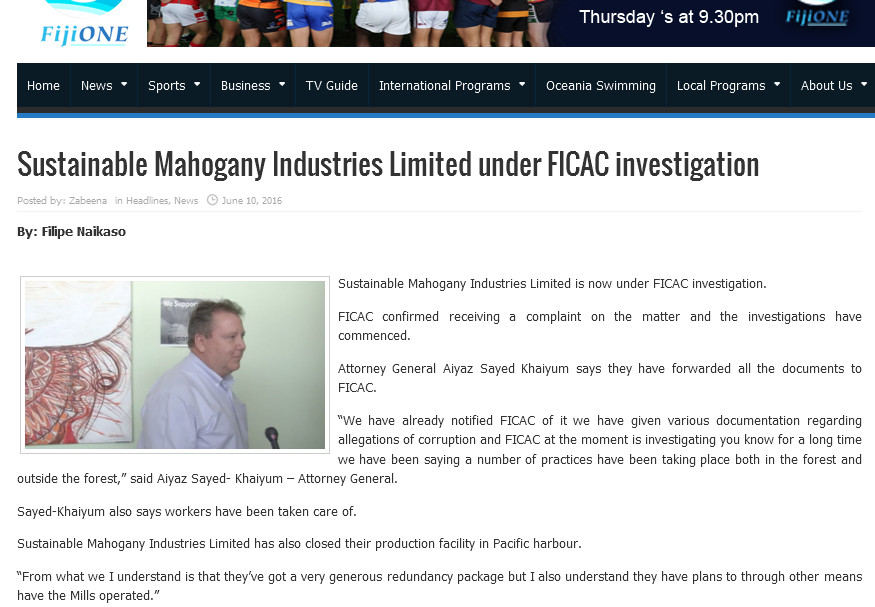
Fijileaks: The Dayals are also under investigation by FICAC
 |  |
From Coupfourpointfive Archive, September 26, 2011, by VICTOR LAL:
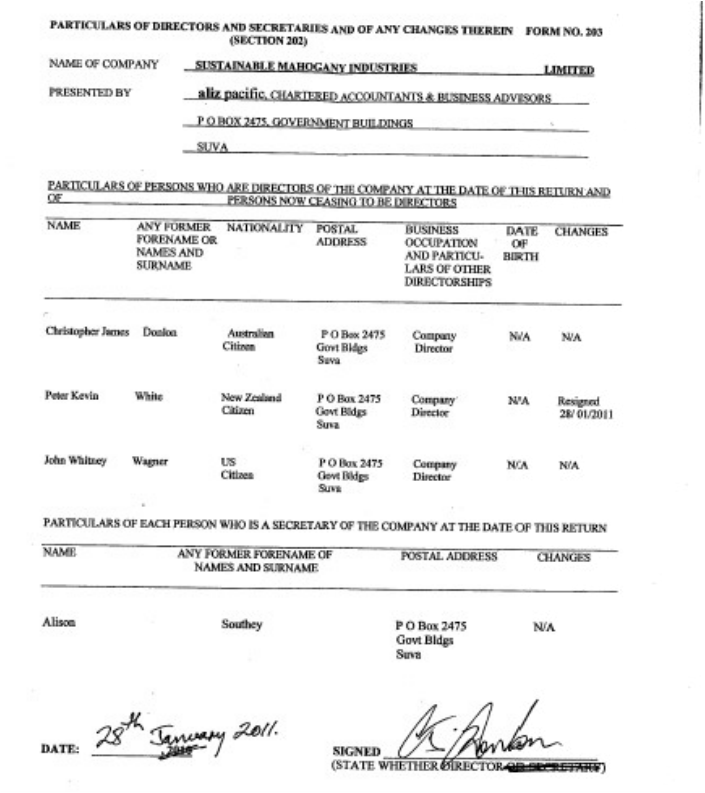
Multi-million dollar profit forecast before registration of SMI?: Looking at SMI company files, Peter White was appointed company director on 13 April 2010, and Articles of Association was submitted to the Registrar of Companies in January 2010, and yet, in December 2009, the Fiji Sun was informing its readers under the headline: “$30M FROM NEW MAHOGANY DEAL”
 |  |
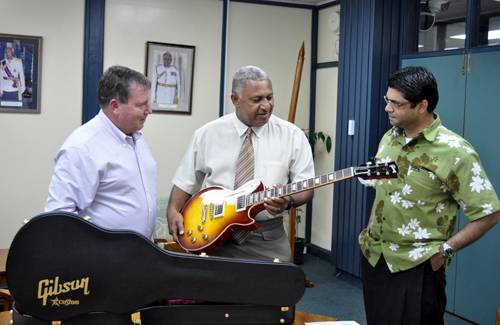
"In July, SMI showcased its factory in Deuba to the dictator and his master puppeteer Khaiyum, with Wagner saying the Deuba factory concentrated on “value adding” the mahogany timber by making guitar bodies as well as materials for yachts. In May, Wagner had also presented the dictator an electric guitar costing over $7,000 made from Fiji grown mahogany. The guitar was a “gift of appreciation” to the dictator and his master puppeteer from Pacific Western Timbers Incorporated, an American-based guitar manufacturing company."
 |  |
The Congress of Accountants also heard that SMI would pay a licence fee of $70 for every cubic metre of mahogany logs bought from Fiji Hardwood Corporation Limited. This is expected to result in $14 million paid as licence fees over 5 years in addition to the price of the logs. A separate and additional reforestation fee of $25 per cubic metre of logs will also be payable.
What Bainimarama did not disclose are the following: Who owns SMI? When was the public tender advertised? Who approved SMI? Who is SMI’s accountant?
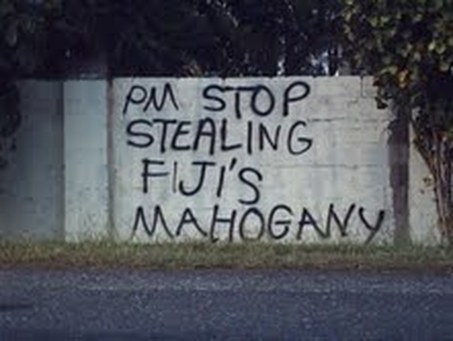
DICTATOR CHAIRMAN OF FIJI MAHOGANY COUNCIL UNDER KHAIYUM’S ILLEGAL MAHOGANY DEVELOPMENT DECREE 2010
Let us be reminded that the dictator is not only Fiji’s illegal treasonist Prime Minister but he is also the chairman of the Fiji Mahogany Council under the Mahogany Industry Development Decree 2010, a decree drafted by fellow treasonist Aiyaz Sayed Khaiyum.
In introducing the Mahogany Decree, Khaiyum in his capacity as Minister for Public Enterprises, Industry and Trade claimed that the Decree “has introduced a transparent, efficient and results-oriented regime to develop a mahogany industry. It will leapfrog reforms and contribute to growing the GDP”. Khaiyum also disclosed that expressions of interest were called for the issuance of licences in the mahogany industry.
THE SMI BEGINNING: ANARETA NARAWA AND CHRISTINE MITCHELL – FIRST DIRECTORS
On 25 January 2010 Sustainable Mahogany Industries Ltd was duly incorporated under the Companies Act (CO NO RCBS2010L0271). Earlier, on 14 January, the acting Registrar of Companies was notified as follows: “Sustainable Mahogany Industries Limited hereby gives you notice. In accordance with Section 110 of the Companies Act, that the registered office of the company is situated at c/- aliz pacific, Level 8, Dominion House, Thomson St, Suva, P. O. Box 2475, Government Buildings, Suva.”
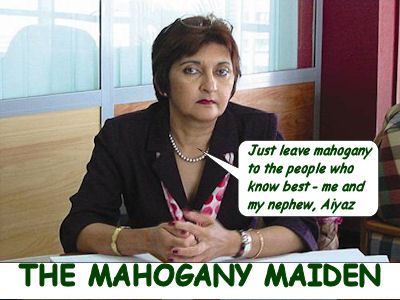
Aliz Pacific, as we are so familiar since the treasonous 2006 coup, is owned by Khaiyum’s aunty, Nur Bano Ali, who describes herself as managing director of the company, “one of the largest local professional services firms in Fiji, specializing in providing expert business and accounting advice and innovation in business through growth strategy”. She is also the President of the Suva Chamber of Commerce & Industry and President of Women in Business. And her office is as stated above in her application on behalf of SMI.
What she has not advertised, and understandably so, is that she is the illegal pay-mistress to Bainimarama’s Cabinet ministers. Her accountancy firm is also currently providing advice to SMI for Joint Venture set up and corporate group restructure.
The first directors of SMI, as listed in the company files from 14 January 2010 were Anareta Narawa and Christine Mitchell, both Fiji citizens, who gave Nur Bano’s office address as their postal address. Narawa was listed as secretary to the SMI. And in pursuance of the Memorandum of Association, they declared that the two were agreeing to take one share each in the capital of SMI. Accountant Nitesh Kumar, who also gave Nur Bano’s office address as his address, witnessed their signatures.
On 20 January 2010 Narawa while fulfilling other obligations under the Companies Act, declared that the objects of the Company, among other things, is “to carry on the trade or business of timber merchants, building contractors, saw milers and forestry”. The liability of the members was limited, and the share capital of SMI was two million dollars divided into 2million shares at $1each. Suva lawyer Peniana Mailoa Salele, presently representing deposed Prime Minister Laisenia Qarase in cases brought against him by FICAC, witnessed the declaration.
But on 4 March 2010 Christine Mitchell resigned as director, and a sportswoman Alison Southey replaced her, with Narawa still acting both as director and secretary of SMI. Southey also gave Nur Bano’s office address as her correspondence address.
FOREIGN GREEN GOLD HUNTERS TAKEOVER SMI UNDER MAHOGANY DECREE
A day before Mitchell resigned and Southey was appointed, the illegal A-G Khaiyum, on 3 March 2010, suddenly announced that the Cabinet had approved the promulgation of the MAHOGANY INDUSTRY DEVELOPMENT DECREE 2010, based on his submission. He once again chanted his now familiar mantra: “THE DECREE SEEKS TO IMPLEMENT A TRANSPARENT, EFFICIENT AND RESULT-ORIENTED REGIME, WHICH WILL ENSURE THAT THE MAHOGANY INDUSTRY IS FURTHER AND BETTER DEVELOPED, HAVING REGARD TO THE INTERESTS OF ALL STAKEHOLDERS, INCLUDING THE LANDOWNERS, IN ORDER TO ENSURE THAT THE MAHOGANY INDUSTRY IS ABLE TO PROVIDE SUITABLE AND SUSTAINABLE RETURNS FOR THE BETTERMENT OF THE ECONOMY AND THE PEOPLE OF FIJI AND CREATING A DISTINCT BRAND OF FIJIAN MAHOGANY.”
Donlon, White and Wagner arrive at SMI
Following the promulgation of the Mahogany Decree, Narawa and Southey resigned as directors on 13 April 2010 but Southey was retained as SMI secretary. On the same day American, John Whitney Wagner, Peter Kevin White, New Zealander and Christopher James Donlon, an Australian, became SMI directors.
They listed their postal addresses as P O Box 2475 Government Buildings, Suva, i. e. Khaiyum’s auntie’s accountancy firm.
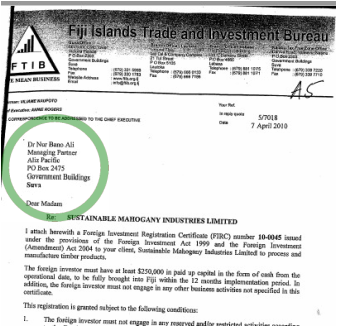
Curiously, although SMI company files state that the three were appointed on 13 April, the CEO for Fiji Islands Trade & Investment Bureau, Annie Rogers, issued a Foreign Investment Registration Certificate (FIRC) number 10-0045 on 7 April, as she informed Nur Bano Ali in a letter issued on that day: “Dear Madam – Re Sustainable Mahogany Industries Ltd – I attach herewith….issued under the provisions of the Foreign Investment Act 1999 and the Foreign Investment (Amendment) Act 2004 to your client, Sustainable Mahogany Industries Ltd to process and manufacture timber products.”
Rogers also pointed out to Nur Bano: “The foreign investor must have at least $250,000 in paid up capital in the form of cash from the operational; date, to be fully brought into Fiji within the 12 months implementation period. In addition, the foreign investor must not engage in any other business activities not specified in this certificate.”
Annie Rogers noted the following, as she notified Nur Bano: “Sustainable Mahogany Industries (Fiji), shareholder, 99.9%, Christopher Donlon, shareholder, 0.1%, Peter White, director and John Wagner, director.”
Multi-million dollar profit forecast before registration of SMI?
Looking at SMI company files, Peter White was appointed company director on 13 April 2010, and Articles of Association was submitted to the Registrar of Companies in January 2010, and yet, in December 2009, the Fiji Sun was informing its readers under the headline: “$30M FROM NEW MAHOGANY DEAL”:
“Fiji is going to pocket more than $30million of revenue per year from a new venture where products made from mahogany will be exported. This was revealed at the launch of the expansion of the Sustainable Mahogany Industries mill at Pacific Harbour in Deuba yesterday. Company Principal Officer, Peter White, said the initiative would be structured as a Fijian domiciled business for the purpose of creating revenue and employment to the people of Fiji. “Our intention is to build something Fiji can be proud of,” he said. “This venture we can guarantee will provide no risk guaranteed return to the people of Fiji, through log revenues and employment. All its worldwide income will [be] repatriated back into the country.”
“Mr White said they were currently producing parts for more than 4500 musical instruments per month and for this they were predominantly using mahogany. “We are looking at raking about $30m worth of revenue per year.” The first stage of this joint venture will cost around $15m and that is to set it up with a number of high skill value adding facilities planned for commencement for the next two years. The overseas investors are Sustainable Forest Industries, Wood Product International from New Zealand and Pacific Western Timbers from the United States. Pacific Western Timber is a manufacturing and engineering company based in Washington. It manufactures machinery parts and components for the aerospace industry like NASA and Boeing. World Product International has been marketing Fiji mahogany since 2004.”
The chief guest at the announcement was none other than Nur Bano’s nephew Khaiyum who told the gathering that the venture would also help Fijians to develop their skills and expertise in the mahogany industry. “Government is very keen on developing the mahogany industry in a sustainable manner. There is no point in capitalising in the mahogany industry if it is not going to be profitable. Therefore we need a partnership with the private sector so that workers are up-skilled and there is employment. The value must also go to the landowners, it’s very important to us that Fiji benefits as a country,” Khaiyum added. According to SMI records, Peter Kevin White resigned as company director on 28 January 2011.
Who is Christopher James Donlon
He is an Australian who doesn’t come from a forestry background. We will let him introduce himself as he did so in October 2004 to Ross Duncan of the ABC Radio Australia on a documentary “Mahogany Dreaming”, with music from Black Rose serenading in the background.
Ross Duncan: “There’s another Australian doing a bit of mahogany business in Fiji. Forty-one-year-old, Chris Donlon, was happy to hook up and talk timber. A few days later when I called again, he was on his way to see his lawyer and he suggested we meet there to record an interview. His lawyer is Isireli Fa who I’d spoken to before about the legal actions between the landowners and the government. It was just another reminder of what a small town Suva is.”
Chris Donlon: “If we’re studying the history of Chris Donlon, probably easier if I deliver it. Christopher Donlon, born in Byron Bay in 1963, educated Mullumbimby High School, St Joseph’s College, University of Sydney, studying economics and law. Developed into the financial community, and I guess after the ’87 stockmarket crash, determined in my own mind that one should disinvest from financial instruments and into resource-based industries, whether that be in mining, forestry. I invested in the company called Red Anchor Resources Limited, I’d invested in a company or a group of companies which is actually the spearhead of investments in Fiji and the Solomons, called the Axiom Group, and Axiom Investments Limited, which then owned Pacific Timber Development Limited, which in turn owned Vusena Forest Corporation.
Ross Duncan: “I knew a little already about one of the companies Chris Donlon mentioned. In 1990 Red Anchor Resources raised $1.5-million to fund gold mining exploration in Papua New Guinea, and managed to spend or lose most of the money in a year. In 1996 Chris Donlon was fined a total of $13,500 for being knowingly concerned in Red Anchor financing the purchase of its own shares by another company, misusing his position as a director, and making false and misleading statements to auditors. His brush with Australia’s corporate watchdogs concerned Fiji’s Immigration authorities.”
Chris Donlon: It in fact created a problem for me where I was asked not to be in Fiji for a period of about six months while we worked through those issues. Whether that’s part of sour grapes in a reverse manner and people picking on you, or whether it’s the authorities applying an appropriate amount of discretion and audit, either way, yes, that certainly occurred and has affected my status here in the past; if indeed errors were made, then hopefully everyone does watch me.
Ross Duncan: “Chris Donlon acknowledges he’s been through some tough times, and he’s learned a lot. He has a slight limp and wears a trucker’s cap. He says he came to Fiji to recover money he had loaned to a local timber company. He now runs a company called Sustainable Forest Industries, or SFI. Its website says: SFI has received the concession harvesting rights for the Fijian Mahogany plantations from the Fijian Hardwood Corporation.”
Ross Duncan: “In fact, Sustainable Forest Industries has no rights to harvest Fiji’s mahogany. Chris Donlon says he didn’t personally write the website. His company does buy logs from Fiji Hardwood Corporation and processes them into sawn timber for export. It was Fiji Hardwood’s first customer. The two companies recently settled a dispute in relation to about $600,000 Fiji Hardwood claimed it was owed for log sales…”
Donlon’s Sustainable Forest Industries Nur Bano’s client
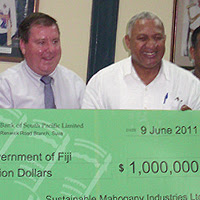
According to Nur Bano Ali’s official Aliz Pacific website, as of yesterday, among her clients are SMI and Sustainable Forest Industries Ltd. In June 2011 Donlon expressed confidence in Fiji’s mahogany industry as SMI handed a cheque of $3.8million to the dictator for obtaining a licence to purchase mahogany from Fiji Hardwood Corporation. Donlon told Riyaz Khaiyum controlled propaganda broadcast FBC that Fiji has treated their company well in the past year and are delighted to have been approved the licence to be the first to buy mahogany: “We’ve had only the best reception from Fiji in the past 12 months. There has been a lot of restructuring and negotiations going on and there is difficulty in investment worldwide. We’re had a lot of support from government bodies and authorities to get us here and we’re comfortable in Fiji. And we’re particularly pleased that we now have something secure that we can provide to our customers worldwide.”
In July SMI showcased its factory in Deuba to the dictator and his master puppeteer Khaiyum, with Wagner saying the Deuba factory concentrated on “value adding” the mahogany timber by making guitar bodies as well as materials for yachts. In May, Wagner had also presented the dictator an electric guitar costing over $7,000 made from Fiji grown mahogany. The guitar was a “gift of appreciation” to the dictator and his master puppeteer from Pacific Western Timbers Incorporated, an American-based guitar manufacturing company.
“Pacific Timbers Incorporated appreciates the opportunity to have access to sustainable supply of high quality of mahogany from Fiji. We now look forward to manufacturing guitars and musical instrument components for many world-recognised brands at our facilities in Fiji. “We thank Government and the people of Fiji for the opportunity to work toward a mutually beneficial relationship with this unique, sovereign and world’s sustainable mahogany brand,” said Wagner, who had handed the million plus cheque to the dictator.
In July Wagner had also informed the dictator that the world’s leading guitar maker Gibson Guitars has labelled Fiji Mahogany as “world class”. “We supply Gibson guitars for the last three to four years and they’ve wrote to us saying that Fiji Mahoganies are certainly superior,” Wagner said. And not to mention the recent deal between the dictator and Gibson Guitar!
John Wagner and Fiji’s Dictator
To paraphrase a book by Joachim Kohler, Wagner’s Hitler: The Prophet and His Disciple, it is worth reminding SMI’s John Wagner that no matter how much he sings praise for Fiji’s dictator for granting SMI the exclusive right to the nation’s mahogany, when democracy returns, Wagner and SMI will be forced to sing the right tune, with the Khaiyums, Nur Bano Ali, Christine Mitchell, Anareta Narawa, Annie Rogers and the dictator forced to provide in court a true copy of SMI “commercial notes”. Victor Lal, C4/5, September 2011
9 July 2016: Departing American businessman John Wagner, donates $30,000 to the Fiji Women’s Crisis Centre (FWCC). Wagner is winding up his timber businesses in Fiji. Sustainable Mahogany donated $25,000, while Pacific Western Timbers donated $5,000. Last year Wagner donated $50,000 on behalf of his company, bringing to $80,000 his total donation to the FWCC. WAGNER: “This will be our last cheques because we are departing from Fiji. But we wanted to make sure before our departure that the vulnerable are taken care of and this part of our social responsibility.”
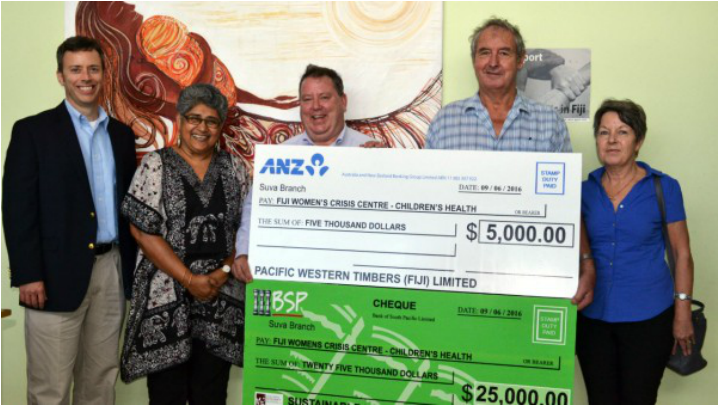
From Fijileaks Archive:
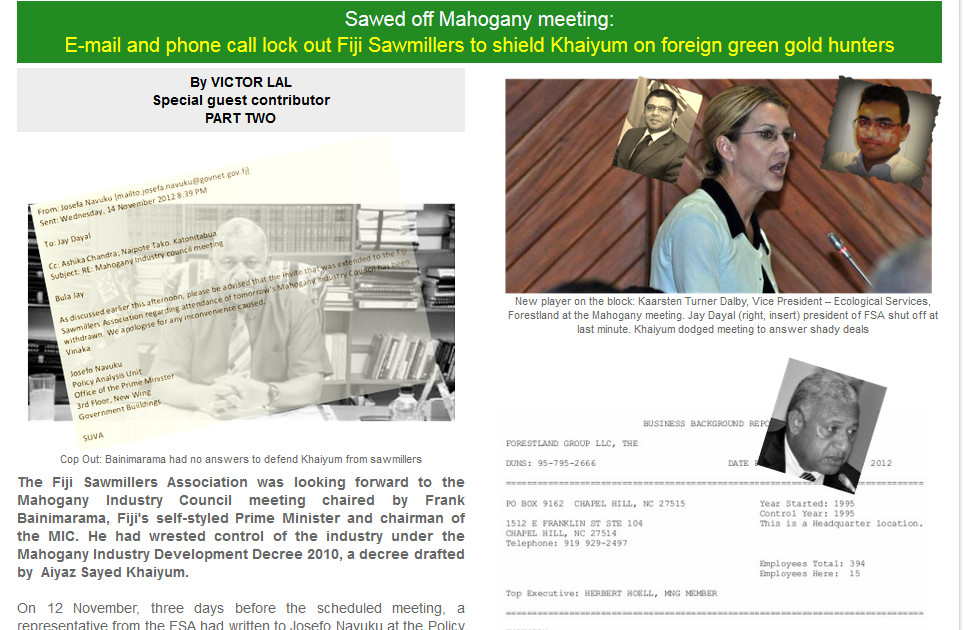
A year on: Sawmillers peel off SMI business "bark" in Fiji
Now, a year later, the Fiji Sawmillers Association (FSA) president Jay Dayal, in a letter dated 24 September 2012 to Bainimarama, has laid bare some hard-hitting truths regarding SMI:
MONOPOLIZATION OF RESOURCES BY SUSTAINABLE MAHOGANY INDUSTRIES (SMI):
(a) Last year the entire Mahogany industry was staggered that SMI was issued with license for all of Grade 1 and Grade 2 logs when specific Expression of Interest was never published for bidding as was done for Grade 3, 4 and 5 (on Saturday, the eve of Christmas 2011 in the Fiji Sun).
(b) We understand that SMI was supposed to produce guitars in Fiji however the export data reveals that approximately 90%, of their production is exported as rough sawn timber–with no value adding. Interestingly, almost 50% of their exports are to Dominican Republic market where most of the local sawmillers are exporting due to unavailability of Grade 1 and Grade 2 logs/ sawn timber. The above information is readily available from Department of Forestry or Ports Authority of Fiji.
(c) The current recommendation of license to Pacific Western Timber (which is owned b John Wagner, the shareholder of SMI) for 30,000 cubic meters of Grade 3 logs (75% of the entire Grade 3 in the forest) indicates that Government is supporting SMI in their ploy to drive out local sawmillers and exporters who are competing against SMI in Dominican Republic market by restricting log supply to the local processors by eliminating competition.
(d) Whilst your Government is promoting fair trade and competition the above actions are very much contradictory, unhealthy and uncalled for.
(e) Pacific Western Timber is not a locally owned company and does not even own a sawmill. The comments from Mrs. Powell suggest that they intend to setup a sawmill in Vanua Levu as a justification to their application. The present sawmillers in Vanua Levu are struggling for logs for peeling into veneer and plywood or sawn timber. With the introduction of additional sawmill in Vanua Levu your Government will lead the present sawmillers to demise due to scarcity of log supply.
(f) Our Vanua Levu sawmillers were not even given a fair chance to submit their respective bids for the Grade 1 and Grade 2 logs which are suitable for peeling. Valebasoga Tropikboard Ltd is one of the largest privately owned plywood mills in Fiji with more than $15 million worth of investments. They have been struggling to secure enough log supply and with their intention to process Mahogany in the foreseeable future is now completely shattered due to the actions of your Government.
(g) SMI, as per export records are selling to their own company in the US namely Pacific Western Timber and Sustainable Mahogany USA. This poses a question transfer pricing and repatriation of the fair value of the timber back into Fiji.
(h) In November 2011, the forest operations were closed in Nukurua by the FHCL Board. We understand that the entire operation was shut down until April 2012 because SMI was over stocked with logs and sawn timber which it was finding hard to sell. This shows that the industries welfare and forest operations are dictated by SMI.
(i) SMI is following it’s own log grading rules that are different from what other buyers follow. How come a foreign company is allowed such an extent of dictatorship in the forest operations?
(j) SMI is further allowed 30 days credits terms while local bona fide companies are not even permitted to remove logs until they present a bank cheque.
FSA follow up with October letter on unfair mahogany license
On 11 October the FSA followed up with another letter to Bainimarama, writing through his secretary Pio Tikoduadua: "We refer to our letter dated 24th September, 2012 on the above matter and our subsequent meeting at the Conference Room at the Prime Minister’s Office with yourself, Colonel Inia Seruratu and the industry duly represented by the Fiji Sawmillers Association members on Monday 1st October, 2012. As the above matter is of great concern to our industry members we kindly seek your response following our submission and meeting above. We wish to reaffirm that the industry is willing to meet with your office at any time mutually convenient to discuss the above issues further. The concerns of our members are still very much unvaried since our last meeting. Hoping to hear from you at the earliest."
FSA: Licenses anti-local investors
In its September letter the FSA had begun its letter by reminding Bainimarama: "We, the members of Fiji Sawmillers Association hereby express our grave concern and utmost disappointment over the attached list duly signed by the FHCL Chair Mrs Elizabeth Powell recommending issuance of Mahogany Log Licenses. The said recommendations are absolutely unfair and biased against the local businesses, the resource owners and are not in the best interest of the country as a whole. The recommendations, if implemented, will create an atmosphere of disharmony, mistrust and total breakdown of faith between the Bainimarama Government and the local business stakeholders involved in Mahogany processing.The recommendations seem to be intentionally undertaken to drive out local competitors against foreigners. We wish to highlight the following points for your consideration:
1) We are hundred percent locally owned businesses.
2) We repatriate hundred percent of the true value of the product and profit back to Fiji hence no transfer pricing takes place.
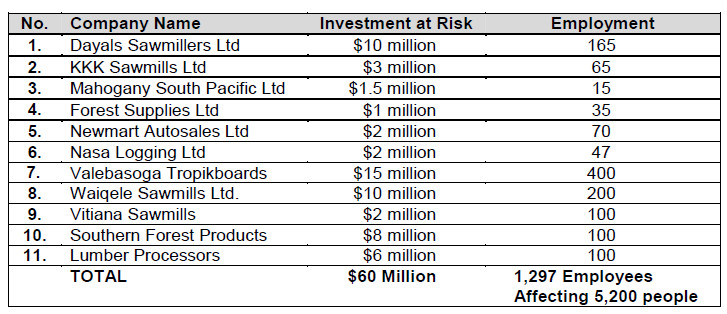
3) We, the current and potential processors of Mahogany timber, provide employment and the value of our investment are as follows:
Ladies and Gentlemen.
Bula Vinaka and a Good Morning
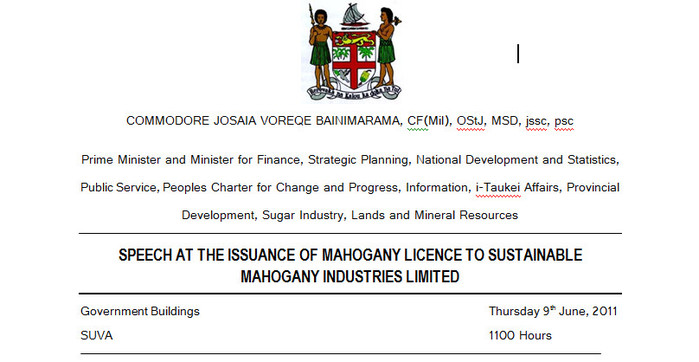
Following careful consideration of numerous expressions of interest received from interested persons and companies applying for licences to purchase mahogany logs and timber from Fiji Hardwood Corporation Limited ("FHCL"), I am happy to announce that the Government is today issuing the first licence to purchase mahogany to Sustainable Mahogany Industries Limited or SMI.
The licence to SMI is the first in the series of licences that will be issued in due course to other successful bidders. This licence will now enable SMI to obtain guaranteed quantities and grades of mahogany logs from FHCL.
The only primary source of revenue for FHCL has been from the sale of mahogany at prices set by it. There has been hitherto no licence fees payable to access this valuable resource. There has been no separate allocation for reforestation nor value extracted from the branding/certification of this unique resource.
FHCL has a debt stock of approximately $26 million, of which approximately $17 million is Government guaranteed. Since its inception, FHCL has also been given $25 million in grant. Notwithstanding the sale of mahogany over the most number of years, no substantive value adding on a large scale for the export market has taken place in Fiji.
With the commencement of this licensing regime in conjunction with the mandate of the interim Board of FHCL these outstanding anomalies are to be removed.
As I have stated, the reforms in and the rightsizing of FHCL and the introduction of a licensing regime is to increase private sector participation, position Government and FHCL as facilitators for economic and GDP growth and to bring about tangible and increased returns to landowners.
All these objectives will not be achieved over night. But the issue of this Licence is a major step to achieving those objectives.
The licence fee payable by SMI is based on the cubic metre of mahogany purchased.
SMI will pay a licence fee of FJD$70 (VEP) for every cubic metre of mahogany logs purchased from FHCL. However, it will pay an upfront licence fee of FJD$1 million upon the grant of the licence today.
I wish to point out that the licence fee is separate from the actual price that will be paid by SMI for the purchase of mahogany logs at the current market rates, with annual incremental reviews over a period of 5 years. By way of example, G1 grade A logs are sold at $305 per cubic metre.
Furthermore, given the need to ensure that this important and emerging industry continues to operate on a sustainable basis and provide continuous revenue stream for landowners, a separate and additional reforestation fee of $25 (VEP) per cubic metre of logs or timber supplied will also be payable by SMI.
Using G1 grade A as an example, this means that we will now receive an additional $95 per cubic metre on top of the $305 per cubic metre current sale price of logs.
There is also a requirement in the licence for substantive value-adding to be done to mahogany supplied to SMI in Fiji.
In this regard, I am pleased to note that SMI already has an existing plant for value adding but by the issuance of this Licence SMI through its partners will bring sophisticated value adding to Fiji which is currently being done offshore, in particular in the USA. This will entail the shaping of guitar necks and bodies and specialised components for yachts. This means new jobs, new skill sets for Fijians and more foreign exchange for Fiji.
It should be noted that certain resources such as timber need to be branded and differentiated to give it substantive value. Government is in the process of registering suitable designation mark for Fijian mahogany in Fiji as well as in other countries where Fijian mahogany is and will be supplied or exported to, such as the United States of America.
The registration of a sovereign trademark called “Fiji Pure Mahogany” which will be owned by the Fijian Government and the Fijian people will be instrumental in setting a new benchmark in the certification of Fijian mahogany which will be sold as a unique world class brand.
A distinct sovereign brand will also enable the creation of a world class chain of custody of Fijian mahogany and will eliminate any mixing of inferior quality mahogany, thereby resulting in greater customer and investor confidence.
Purchasers of Fijian mahogany from FHCL will be able to have access to this brand upon the payment of initial fee plus a fee to be determined per cubic metre.
My Government remains steadfast in implementing the objectives and visions for mahogany industry articulated in the Mahogany Decree, which has introduced a transparent, efficient and results-oriented regime to develop the mahogany industry with regard to interests of all stakeholders. It is to achieve optimal returns from the mahogany industry for the betterment of the economy and the people of Fiji.
For the Fijian economy, the issuance of the licence to SMI today and further licences to be issued to other purchasers in due course, together with the mandated requirement of value-adding and utilisation of distinct branding, is a giant step towards attracting foreign as well as local investment, creating employment, up-skilling of the Fijian workforce, and stimulating private sector and landowner participation.
The issue of licences to mahogany purchasers will also assist Government in eliminating the liabilities of FHCL in particular those that have been Government guaranteed.
To facilitate greater returns to landowners, it is imperative that the restructure of FHCL is expeditiously implemented to reduce its operational costs which will ensure quicker and greater returns to landowners by way of them being given a share of the proceeds from the sale of mahogany.
I warmly congratulate SMI on the issuance of this licence, and look forward to SMI's participation and contribution in advancing the Fijian mahogany industry to be producer global leader in manufacturing and exporting quality mahogany products.
Vinaka Vakalevu.
HISTORY REPEATING ITSELF: SMI is not the first one, remember this one
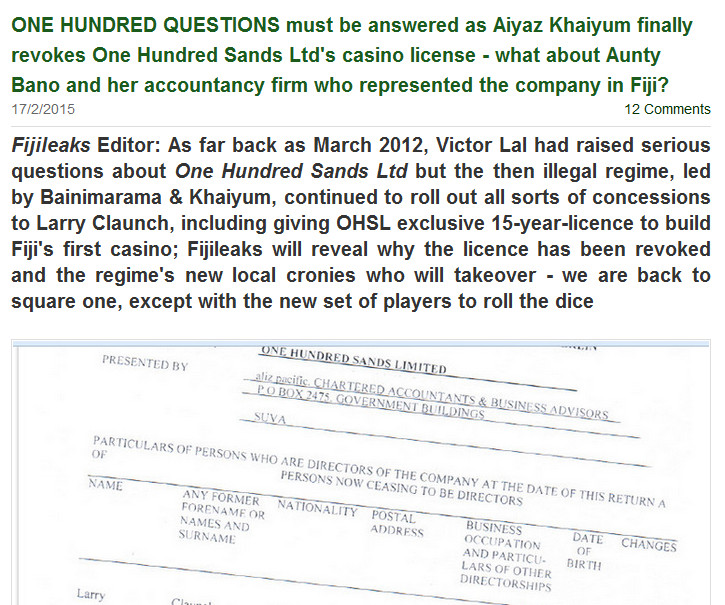
http://www.fijileaks.com/home/one-hundred-questions-must-be-answered-as-aiyaz-khaiyum-finally-revokes-one-hundred-sands-ltds-casino-license-what-about-aunty-bano-and-her-accountancy-firm-who-represented-the-company-in-fiji